I want you to think about the last time you pulled a dress shirt out of your suitcase after a four-hour flight. You know that feeling? The one where you hold it up and it looks like a topographic map of the Himalayas? You have a meeting in two hours. The hotel iron is either broken or it spits brown water. You are screwed. That is the wrinkle tax. You pay it every time you travel, every time you sit through a long dinner, every time you wear a garment made from fabric that has no memory.
At Shanghai Fumao, we have spent twenty years fighting the wrinkle. It is not just about looking crisp. It is about liberty. It is about wearing a linen-blend blazer to a conference and still looking like a CEO at 5:00 PM. It is about shipping a container of viscose dresses to a boutique in Sydney and having them hit the rack ready to sell, not requiring a steam tunnel. Most people think "wrinkle-free" means stiff, chemical-laden, plastic-feeling fabric. That is the old way. That is the cheap way. Our way is different. We engineer crease recovery into the very structure of the yarn and the weave.
In this article, I am going to break down the three pillars of Fumao Wrinkle Resistance. It is not one magic spray. It is a combination of fiber selection, yarn engineering, and mechanical finishing. I will show you why our Tencel blends bounce back when competitors fall flat, and why our high-twist cottons look fresh after a transatlantic flight. If you are tired of hearing "It’s supposed to look that way, it’s natural" as an excuse for a sloppy fabric, you are in the right place.
What Fiber Blends Does Fumao Use to Achieve "Travel-Ready" Recovery?
Let’s start with the raw material. You cannot build a skyscraper out of wet cardboard. And you cannot build a wrinkle-resistant fabric out of weak, limp fibers. The foundation of recovery is elastic modulus—the ability of a fiber to snap back to its original shape after being bent. Different fibers have vastly different recovery rates.
- Cotton: Low recovery. It creases easily. But it is breathable and soft. It needs help.
- Linen: Zero recovery. It is the king of wrinkles. But it is cool and textural.
- Viscose/Rayon: Moderate recovery when dry, terrible recovery when wet. That is why rayon dresses grow and sag.
- Polyester: High recovery. It bounces back like a spring. But it does not breathe and feels synthetic.
- Tencel™ Lyocell: The secret weapon. High wet strength, high dry strength, and excellent elastic recovery compared to other cellulosics.
At Fumao, we do not rely on just one fiber. We are blenders. We use Polyester for the skeleton and Tencel or Cotton for the skin. The trick is to hide the synthetic inside the yarn structure so the fabric feels natural but performs like a technical textile.
I had a client from a corporate uniform company in Chicago visit us in January 2026. Their biggest complaint? The cotton-rich poplin shirts they were sourcing looked like used napkins by 10:00 AM. They wanted "Non-Iron" but they hated the cheap, clammy feel of 100% polyester. We developed a 60% Cotton / 40% Fumao High-Tenacity Polyester blend for them. But we did not just mix the fibers. We core-spun the yarn. The polyester filament is hidden in the center. The cotton wraps around the outside. The wearer feels only soft, breathable cotton. But the internal polyester core acts like a memory wire, pulling the fabric flat after every movement. The shirts tested at a 3.5 Durable Press Rating (DP Rating) after 50 washes. That is near military-grade wrinkle resistance, with a 100% cotton hand feel.

How Does Tencel’s Fibrillation Control Minimize Wet-Creasing vs. Generic Rayon?
This is the science that separates Fumao Viscose from the cheap stuff. I touched on this in the durability article, but it is even more critical for wrinkle recovery. When cellulosic fibers get wet, they swell. Generic rayon swells unevenly because of that brittle skin-core structure I talked about earlier. This uneven swelling creates internal stress points. When the fabric dries, those stress points lock in place as hard creases. That is why a cheap rayon dress that gets slightly damp in humidity looks like a crumpled paper bag.
Tencel™ Lyocell swells uniformly. It has a dense, homogenous structure. Because it swells evenly, it dries evenly. There are no stress points to lock in creases. Furthermore, we apply a cross-linking resin (more on that later) that bonds the cellulose chains together, preventing them from sliding past each other and forming new creases when wet.
I did a side-by-side test for a client in March 2025. We took a Fumao Tencel Twill and a Generic Rayon Challis. We soaked them both in water, wrung them out, and hung them to dry without smoothing them. The generic rayon dried into a solid mass of accordion pleats. The Fumao Tencel dried with only light, soft rumples that fell out after 10 minutes on a hanger. The difference is the fiber morphology. If you are sourcing for a travel capsule collection, you need to understand why Tencel lyocell recovers from creasing better than viscose. It is the fiber’s ability to manage water absorption at the molecular level.
Why Does the Polyester Staple Length Affect Crease Recovery in Blends?
Here is a detail that even some textile veterans overlook. When we blend polyester with cotton, we have a choice: Polyester Staple Fiber (short cut) or Polyester Filament (continuous) . The length matters.
Short Staple Polyester (1.5 inches): This acts like cotton. It spins easily. It is cheap. But it has ends. Those fiber ends poke out of the yarn. They do not contribute to the continuous "spring" effect. The crease recovery is only marginally better than 100% cotton.
Long Staple / Filament Polyester: This is a continuous, unbroken strand. When you bend the fabric, you are bending this continuous spring. It wants to straighten out immediately.
At Fumao, for our premium "Travel Twill" and "Recovery Poplin" , we use polyester filament core-spun yarn. The staple length is essentially infinite (until you cut the fabric). This provides maximum flexural rigidity recovery. I remember a specific batch of cotton-poly broadcloth we ran in 2024. We accidentally used a batch of short-staple poly instead of filament poly. The fabric looked identical. The weight was identical. But the crease recovery angle (tested to AATCC 66) dropped from 285 degrees to 240 degrees . That is a massive, visible difference in performance. We caught it in QC, stripped the batch, and re-ran it. That is the level of detail you get when you work with a mill that actually tests its blends.
How Does High-Twist Yarn Construction Reduce Surface Creasing?
Let’s move from the fiber to the yarn. Yarn is not just a fluffy string. It is a helical spring. When you take a bundle of short fibers and twist them together, you are storing torque. The tighter the twist, the more "livelihood" the yarn has. It wants to untwist. It wants to move.
This is a double-edged sword. Too much twist, and the fabric skews and spirals (we call that torque or skewing). Too little twist, and the fibers are loose. They slide past each other when you bend the fabric. They do not snap back. The crease sets in.
We use a process called "Double Crepe Twisting" for our best-selling anti-wrinkle wovens. We take two yarns that have been twisted very tightly in the "S" direction and two yarns twisted in the "Z" direction . We alternate them in the weave. This creates a balanced torque. The fabric lies flat. But the individual yarns are loaded with potential energy. When you crush the fabric, those high-twist yarns act like tiny springs. They push back against the fold. They resist forming a sharp crease.
I explain it to my non-technical clients like this: Imagine a slinky toy (loose twist). You bend it, it stays bent. Now imagine a tightly coiled spring from a car suspension (high twist). You compress it, it explodes back to shape as soon as you let go. Fumao high-twist yarns are the suspension springs of the textile world.

What Is the Relationship Between TPM (Twists Per Meter) and Durable Press Rating?
Let’s get quantitative. TPM stands for Twists Per Meter. It is the number we dial into the spinning frame. For a standard 40s Cotton yarn, a normal TPM might be 800. This gives a soft, fluffy hand. It is great for a cozy flannel. It wrinkles like crazy.
For our "Fumao Easy-Care" line, we crank the TPM up to 1,100 or even 1,200. This is what we call "Hard Twist" or "Voile Twist." The result is a fabric that is thinner, crisper, and far more resistant to creasing.
Here is the lab data to back it up. We test Durable Press (DP) Rating using AATCC 124 (Appearance of Fabrics after Repeated Home Laundering). The scale is 1 to 5, with 5 being perfectly smooth and 1 being a wrinkled mess.
| Yarn Type | TPM Range | Fabric Hand | DP Rating (After 5 Washes) |
|---|---|---|---|
| Standard Cotton Poplin | 750 – 850 | Soft, smooth | 2.5 (Requires Ironing) |
| Fumao High-Twist Poplin | 1,100 – 1,200 | Crisp, dry | 3.8 (Smooth after hanging) |
| Fumao Core-Spun Poly/Cotton | 900 (Core) + Wrap | Crisp, cool | 4.2 (Near Non-Iron) |
Look at that jump from 2.5 to 3.8. That is the difference between a shirt that looks sloppy by lunch and a shirt that looks sharp all day. It is purely the mechanics of the twist. (Here I have to mention—this high twist does make the fabric slightly more sheer. It is a trade-off. Crispness and recovery vs. opacity. We always guide clients on this balance.)
Can "Torque-Free" Finishing Prevent Skewing in High-Twist Fabrics?
Alright, here is the catch with high-twist yarns. They want to spiral. If you just weave them and wash them, the fabric will skew (the weft line will run diagonally). That is a defect. You cannot cut a garment from skewed fabric; the side seams will twist around the body.
To prevent this, we use "Torque-Free Finishing." This is a multi-step process that happens in the stenter frame (the big oven we talked about in the printing article). We overfeed the fabric in a specific way and use steam injection to relax the internal twisting forces of the yarn before we set the width with heat. It is like giving the fabric a hot yoga session to work out its kinks.
If you skip this step, you get a fabric that is wrinkle-free but crooked. We call that "Spiral Skew." It is the number one reason cheap, high-twist fabrics from some markets are unusable. They fix the wrinkle problem but create a twisting problem. At Shanghai Fumao, we measure skew on every roll of high-twist fabric. We guarantee less than 2% skew . That means your stripes stay straight and your side seams stay vertical. If you are curious about how to measure and correct residual torque in woven textiles, there are detailed engineering papers on weft straightener calibration. It is a precise science.
Which Mechanical Finishing Processes Create Fumao’s "Memory" Hand?
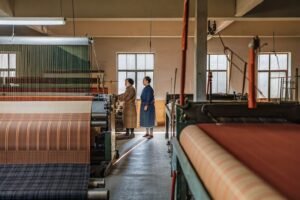
Let’s get out of the yarn and into the finishing plant. This is where the magic happens. This is where we take a greige fabric that is stiff and wrinkly and turn it into a "Travel-Friendly" dream. We do not just rely on chemicals. We rely on mechanical compression.
The process is called Compressive Shrinkage, but the machine is universally known as a Sanforizer (named after the Sanforized brand). Here is how it works: The fabric enters the machine and is sprayed with water and steam. It is then fed between a thick, stretchy rubber blanket and a large, heated steel cylinder. The rubber blanket is stretched as it approaches the cylinder. Then, as it wraps around the cylinder, the blanket is allowed to contract back to its original length. Because the fabric is sandwiched between the blanket and the steel, it is forced to contract along with the rubber.
This mechanical compression crams the yarns closer together. It increases the yarn crimp. This does two things for wrinkle resistance:
- It pre-shrinks the fabric. It cannot shrink much more in the wash, so it does not pucker and pull at the seams (a common source of "laundry wrinkles").
- It creates "mechanical memory." The yarns are now in a relaxed, contracted state. When you bend the fabric, you are stretching these yarns. They naturally want to return to that compressed, relaxed state.
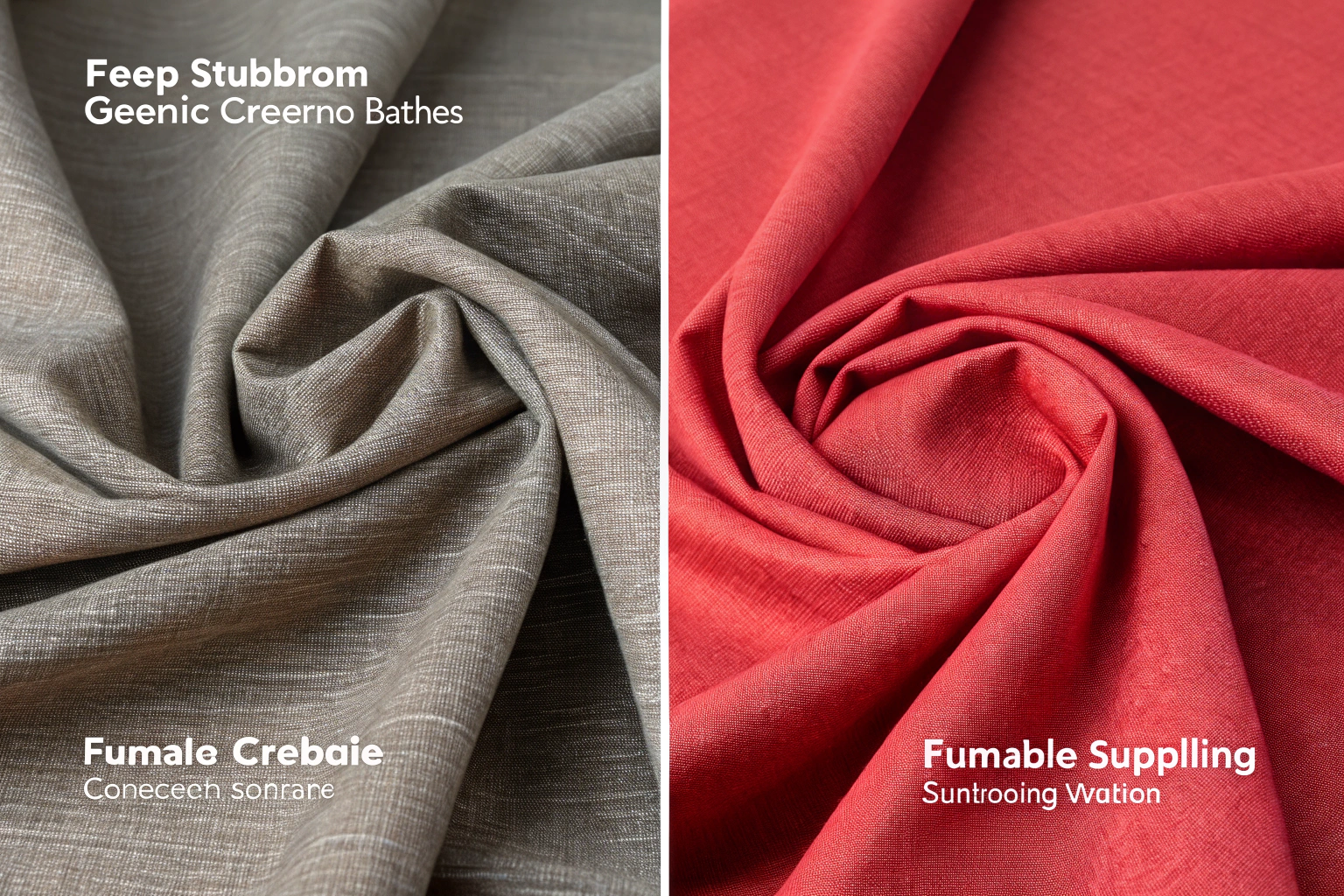
A client of mine who makes linen trousers was blown away by this. Everyone knows linen wrinkles. But he wanted a linen that wrinkled gracefully —soft rolls, not sharp creases. We took our heavy linen-viscose blend and ran it through the Sanforizer with maximum compaction (about 12%) . The result was a fabric with "bounce." You could ball it up in your hand, release it, and it would spring open. It still showed some wrinkles (it is linen, after all), but they were soft, rounded shadows rather than sharp, jagged cracks. That is the Fumao "Memory Hand."

How Does Compressive Shrinkage Differ from Chemical Cross-Linking Resins?
This is a critical distinction for anyone marketing "sustainable" or "clean" fashion. There are two main ways to make fabric wrinkle-resistant:
- Chemical Resins (DMDHEU): This is the old-school "Permanent Press." You soak the fabric in a formaldehyde-based resin and bake it. The resin cross-links the cellulose molecules. It works great. It makes cotton act like polyester. But it reduces tear strength significantly (up to 50%) and it releases formaldehyde. It is banned in many EU applications and is a known skin irritant.
- Mechanical Compressive Shrinkage (Sanforizing): This is purely physical. No chemicals. No formaldehyde. No loss of strength. The fabric actually gets stronger because the yarns are packed tighter.
At Fumao, we default to Mechanical Finishing for all our natural and eco-focused lines. We only use resin finishes if the client specifically requests a "Non-Iron" rating of 4.0 or higher on a 100% cotton base, and even then, we use ultra-low formaldehyde resins and do extensive wash testing to ensure the free formaldehyde is below 16 ppm (the OEKO-TEX limit for baby wear).
I had a client in the baby clothing space who asked for "Wrinkle-Free Cotton." I said, "Absolutely not. You cannot put DMDHEU resin on a onesie. It is not safe." I showed her the mechanical Sanforized cotton interlock. It had a DP Rating of 3.0 (not perfect, but good enough for baby clothes) and zero chemistry. She loved it. It is softer, safer, and still looks decent out of the dryer. If you want to understand the difference between formaldehyde resin finishing and mechanical Sanforizing, look at the tensile strength test results. Resin-treated fabric rips like paper. Sanforized fabric stretches before it breaks.
Why Does Felt Calendering Create a Smoother Surface That Resists Creasing?
This is a finishing technique we use for high-end shirting and lining fabrics. Calendering is ironing on an industrial scale. The fabric passes between massive, heated steel rollers under tons of pressure. A standard calender smooths the surface, but it can make the fabric flat and lifeless.
We use a special type called Felt Calendering. One of the rollers is covered in a thick, dense wool felt or cotton paper. This soft roller gives slightly under pressure. It allows the fabric to be pressed into the roller. This does two things: It closes the interstitial spaces between the yarns (making the fabric denser and less likely to crease), and it polishes the surface to a silky sheen.
Think about a piece of paper. A rough, pulpy piece of paper holds a crease forever. A smooth, glossy magazine cover resists creasing because the surface is so flat. Felt calendering turns cotton poplin into magazine-cover fabric. The yarns are flattened and aligned. There are fewer "peaks and valleys" for a crease to grab onto.
I used this for a client doing printed silk scarves on a cotton lawn base. The felt calendering gave the cotton a silky, fluid hand that mimicked silk twill. And because the surface was so smooth, the scarf would slide through a ring without bunching or creasing. It was a game-changer for their product quality.
When Should Buyers Specify "Wrinkle-Resistant" vs. "Wrinkle-Free" Finishes?
This is where the vocabulary you use in your purchase order determines the performance of your garment. There is a massive legal and performance difference between Wrinkle-Resistant and Wrinkle-Free. If you use the wrong term, you might get a fabric you cannot sell.
Wrinkle-Resistant: This is the natural, mechanical approach we have been talking about. It means the fabric will resist heavy creasing and will recover quickly from light rumpling. It will look good after a day at the office or after hanging in a steamy bathroom. It is safe for all skin types and maintains fiber strength. It is the standard for premium, natural-fiber apparel.
Wrinkle-Free / Non-Iron: This is the chemical approach. It means you can wash the shirt, tumble dry it, pull it out of the dryer, and wear it without touching an iron. It is achieved with cross-linking resins. The fabric has a stiffer, slicker hand and reduced breathability. It is standard for mass-market dress shirts and uniforms.
I get very nervous when a client says "Wrinkle-Free" and "Linen" in the same sentence. You cannot make linen truly wrinkle-free without encasing it in plastic (lamination). You can make it "Wrinkle-Resistant" with our Sanforizing and enzyme washes.
I always ask my clients: "Who is your customer?" If it is a luxury boutique customer, they expect a few soft wrinkles. It is proof of the natural fiber. Give them Wrinkle-Resistant. If it is a traveling business executive who lives out of a suitcase and hates the hotel iron, give them Wrinkle-Free Poly/Cotton (but make sure it is our core-spun yarn so it still feels like cotton).

How Does ASTM D3776 Weight Testing Correlate to Wrinkle Performance?
This is a secret of the trade. Heavier fabric wrinkles less perceptibly than lightweight fabric. Gravity is your friend. A heavy crepe (200 GSM) will hang straighter and pull out its own wrinkles under its own weight. A lightweight voile (70 GSM) will float in the breeze and hold every single crinkle.
ASTM D3776 is the standard test for Fabric Mass per Unit Area (Weight) . When you are specifying a fabric, do not just say "I want wrinkle-resistant." Say, "I want a wrinkle-resistant fabric with a minimum weight of 180 GSM ."
Here is why: The bending stiffness of a fabric increases with the cube of its thickness. A fabric that is twice as thick is eight times stiffer. Stiffer fabrics resist the initial fold that starts a crease. If you are making a travel blazer, you want a fabric with "body." You want weight. We often recommend a 240 GSM Tencel/Linen blend for this exact reason. It has the fluid drape of linen but the gravitas to hang smooth.
I had a client who loved a 70 GSM cotton voile for a beach cover-up. She asked if we could make it wrinkle-resistant. I told her, "Physics says no. This fabric is a butterfly wing. It will crease. That is its charm." If you want performance, you need mass. Understanding how fabric weight measured by ASTM D3776 affects drape and wrinkle recovery is crucial for setting realistic expectations.
What Is the Acceptable Crease Recovery Angle for Premium Shirting?
Let’s get specific about the lab test. AATCC 66 is the standard for Wrinkle Recovery of Fabrics: Recovery Angle Method. We take a small strip of fabric, fold it in half, put a weight on it for an hour, then release it. We measure the angle it springs back to.
- 0 Degrees: No recovery. Stays folded flat. (Wet tissue paper).
- 180 Degrees: Full recovery. Springs back completely flat. (Spring steel).
- Premium Cotton Shirting (Fumao Standard): 120 – 140 Degrees. This is a crisp, tailored shirt that shows "wear wrinkles" at the elbow but looks sharp on the body.
- Fumao Travel Shirting (High-Twist/Core-Spun): 150 – 170 Degrees. This is near non-iron performance without the harsh chemicals.
I always tell my buyers: "Ask for the AATCC 66 angle." It is a single number that tells the truth about the fabric’s memory. If a supplier cannot give you that number, they do not test for it. They are hoping you do not notice the wrinkles until after you have paid.
Conclusion
Wrinkle resistance is not a single checkbox. It is a system of engineering. It starts deep inside the fiber blend, where we use Tencel and core-spun polyester to create internal springs. It continues on the spinning frame, where we crank up the Twists Per Meter to load the yarn with potential energy. It culminates in the finishing plant, where mechanical compaction and felt calendering lock in a smooth, memory-rich surface.
The difference between Fumao Fabric and the generic alternative is the difference between a car with a tuned suspension and a car with broken shocks. Both will get you down the road. But one leaves you fresh and composed; the other leaves you rattled and disheveled. We do not just rely on cheap chemical resins that wash out and weaken the cloth. We build the recovery into the architecture of the textile. That means our wrinkle-resistant cotton feels like cotton, breathes like cotton, but behaves like a much more expensive fabric.
If you are tired of apologizing for how your clothes look after an hour of wear, if you want to build a brand known for effortless, travel-ready style, then it is time to look at the spec sheet, not just the color card. We have the lab reports and the fabric swatches to prove everything I have told you today.
Let’s build a fabric that works as hard as your customers do. Reach out to our Business Director, Elaine. She can send you our Wrinkle Performance Sample Pack so you can see—and feel—the recovery angle for yourself. Email her at elaine@fumaoclothing.com. Stop fighting wrinkles. Start engineering them out.