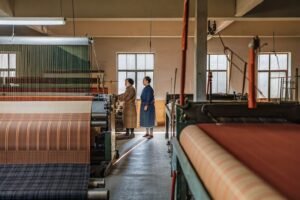
I’m going to tell you a story that cost a brand I know nearly $80,000. They launched a beautiful line of yoga wear in a stunning neon coral color. The fabric felt amazing—soft, compressive, perfect. They sold out online in two weeks. Then the emails started coming in. Pictures from customers showing the armpits of those $98 leggings turned a sickly shade of pale orange. The neckline, faded from just driving to the gym in the sun. The color was migrating. The dye was bleeding. It was a disaster. That brand no longer exists. And you know what the root cause was? They trusted a mill that said "Yeah, colorfastness is fine" without ever asking to see a test report.
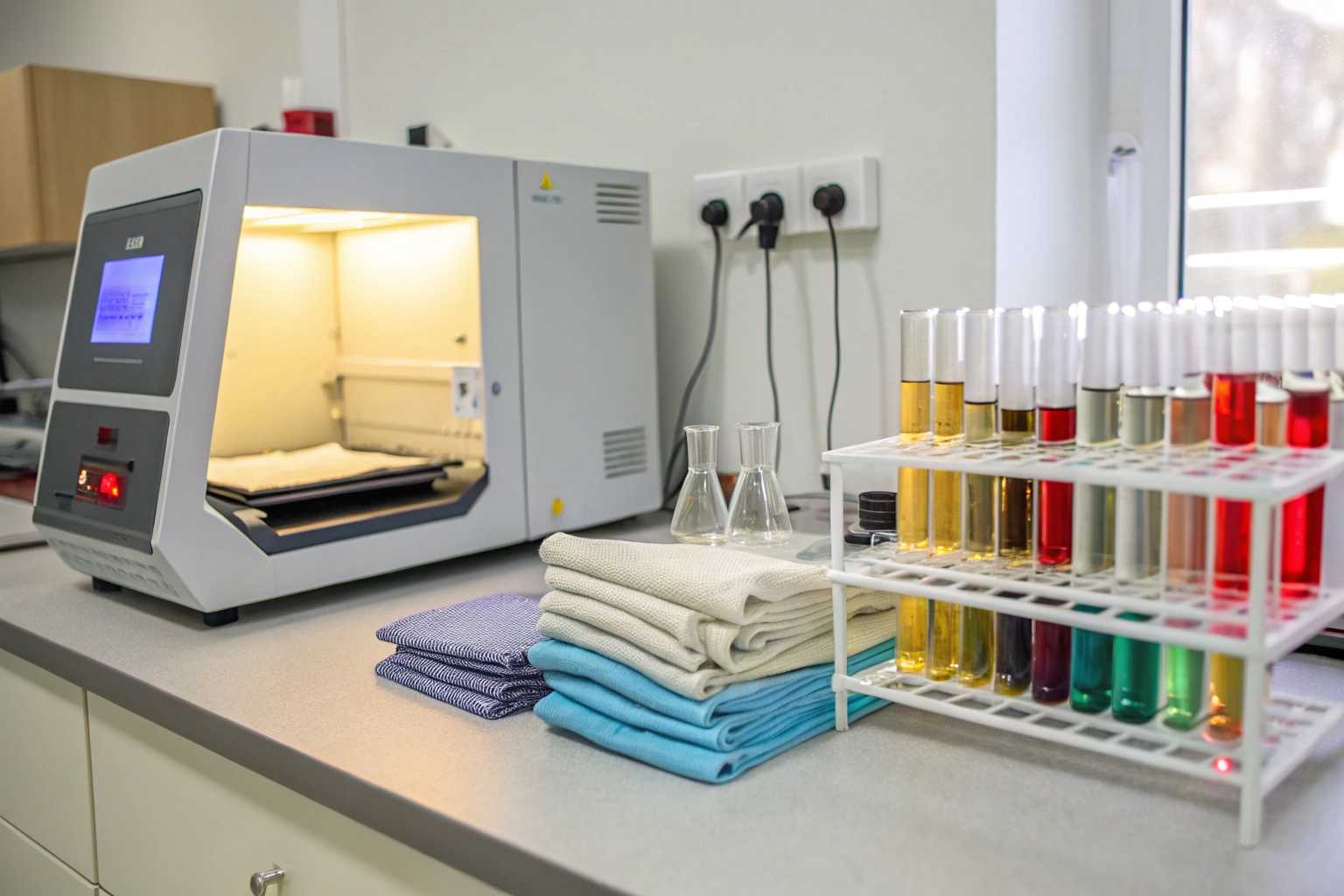
At Shanghai Fumao, we treat colorfastness like a religion. Because I’ve seen too many businesses die from a lack of it. The question isn’t just "Does it fade?" It’s "How fast does it fade under your customer’s specific conditions?" Are they sweating on a spin bike under studio lights? Are they wearing a jacket next to a sunny window in a Paris café? These are two completely different chemical and physical attacks on the dye molecule. The answer to how we test for these is straightforward: we replicate those exact conditions in our CNAS-accredited laboratory using international standards that don’t lie. We don’t guess. We measure.
Now, I know lab testing sounds boring. But trust me, it’s the most exciting thing in the world when it saves you from a recall. What I’m about to show you isn’t just a marketing pitch. It’s the exact process we use every single day on our recycled polyester, our organic cotton, and everything in between. Let’s walk through the two big tests that matter most for apparel: Light and Sweat.
What Is the ISO 105 B02 Light Fastness Standard
Let’s start with the sun. Or rather, fake sun. When a European buyer asks us, "What’s the lightfastness rating on this recycled satin?" they are speaking a specific language. They want to know how long that fabric can sit in a shop window display before it turns from Navy Blue to a sad, washed-out gray. The test we use is ISO 105 B02. This is the gold standard for textiles.
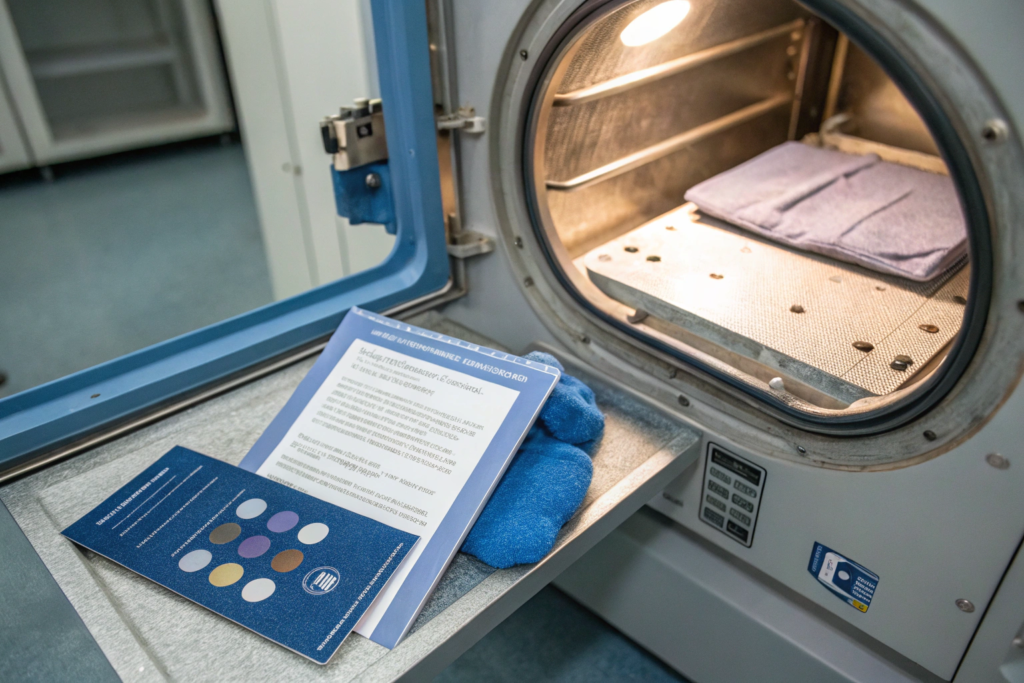
Here’s how it works in our lab. We cut a small swatch of your fabric—say, the Fumao recycled twill we just developed. We place it inside a machine called a Xenon Arc Lamp tester. This machine is brutal. It blasts the fabric with intense light that mimics the full spectrum of natural daylight, including the nasty UV part that breaks down chemical bonds. We run this light for a specific number of hours, usually until a standard reference material (called Blue Wool) fades to a certain point.
The result is a grade from 1 to 8.
- Grade 1-3: This fabric is for vampires. It will fade if you look at it funny. (Okay for some disposable fashion, maybe).
- Grade 4: The industry minimum for apparel. It survives a few washes and moderate sun.
- Grade 5-6: The Fumao Standard. This is what we target for outerwear and sportswear. It can handle a vacation in Spain.
- Grade 7-8: Automotive and outdoor furniture grade. Overkill for a dress, but great for awnings.
At Shanghai Fumao, if a fabric tests below a Grade 4, we don’t ship it without a written waiver from the client. Period.
Why Does Xenon Arc Testing Matter More Than Window Sunlight
You might think, "Why not just put the fabric in a real window?" Because the weather in Keqiao is different from the weather in Berlin. A real window test takes months and is inconsistent. The Xenon Arc lamp gives us accelerated weathering. Twenty hours in that machine equals roughly three months of sitting in a bright room.
The key here is the UV spectrum. Window glass filters out some UVB rays, but UVA rays (the aging rays) pass right through. A fabric that looks fine in a warehouse under LED lights can fall apart under UVA exposure. We’ve seen specific red dyes—especially some cheaper reactive dyes used on cotton—fade to pink in under 40 hours of Xenon exposure.
We caught this exact issue in May 2024. A client wanted a specific bright turquoise on organic cotton poplin. The first dye formula we tried from our dye house tested at a Grade 3. Unacceptable. We worked with the lab to add a UV absorber to the finishing bath. It’s a chemical sunscreen for the fabric. The re-test came back at a Grade 5. That’s the difference between a return and a re-order. For a deeper dive into the technical specs of this machine, you can read this explanation of how Xenon arc testing simulates full spectrum sunlight for textile durability.
How Do You Read a Blue Wool Scale for Color Fading
This is where the human eye still beats a machine. The test doesn’t just give a digital readout. We compare the faded sample against the Blue Wool Reference Card. This is a strip of wool fabric dyed with specific blue dyes of known sensitivity.
- Blue Wool 1: Fades very fast. (Think cheap construction paper).
- Blue Wool 8: Fades incredibly slow. (Think museum-grade pigment).
We look for the contrast between the exposed part of your fabric and the unexposed part (which we cover with a mask during the test). We match that visual contrast to the contrast shown on one of the Blue Wool steps. If the contrast matches the step 4 standard, your fabric gets a Grade 4.
(I have to be honest here—this part requires a trained eye. Our lab technicians do this in a lightbox with specific D65 lighting to make sure the color temperature of the room doesn’t trick us.) If you want to see what these scales look like, this guide to using the blue wool scale for textile lightfastness evaluation is a great reference.
How Is ISO 105 E04 Perspiration Fastness Tested
Light is one thing. But your body is a chemistry set. Sweat isn’t just water; it’s salt (sodium chloride), acids, and proteins. And it’s warm. This cocktail is a nightmare for certain dyes, especially on fabrics like viscose or nylon. The test we use to predict whether your customer’s white shirt will turn pink under the arms is ISO 105 E04.
This is the test that separates the professionals from the amateurs. We don’t just wet the fabric with tap water. We use a synthetic perspiration solution—specifically two types: Alkaline (to mimic sweat when it’s fresh) and Acidic (to mimic sweat after bacteria start breaking it down).
Here’s the step-by-step we follow in the Fumao lab:
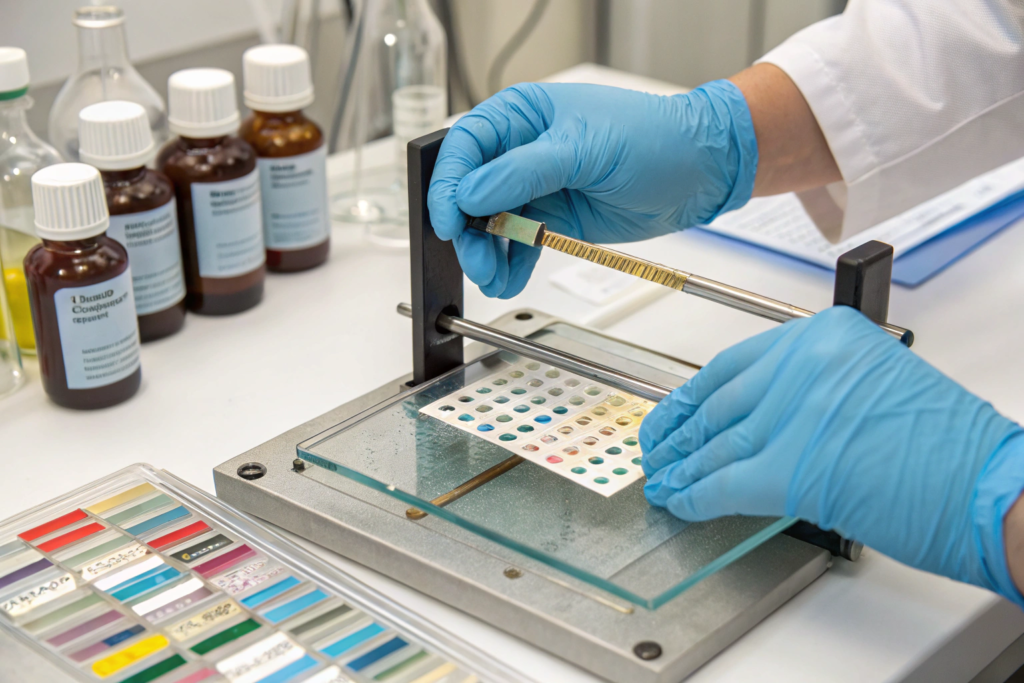
- Prepare the Specimen: We sew the colored fabric to a piece of Multi-Fiber Adjacent Fabric. This white strip contains bands of different fibers: wool, acrylic, polyester, nylon, cotton, and acetate. It tells us if the dye migrates (stains) onto other materials.
- Soak and Squeeze: We soak the whole sandwich in the fake sweat solution and squeeze it to exactly 100% wet pickup.
- The Oven (Perspirometer): We clamp the wet sample between glass plates under a specific pressure and put it in an oven at 37°C ± 2°C (That’s body temperature, 98.6°F) for 4 hours.
- The Read: After drying, we compare the color change of the original fabric and the staining on the white multi-fiber strip to a Grey Scale.
Why Do You Test Both Alkaline and Acidic Sweat Solutions
This is a level of detail that cheap mills skip entirely. They just test water. But sweat changes chemistry as it dries. Fresh sweat is slightly alkaline. As it sits on the skin and bacteria eat it, it turns acidic.
Some dyes are stable in acid but bleed like crazy in alkaline conditions. Others do the opposite. If you only test one, you might approve a fabric that fails in the real world. We had a case with a bright blue nylon/spandex swimwear fabric. It passed the Acidic Sweat test with flying colors (Grade 4-5). But in the Alkaline Sweat test, the color change was a Grade 2 . It turned greenish! Why? The alkaline solution broke down the specific disperse dye used in the nylon.
If we had shipped that fabric for yoga wear, every single pair of leggings would have had green crotch staining. We flagged it, changed the dye recipe to a high-fastness alternative, and saved the client from a catastrophe. For the chemistry nerds out there, this article on the chemical composition of artificial perspiration for textile testing shows the exact recipe we use in the lab.
How Do You Interpret Grey Scale Ratings for Staining
After the 4-hour sweat torture test, we look at the white multi-fiber strip. If the colored fabric bled, the white strip will now be pink or blue or whatever. We compare the intensity of that stain to the Grey Scale for Staining.
This scale has 9 pairs of white/grey chips.
- Grade 1: Massive stain. The white strip is now the color of the fabric. (Fail).
- Grade 3: Noticeable stain. (Borderline fail for light colors).
- Grade 4: Slight stain. Just a whisper of color. (This is our minimum passing grade for dark colors like navy or black).
- Grade 5: Zero stain. White is still perfectly white. (Ideal, but hard to achieve with deep shades).
We provide our clients with the full breakdown. For example: "Polyester Staining: 4-5. Nylon Staining: 3-4." That nylon score might be a problem if you’re sewing this printed fabric into a white jacket with a nylon zipper. The zipper tape might turn pink. We alert you to this so you can change the trim or change the fabric. For more on how to use these scales, check out this practical guide to assessing color change and staining using grey scales.
Can You Guarantee Color Consistency Across Different Dye Lots
Testing a single swatch in the lab is one thing. But what happens when we make 5,000 meters of that fabric? You need the first meter and the last meter to match exactly. This is called Lot-to-Lot Consistency, and it’s the hardest part of textile manufacturing. Lightfastness and sweat fastness don’t matter if the left sleeve of the jacket is a different shade of navy than the right sleeve.
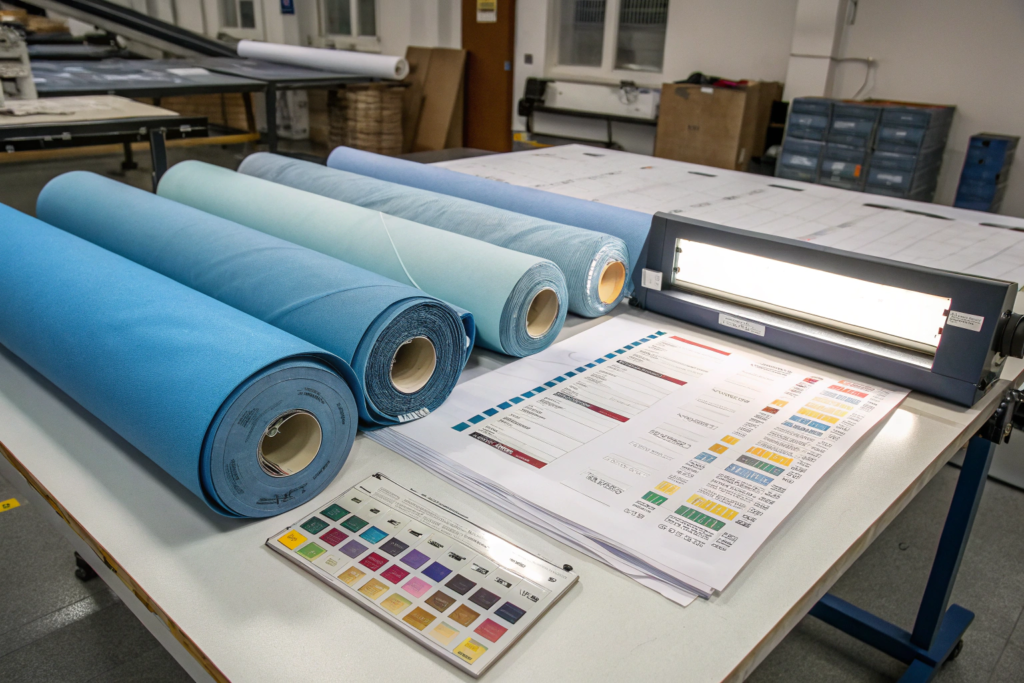
At Shanghai Fumao, we don’t rely on the human eye for this. The human eye gets tired. The human eye has a bad day. We use a Spectrophotometer. This device reads the color as a numerical value in a 3D color space (usually the CIELAB system). We’re looking at the Delta E (dE) value. This number represents the total color difference between the standard (the approved lab dip) and the bulk production sample.
Here’s our internal rule, which is tighter than the industry norm:
- Delta E < 0.8: Excellent match. Invisible to the human eye.
- Delta E 0.8 – 1.5: Commercial match. Acceptable for most solid color garments. (Our passing grade).
- Delta E > 1.5: Fail. We send the dye lot back for re-dyeing or shading.
What Is a Delta E Tolerance and Why Does It Matter
Let me put this in plain English. A Delta E of 1.0 is roughly the smallest color difference a trained eye can see under perfect lighting. A regular customer might not see a difference until Delta E hits 2.0 or 3.0. So why do we hold ourselves to <1.5?
Because of Metamerism. This is the scariest word in textiles. Metamerism is when two fabrics match perfectly under the store’s fluorescent lights, but when the customer walks outside into the sun, one panel looks green and the other looks purple. This happens because the dye recipe used to achieve the color was different, even if the final shade looks the same under one light source.
By keeping the Delta E extremely tight across all light sources (we check under D65 Daylight, TL84 Store Light, and A Incandescent), we prevent metamerism disasters. We had a UK client in 2023 who rejected a whole shipment from another mill because the collar and body of their shirts were cut from different dye lots and the metamerism was visible outside. They came to us because we document the spectral reflectance curve, not just the visual match.
How Do You Ensure Shade Continuity for Re-Orders
This is the long game. You design a best-selling dress. You need to re-order fabric 6 months later. How do we make sure the new batch matches the old batch perfectly?
We keep a Physical Retention Sample of every single dye lot we ship. That’s a small piece of fabric sealed in a black plastic bag to protect it from light and air. We store it for 3 years. When a re-order comes in, we don’t just look at the new lab dip. We pull out the retention sample from the last shipment and put it under the spectrophotometer. We match the new bulk to the old bulk, not just to a paper standard. This is how we build trust with European buyers who run multi-season programs.
For a more technical explanation of how this equipment works, read this overview of spectrophotometers and their role in textile color management.
Why Is CNAS Accreditation Critical for Export Testing
You might be reading all this and thinking, "Okay, but how do I know you’re not just making these numbers up?" That’s the exact right question to ask. In the textile world, especially when exporting to the EU or the US, a test report is only as good as the lab that issued it. And a lab is only as good as its accreditation.
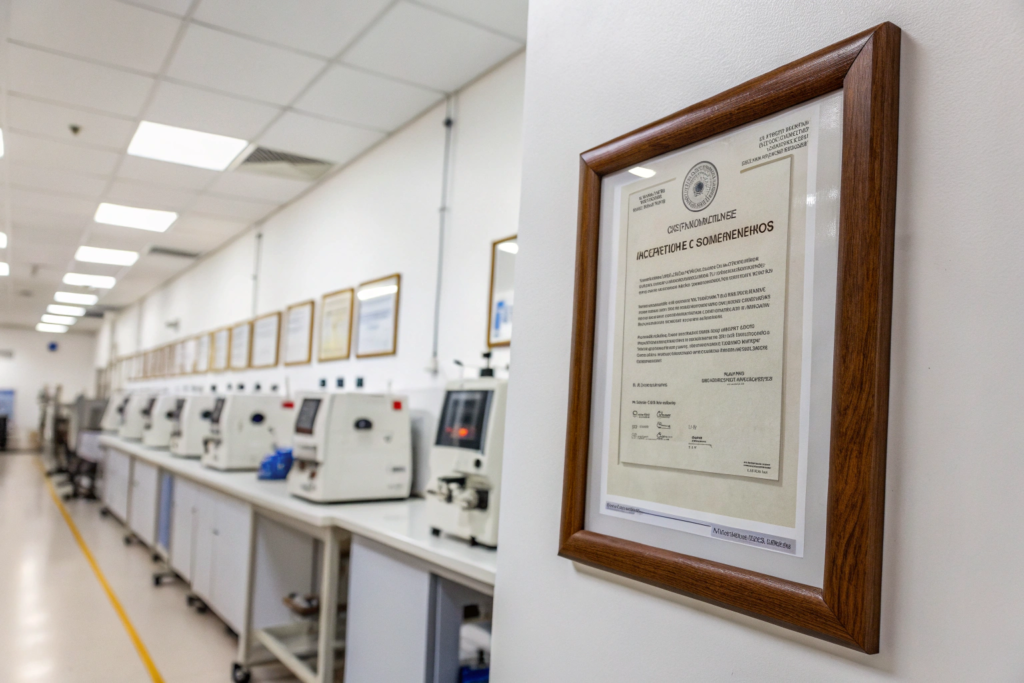
CNAS stands for China National Accreditation Service for Conformity Assessment. It’s the Chinese body that certifies labs to the international standard ISO/IEC 17025. This is the same standard used by SGS, Intertek, and Bureau Veritas. When you see a Fumao test report with the CNAS stamp, it means:
- Our equipment is calibrated correctly.
- Our technicians are qualified.
- Our results are traceable and legally defensible.
If you try to import fabric into Germany and customs flags your colorfastness claim, they will accept a CNAS-accredited lab report. They will not accept a random report from a mill’s back office with no accreditation. This saves our clients time and legal fees. It means they can trust the data.
Does CNAS Accreditation Meet EU REACH Compliance Standards
Yes, and this is a huge deal for our European clients. REACH (Registration, Evaluation, Authorisation and Restriction of Chemicals) is the strictest chemical regulation in the world. While CNAS accredits the testing method (like ISO 105 E04), it’s the accuracy of that method that proves compliance.
For example, if we test for Azo dyes (forbidden amines) and the fabric passes, the CNAS stamp on the report is the proof that the test was done correctly. Without that accreditation, the EU customs authority might reject the shipment and demand expensive re-testing in a European lab. We’ve built this lab specifically to avoid that bottleneck. It cost a lot of money and took a lot of time, but it means our recycled polyester and coated fabrics clear customs faster than 90% of the competition.
If you want to understand the specific chemical limits, you can review this official list of restricted substances under the EU REACH regulation for textiles.
Can I Request a Third-Party Verification of Your Lab Results
Absolutely. And we encourage it for first-time orders. Transparency is the only way to build trust in this business. We can send duplicate samples to SGS or Intertek for parallel testing. You, as the buyer, can select the lab and pay them directly if you prefer. We are 100% confident in our CNAS lab results, but we understand that sometimes a buyer’s internal compliance department requires a specific third-party name.
I recall a project in 2024 for a US client who required AATCC methods instead of ISO. While our lab is set up for ISO (which is standard for Europe), we simply sent the fabric to our partner lab in Shanghai for the AATCC 16 (Lightfastness) test. The results came back within 0.5 grade points of our internal ISO test. That correlation proved our internal data was solid. We always tell clients: "Trust, but verify." We give you the tools to verify.
Conclusion
Testing for colorfastness to light and sweat isn’t a box-ticking exercise. It’s the only thing standing between your brand and a social media post showing a faded, stained, ruined garment with your logo on it. At Shanghai Fumao, we’ve invested in the people, the Xenon machines, the perspirometers, and the CNAS accreditation to make sure that post is never about us—or you.
We test lightfastness to ISO 105 B02 because we want your fabric to survive the window display and the summer holiday. We test sweat fastness to ISO 105 E04 because we know what happens to a shirt in a hot nightclub or a spin class. And we use spectrophotometers to make sure the color you loved on the lab dip is the exact color that lands in your warehouse, batch after batch.
This is the invisible work that happens behind the scenes in Keqiao. You don’t see the Xenon lamp running 24/7. You just see a garment that looks as good on its 50th wear as it did on day one. That’s the promise we make.
If you have a project that demands high colorfastness—maybe it’s a neon activewear line or a dark, dramatic evening wear collection—we need to talk before you commit to a dye house. We can help you set the right specs from the start.
For a confidential review of your current fabric’s performance or to request a sample of our high-fastness lining or shell fabrics, reach out to our Business Director, Elaine. She has the lab reports ready to go. Email her at: elaine@fumaoclothing.com. Let’s make sure your colors stay true.