Let me start with a story that still makes my warehouse manager flinch. About seven years ago a client returned a pallet of beautiful heavyweight wool coating to us. They had over-ordered for a winter coat program. Instead of sending it back to our main warehouse they stored it in their own unheated garage in New Jersey for 18 months. They stacked the rolls Vertically on the concrete floor like logs in a woodpile.
When they finally shipped it back to us we opened the truck. The smell hit us first. Mildew . Deep musty sour mildew. Then we saw the rolls. The ends that had been resting on the concrete had wicked up moisture from the floor. The fabric was Stained and Rotted . But the real damage was invisible. The rolls stacked vertically had developed Flat Spots . The weight of the fabric had compressed the pile over hundreds of days. When we unrolled it on the cutting table it looked like a topographical map of the Rocky Mountains. Valleys and peaks. Uncuttable. Unsellable.
$30,000 worth of premium wool. Destroyed. By gravity and damp concrete.
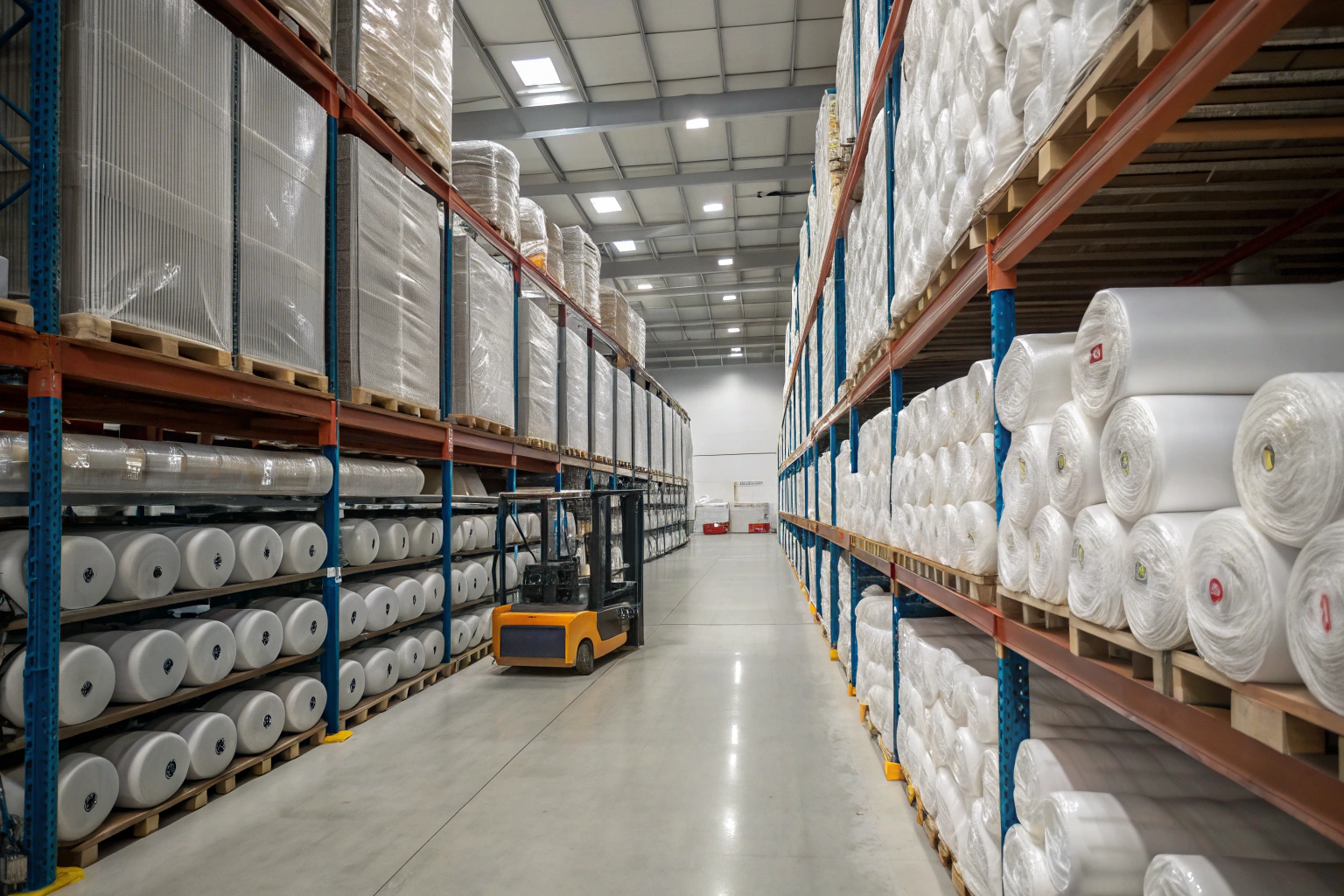
Proper fabric storage is not a warehouse chore. It’s Asset Protection . Your fabric inventory is cash sitting on a shelf. If you treat it like a pile of junk you are burning money. At Shanghai Fumao we store millions of yards of fabric at any given time. We’ve made every mistake in the book so you don’t have to. In this article I’m going to give you the exact protocols we use to keep fabric in Cuttable Condition for years. Whether you have a 50,000 sq ft distribution center or a 200 sq ft studio stockroom these principles scale.
Why Should Fabric Rolls Be Stored Horizontally Not Vertically
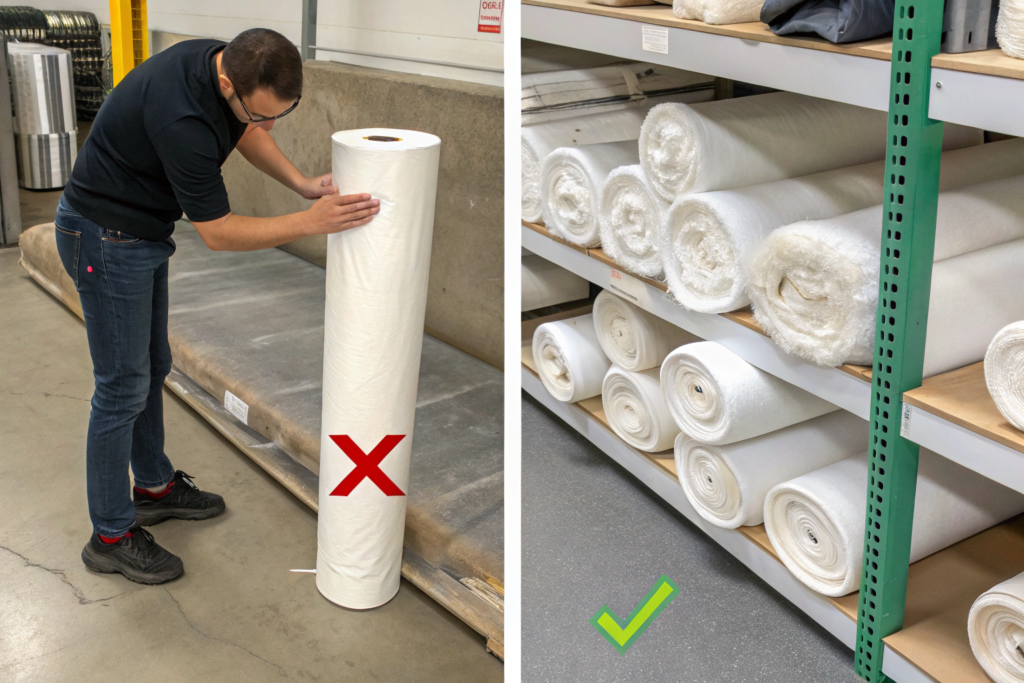
This is the single most common and most destructive mistake I see in small brand warehouses. Standing rolls on end. It seems logical. It saves floor space. You can see the ends. It’s easy to grab one.
Do Not Do This.
Here is the physics of what happens. A 50-yard roll of 12oz denim weighs about 25-30 pounds . When you stand it on end all 30 pounds of pressure is concentrated on a Surface Area of about 3 square inches (the edge of the cardboard tube and the compressed fabric edge).
Over time gravity does its work. The fabric at the bottom of the roll Compresses . The fibers become Permanently Crushed . This is called Pile Distortion . When you unroll it there will be a Hard Crease Line every few feet corresponding to the layers of the roll. You cannot iron this out. You cannot steam it out. The fabric is Damaged Goods .
The Rule: Rolls Must Be Stored Horizontally. The weight of the roll must be distributed along its Entire Length on a flat smooth shelf. This prevents compression and maintains the Round Profile of the roll.
The Exception: Very Large Master Rolls (over 150 yards / 300 lbs). These are often stored on end because they are too heavy to move horizontally. BUT they must be on Specialized A-Frame Racks or Cradles that support the curve of the roll and prevent it from developing a flat spot.
How Does Pressure Damage the Selvage Edge Over Time
Even when stored horizontally there is a hidden danger. The Selvage Edge .
The selvedge is the densest tightest part of the fabric. It’s slightly Thicker than the body of the cloth. When you stack rolls horizontally the Full Weight of the Top Rolls rests on the Selvage Edges of the Bottom Rolls .
This creates a Pressure Point . Over months this pressure can actually Cut the fabric. You’ll unroll it and find a line of Broken Yarns exactly where the edge of the roll above it was resting.
The Solution: Roll Rotation . Every 3-6 months the warehouse team should "Burp" the rolls. Give them a quarter turn. This shifts the pressure point. It’s a simple task that prevents irreversible damage.
At Shanghai Fumao we also use Roll Cradles . These are curved plastic or metal supports that separate the rolls and distribute the weight evenly across the face of the fabric not just the edge.
What Is the Ideal Shelving Material for Long-Term Fabric Contact
Be careful what your fabric touches. Unsealed Wood is the enemy.
Wood contains Lignin and Acids . Over time these chemicals can Off-Gas and Stain the outer layers of the fabric especially light-colored silks and cottons. You’ll see a Yellow or Brown Stripe on the outside of the roll.
Metal Shelving can Rust . If humidity is high condensation forms on cold metal pipes. This rust transfers to the fabric as Orange Stains .
The Gold Standard: Powder-Coated Steel or Epoxy-Coated Wire Shelving . The coating is inert. It won’t react with the fabric.
If you must use wood shelving (for cost reasons) line the shelves with Acid-Free Tissue Paper or Archival Cardboard . Replace this paper every year. It’s a small cost to protect a large asset.
How to Protect Fabric Inventory from Moisture and Mildew
Mildew is the silent killer. You can’t see it until it’s too late. And once it’s there It Does Not Wash Out . The spores stain the fiber permanently. The smell is Permanent .
Mildew requires three things: Heat Moisture and Stagnant Air . Your job is to eliminate at least one of those.
Moisture Control (The Most Important):
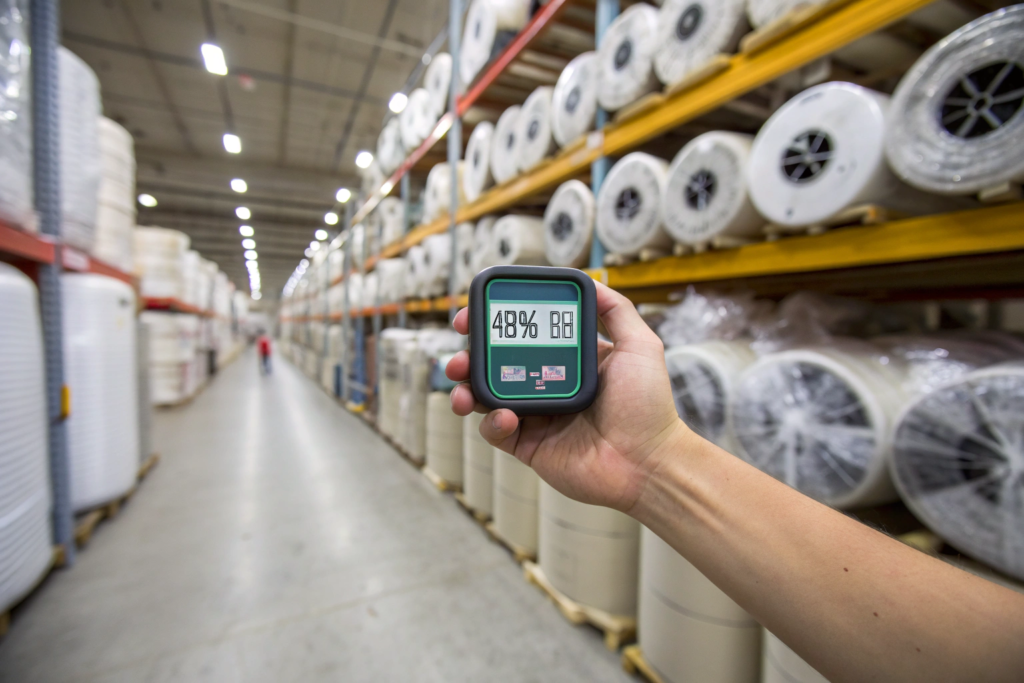
Invest in a Hygrometer . It measures Relative Humidity (RH) . You want the RH in your fabric storage area to be Between 45% and 55% .
- Above 65% RH: Mildew growth is active. You have weeks to fix it.
- Below 35% RH: Natural fibers become Brittle and lose strength. They crack when handled.
If you are in a humid climate (Florida Southeast Asia) you Must Have a Dehumidifier running 24/7. Empty it daily or plumb it to a drain. This is non-negotiable.
Air Flow:
Do not seal fabric in Airtight Plastic Bags . Fabric needs to Breathe . If you trap ambient moisture inside a sealed bag and the temperature drops you get Condensation . The fabric gets wet inside the bag.
We use Breathable Polyethylene Covers or Tyvek . These keep the dust off but allow Vapor Transmission . Leave the ends of the rolls slightly exposed or use vented bags.
Why Is Concrete Floor Contact a Recipe for Disaster
Concrete looks dry. It is not.
Concrete is Porous . It acts like a giant sponge. It pulls Ground Moisture up through capillary action. This is called "Rising Damp."
If you place a fabric roll directly on a concrete floor the fabric acts as a Wick . It pulls that moisture out of the concrete and into the fibers. Within weeks you will have a Tide Mark of mildew at the base of the roll.
The Rule: The 6-Inch Rule . Nothing fabric-related touches the floor. The bottom shelf of your rack must be at least 6 Inches Off the Ground . This allows air to circulate underneath and breaks the moisture bridge.
I’ve seen brands lose entire pallets of denim to a flood from a backed-up floor drain. If the pallet was on the floor it’s a total loss. If it was on a raised shelf it survived.
How to Handle and Prevent Silverfish and Moth Infestations
Pests love dark undisturbed natural fibers. Wool cashmere and silk are Candy to moths. Cotton and linen are Salad to silverfish.
Prevention is the only cure. Once you have an infestation it is incredibly difficult to eradicate because the eggs are microscopic and live deep in the rolls.
Protocol 1: Sticky Traps. Place Pheromone Traps for moths and Glue Boards for silverfish along the baseboards of your warehouse. Check them Monthly . If you see an increase in catch you have a problem and need to act fast.
Protocol 2: Cold Treatment. If you suspect a roll is infested you can kill the eggs by putting the roll in a Deep Freezer (below 0°F / -18°C) for At Least 7 Days . This is standard practice for high-value cashmere.
Protocol 3: No Food in the Warehouse. This seems obvious but I see it all the time. Employees eating lunch at their desk near the fabric. Crumbs attract silverfish. Silverfish eat fabric. Keep the break room separate.
What Is the Proper Way to Roll and Label Fabric for Longevity
How the fabric is rolled at the Mill determines how well it stores in the Warehouse . A bad roll is a time bomb.
Tension is Everything.
If the fabric is rolled Too Tight it stretches the fibers. When you unroll it months later the fabric will be Narrower than when it went on the roll. It will also have Tension Lines (waves in the cloth).
If the fabric is rolled Too Loose the roll is "Soft." It will collapse under its own weight on the shelf creating flat spots and creases.
The Core Tube:
Cheap fabric comes on Thin Flimsy Cardboard Tubes . These tubes bend and crush. When the tube bends the fabric roll sags in the middle. This creates Uneven Pressure and distorted yardage.
Premium Storage Standard:
- Tube Thickness: Minimum 5mm Wall Thickness .
- Tube Diameter: 2 Inches for standard rolls 3 Inches for heavy rolls.
- Rolling Method: Hard Roll (Firm to the touch but not rock hard).
At Shanghai Fumao we use an automated rolling machine with Constant Tension Control . We also insert a Plastic Plug in the end of the tube to prevent the core from being crushed when the rolls are stacked.
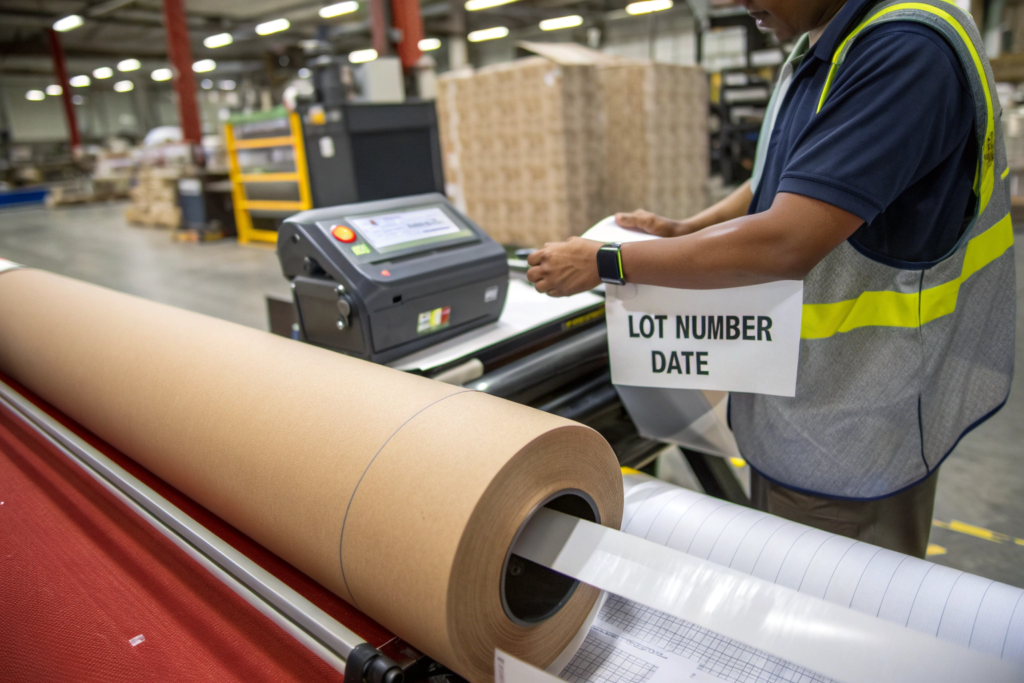
How to Create a Foolproof Labeling System for Bulk Storage
You cannot rely on the mill’s label. They fall off. They fade. You need an Internal Redundant System .
The 3-Point Label Method:
- Outside End: A large 4×6 thermal label on the Plastic Wrap . This is what you see on the shelf. Contains: Item Code Color Lot Number Yardage Date Received .
- Inside Core: Write the Lot Number in Sharpie on the Cardboard Tube . This is your backup if the outer label gets torn off.
- The Ticket: Tuck a small paper ticket Inside the Roll about 2 yards in. This is the Forensic Label . If all other labels are destroyed you can find this ticket and identify the fabric.
Barcodes are Mandatory. Scanning a barcode eliminates data entry errors. We use a simple Code 128 Barcode containing the Lot Number .
Why Should You Avoid Storing Fabric in Original Poly Bags Long Term
The poly bag the fabric came in is for Shipping not Storage .
Shipping bags are often Non-Vented . They trap moisture. They also Off-Gas . The plasticizers in cheap poly bags can react with the dyes in the fabric causing Color Shift especially in whites and pastels.
Remove the fabric from the shipping bag. Inspect it. Re-wrap it loosely in a Breathable Textile Wrap or a Vented Poly Bag . Allow the ends of the roll to breathe.
How to Manage Fabric Inventory Rotation to Prevent Deadstock
Proper storage prevents physical damage. Proper Rotation prevents Financial Damage . A roll of fabric that sits on the shelf for 5 years is dead money. Even if it’s in perfect condition it’s Aged Inventory .
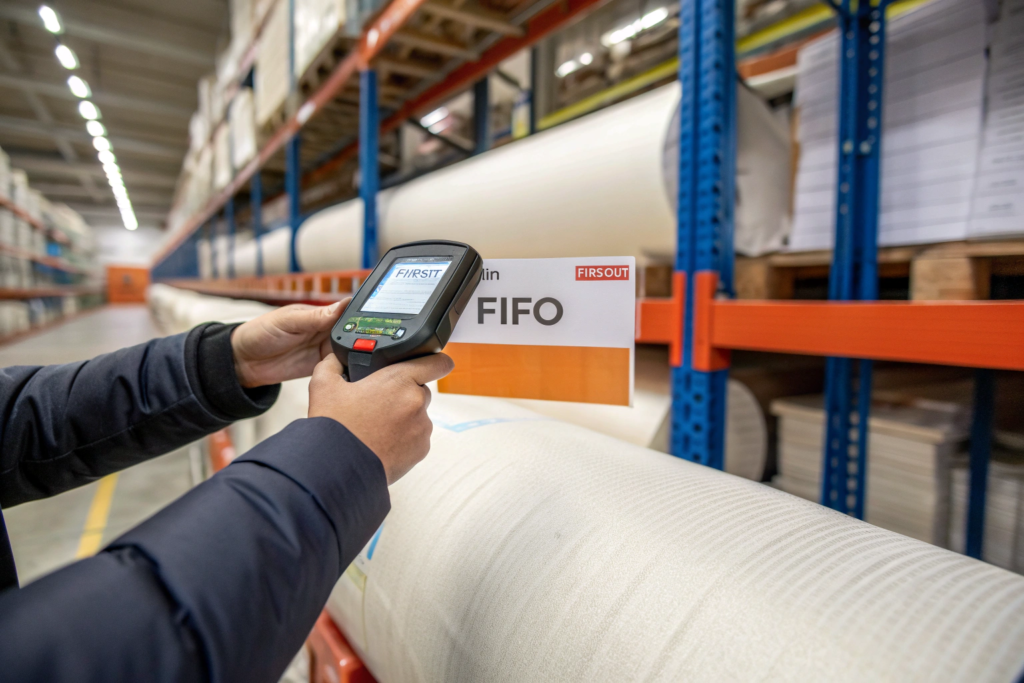
We use a strict FIFO (First In First Out) system. The oldest fabric in the warehouse is the First Fabric we try to sell or use.
How to Implement FIFO Physically:
- Date Coding: Every roll label has a Date Received printed in Large Bold Font .
- Zoned Shelving: We have a section for Current Season and a section for Prior Seasons . Prior season fabric is marked with a Red Flag Label .
- The "Scratch and Dent" Pile: Rolls with minor cosmetic damage to the outer layer (dust marks shelf wear) are moved to a Sample Sale Section . We sell these at a discount to students and sample makers. Get it out of the main warehouse. It clutters the space and slows down picking.
How Often Should You Unroll and Inspect Long-Term Storage Items
Fabric is not a set-it-and-forget-it asset. It needs Custodial Care .
Annual Audit Schedule:
Once a year we pull a Random Sample of 5% of our aged inventory.
We unroll the First 10 Yards . We check for:
- Yellowing (from oxidation).
- Crease Marks (from compression).
- Pest Evidence (frass or webbing).
We also Re-Roll the fabric to relieve the tension memory. This is a time-consuming process but it prevents permanent set-in wrinkles.
For high-value woolens this is done Twice a Year . The cost of the labor is far less than the cost of writing off a $5,000 roll of Super 150s wool.
What Is the Best Software for Tracking Bulk Textile Inventory
You cannot run a fabric warehouse on an Excel spreadsheet. You need Lot Control .
Textiles are unique because you have Dye Lot Variation . You cannot just pick "Black Cotton Twill." You must pick "Black Cotton Twill Lot #2403B ."
We use ERP Software specifically configured for textiles. Features we rely on:
- Lot Traceability: Track the fabric from Greige receipt to Dyeing to Finishing to Shipping.
- Location Management: Know exactly which shelf and which bin the roll is in.
- Yardage Tracking: The system deducts yardage as we cut sample yardage. It prevents us from selling a 50-yard roll that actually only has 42 yards left.
For smaller brands a simple Cloud-Based Inventory App with Custom Fields for Lot Number and Location is sufficient. The key is Consistency of Data Entry .
Conclusion
The best way to store bulk fabric in a warehouse is to treat it with the same respect you would treat cash stacked on a pallet. It requires a commitment to horizontal storage to prevent compression a vigilant eye on humidity and pests to prevent biological decay and a disciplined FIFO rotation system to prevent financial decay.
The investments in proper shelving climate control and inventory software are not overhead costs. They are Insurance Premiums against catastrophic loss. A single roll of premium fabric saved from a concrete floor or a moth infestation pays for the entire storage system.
At Shanghai Fumao we have refined these storage protocols over two decades. We store fabric for ourselves and for our clients with the same meticulous care. We believe that the quality of the fabric when it leaves our warehouse should be identical to the quality when it left the finishing machine.
If you have questions about storing a specific fiber or if you are looking for a storage partner for your greige goods inventory we are here to help. Please reach out to our Business Director Elaine. She can advise on best practices for your specific climate and fiber mix.
Contact Elaine at: elaine@fumaoclothing.com