Let me paint you a picture. It’s the middle of a scorching summer, and you’re an American buyer stuck with a shipment of activewear tops that feel more like a winter blanket. Your customers are returning them, complaining about sweat patches and a sticky feel. I’ve been there, not as the buyer, but as the supplier trying to fix that mess. A few years ago, a client from California, a startup making yoga wear, came to us with exactly that problem. Their first order using standard cotton jersey from another mill was a disaster. The fabric held moisture, lost its shape after a few washes, and frankly, it just wasn’t right for their brand promise of "cool and free." That’s when we realized we had to stop just selling fabric and start engineering it for the specific end-use.
So, can our knitted fabrics handle the heat of summer activewear? Absolutely, yes. But it’s not a blanket yes for all our knits. The suitability hinges on one critical factor: the specific engineering of the fabric. At Shanghai Fumao, we’ve spent over two decades learning that a successful summer activewear fabric is a delicate balance of fiber selection, knit structure, and finish. It’s not just about the raw material; it’s about how we construct it. For example, in 2024, we helped a Swedish athleisure brand transition from a standard 100% cotton jersey to a 160 GSM polyester-spandex blend with a moisture-wicking finish. The result? Their return rate for "discomfort" dropped by 40% in their summer line. So, the short answer is yes, our knitted fabrics can be perfect for summer activewear, provided we start with the right specs.
You might be thinking, "That’s all great, but what about the costs? And the shipping? And what about the tariffs?" I get it. As a supplier dealing with dozens of US clients, I know that for you, the business equation has to work. Quality is the price of entry, but your real pain points are the hidden ones: inefficient pricing, unpredictable sailing schedules, and those looming tariff costs. You need a partner who understands that a fabric’s performance is only half the battle; getting it to you on time, at the right price, and through customs without a hitch is the other half. Let’s break down exactly how we make this work.
How Do You Engineer Knits for Breathability and Moisture Management?
Look, anyone can sell you a piece of knit fabric. But can they tell you why it breathes? Or why it might turn into a sweat-soaked rag after a 15-minute run? This is where the real expertise comes in. We’re not just merchants here at Shanghai Fumao. Our team, based right in the Keqiao textile cluster, includes engineers who spend their days tweaking yarn counts and knitting patterns to get that perfect airflow. We’ve learned that for summer activewear, the rule is simple: you need to move moisture away from the skin and let it evaporate fast. If you don’t, you’re just selling a sponge.
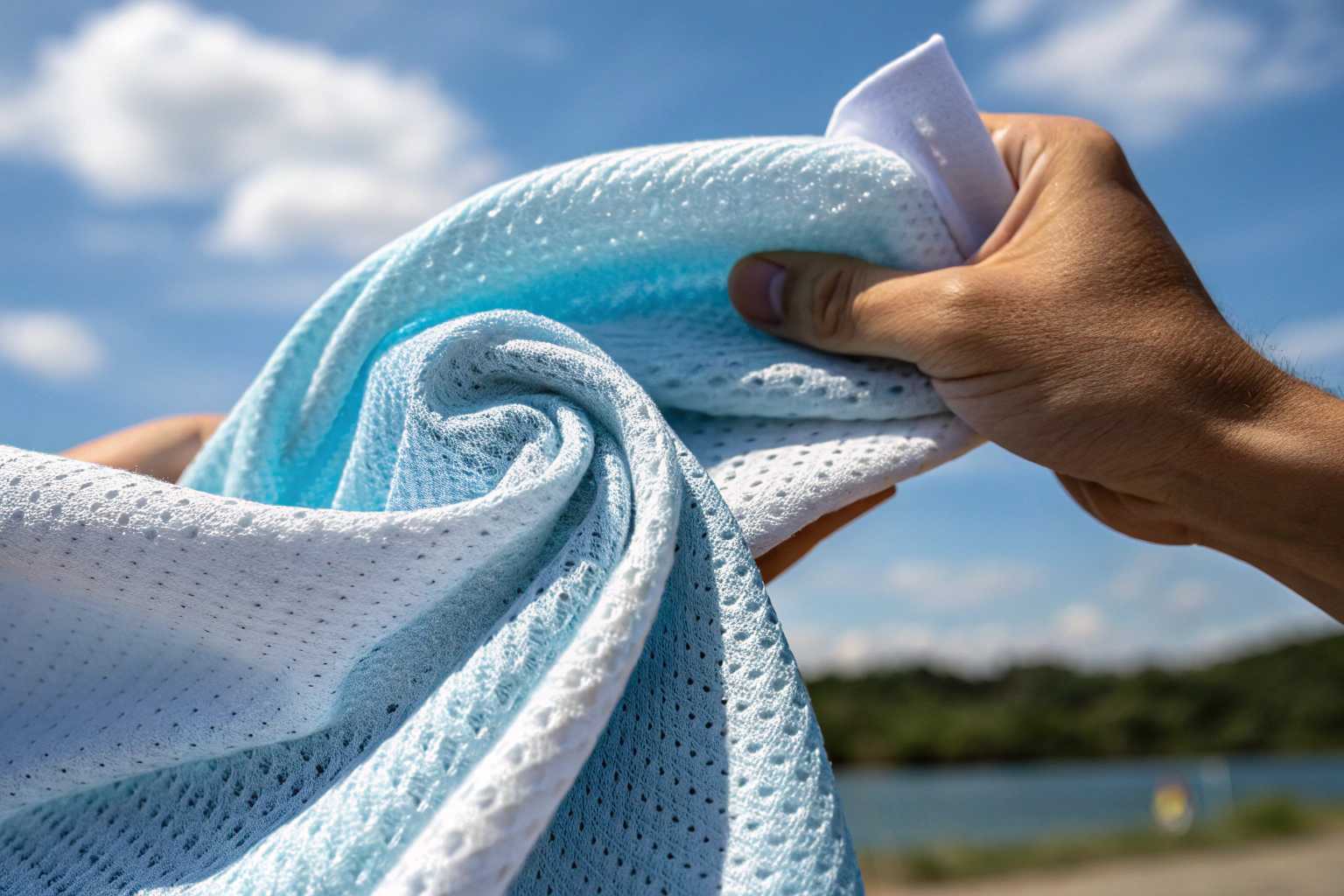
We achieve this through a three-pronged approach that we’ve refined over 20 years. First, it’s the yarn itself. We often use specially engineered polyester filaments that have a cross-section shape designed to create capillary action. Think of it like tiny straws that suck moisture away from the skin. Second, it’s the knit structure. A basic jersey might be fine for a t-shirt, but for high-intensity activity, we often recommend a mesh or a pique knit, which inherently has more air pockets. And third, it’s the finish. We apply a durable moisture-wicking finish that doesn’t wash out after the first few cycles. This isn’t just theory; it’s science we put into practice every day.
But let’s get into the weeds a bit. Because the real art is in the combination. You can’t just pick one element and hope for the best.

What Specific Knit Structures Work Best for Summer Sportswear?
We’ve found that not all knits are created equal when it comes to summer. Here’s a quick breakdown from our lab tests:
| Knit Structure | Breathability | Moisture Management | Best Use Case |
|---|---|---|---|
| Single Jersey | Moderate | Moderate (with finish) | Light yoga, casual tees |
| Pique Knit | High | Good (due to textured surface) | Polos, golf shirts |
| Mesh Knit | Very High | Excellent (open structure) | Running jerseys, side panels |
| Interlock | Low to Moderate | Moderate | Linings, more structured tops |
For high-performance summer wear, we’re constantly recommending our clients look beyond the standard jersey. For instance, one of our European clients in 2023, a brand focused on triathlon gear, needed a fabric that would perform under extreme sweat conditions. We developed a custom 150 GSM polyester mesh knit using a filament yarn with a patented cross-section. The open structure of the mesh, combined with the yarn’s capillary action, allowed for rapid drying. We tested it in our CNAS-accredited lab against a standard 180 GSM jersey, and the drying time was cut by over 60%. If you want to learn more about the technical parameters to specify in your tech packs, this guide on selecting performance fabrics from a sports textile forum is a good starting point.
Why Do Some Knitted Fabrics Still Feel Heavy and Sweaty?
This is a common complaint, and it usually comes down to one or two failures: either the yarn is too thick, or the finish wasn’t applied correctly. I remember a specific case in early 2024 with a US-based brand that was sourcing a recycled polyester jersey from another supplier. They told us the fabric felt heavy and clammy during their customer trials. When we got a sample and ran it through our lab, we found two issues. First, the knit structure was too tight, restricting airflow. Second, the "moisture-wicking finish" they were promised was barely detectable; it had been applied as a simple top-coat that would wash out in a few cycles.
We solved this by recommending a shift to a slightly more open-knit structure, moving from a 32-gauge to a 28-gauge machine, which creates a looser, more breathable fabric. We then used a proprietary, durable moisture-wicking finish that we apply during the dyeing process, not after. The result was a fabric that felt lightweight and dry to the touch, even under stress. For our clients concerned about the durability of such finishes, we always provide test data from our CNAS-certified lab, including results for how to source GOTS certified organic cotton from China or for the specific finish we use. It’s about moving past promises and into verifiable data.
What Are the Cost Implications vs. Quick-Turn Supply Chain Needs?
I know what you’re thinking. "All this engineering sounds expensive. And if it takes forever to produce, it doesn’t matter how good it is." You’re right. This is the core tension we manage every day: delivering high-performance fabrics that also make financial sense for your business, and doing it on your timeline. We can’t afford to be the supplier that has great fabric but misses the boat—literally. (Here’s a fun fact: we once had a client who missed their sailing date because they changed a color 48 hours before production was scheduled. We managed to re-do the dye lot and still get it on the vessel, but it took a midnight shift at our dyeing partner’s factory. We’ve since built in safeguards for those last-minute changes.)
The key is to stop thinking about cost and timeline as separate things. At Shanghai Fumao, they are two sides of the same coin. We manage them through our integrated supply chain. Because we have our own weaving and cooperative dyeing, printing, and finishing plants, we cut out the middleman. This vertical integration allows us to control both the price and the speed. For a client in the US, this means we can offer the price competitiveness of a large mill with the agility of a small-scale developer. We’ve built our entire operation around the reality that your business can’t afford to be tied up in inventory for months, nor can it pay a premium for that flexibility.
Let’s look at the actual numbers and processes that make this balance possible.

How Does Your Integrated Supply Chain Reduce Lead Times?
The answer is simple: we own the process. From the moment you confirm a sample, we are not waiting on emails from a third-party supplier to coordinate. Let me give you a real example. In March 2024, right in the middle of our peak production season, a major US streetwear brand came to us with a last-minute order for a custom jacquard knit. They needed the bulk fabric delivered in 35 days to meet their production schedule for a holiday drop. A typical timeline with a non-integrated supplier could be 60-70 days.
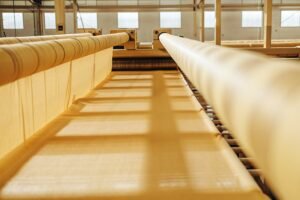
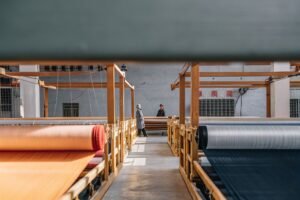
Because we have our own weaving factory, we could schedule the production immediately. Our in-house team communicated directly with our cooperative dyeing partner, which we’ve worked with for over a decade, to ensure the dye baths were ready as the greige fabric came off the loom. The entire process, from yarn sourcing to final QC inspection at our own packaging factory, was managed under one roof, figuratively speaking. We delivered the fabric in 38 days, and the client’s order made it onto the ship before the holiday rush. This is the power of being part of the world’s largest textile cluster; everything is at our doorstep.
Can I Get Lower Prices by Ordering During Slower Periods?
Absolutely. And I don’t say that just to get your business. The reality of manufacturing in China is that it’s cyclical. The peak production periods—March to May and August to October—are when every factory is slammed. During these times, you’re competing for machine time, which can add 1-2 weeks to your timeline and sometimes even push up the price a bit due to demand.
But the slower periods, which are typically June-July and November-December, offer a real strategic advantage. If you can plan your orders for these windows, you can often negotiate better pricing. We have more machine availability, our supply chain isn’t stressed, and we can give you more attention. A savvy US-based swimwear brand we work with does exactly this. They finalize their pre-production in May, right before our summer slowdown. They use the June-July period for their bulk production. Not only do they get a 5-7% cost advantage compared to peak season orders, but they also get priority shipping as the market heats up for their summer line. We’re happy to share our production calendar with you to help you strategize. This kind of planning is crucial, especially when considering variables like sailing schedules from Shanghai to Los Angeles that can fluctuate.
How Do You Guarantee Quality and Testing Standards for Performance Fabrics?
Here’s where I get a bit of a reputation as a stickler. You can call it obsession, but I call it responsibility. When you claim a fabric is "moisture-wicking" or "antibacterial" for summer activewear, you better have the proof to back it up. I’ve seen too many suppliers just slap those labels on a product without any testing. It’s not just dishonest; it’s a direct hit to your brand’s credibility. When a customer buys a $80 sports top from you, they expect it to perform. If it doesn’t, they aren’t blaming the factory in China; they are blaming you.
This is why we built our own CNAS-accredited testing center. It wasn’t a marketing move; it was a necessity. It allows us to test every single batch of fabric for the properties that matter to you: moisture wicking (AATCC 197), breathability (ASTM D737), colorfastness (AATCC 61), and shrinkage (AATCC 135). We don’t rely on a third-party lab that might have a week-long queue; we do it ourselves in real-time. If a batch of fabric for a German client’s summer outdoor line fails the UV protection test, we catch it before it’s shipped, not after it’s been cut and sewn into a $150,000 order.
Our system isn’t just about having a lab; it’s about how we use it to give you total peace of mind.

What Real-World Testing Do You Perform on Summer Knits?
We go way beyond just looking at a piece of fabric. We put it through the same rigors you’d expect from a major sportswear brand. Our testing protocols are designed to simulate real-world use, not just lab conditions.
For instance, one of our clients in the UK, a high-end cycling apparel brand, was concerned about their fabric pilling after repeated contact with a bike seat. We didn’t just run a standard Martindale test (which we do). We worked with them to create a custom testing protocol that involved repeated abrasion under a weighted condition that simulated the friction of cycling shorts. We tested multiple fabric constructions and found that a specific blend of nylon and spandex with a tighter knit structure performed 40% better than the original cotton-spandex blend they were using.
Here’s a quick look at our standard testing suite for summer knits:
| Test | Standard | What We’re Looking For | Why It Matters for Summer Wear |
|---|---|---|---|
| Moisture Management | AATCC 197 | Time to dry, one-way transport | Ensures sweat evaporates quickly, not just moves. |
| Breathability | ASTM D737 | Air permeability (CFM) | High airflow prevents a "sauna" effect under the fabric. |
| UV Protection | AATCC 183 | UPF rating | Critical for outdoor activewear to protect skin. |
| Colorfastness | AATCC 61 | Resistance to fading from washing & sweat | Ensures colors stay vibrant after heavy use and sweat exposure. |
| Dimensional Stability | AATCC 135 | Shrinkage % | Guarantees the garment will keep its fit after washing. |
We provide all this data with every shipment. When you order from us, you get a QR code that links to the full test report for that specific roll of fabric. It’s a level of transparency that builds trust. For a deeper look into how we verify recycled polyester content for eco-conscious brands, we have our testing procedures outlined in a public white paper on our site.
How Do You Handle QC for Fabrics Destined for the US Market?
For the US market, we have a specific, almost military-like QC process. We know that US buyers are particularly sensitive to issues like shading, shipping marks, and paperwork for customs. Our QC doesn’t just start at the end; it’s woven into every step. We use a system called "Four-Point Inspection" on every single roll of fabric. This is the industry standard, but we’re rigorous about it. Our inspectors are trained to identify defects like broken needles, slubs, or color variation that might be less than 1 cm wide.
I remember a specific case in late 2023 with a large US-based e-commerce brand that orders thousands of units of basic summer tanks. Their biggest pain point was fabric roll weights being inconsistent, which messed up their costing and their cut-and-sew planning. They had previously switched suppliers four times because of this issue. We solved it by implementing a system where we weigh and measure every roll of fabric after it’s been packaged in our factory. We then label each roll with its exact net weight and length. This is not standard practice for many mills. We created a simple packing list format that detailed every roll’s specs. The client’s production manager in LA told us it was the first time they could plan their cutting lay with 99.9% accuracy without any surprises. This attention to detail is what happens when you have a QC team that understands the downstream consequences of a small mistake.
What Are the Real Logistics and Tariff Challenges for US Buyers?
Now for the part that keeps most of you up at night. The fabric is perfect. The quality is top-notch. But then, you have to get it from our factory in Keqiao to your warehouse in, say, Atlanta. And along the way, you have to navigate tariffs that can eat into your margin, sailing schedules that change with the wind, and customs paperwork that looks like it was designed by a committee. I’m not going to sugarcoat it; it’s a challenge. But it’s a challenge we’ve been navigating for over 20 years for clients in the US and around the world. We see it as part of our job, not just something we hand off to a freight forwarder.
The key to managing US-bound logistics is proactivity and diversification. We don’t wait for you to ask about shipping; we provide you with options. Because of the "Silk Road Keqiao" initiatives, we have direct relationships with major shipping lines and can offer competitive rates. For tariffs, we work with our clients to optimize their supply chain through HTS code classification and, where possible, by sourcing raw materials that might qualify for exemptions or lower duties. We treat the logistics and tariff piece as an extension of our production process. If we can’t get it to you efficiently and cost-effectively, then all our great work in the factory is for nothing.
Let’s get into the nitty-gritty of how we make the trans-Pacific journey work.

How Do You Mitigate Risks from US Tariffs on Chinese Textiles?
This is the number one question I get from American buyers. The truth is, we can’t make the tariffs disappear, but we can help you navigate them. We’ve been doing this for years, and we’ve become experts in US Customs regulations. The first thing we do is a thorough HTS code analysis. We work with our clients to ensure that the fabric is classified in a way that is both accurate and, if possible, takes advantage of any lower-duty categories.
For example, a US client of ours, a home-based entrepreneur selling premium children’s pajamas, was facing a high tariff rate on their cotton fleece fabric. We realized that if we used a certain blend of cotton and recycled polyester and changed the finish to meet a specific flame-retardant standard, the product could be reclassified under a different HTS code with a significantly lower duty rate. We did this legally, with all proper documentation. This wasn’t a trick; it was using our knowledge of the tariff code to the client’s advantage. We also work with clients to source raw materials, like yarns, from countries not subject to the same tariffs, which can be a complex but viable option for large-volume orders. To understand the current landscape, it’s always worth checking resources like the USITC Tariff Database for the latest rulings.
What Are the Best Practices to Avoid Shipping Delays?
Shipping delays are rarely caused by one thing. They are usually a cascade of small issues. A late sample approval, a missed production slot at the dye house, a delay in getting a container from the port. Our entire supply chain is built to avoid these cascading failures. We treat the shipping schedule as a non-negotiable deadline, just like the quality standards.
We’ve learned that the biggest enemy of on-time delivery is a lack of planning around Chinese holidays. The Chinese New Year shutdown, which is typically 3-4 weeks, is a massive event. We learned this the hard way about 15 years ago when we missed a major shipment because we didn’t plan for it. Now, we do the opposite. We have a strict rule: all pre-production for any order that needs to ship before or right after Chinese New Year must be completed 6 weeks before the holiday. This ensures that as soon as the factories reopen, our production is on the loom, not waiting for approvals. We communicate this timeline to our US clients well in advance.
Here’s a quick summary of our holiday planning protocol:
| Holiday | Typical Duration | Our Action Plan |
|---|---|---|
| Chinese New Year | 3-4 weeks | All pre-production completed 6 weeks prior. Bulk production scheduled for the first week back. |
| Golden Week | 1 week | Advance planning for raw material orders. Production schedules adjusted 2 weeks prior to ensure no bottlenecks. |
For clients who need more immediate guidance, we often share this blog post on managing Chinese manufacturing timelines from a non-competing sourcing blog. It’s a good primer for those new to the market. Our team is constantly monitoring the sailing schedule from ports like Ningbo and Shanghai. We build in a buffer for potential delays, and we keep you informed every step of the way.
Conclusion
Look, sourcing knitted fabric for summer activewear from China doesn’t have to be a gamble filled with uncertainty about performance, cost, and logistics. It’s about finding a partner who treats your business challenges as their own. At Shanghai Fumao, we’ve built our entire operation—from our integrated supply chain and CNAS-accredited lab to our deep understanding of US tariffs and shipping—to do exactly that. We’ve moved past the old model of just being a transactional supplier. Our 20+ years in the heart of the Keqiao textile cluster have taught us that real value is created when you combine technical fabric expertise with supply chain reliability.
We know you need a fabric that performs in the heat of summer, but you also need a partner who can deliver it on time, at the right price, and without any nasty surprises at customs. We’ve helped a Swedish athleisure brand cut their return rate by 40% through engineered knits. We’ve helped a US e-commerce giant gain perfect inventory predictability with our meticulous roll-by-roll QC. And we’ve helped a UK cycling brand design a custom testing protocol to ensure their fabric outlasts the competition. We can do the same for you.
So, if you’re tired of the runaround and want a partner who speaks your language—both in fabric performance and in business terms—let’s talk. I’m ready to put our team to work for you.
Contact our Business Director, Elaine, directly at elaine@fumaoclothing.com. Tell her you read this post and you’re ready to build a summer activewear line that stands out for its quality and reliability. Let’s weave your success together.