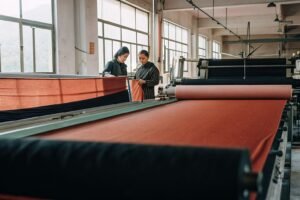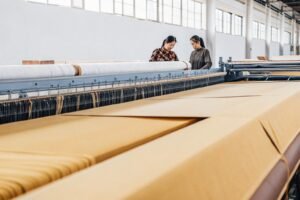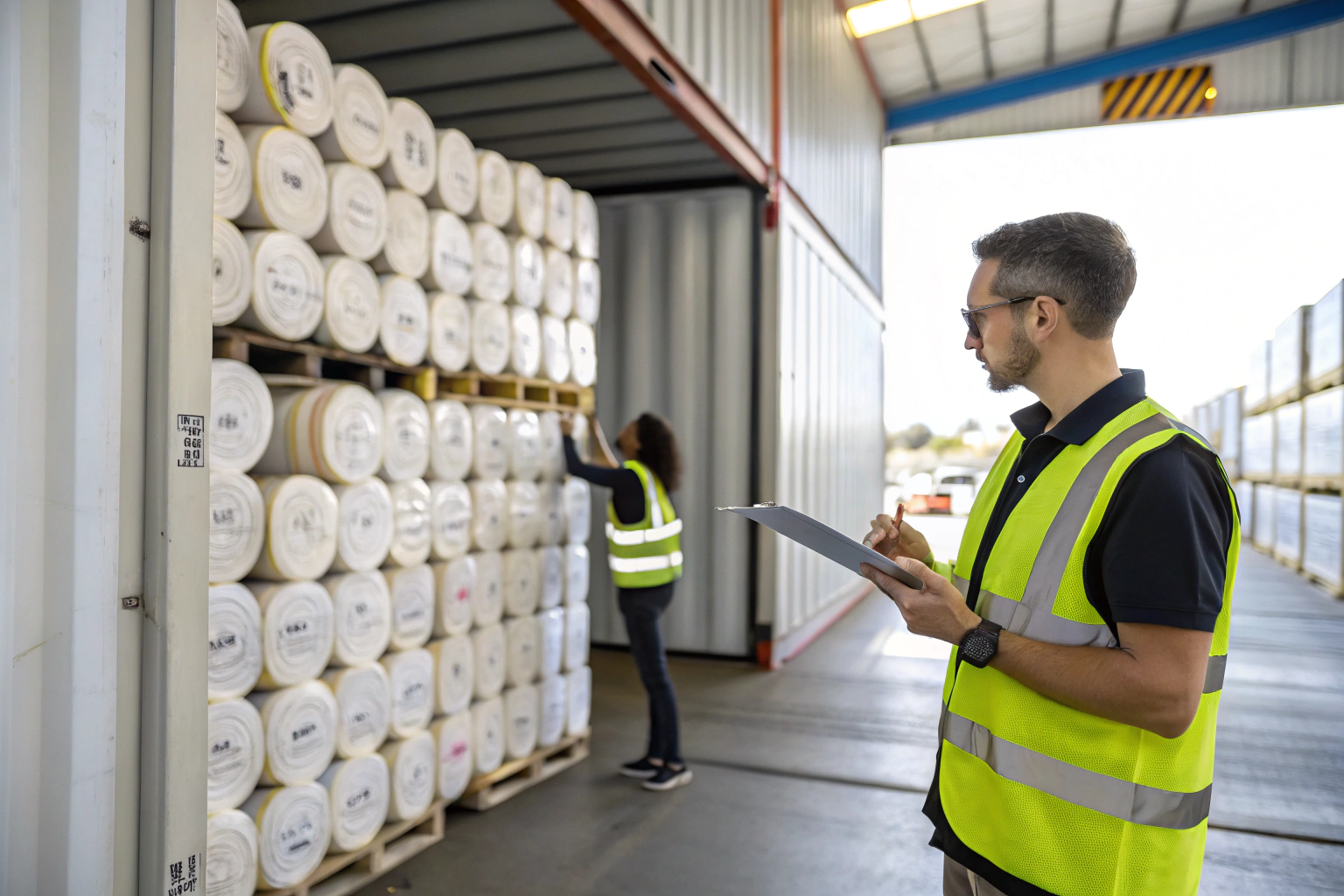
I remember a call I got from a client in Los Angeles about four years ago. He was frantic. A container of woven fabric we had shipped to him was sitting at the Long Beach port. It had been there for three weeks. Customs had flagged it for inspection. The paperwork was incomplete. The fiber content declaration didn’t match the actual composition. The country of origin was mislabeled. The client had a factory waiting for that fabric. His production schedule was shot. He was losing thousands of dollars a day. And the worst part? The fabric itself was perfect. It was the paperwork that failed.
That experience taught me something that has stuck with me ever since: getting your fabric through US customs is not just about the fabric. It’s about the documentation. The US Customs and Border Protection (CBP) doesn’t care how beautiful your jacquard is. They care about whether the paperwork is accurate, whether the duties are paid, and whether the goods comply with US regulations. If the paperwork is wrong, your fabric sits at the port. And time is money.
At Shanghai Fumao, we ship woven fabric to the US every week. We’ve learned the hard way what works and what doesn’t. We’ve had shipments delayed. We’ve had shipments flagged. We’ve had clients call us in a panic. Over the years, we’ve developed a system that ensures our woven fabric passes US customs clearance smoothly. In this article, I’m going to share what we’ve learned—the paperwork, the classifications, the labeling, and the common pitfalls to avoid.
What Paperwork Do You Need for US Customs Clearance?
The paperwork is the backbone of customs clearance. If your paperwork is incomplete or inaccurate, your shipment will be delayed. If it’s fraudulent, your shipment can be seized and you can face fines. The key documents are the commercial invoice, the packing list, the bill of lading, and the entry summary.
What Must Be on the Commercial Invoice?
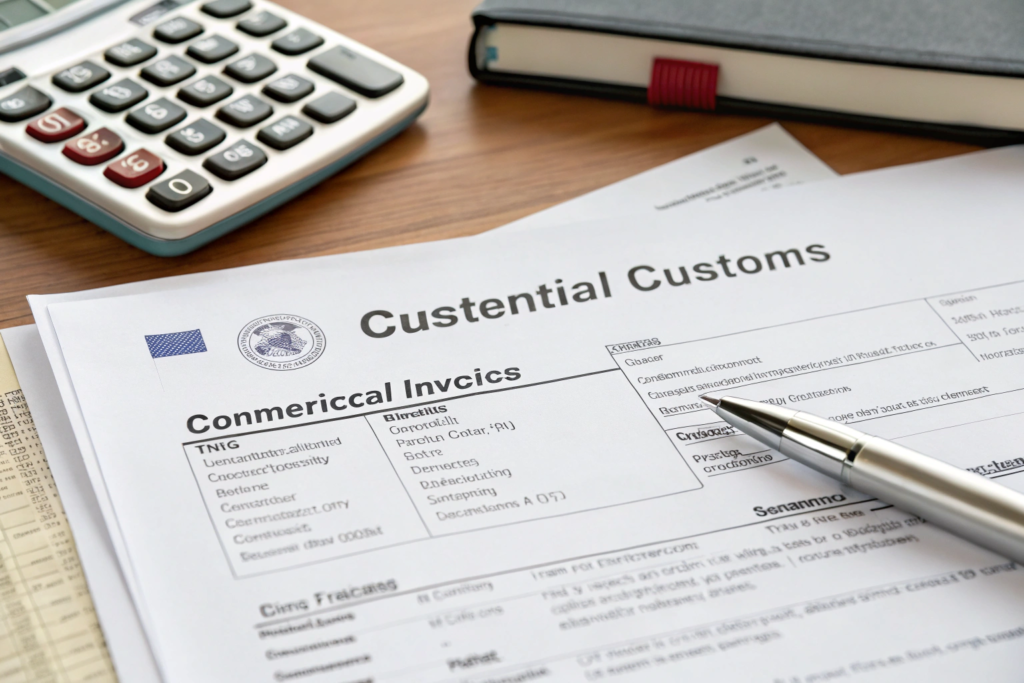
The commercial invoice is the most important document. It tells CBP what the goods are, where they came from, and how much they cost. The information on the invoice must match the information on the packing list and the bill of lading exactly.
The commercial invoice must include the following: the shipper’s name and address, the consignee’s name and address, the importer of record (if different), a detailed description of the goods, the HTSUS classification number, the country of origin, the quantity, the unit value, the total value, the currency, the terms of sale (like FOB or CIF), and the freight and insurance costs if they’re not included.
The detailed description is critical. “Woven fabric” is not enough. CBP wants to know the fiber content, the weave type, the width, the weight, and the finish. For example: “100% cotton woven twill, 58/60 inches width, 280 GSM, dyed, with water-repellent finish.” The more detail, the less likely your shipment will be flagged for review.
I had a client who shipped a container of woven polyester fabric with an invoice that just said “Polyester Fabric.” CBP flagged it. They wanted to know the weave, the weight, the finish. The client didn’t have that information on the invoice. The shipment was delayed for two weeks while we provided additional documentation. Now, we always include a full fabric specification on every invoice. For a detailed guide to commercial invoices for textile imports, this customs resource offers a textile-specific commercial invoice template.
What Is the Difference Between a Packing List and a Bill of Lading?
The packing list details how the goods are packed. It should list each carton or roll, with the quantity, the weight, and the dimensions. If your fabric is on rolls, the packing list should show the roll numbers, the length of each roll, and the net and gross weight. This information helps customs verify that the shipment matches the invoice.
The bill of lading is the contract between the shipper and the carrier. It proves that the goods were loaded onto the vessel. There are two types: a straight bill of lading, which is non-negotiable, and a negotiable bill of lading, which can be transferred. For US imports, you usually need a negotiable bill of lading to take possession of the goods.
The bill of lading must be accurate. If the shipper’s name is misspelled, if the container number is wrong, if the weight is off—these small errors can cause big delays. I’ve seen shipments held up because the bill of lading listed the weight in kilograms but the invoice used pounds, and the numbers didn’t match. Consistency across all documents is critical.
For a guide to bills of lading for textile imports, this logistics resource offers an explanation of BOL requirements.
How Do You Classify Woven Fabric for US Customs?
Classification is the most technical part of customs clearance. Every product imported into the US has a classification number under the Harmonized Tariff Schedule of the United States (HTSUS). That number determines the duty rate. Get it wrong, and you could be overpaying duties or, worse, facing penalties for misclassification.

What Is the HTSUS Classification for Woven Fabric?
Woven fabrics fall under Chapter 50 through 63 of the HTSUS. Chapter 50 covers silk. Chapter 51 covers wool. Chapter 52 covers cotton. Chapter 53 covers other vegetable fibers like linen and hemp. Chapter 54 covers man-made filaments like polyester and nylon. Chapter 55 covers man-made staple fibers. Chapter 58 covers special woven fabrics like terry and chenille. Chapter 59 covers coated and impregnated fabrics. Chapter 60 covers knits (which is a whole separate category).
Within each chapter, the classification gets more specific. For a cotton woven fabric, you need to know the fiber content (100% cotton or a blend), the weave type (twill, satin, plain), the weight (in grams per square meter), the width, and the finish (dyed, printed, bleached, coated). Each of these factors affects the classification number.
For example, a 100% cotton woven twill, weighing 280 GSM, dyed, would typically fall under HTSUS 5209.32.00. The first four digits (5209) indicate woven cotton fabric with 85% or more cotton, weighing more than 200 GSM. The next two digits (.32) indicate twill weave. The final two digits (.00) indicate dyed.
I had a client who was importing a cotton-polyester blend twill. The supplier classified it as 100% cotton because the duty rate was lower. Customs tested the fabric during an inspection. The fiber content was actually 70% cotton, 30% polyester. The classification was wrong. The client was fined and had to pay back duties. Now, we always test fiber content before classification and use a customs broker to verify the number. For a guide to HTSUS classification for textiles, this trade resource offers a textile classification tool.
What Are the Common Classification Mistakes?
The most common mistake is misstating the fiber content. If you declare a fabric as 100% cotton and it’s actually a blend, that’s a problem. CBP tests fabrics. They have labs at the ports. If they test your fabric and find a discrepancy, your shipment will be held, you’ll face fines, and your relationship with CBP will be damaged.
The second common mistake is misstating the country of origin. The country of origin is where the fabric was manufactured. If you’re shipping from China, the country of origin is China. If you’re shipping from China but the yarn came from Vietnam, the country of origin is still China because the fabric was manufactured there. The rules are complex, especially for fabrics with components from multiple countries. CBP has specific rules for determining origin, and they change frequently.
The third common mistake is misstating the value. If you undervalue the fabric to pay lower duties, that’s fraud. CBP can look at market prices and determine if your declared value is reasonable. If they suspect undervaluation, they can hold your shipment and demand proof of the actual transaction value.
I remember a shipment where the supplier had declared the fabric value at $1.50 per meter. The actual market value was $3.00. Customs questioned it. The client had to provide bank statements, contracts, and correspondence to prove that the declared value was accurate. It was a nightmare. Now, we always declare the actual transaction value, and we keep documentation ready in case customs asks. For a detailed guide to common classification errors, this customs compliance resource offers a checklist for textile importers.
What Labeling Requirements Does the US Have for Fabric?
US labeling requirements are strict. The Textile Fiber Products Identification Act (TFPIA) and the Wool Products Labeling Act set rules for how fabric must be labeled. If your fabric is not labeled correctly, CBP can refuse entry. If it’s sold in the US without correct labels, the FTC can fine you.
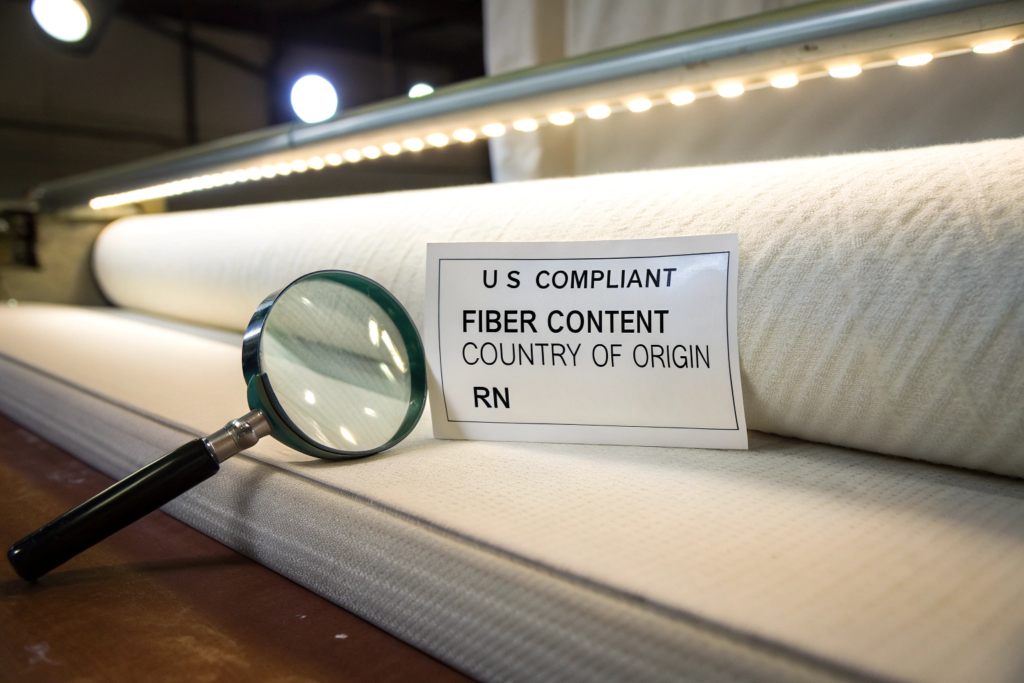
What Must Be on the Label?
The label must include the fiber content, expressed as percentages. “100% Cotton” is acceptable. “Cotton/Polyester” is not. You must list the percentages: “70% Cotton, 30% Polyester.” The fiber names must be the generic names recognized by the FTC. “Tencel” is a brand name; the generic is “Lyocell.” “Lycra” is a brand name; the generic is “Spandex” or “Elastane.”
The label must include the country of origin. “Made in China” is acceptable. “Made in PRC” (People’s Republic of China) is also acceptable. The country of origin must be in English and must be conspicuous.
The label must include the RN number (Registered Identification Number) of the manufacturer or importer. The RN number is issued by the FTC. It identifies who is responsible for the product. If you don’t have an RN number, you can use the name and address of the manufacturer or importer instead.
The label must be attached in a way that it can be read by the consumer. For fabric sold by the roll, the label can be on the roll itself. For garments, the label must be sewn in.
I had a client who imported a container of woven shirting fabric with labels that said “Cotton Fabric.” That was it. No percentage. No country of origin. No RN number. Customs refused entry. The client had to have the entire container relabeled at a warehouse near the port. It cost him $5,000 and two weeks of delay. Now, he always confirms the label specifications before we ship. For a comprehensive guide to US textile labeling, this FTC resource offers the official textile labeling guide.
How Do You Handle Care Labels?
Care labels are required for garments, but they’re not required for fabric sold by the roll. However, if your fabric is intended for garments, it’s a good practice to include care instructions on the roll label or in the documentation. The care label must include washing instructions, drying instructions, and any special care requirements.
The care symbols used in the US are not the same as in Europe or Asia. In the US, the FTC requires care instructions in words, not just symbols. “Machine wash cold, tumble dry low” is acceptable. Just symbols is not.
I had a client who shipped a container of fabric with care symbols only. The fabric was intended for a US brand that would cut and sew it into garments. The brand’s production team had to create new care labels for the finished garments. It wasn’t a huge problem, but it was an extra step. Now, we always include written care instructions on the roll label, even if it’s not strictly required.
For a guide to care labeling in the US, this consumer protection resource offers the FTC care labeling rule.
How Do You Handle Duties and Tariffs for Woven Fabric?
Duties and tariffs are a major concern for anyone importing fabric into the US. The duty rate depends on the HTSUS classification. In recent years, additional tariffs (Section 301 tariffs) have been applied to many Chinese textiles. Understanding these costs upfront is critical to pricing your product correctly.
What Are the Section 301 Tariffs on Chinese Fabric?
The Section 301 tariffs were imposed by the Trump administration and maintained by the Biden administration. They add an additional 7.5% to 25% duty on many Chinese goods, including textiles. The exact rate depends on the HTSUS classification. Some woven fabrics are subject to 7.5% additional duty. Others are subject to 25%. Some are exempt.
The list changes. New exclusions are added. Some exclusions expire. It’s a moving target. If you’re importing woven fabric from China, you need to check the current status of the Section 301 tariffs for your specific HTSUS number.
I had a client who was importing a specific woven polyester fabric with an HTSUS code that was subject to 25% additional duty. He had priced his product based on the standard duty rate. When the fabric arrived, he was hit with a duty bill that was 25% higher than he expected. His margin was wiped out. Now, he always checks the current tariff status before quoting a price.
For the current status of Section 301 tariffs on textiles, this trade resource offers a searchable database of tariff exclusions.
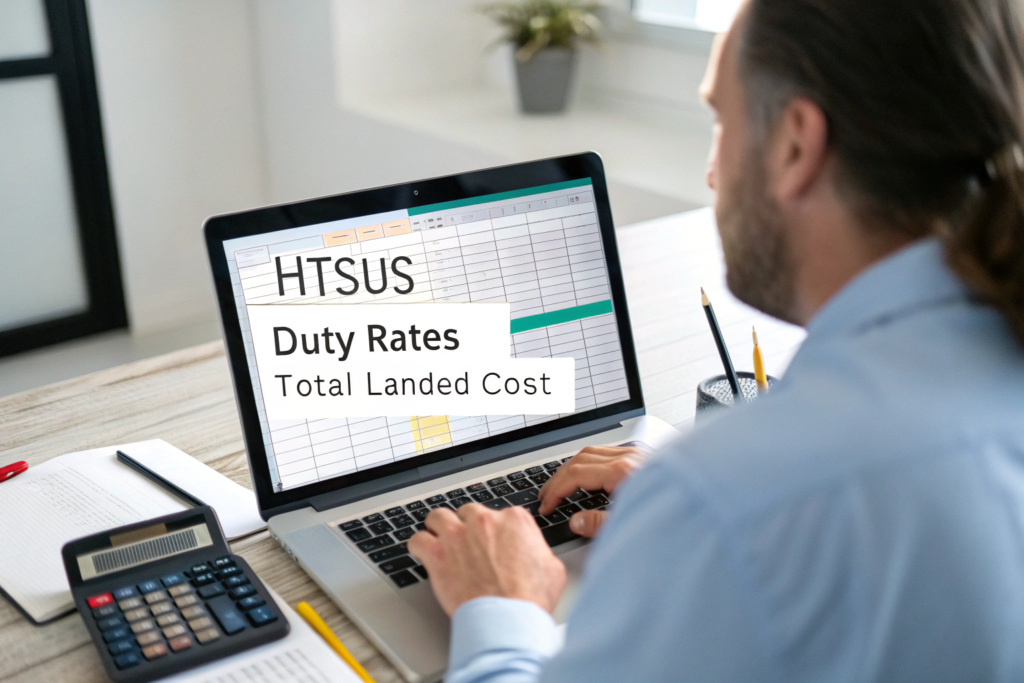
How Do You Calculate Landed Cost?
Landed cost is the total cost of getting your fabric to your warehouse. It includes the cost of the fabric, the freight, the insurance, and the duties. You need to calculate landed cost accurately to price your product correctly.
The formula is: Fabric Cost + Freight + Insurance = Customs Value. Customs Value x Duty Rate = Duties. Customs Value + Duties = Dutiable Value. Dutiable Value + Customs Broker Fees + Inland Freight = Landed Cost.
Many buyers forget to include the freight and insurance in the customs value. That’s a mistake. The duty is calculated on the total cost of the goods, including freight and insurance. If you declare a lower customs value to reduce duties, that’s fraud.
I had a client who calculated his landed cost based on the fabric cost only. He forgot to add the freight and duties. When the fabric arrived, his actual cost was 15% higher than he expected. He had to raise his prices, which hurt his sales. Now, he always calculates landed cost before quoting his customers.
For a guide to landed cost calculation for textile imports, this logistics resource offers a landed cost calculator.
What Are the Common Pitfalls That Cause Customs Delays?
Even with perfect paperwork, things can go wrong. Customs has the right to inspect any shipment. If they choose to inspect yours, you need to be prepared. There are certain things that trigger inspections more often than others.
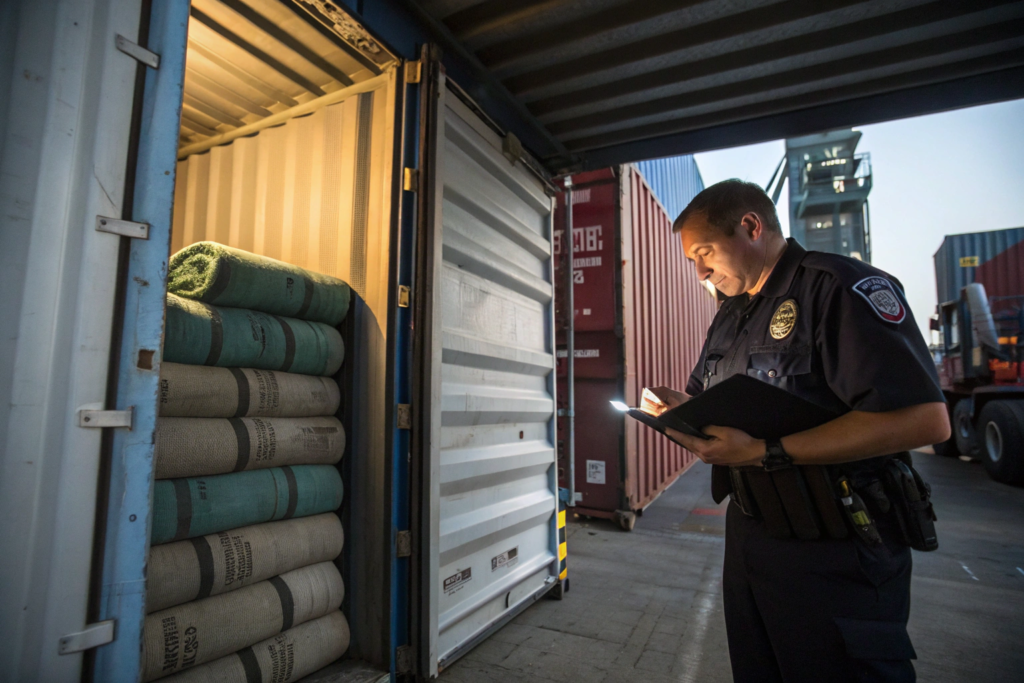
What Triggers a Customs Inspection?
Certain things make customs more likely to inspect your shipment. The first is a high-risk country of origin. Chinese shipments are inspected at a higher rate than shipments from other countries. The second is a new importer. If you’ve never imported before, or if you haven’t imported in a long time, you’re more likely to be inspected. The third is a change in shipper or consignee. If the names on the paperwork change frequently, that’s a red flag.
The fourth is commodity-specific risk. Certain textile categories are considered high-risk for fraud or for quota evasion. If your fabric falls into one of these categories, you’re more likely to be inspected. The fifth is discrepancies in the paperwork. If the invoice says one weight and the packing list says another, that’s a trigger. If the declared value seems too low, that’s a trigger.
I had a client who was importing a woven fabric that fell into a high-risk category. His shipment was inspected three times in a row. Each inspection added two to three weeks of delay. After the third inspection, he changed his classification to a different, lower-risk category that still accurately described his fabric. The inspections stopped.
For a guide to customs inspection triggers, this trade compliance resource offers a list of red flags for textile shipments.
How Do You Prepare for a Customs Inspection?
You can’t prevent an inspection. But you can prepare for it. The best preparation is having your paperwork in order. Keep copies of everything: the commercial invoice, the packing list, the bill of lading, the entry summary, the fiber content test reports, the country of origin declarations, and any other relevant documentation.
If you’re inspected, CBP will ask for documentation. They might also take a sample of your fabric for testing. They’ll test the fiber content, the country of origin, and the classification. If everything matches, the inspection will take a few days. If there are discrepancies, it can take weeks or months.
I had a client who was inspected. CBP asked for fiber content test reports. The client didn’t have them. The fabric was held for three weeks while we sent samples to a lab, got the test results, and submitted them to CBP. Now, we always include fiber content test reports with every shipment. They’re in the packet, ready to go.
For a guide to preparing for a customs inspection, this trade compliance resource offers a checklist for textile importers.
Conclusion
Getting your woven fabric through US customs clearance is not automatic. It requires attention to detail, accurate paperwork, and a clear understanding of the rules. The commercial invoice must be detailed and accurate. The HTSUS classification must be correct. The labeling must comply with FTC rules. The duties must be calculated correctly. And you must be prepared for the possibility of inspection.
The cost of getting it wrong is high. Delays can cost you thousands of dollars. Fines can eat into your margin. Seizures can destroy your business. But the cost of getting it right is relatively low. It takes a little extra time. It takes a little extra attention. It takes a partner who understands the process.
At Shanghai Fumao, we ship woven fabric to the US every week. We have the documentation down to a system. We test fiber content before shipping. We classify carefully. We label correctly. We calculate duties accurately. And we keep all the paperwork ready in case of inspection. We do this because we know that our clients’ success depends on their fabric arriving on time.
If you’re sourcing woven fabric from China, don’t leave customs clearance to chance. Work with a supplier who understands the process. Ask them about their documentation. Ask them about their classification process. Ask them about their labeling. And when your fabric ships, make sure you have everything ready for customs.
Contact our Business Director, Elaine, to discuss your next woven fabric order to the US.
Email: elaine@fumaoclothing.com
Let’s make sure your fabric clears customs without delays.