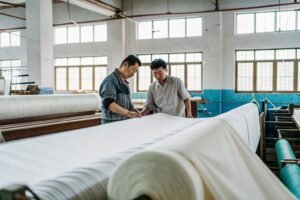
I’ve been in the textile industry for over 20 years, and I’ll tell you something that might surprise you.
The way I source fabric today is completely different from how I sourced it five years ago.
Back in the day, finding fabric was about relationships. You knew a guy who knew a guy. You went to the same Canton Fair booths every year. You called the same mills. You worked with the same agents.
And that still matters. Relationships still matter.
But here’s what’s changed.
The sheer volume of information available today is overwhelming. There are thousands of mills in China alone. Tens of thousands of traders. Millions of fabric listings online. How do you find the best price without spending weeks scrolling through Alibaba pages?
The answer, I’ve discovered, is artificial intelligence.
Now, I’m not a tech guy. I’m a fabric guy. I’ve been running weaving machines and dye houses for two decades. But in the last two years, I’ve watched AI tools completely transform how we source raw materials, how we price our products, and how we help our clients find the best deals.
Let me share what I’ve learned. I’ll show you the tools we’re using, the strategies that work, and how you can use AI to find better fabric prices without sacrificing quality.
What AI Tools Actually Work for Fabric Sourcing?
I’m going to be honest with you. Not every AI tool is worth your time.
I’ve tested dozens of platforms over the last two years. Some are gimmicks. Some are genuinely useful. Let me tell you about the ones we actually use in our business.

How Can Visual Search Tools Help Me Find Fabric Faster?
This is the AI tool that surprised me the most.
You know the problem. You see a fabric you like—maybe at a trade show, maybe on a competitor’s garment, maybe in a photo online. You want to find a source for that exact fabric. But you don’t know what it’s called. You don’t know the fiber content. You don’t know where to start looking.
Visual search AI solves this.
We’ve been using a platform called Pinterest Lens for fabric research. It’s free. You take a photo of a fabric, and it finds visually similar fabrics across the platform. You can see what mills are producing similar textures, similar weaves, similar colors.
But for sourcing, I’ve found that Alibaba’s image search is even more powerful. You upload a photo of a fabric, and Alibaba’s AI shows you listings from suppliers with similar fabrics.
In 2024, a client from Australia sent me a photo of a fabric they’d seen at a trade show in Milan. It was a textured woven with a subtle herringbone pattern. They didn’t know the composition or the mill. They just had the photo.
I uploaded it to Alibaba’s image search. Within 30 seconds, I had 15 supplier listings with visually similar fabrics. I cross-referenced the listings with supplier credentials, order history, and customer reviews. Within an hour, I had three potential sources.
We ordered samples from two of them. One was perfect. The client placed a 50,000-meter order.
Without visual search AI, that process would have taken weeks. I would have had to describe the fabric to contacts across Keqiao, wait for them to send samples, and hope someone had something close.
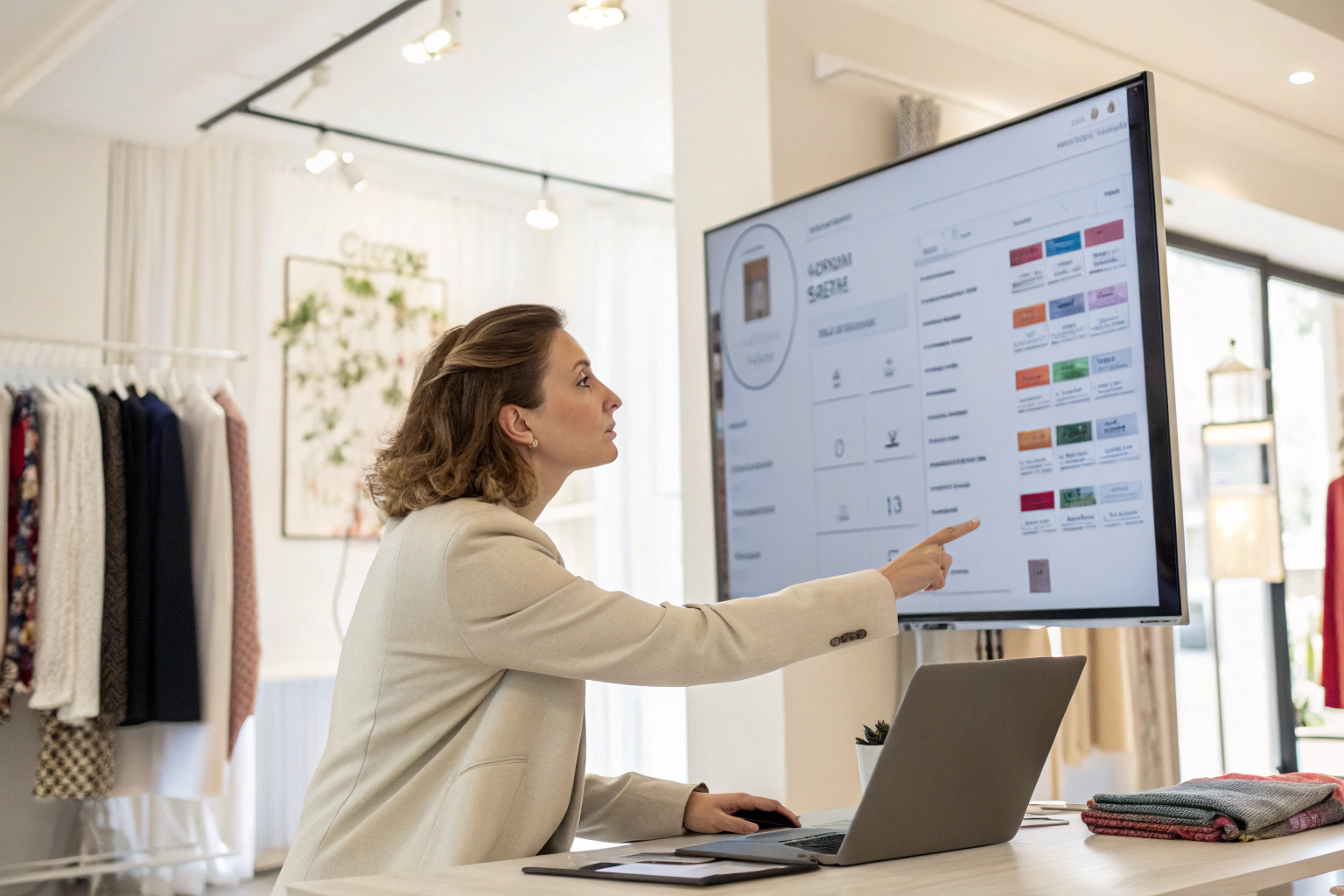
Now, there’s a dedicated platform called Zhaoyang AI Sourcing that’s gaining traction in China. It’s a B2B textile search engine that uses AI to match buyer requests with supplier capabilities. You type in what you need—"70 denier nylon ripstop, PFAS-free DWR, 20,000mm hydrostatic head"—and it returns a ranked list of suppliers who can actually produce it.
We’ve been using it for raw material sourcing for our own weaving factory. It’s cut our raw material search time by about 70%.
Can AI Really Negotiate Better Prices for Me?
This is where things get interesting.
There’s a platform called TexPro that we use for price intelligence. It aggregates pricing data from textile transactions across Asia. You can see what mills in China, Vietnam, and Bangladesh are actually charging for similar fabrics.
Here’s how we use it.
When a client asks us for a price on a specific fabric, we don’t just pull a number out of our head. We check TexPro to see what the market rate is for that construction, that fiber content, that volume. If our internal cost is higher than the market average, we go back to our raw material suppliers and negotiate.
In 2023, we were quoting a cotton-spandex jersey for a European brand. Our initial price was $3.20 per meter. TexPro showed that comparable fabrics were trading at $2.90-$3.00.
We went back to our yarn supplier. We renegotiated our cotton price based on market data. We adjusted our weaving schedule to use a more efficient machine configuration. We got our cost down to $2.85.
We quoted the client at $2.95. We won the order. And we made a healthy margin because we knew what the market would bear.
Now, there are AI negotiation tools emerging. Pactum is one—it’s an AI chatbot that negotiates with suppliers on your behalf. You set your parameters—target price, payment terms, delivery timeline—and the AI negotiates with suppliers who are also using the platform.
I haven’t used it personally, but I have a client in Germany who swears by it. He told me the AI negotiated a 12% price reduction on a large polyester order that his human buyers couldn’t get. The AI was able to have hundreds of negotiation conversations simultaneously and found a supplier willing to meet his terms.
How Do I Use AI to Compare Fabric Quality Across Suppliers?
Price is one thing. Quality is another.
And this is where AI is becoming incredibly powerful. Because the best deal isn’t the lowest price. It’s the best value. And value is about quality relative to price.

How Can I Use AI to Analyze Supplier Test Reports?
This is something we’ve started doing for our clients.
When a client is choosing between multiple fabric suppliers, they often receive test reports from each one. But comparing those reports is tedious. One supplier uses AATCC standards, another uses ISO. One reports shrinkage as a percentage, another reports in millimeters.
We now use AI tools to normalize this data.
We upload all the test reports into a system that converts everything to the same standards. The AI flags discrepancies. It highlights where one supplier’s fabric outperforms another on key metrics.
In 2024, a US-based outdoor brand was choosing between three suppliers for a waterproof breathable fabric. One supplier was 15% cheaper than the others. On paper, it looked like the best deal.
We ran the AI analysis on their test reports. The cheaper supplier’s fabric had a hydrostatic head of only 12,000mm compared to 20,000mm for the others. The tear strength was 30% lower. The colorfastness to light was a full grade lower.
The cheaper fabric wasn’t a deal. It was a liability. The brand would have faced warranty claims and returns.
They chose the mid-priced supplier. The fabric cost more upfront, but the total cost of quality was lower.
There’s a platform called QIMA that offers AI-powered quality analysis. They analyze your supply chain data and predict which suppliers are most likely to have quality issues. It’s not cheap, but for large brands, it’s invaluable.
What Is Predictive Quality Analytics and How Does It Help Me?
This is the next frontier.
Instead of just telling you what happened in the past, predictive AI tells you what’s likely to happen in the future.
We’ve been piloting a system that analyzes our production data—yarn quality, machine settings, dye batch records—and predicts which fabric batches are most likely to have shrinkage issues or color variations.
For our clients, this means we can flag potential problems before the fabric even ships.
In 2023, this system flagged a batch of cotton-spandex jersey that had a 15% probability of excessive shrinkage based on the yarn tension data from our knitting machines. We ran extra tests. The tests confirmed the prediction. We adjusted the knitting parameters and re-ran the batch.
That batch would have shipped to a client in Canada. If it had gone out, they would have cut 10,000 meters, sewn garments, and discovered the shrinkage issue after washing. The cost would have been catastrophic.
Instead, we caught it. The client never knew there was a problem. That’s what good AI does—it prevents problems before they become your problems.
How Can I Use AI to Predict Market Trends and Time My Purchases?
Fabric prices move. And if you’re importing from China, you need to know when to buy.
Cotton prices can swing 30% in a year. Polyester prices follow oil. Shipping costs are volatile. If you time your purchases wrong, you can lose your margin before you’ve even cut the first garment.

How Do AI Price Forecasting Tools Work?
We use a platform called Cotton Incorporated’s market intelligence for cotton price forecasting. It uses AI to analyze global supply and demand data, weather patterns, currency fluctuations, and geopolitical events.
In early 2024, the AI predicted a cotton price increase of 15% in the second quarter due to drought conditions in major growing regions in India and the US.
We saw this forecast in January. We advised our clients to place their cotton fabric orders early. Those who listened locked in their prices in February. Those who waited paid 12-15% more by April.
For synthetic fibers, we use Platts for petrochemical price data. The AI models there are incredibly sophisticated. They track refinery utilization rates, crude oil inventories, and demand forecasts.
A client from New York learned this the hard way in 2022. They were sourcing polyester fabrics. They waited to place their order, expecting prices to drop. Instead, oil prices spiked due to geopolitical tensions. The fabric price increased by 25% between their initial inquiry and their order placement.
They still placed the order. They had to. Their retail deadlines were fixed. But their margin disappeared.
Now they work with us on a forecasting schedule. We share our AI-generated price forecasts with them quarterly. They plan their purchases based on the predicted price movements.
Can AI Help Me Manage Inventory to Avoid Rush Orders?
This is a problem I see constantly.
A brand waits too long to order fabric. Then they need it in four weeks instead of eight. They pay for air freight. They pay for expedited production. Their cost per meter jumps by 30-40%.
AI inventory forecasting can prevent this.
Tools like ThroughPut AI analyze your sales data, lead times, and production schedules. They predict when you’ll run out of fabric and recommend when to place orders.
One of our clients—a European activewear brand—uses this system. The AI analyzes their sales velocity, their current inventory, and our lead times. When inventory drops below a threshold, the system automatically generates a purchase order and sends it to us.
We’ve been working with them for three years. They’ve never had a stockout. They’ve never had to pay for air freight. Their fabric cost per unit is 20% lower than their competitors because they always order at the optimal time.
The AI paid for itself in the first year just from freight savings alone.
What’s the Future of AI in Fabric Sourcing?
I’ve been in this industry long enough to see trends come and go.
But AI isn’t a trend. It’s a fundamental shift in how sourcing works.

Will AI Replace Human Sourcing Professionals?
This is the question everyone asks me.
And my answer is no. Not completely.
AI can find suppliers. AI can compare prices. AI can analyze quality data. AI can predict market trends.
But AI can’t build relationships. AI can’t walk a factory floor and spot a problem that isn’t in the data. AI can’t negotiate a payment extension when your cash flow is tight. AI can’t visit a mill and see that the new machine they just installed is going to double their capacity and lower their prices.
I’ve been doing this for 20 years. The relationships I’ve built matter. When a client needs fabric in three weeks instead of eight, I can make calls that an AI can’t make.
The future, I believe, is human expertise augmented by AI intelligence.
The best sourcing professionals will use AI to handle the data—the searching, the comparing, the forecasting. And they’ll use their human skills for what AI can’t do: building trust, solving problems, and navigating the complexity of global supply chains.
How Should I Start Using AI in My Sourcing Process?
If you’re new to AI, don’t try to do everything at once.
Start with one tool. Learn it. Use it. See what it does for your business.
Here’s what I recommend:
If you’re a small brand, start with Alibaba’s image search and their supplier verification tools. It’s free. It’s accessible. It will help you find suppliers and verify their credentials faster.
If you’re a growing brand, invest in a price intelligence tool like TexPro. Understanding market rates will help you negotiate better prices and avoid overpaying.
If you’re a large brand, look at predictive analytics tools for quality and inventory management. The upfront cost is higher, but the savings in prevented quality issues and avoided rush orders will more than pay for it.
At Shanghai Fumao, we’re investing heavily in AI tools for our own operations. We use AI for raw material sourcing, production planning, quality prediction, and market intelligence. And we’re sharing that intelligence with our clients.
Because the best fabric deal isn’t just about price. It’s about getting the right quality, at the right time, at the right price. And AI helps us deliver all three.
Conclusion
I’ve been in the textile industry for over two decades. I’ve seen the shift from fax machines to email, from trade show directories to Alibaba, from phone calls to WeChat.
AI is the next shift. And it’s happening now.
The tools I’ve described today—visual search, price intelligence, predictive quality analytics, inventory forecasting—are not science fiction. They’re available today. They’re being used by smart brands to find better fabric deals, reduce risk, and protect their margins.
But here’s what I want you to remember.
AI is a tool. It’s not a replacement for good judgment. The best deals come from combining AI’s data-processing power with human experience and relationships.
At Shanghai Fumao, we use AI to work smarter. We use it to find better raw materials, to optimize our production, to predict market movements. And we use that intelligence to help our clients get better deals.
But we also have 20 years of experience. We have relationships with mills across China and Southeast Asia. We have a CNAS-accredited lab that tests every batch. We have a team of professionals who speak your language and understand your business.
That combination—AI intelligence plus human expertise—is what delivers real value.
If you’re ready to start using AI to find better fabric deals, I invite you to reach out. Let’s talk about your sourcing needs. Let me show you how we use AI to find the best quality at the best price.
Because the best deal isn’t the one you find by scrolling through Alibaba listings for hours. It’s the one you find by combining the best technology with the best people.
Ready to source smarter? Contact our Business Director, Elaine, directly at elaine@fumaoclothing.com. She’ll walk you through how we use AI to find the best fabric deals for our clients and how we can do the same for you.