I remember the first time I tried to find a supplier on Alibaba, back when the platform was still new. I typed "fabric supplier" and got 10,000 results. Ten thousand. Most were traders with no factory, some were scams, and a few were legitimate manufacturers. Finding the real ones felt like finding needles in a haystack. Today, the platform is more sophisticated, but the challenge remains: how do you separate reliable suppliers from the rest?
Here’s the truth about Alibaba in 2026: it’s a powerful tool for finding suppliers, but it’s also a platform where anyone can look legitimate. The badges, the reviews, the fancy websites—these can all be manufactured. Real reliability comes from digging deeper, asking the right questions, and verifying what you’re told.
Let me walk you through exactly how to find reliable fabric suppliers on Alibaba. I’ll share what the platform’s signals really mean, what questions to ask, and how to verify before you commit.
What Do Alibaba’s Supplier Badges Actually Mean?
Alibaba uses various badges and indicators to help buyers evaluate suppliers. Understanding what these actually mean—and their limitations—is essential.
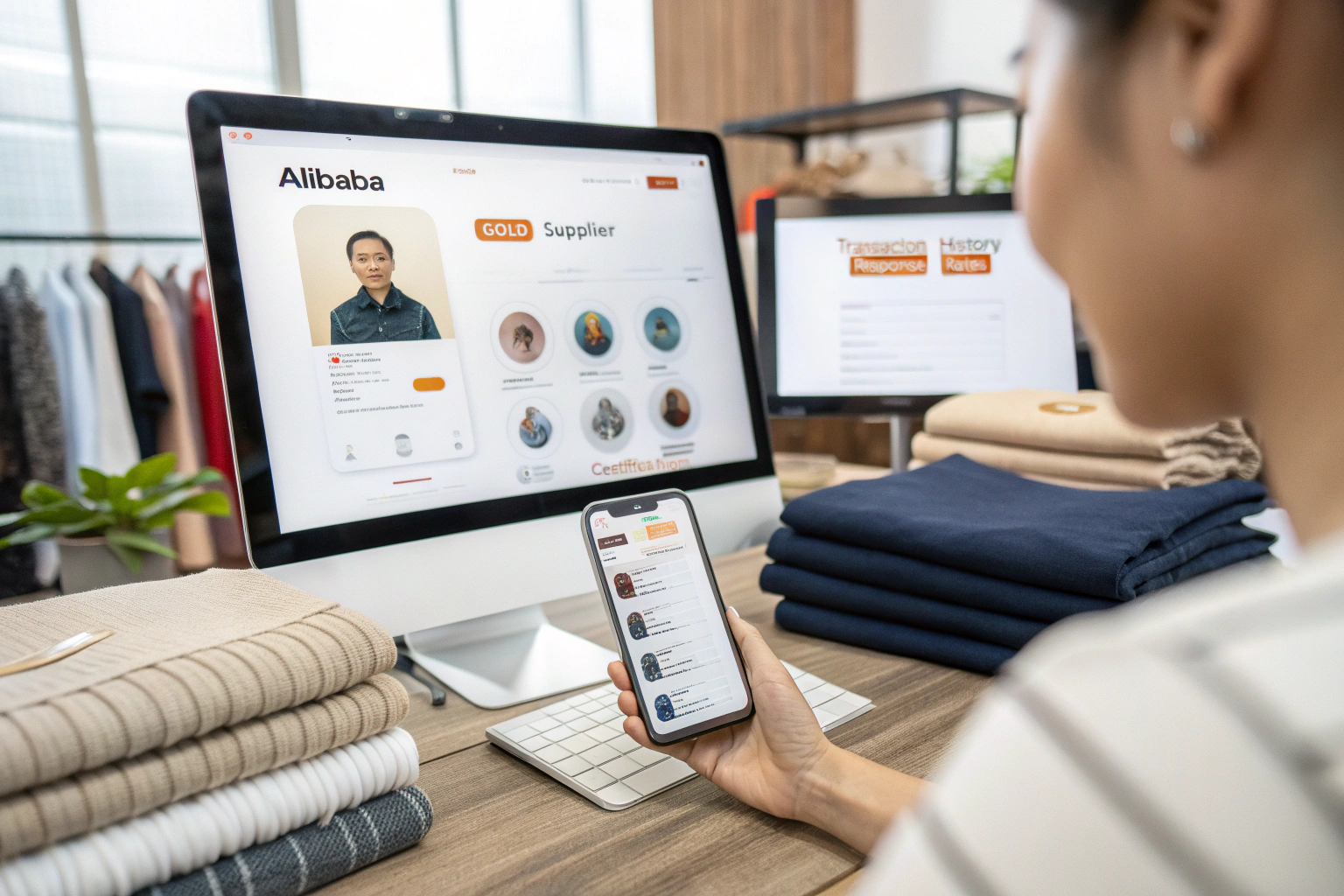
Gold Supplier status means the supplier has paid for a membership and been verified by a third-party company. The verification confirms that the business exists at the claimed address and has been operating for at least a year. It does NOT verify quality, reliability, or that they’re actually a manufacturer. It’s a baseline, not a guarantee.
The years shown (e.g., "Gold Supplier 8 Years") indicate how long they’ve maintained paid membership. Longer is generally better—it’s expensive to maintain membership, so it suggests ongoing business. But some excellent suppliers are new, and some long-term suppliers are still unreliable.
Verified Supplier is a higher level of verification, including an on-site audit of facilities. This is more meaningful than basic Gold status. The audit report is usually available to view—download it and read it. Look for notes about equipment, capacity, and any findings.
Transaction Level (the star ratings) shows order volume through Alibaba. Higher levels indicate more transactions. This is useful but can be gamed—some suppliers create fake transactions. Look at the combination of level and years.
Response Rate shows how quickly they reply to inquiries. High response rates (95%+) suggest active, professional sales operations. Low response rates may indicate they’re overwhelmed or not serious.
A German buyer once told me she only considers suppliers with Verified status and at least 3 years Gold membership. This filter eliminates most low-quality options while still leaving enough choices.

How Reliable Are Supplier Reviews on Alibaba?
Reviews can be helpful but must be interpreted carefully.
Read recent reviews first. A supplier with great reviews from 2022 but nothing recent may have changed ownership or quality. Look for patterns in the last 6-12 months.
Read negative reviews carefully. One negative review among hundreds might be an outlier. Multiple negatives mentioning the same issue (late delivery, poor quality, bad communication) indicate a pattern.
Look for detailed reviews. "Great supplier, will order again" tells you little. "Quality matched samples, shipped on time, good communication" is more meaningful. Detailed reviews are harder to fake.
Consider the reviewer’s history. Some suppliers create fake reviews from accounts with no other activity. If a reviewer has only reviewed this supplier, be suspicious.
Check if the supplier responds to reviews. Professional suppliers address negative feedback constructively. Defensive or angry responses are red flags.
A US buyer was almost fooled by a supplier with dozens of 5-star reviews. Then she noticed all reviews were from accounts created the same week. The reviews were fake. She avoided a costly mistake.
What’s the Difference Between Manufacturers and Trading Companies?
This distinction matters enormously for fabric sourcing.
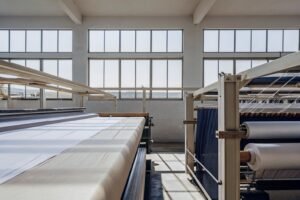
Manufacturers own and operate factories. They control production, quality, and timelines. They can often offer better prices and more flexibility. They’re usually the best choice for serious buyers.
Trading companies buy from multiple factories and resell. They can offer a wider range of products and may handle logistics better. Some are excellent partners. But they add a layer between you and production, which can complicate quality control and communication.
On Alibaba, many trading companies present themselves as manufacturers. Look for clues:
- Do they have photos of a factory? Reverse image search to verify
- Do they claim multiple unrelated products? A real fabric mill won’t also sell electronics
- Can they answer detailed technical questions about production?
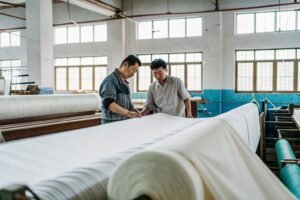
- Will they arrange a video call showing the factory floor?
A reliable trading company is honest about their role. They’ll say "we work with several mills" rather than pretending to be something they’re not. Both manufacturers and traders can be good partners—the key is knowing which you’re dealing with.
A French brand works with both: manufacturers for their core fabrics, a trusted trading company for small quantities of specialty items where minimums would be too high otherwise.
What Questions Should You Ask Shortlisted Suppliers?
Once you’ve identified potential suppliers, your questions will separate the serious from the unserious.
"Are you a manufacturer or trading company?" Ask directly. A legitimate manufacturer will answer proudly. A trading company may hedge. Either is acceptable, but you need to know.
"Can you show me your factory on a video call?" This is the single best verification step. A real factory can show you machines, workers, materials. A trader cannot. If they refuse or make excuses, move on.
"What’s your minimum order quantity?" For fabric, MOQs typically range from 500-3,000 yards per color. Vague answers suggest inexperience. Specific numbers indicate they know their production.
"What’s your typical lead time?" Fabric production takes 30-60 days typically. Add shipping. If they quote 10 days for woven fabric from scratch, they’re lying or misrepresenting.
"Can you provide samples before order?" Reliable suppliers will send samples. They may charge for samples and shipping, which is reasonable. Free samples with free shipping can indicate desperation.
"What certifications do you have?" For fabric, relevant certifications include OEKO-TEX, GOTS, GRS, ISO. Ask for certificates and verify them.
A Swedish brand sends a 20-question qualification survey to every potential supplier. The ones who answer thoroughly and honestly get samples requests. The ones who give vague answers get deleted.

What Technical Questions Reveal Real Expertise?
Fabric sourcing requires technical knowledge. Ask questions that test it.
"What yarn count do you recommend for this weight?" A knowledgeable supplier can discuss yarn selection. A generalist will guess.
"How do you control for shrinkage?" Look for answers about compacting, sanforizing, or specific finishing processes. Vague "we have quality control" is insufficient.
"What’s your process for color matching?" Serious suppliers discuss lab dips, spectrophotometers, and multiple rounds. Amateurs say "we match your sample."
"How do you handle barre in knitting?" This specific question reveals knit expertise. A real knit specialist knows about tension control, yarn quality, and inspection.
"What’s your typical AQL for fabric inspection?" 2.5 for major defects is standard. If they don’t know what AQL means, they’re not professional.
A Japanese buyer asks every potential supplier to explain their quality control process in writing. The responses immediately separate professionals from amateurs.
How Do You Verify Samples Are Representative?
Samples can be misleading if they’re specially prepared.
Ask for samples from current production, not specially made for you. A supplier who’s running similar fabric can send a piece from that run. This represents what you’ll actually get.
Order multiple samples. If you’re considering several colors or weights, sample them all. Consistency across samples indicates reliable production.
Test samples thoroughly. Wash them, measure shrinkage, check colorfastness. A sample that looks good but fails simple tests saves you from a bad bulk order.
Compare samples to specifications. Measure weight, width, hand feel. Document any discrepancies.
Consider a small trial order before committing to large volume. A 500-yard order tests the supplier’s production, quality, and delivery without risking your whole season.
A Canadian brand ordered samples from three shortlisted suppliers. Two sent beautiful samples that matched specifications. One sent samples that looked good but failed shrinkage tests. They eliminated that supplier before placing a $50,000 order that would have been a disaster.
What Red Flags Should Eliminate a Supplier?
Experience teaches you to spot problems before they become disasters.
Vague answers to specific questions. "We have good quality" instead of explaining processes. "Prices depend on order" instead of giving ranges. Evasion hides lack of knowledge or intention.
Refusal of video calls. In 2026, every legitimate business can do video calls. Refusal means they’re hiding something—probably that they’re not a factory.
Pressure to pay quickly. "Special price expires tomorrow" is a classic scam tactic. Legitimate suppliers quote valid prices for reasonable periods.
Samples that don’t match specifications. If the sample weight is wrong, bulk will be wrong. If color is off, production will be off. Samples reveal capability.
Certificates that don’t verify. Always check certificate numbers with issuing bodies. Fake certificates are common.
Communication that disappears after samples. If they’re responsive before sample order and silent after, they may have sent something they can’t produce consistently.
Extremely low prices. If it seems too good to be true, it probably is. Quality fabric costs what it costs.
A Dutch buyer once had a supplier quote 40% below market. They sent beautiful samples. But the supplier refused video calls and couldn’t answer technical questions. The buyer walked away. Six months later, that "supplier" was exposed as a scam.

What Payment Terms Are Reasonable vs Risky?
Payment terms reveal confidence and capability.
30% deposit, 70% before shipment is standard for first orders. This is reasonable and protects both sides. Anything demanding full payment upfront is high risk.
Letters of credit offer strong protection but add complexity. For large first orders, L/C is worth considering.
Alibaba Trade Assurance provides platform-mediated protection. Use it for orders within Alibaba’s system. It’s not perfect but better than direct wire transfers.
Payment to personal accounts is always a red flag. Business payments should go to business accounts in the supplier’s country.
Requests to change payment details after order is a common scam. If you receive "updated bank details" by email, verify by phone before sending money.
A US client once had a supplier’s email hacked. The hacker sent "updated" bank details just before payment. A verification call to the supplier’s known number revealed the fraud. They saved $45,000.
How Do You Verify a Supplier’s Physical Existence?
Beyond video calls, other verification methods exist.
Reverse image search factory photos. If the same photos appear on multiple supplier websites, they’re stock images, not real factories.
Check business license. Chinese companies have registrations you can verify through services like Qianzhan or through Alibaba’s verification reports.
Use Google Earth. If they give you an address, look it up. Does a factory actually exist there? Street view may show the building.
Ask for local references. A supplier with real customers can connect you with them. Verify independently.
Consider third-party verification services. Companies like SGS or QIMA will visit and audit suppliers for a fee. For large orders, this is money well spent.
A German brand paid $500 for a third-party audit of a potential supplier. The audit revealed the "factory" was a small office with no production equipment—a trading company posing as a mill. The $500 saved them from a much larger loss.
How Do You Build Long-Term Relationships with Alibaba Suppliers?
The goal isn’t just to find a supplier—it’s to build a partnership that lasts.
Start with clear communication. Set expectations early about quality, timelines, and communication frequency. Good relationships begin with clarity.
Pay promptly. Nothing builds trust like reliability. Suppliers prioritize clients who pay on time.
Visit when possible. There’s no substitute for face-to-face meetings. Even one visit builds connection that emails never can.
Give feedback, both positive and negative. Good suppliers want to improve. Tell them what works and what doesn’t.
Be reasonable during problems. Every relationship faces challenges. How you handle them determines whether the relationship strengthens or ends.
Grow together. As your needs increase, give trusted suppliers the opportunity to grow with you. Loyalty is rewarded.
A UK brand has worked with the same Alibaba-found supplier for 12 years. They started with 500-yard orders; now they order container loads. The relationship survived quality issues, shipping delays, and market changes because both sides committed to making it work.

How Do You Transition from Alibaba to Direct Relationship?
Alibaba is a meeting place, not a long-term home.
After successful orders, suggest moving communication off-platform. WeChat is the standard in China. Exchange WeChat contacts and continue there.
Negotiate terms directly. Without Alibaba’s fees, suppliers may offer better pricing. But remember that Alibaba’s protections also disappear.
Maintain professionalism. Off-platform doesn’t mean informal. Keep clear records, confirm orders in writing, maintain standards.
Visit when possible. An in-person visit cements the relationship and verifies everything you’ve learned.
Consider exclusivity as relationship deepens. For your core fabrics, you may want exclusive arrangements with trusted suppliers.
A French brand now works exclusively with three suppliers they found on Alibaba years ago. They visit annually, communicate weekly on WeChat, and have developed fabrics together. The platform was just the introduction.
What Tools Help Manage Ongoing Supplier Relationships?
Technology supports long-term partnerships.
WeChat is essential. Groups with sales, production, and quality contacts keep everyone informed. Voice and video calls build connection.
Shared document systems (Google Docs, shared folders) keep specifications, orders, and communications organized and accessible.
Translation apps help bridge language gaps. WeChat’s built-in translation works for basic communication. For technical discussions, consider professional translators.
Project management tools (Trello, Asana) can track orders through production stages. Both sides see status in real time.
Regular review meetings (quarterly video calls) keep relationships healthy. Discuss what’s working, what’s not, and future plans.
A Swedish brand has a shared Google Sheet with each supplier showing upcoming orders, current production status, and shipped orders. Both sides update it, eliminating "where’s my order" emails.
Conclusion
Finding reliable fabric suppliers on Alibaba in 2026 requires a systematic approach, not luck. The platform provides tools, but you must use them wisely.
The key steps:
- Understand what badges really mean (baseline, not guarantee)
- Read reviews critically, looking for patterns
- Distinguish manufacturers from trading companies
- Ask detailed questions that reveal expertise
- Verify through video calls, samples, and third-party checks
- Watch for red flags: vagueness, pressure, evasion
- Start small, test thoroughly, grow carefully
- Build relationships that last beyond the platform
The suppliers worth finding are those who answer questions thoroughly, show their facilities willingly, provide representative samples, and communicate professionally. They’re not always the cheapest or the flashiest—but they’re the ones who deliver.
At Shanghai Fumao, we’ve been on Alibaba for over 15 years. Our profile shows our history, our certifications, our transaction record. But more importantly, we respond to inquiries with real information, we show our factory on video calls, we send samples that represent our production, and we deliver what we promise.
We’re not the only reliable supplier on Alibaba, but we’re proof that they exist. The process of finding us—asking questions, verifying, testing—is exactly what we recommend to every buyer.
Whether you find us on Alibaba or elsewhere, we’re here to help you succeed.
Contact our Business Director, Elaine, today to discuss your fabric needs. She and her team will answer your questions thoroughly, arrange video calls, send representative samples, and build the kind of relationship that lasts. Email her directly at: elaine@fumaoclothing.com. Let’s start a conversation that leads to partnership.