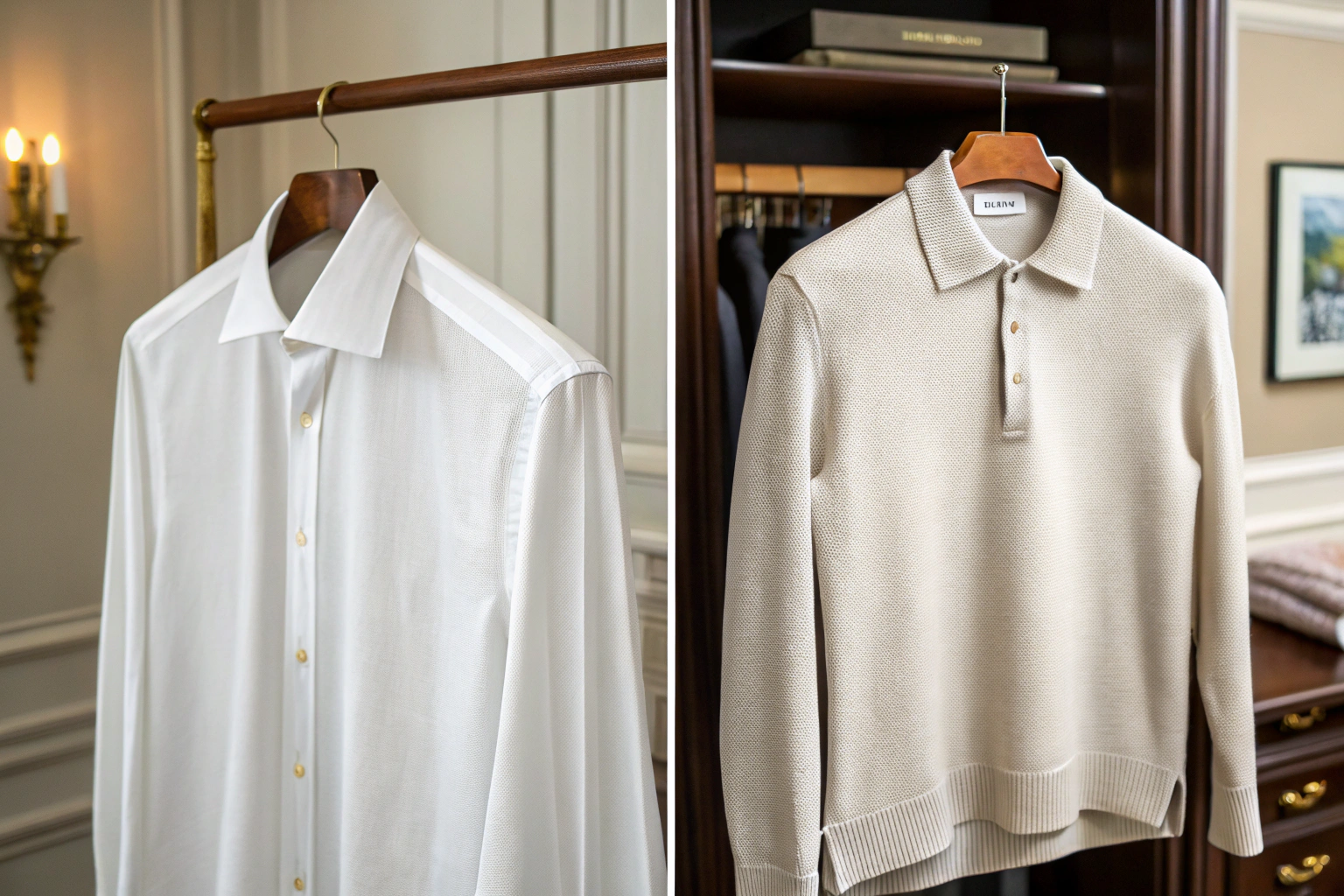
I’ve been in this industry long enough to remember when this question would have seemed ridiculous. A "knitted shirt" for men meant one thing: a polo shirt for casual Fridays. Woven fabrics were for real shirts—the kind with collars that stay crisp, cuffs that button, and fronts that hold a crease. But the world has changed. Today, some of the most luxurious men’s shirts on the market are knitted, and they’re competing directly with traditional wovens for the attention of discerning customers.
Here’s the nuanced answer: for traditional high-end men’s shirts—the kind you wear with a suit or for formal occasions—woven fabrics remain the undisputed choice. The structure, crispness, and formal appearance of fine poplin, twill, or oxford cloth simply can’t be replicated in a knit. But for luxury casual shirts, premium knitted fabrics offer comfort, texture, and a modern aesthetic that many customers now prefer over traditional wovens.
Let me walk you through the complete picture of high-end men’s shirts, from classic formal wear to contemporary luxury casual. I’ll share what we’ve learned supplying fabrics to premium shirt makers in Italy, Japan, and the US, and help you understand which construction serves which purpose.
What Makes Woven Fabrics the Traditional Choice for Dress Shirts?
For over a century, the high-end men’s dress shirt has been defined by woven fabric. This isn’t tradition for tradition’s sake—woven construction delivers specific qualities that formal shirts require.
Structure and stability are essential. A dress shirt collar must stand up, not flop over. Cuffs must hold their shape around a wrist. The front placket must lie flat and straight. Woven fabrics provide this structure naturally. The interlaced yarns create dimensional stability that knits can’t match. Even the finest knit will have some give; a woven dress shirt has none where it shouldn’t.
Crispness is part of the aesthetic. A freshly ironed woven shirt has a clean, sharp appearance that signals formality and attention to detail. The fabric holds a crease where desired—along pleats, at seams—and presents a smooth, uniform surface. This crispness is intrinsic to woven construction, not just a result of ironing.
Drape and silhouette control matters for fit. Woven fabrics can be engineered to drape in specific ways—soft for a relaxed fit, firm for a tailored silhouette. The shirt’s shape comes from the fabric as much as the cutting. Wovens give designers predictable control over how the garment will hang on the body.
A Neapolitan shirtmaker once explained to me why they use only woven fabrics: "A shirt should frame the face and complement the jacket. It needs its own architecture, not just fabric that follows the body’s movements." That architecture comes from woven construction.

How Does Fabric Weight Affect Dress Shirt Formality?
Weight is a critical factor in dress shirt perception and performance.
Lightweight wovens (100-120 GSM, or 2.5-3.5 oz) create the most formal, luxurious shirts. These fine fabrics—often called "sea island" or "Egyptian" cotton—have an almost silky hand and a subtle luster. They’re associated with high-end tailoring and warm-weather formality. The trade-off is durability; lightweight wovens show wear sooner and require careful laundering.
Mid-weight wovens (120-150 GSM, 3.5-4.5 oz) are the workhorses of the dress shirt world. Poplin, broadcloth, and pinpoint oxford at this weight offer the right balance of structure, durability, and comfort. Most off-the-rack dress shirts use this weight range. They’re formal enough for business wear but practical enough for daily use.
Heavier wovens (150-180 GSM, 4.5-5.5+ oz) move toward more casual territory. Oxford cloth at this weight has a substantial hand and visible texture that reads as less formal but more rugged. These shirts work well for casual Friday or country settings but would be out of place with a morning suit.
The key insight: within wovens, lighter generally means more formal. But lighter also means more delicate. A true high-end dress shirt balances formality with practical longevity.
A Japanese client who supplies fabric to Savile Row tailors told me their best-selling dress shirt fabric is a 120 GSM two-ply poplin. It’s light enough for luxury, durable enough for regular wear, and holds a crease beautifully. They’ve sold it continuously for 15 years.
What Weave Structures Define Luxury Dress Shirts?
The weave itself communicates quality and affects performance.
Poplin (plain weave) is the classic dress shirt fabric. The simple over-one-under-one construction creates a smooth, uniform surface that takes a high polish and shows color evenly. High-end poplin uses fine yarns (80/2, 100/2, even 120/2 count) for a luxurious hand. The tighter the weave, the more durable and lustrous the fabric.
Twill weaves add subtle texture and visual interest. The diagonal ribs catch light differently, creating a slight sheen and hiding minor wrinkles better than plain weave. Herringbone (a broken twill) is particularly associated with luxury—it’s a small detail that connoisseurs notice.
Oxford cloth, with its basketweave structure, is less formal than poplin or twill but has its own prestige. The texture and slightly heavier hand signal quality through substance. Pinpoint oxford (a finer version) bridges the gap between formal and casual, offering texture with refinement.
Jacquard weaves create patterns within the fabric itself—foulards, geometrics, or custom designs. These are the pinnacle of woven shirt luxury, requiring specialized looms and significant expertise. A jacquard shirt is unmistakably special.
A Swiss client once ordered a custom jacquard with their company logo woven throughout the fabric—not printed, but actually woven. The minimum was substantial, the cost significant, but the effect was extraordinary. That’s the power of woven construction.
How Are Knitted Fabrics Redefining Luxury Men’s Shirts?
The rise of luxury knitted shirts represents one of the most significant shifts in men’s wear in decades. What was once casual has become elevated, and knits are at the center of this transformation.
Comfort is the primary driver. A fine-gauge knitted shirt moves with the body in ways a woven cannot. It stretches slightly during wear, then recovers. It breathes differently, adapting to body temperature. For men who spend long days in transit or meetings, this comfort is not a luxury—it’s a necessity.
Texture adds visual interest that wovens can’t replicate. Knitted structures—fine ribs, interlock, pique—create dimensional surfaces that play with light and shadow. In a world where solid colors dominate, texture provides subtle distinction. A man wearing a fine-gauge knitted shirt looks modern without looking loud.
Drape differs from wovens in ways that appeal to contemporary aesthetics. Knits follow the body’s contours more closely, creating a silhouette that’s less architectural and more organic. This works particularly well for men’s shirts worn untucked or with soft tailoring.
A Milanese designer told me: "The knitted shirt is to the 2020s what the casual blazer was to the 1990s. It’s the new uniform for men who want to look put-together without looking like they’re going to a board meeting."

What Knit Constructions Work Best for High-End Shirts?
Not all knits are created equal. For luxury men’s shirts, certain constructions dominate.
Fine-gauge jersey is the foundation. Using extremely fine yarns (like 60/1 or 80/1 cotton count) on high-gauge knitting machines (28-32 gauge) creates fabric that feels almost like woven but with knit’s give and recovery. The surface is smooth, the hand is soft, and the drape is elegant. This is the closest knits come to mimicking wovens while maintaining knit benefits.
Interlock knits offer more structure than jersey. The double-layer construction creates a stable fabric with a clean surface on both sides. Interlock shirts hold their shape better than jersey, resist curling at edges, and have a more substantial hand. For knitted shirts that need to look more formal, interlock is often the choice.
Pique knits bring texture and heritage. The honeycomb-like structure is classic for polo shirts, but in fine gauges, it elevates to luxury status. Pique breathes well, hides wrinkles, and has a distinctive appearance that signals quality. Luxury brands use pique for shirts that bridge casual and smart-casual.
Rib knits add elasticity and visual interest. Fine ribs (1×1 or 2×2) create vertical texture that elongates the silhouette. Rib knits are particularly effective for fitted styles where the fabric’s natural stretch creates a tailored appearance without tailoring.
A Portuguese brand that supplies luxury knitwear to Italian houses uses primarily 30-gauge interlock for their men’s shirts. The fabric has enough structure for a refined look but enough give for exceptional comfort. Their customers pay €300+ per shirt and reorder regularly.
How Do Yarn Choices Elevate Knitted Shirts?
Yarn quality matters more in knits than in wovens because the loop structure exposes more fiber surface.
Long-staple cottons (Supima, Egyptian, Giza) are essential for luxury knits. Longer fibers mean fewer ends, which means less pilling, smoother surface, and better durability. A fine-gauge knit from Giza 45 cotton feels almost like silk against the skin. The difference from ordinary cotton is immediately apparent to anyone who touches it.
Merino wool has transformed the knitted shirt category. Superfine merino (17-18 micron) is soft enough for next-to-skin wear, breathes beautifully, and resists odors naturally. A merino knit shirt works for travel, business, or casual settings, adapting to each. Many luxury brands now offer merino as their primary shirt fabric.
Cashmere blends add ultimate luxury. A cotton-cashmere blend (say, 90/10) elevates a simple knit shirt to heirloom territory. The cashmere adds softness and warmth without bulk. These shirts require careful care but reward the owner with years of pleasure.
Silk blends create luster and drape. A cotton-silk blend knit shirt has a subtle sheen and fluid movement that pure cotton can’t match. These are special-occasion pieces, perfect for evening events or destination weddings.
A Scottish mill we work with produces a 100% ultrafine merino knit for a German shirt brand. The yarn is 17.5 micron, knitted at 36 gauge—finer than most tights. The resulting fabric is impossibly soft, completely non-itchy, and drapes like heavy silk. It costs more than most woven shirts but sells out every season.
What Are the Key Performance Differences in Real-World Wear?
Beyond construction and aesthetics, performance in daily wear differs significantly between knits and wovens. Understanding these differences helps match fabric to lifestyle.
Wrinkle resistance favors knits dramatically. A fine-gauge knit shirt can be packed in a suitcase, worn for hours, and still look presentable. The loop structure simply doesn’t hold creases the way woven interlacing does. For travelers, this is transformative. A woven dress shirt requires careful packing, steaming, or ironing; a knit shirt survives the journey.
Breathability and temperature regulation differ. Wovens, particularly in lightweight constructions, allow air movement through the yarn intersections. Knits, depending on structure, can be more or less breathable. Open knits (like pique) breathe exceptionally well; dense interlock might be warmer. The fiber matters as much as construction—cotton breathes, wool regulates, synthetics vary.
Durability patterns reverse some expectations. Woven dress shirts typically show wear first at collar points and cuffs—abrasion areas. Knit shirts may pill in high-friction areas (under arms, where bag straps rub) before showing other wear. Different problems, different solutions.
Care requirements differ significantly. Woven dress shirts often need ironing; many knits don’t. But knits can be more sensitive to washing agitation and heat. A fine-gauge knit can stretch or shrink if mishandled; a well-made woven is more forgiving.
A frequent-flying client told me he’s replaced half his woven dress shirts with fine-gauge merino knits. He arrives at meetings looking fresh, never needs hotel ironing, and can wear the same shirt multiple days on trips. The performance advantage outweighs any aesthetic difference.

How Does Each Fabric Handle Body Heat and Moisture?
Temperature regulation matters for comfort throughout the day.
Woven cotton shirts absorb moisture well but can feel damp when saturated. The fabric holds water against the skin until it evaporates. In hot, humid conditions, a woven shirt may cling uncomfortably. In air-conditioned environments, the same moisture can feel chilling.
Knitted cotton shirts behave similarly but with more air movement through the loop structure. Evaporation happens faster, potentially keeping the wearer cooler. However, some knits (like dense interlock) can trap heat more than open weaves.
Merino wool knits are exceptional at moisture management. Wool absorbs moisture vapor before it becomes liquid, keeping the skin dry. It releases moisture to the air as conditions allow. A merino shirt keeps the wearer comfortable across a wide range of temperatures and activities.
Synthetic blends in knits can wick moisture actively but may trap odors. For high-end shirts, synthetics are usually blended with natural fibers to balance performance and aesthetics.
A Swedish brand tested cotton woven, cotton knit, and merino knit shirts in their office environment. Subjects reported the merino kept them comfortable across wider temperature variations. The cotton knit was next best, and the woven was most sensitive to environment changes.
What About Long-Term Durability and Value?
A high-end shirt should last, and the value calculation differs by fabric type.
Woven dress shirts, properly cared for, can last for years. The collar and cuffs will eventually show wear, but quality shirts can be recollared—a service traditional shirtmakers offer. A $300 woven shirt amortized over 5 years of weekly wear costs about $1.15 per wearing—excellent value.
Knitted shirts face different longevity challenges. Pilling can make a shirt look old before it’s worn out. Stretching (particularly in areas of strain) can distort the fit. However, quality knits from long-staple fibers resist these issues better. A fine-gauge merino shirt, cared for properly, can last for years without significant deterioration.
The value proposition differs: a woven shirt that lasts 5 years might need periodic ironing; a knit shirt that lasts 3 years needs no ironing. Which is better value depends on how you value your time and appearance.
A London-based consultant calculated that switching from woven to knit shirts saved him 30 minutes per week in ironing—26 hours per year. Over a three-year shirt life, that’s 78 hours saved. For him, the slightly shorter garment life was worth the time savings.
How Do You Choose Between Knit and Woven for Different Occasions?
The right choice depends on context. Here’s how we guide clients in matching fabric to occasion.
For formal business (client meetings, presentations, events where ties are worn), woven fabrics remain the standard. The crispness, structure, and traditional association with formality matter. A tie against a woven collar sits properly; against a knit collar, it can look forced. Stick with fine poplin or twill for these settings.
For creative professional environments (offices without ties, client dinners, creative industries), fine knitted shirts excel. They signal attention to appearance without formality. A dark fine-gauge knit worn under a blazer looks modern and intentional. The comfort advantage matters for long days.
For travel, knits are unbeatable. Pack a few fine-gauge merino or cotton knits, and you’re set for a week. They resist wrinkles, handle temperature changes, and can be worn multiple days without odor (especially merino). Add one woven shirt for any formal occasions, and your luggage is lighter and your stress lower.
For weekend and social occasions, both work. A textured knit polo says "casual but considered." A soft woven oxford, untucked with jeans, says "classic American style." The choice reflects personal aesthetic more than occasion dictates.
A client who runs a creative agency in Berlin wears fine-gauge knits exclusively—even to meetings with major brands. His reasoning: "If I wore a tie, they’d think I was applying for a job. The knit shirt says I’m already comfortable." Context matters.

Can a Knitted Shirt Ever Be Formal Enough for Black Tie?
This is the boundary test. Can a knit ever replace a woven for the most formal occasions?
The honest answer: not yet, and probably never. Black tie (and its variations) relies on specific garment constructions that require woven fabric. A dinner jacket is structured; a pleated shirt front needs crispness; cufflinks require stable cuffs. Knits simply can’t deliver these architectural elements.
However, for "creative black tie" or less formal evening events, a very fine knit in a dark color can work. Think of it as the shirt equivalent of a velvet jacket—formal-adjacent, appropriate for certain settings, but not replacing the classic.
The distinction matters: a knit shirt can be luxurious, elegant, and appropriate for many evening events. But it cannot be a dinner shirt. Knowing the difference prevents embarrassing missteps.
A Hollywood stylist told me they use fine-gauge black merino knits for red carpet events when the look is "casual cool" but never for traditional formal wear. The knit reads as deliberate choice, not ignorance of protocol.
What About Fabric Blends That Combine Knit and Woven Characteristics?
Innovation continues to blur the lines. Some fabrics now combine knit and woven characteristics through clever engineering.
Knit-like wovens use special yarns (like core-spun with spandex) and weave constructions (like stretch sateen) to add give to traditional woven structures. These fabrics offer some of the comfort of knits with the appearance of wovens. They’re popular for travel shirts and performance dress wear.
Woven-like knits use dense constructions and fine yarns to create knits that mimic woven stability. High-gauge interlock, mentioned earlier, is the best example. These fabrics offer most of the wrinkle resistance and comfort of knits with a surface that approaches woven smoothness.
The hybrids are expanding options, but they remain compromises. A stretch woven doesn’t feel exactly like a knit; a dense knit doesn’t look exactly like a woven. The choice remains between distinct categories, but the boundaries are more porous than ever.
A Japanese textile innovator we work with has developed a fabric they call "knit with woven memory"—a double-layer construction where one layer provides stretch, the other provides stability. It’s expensive, complex, and remarkable. For clients who want the best of both worlds, it exists.
Conclusion
The choice between knitted and woven fabrics for high-end men’s shirts isn’t about which is "better"—it’s about which serves your purpose.
Woven fabrics remain essential for formal dress shirts. Their structure, crispness, and traditional associations are irreplaceable for occasions that require a tie or jacket. Fine poplin, twill, and oxford cloth in quality cottons deliver the architectural elements that formal wear demands.
Knitted fabrics have earned their place in the luxury shirt market. Fine-gauge constructions in premium yarns offer comfort, wrinkle resistance, and modern aesthetics that many men prefer for daily wear. They’re appropriate for creative professional environments, travel, and casual elegance.
The most sophisticated men’s wardrobes include both. A collection of fine woven shirts for formal occasions, plus quality knitted shirts for everything else, covers all bases. The proportions depend on lifestyle—a lawyer might need more wovens; a creative director might lean toward knits.
At Shanghai Fumao, we supply both woven and knitted fabrics to shirt makers worldwide. Our woven offerings include premium poplins, twills, and oxfords in long-staple cottons and blends. Our knit offerings include fine-gauge jerseys, interlocks, and piques in cottons, merino, and innovative blends.
We understand that "high-end" means different things to different customers. For some, it’s the crisp precision of a perfect woven. For others, it’s the subtle luxury of an exceptional knit. We serve both perspectives with equal expertise.
Whether you’re developing a traditional dress shirt collection or pioneering the next generation of luxury knits, we have the fabrics, the knowledge, and the quality systems to help you succeed.
Contact our Business Director, Elaine, today to discuss your men’s shirt fabric needs. She and her team will guide you through woven and knit options, provide samples for evaluation, and ensure your shirts meet the highest standards of quality and luxury. Email her directly at: elaine@fumaoclothing.com. Let’s create shirts that men love to wear.