I’ll never forget the call from a client in Chicago who’d just received their first container of woven fabric from China. They were excited—until they opened the email from their customs broker. There were storage fees, demurrage charges, a customs bond cost they didn’t expect, and a bill for duties and taxes that arrived separate from everything else. The fabric itself was perfect, but the landing process was a nightmare of surprise costs and paperwork they didn’t understand. They asked me: "Isn’t there an easier way?"
There is. It’s called DDP—Delivered Duty Paid—and it’s transformed how many of my clients import fabric. Instead of dealing with freight forwarders, customs brokers, and surprise fees, they receive one quote, pay one invoice, and the fabric arrives at their door with all costs included. No surprises, no paperwork, no headaches.
Let me walk you through exactly how DDP shipping works for woven fabric imports, why it’s gaining popularity, and how to determine if it’s right for your business. I’ll share real examples from clients who’ve switched, the cost comparisons, and the questions you need to ask before choosing DDP.
What Exactly Is DDP Shipping and How Does It Work for Fabric?
DDP stands for Delivered Duty Paid, and it’s one of the Incoterms (international commercial terms) that define who’s responsible for what in a shipment. Under DDP, the seller (that’s us, Shanghai Fumao) takes responsibility for everything—packing, export clearance, ocean freight, import clearance, payment of duties and taxes, and final delivery to your door.
You, the buyer, have one job: receive the fabric. That’s it.
Here’s how it actually works for a typical woven fabric order. You place your order with us, specifying the fabric, quantity, and delivery address. We provide a single DDP quote that includes everything—fabric cost, shipping, insurance, duties, taxes, and delivery. You approve and pay one invoice. We handle the rest.
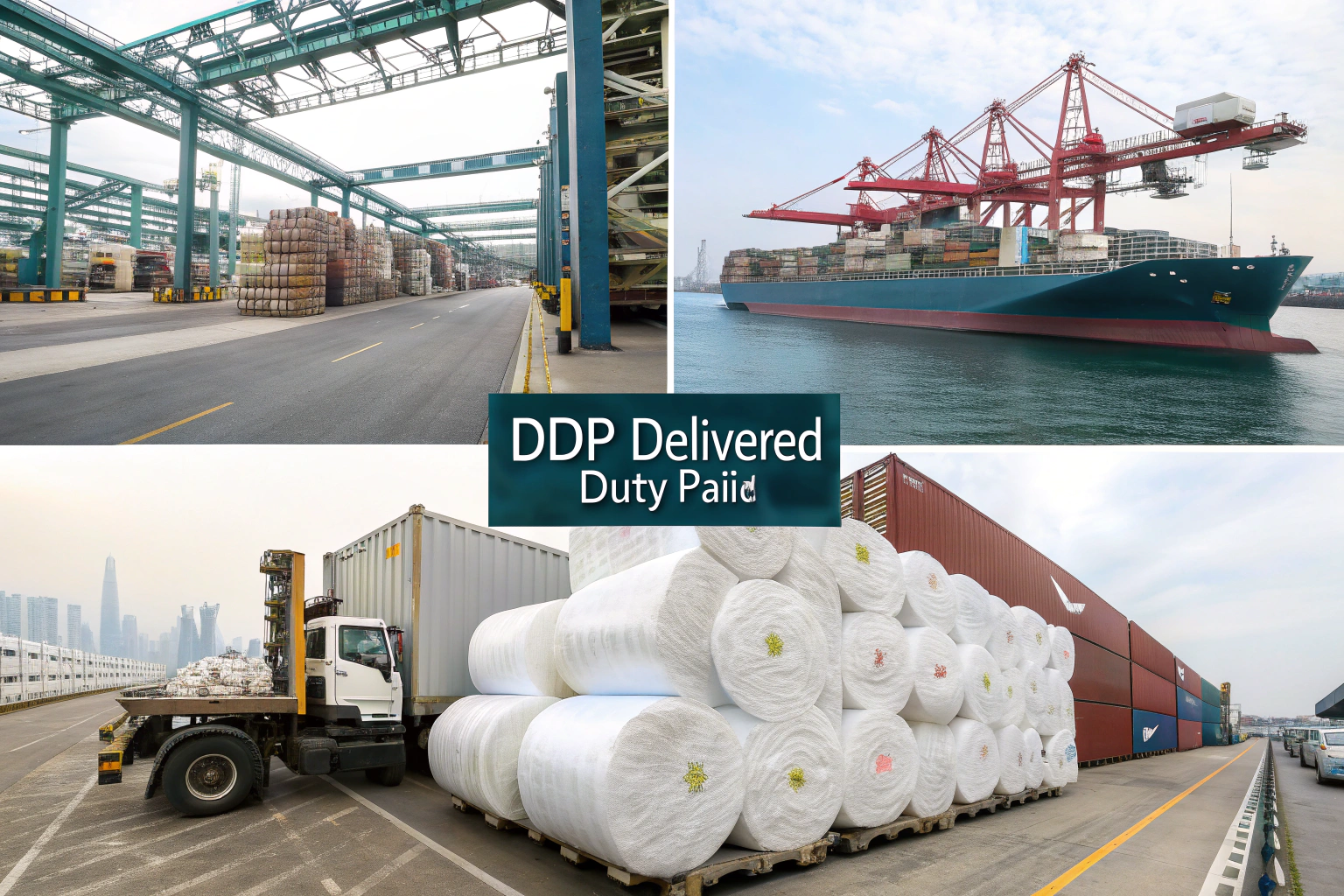
We book the ocean freight, prepare export documentation, clear Chinese customs, and load the container. When the vessel arrives at your country’s port, our appointed customs broker handles import clearance, pays the duties and taxes on your behalf (using the funds included in your payment), and arranges final truck delivery to your warehouse. You receive the fabric, sign for it, and that’s it.
A Canadian client described it as "magic" the first time. They’d been importing for years, always dealing with brokers, always surprised by final costs. Their first DDP shipment arrived exactly as quoted, on time, with no additional paperwork. They’ve never gone back.

What’s the Difference Between DDP and Other Shipping Terms?
Understanding the alternatives helps you appreciate what DDP offers.
Under EXW (Ex Works), you’re responsible for everything from the moment the fabric leaves our factory. You arrange pickup, export clearance, freight, import clearance, and delivery. You pay all costs directly. You have maximum control but also maximum responsibility and risk.
Under FOB (Free on Board), we’re responsible until the fabric is loaded on the ship. After that, you take over—freight, insurance, import clearance, delivery. This is the most common arrangement for experienced importers who have their own freight forwarders and customs brokers.
Under CIF (Cost, Insurance, Freight), we handle up to the destination port, but you’re still responsible for import clearance, duties, and delivery from the port. This is better than FOB for some buyers but still leaves you dealing with customs.
DDP is the only term where we handle everything, including the parts that happen in your country. It’s the most hands-off option for buyers.
A US brand started with FOB, thinking they’d save money by handling their own logistics. After two years of unexpected fees and customs delays, they calculated that DDP actually cost about the same when they factored in their staff time and stress. They switched and never looked back.
Who Handles What Under a DDP Agreement?
Clarity about responsibilities prevents disputes. Under our DDP agreements:
Shanghai Fumao handles:
- Packing the fabric appropriately for ocean transport
- Preparing all export documentation (commercial invoice, packing list, export licenses if needed)
- Clearing Chinese export customs
- Booking and paying for ocean freight
- Insurance during transit (typically included, but confirm)
- Appointing a customs broker in your country
- Providing all documentation needed for import clearance
- Paying all import duties and taxes
- Arranging final delivery to your specified address
You handle:
- Providing accurate delivery address and contact information
- Being available to receive the shipment
- Inspecting the fabric upon arrival
- Notifying us promptly of any issues
That’s it. No customs forms, no duty payments, no arranging truckers.
A German client told me their accounting department loves DDP because they receive one invoice with all costs included. No tracking down separate freight bills, no reconciling duty payments months later. One invoice, one payment, done.
What Are the Cost Components of a DDP Shipment?
When you receive a DDP quote, you’re seeing the sum of multiple cost components. Understanding them helps you evaluate whether DDP makes sense for your situation.
The fabric cost is your base—the price per yard or meter for the woven fabric itself, including our margin.
Export packing includes the materials and labor to prepare the fabric for ocean transport. This might be standard packing (rolls on pallets, wrapped) or specialized (vacuum compression for bulky fabrics).
Ocean freight is the shipping line’s charge to move the container from China to your country’s port. This varies by season, route, and current fuel prices.
Insurance protects against loss or damage during transit. It’s typically a small percentage of the shipment value but provides peace of mind.
Import duties are the tariffs your country charges on imported textiles. These vary by fabric type, composition, and country of origin. We calculate these based on your fabric’s Harmonized Code and current tariff rates.
Import taxes include VAT, GST, HST, or similar consumption taxes. These can be substantial—20% VAT in many European countries, for example.
Customs broker fees cover the professional service of clearing your shipment through customs. Brokers handle documentation, communicate with customs officials, and ensure compliance.
Final delivery (inland freight) gets the fabric from the port to your door. This depends on distance from the port and whether you need liftgate service or other special handling.
A French brand was shocked when they saw their first DDP quote—the fabric cost was only 60% of the total. But when they calculated what they’d paid for their last self-managed shipment (fabric plus freight plus unexpected broker fees plus duty plus VAT), the DDP total was actually slightly lower. The difference was transparency versus surprise.

How Are Duties and Taxes Calculated in DDP Quotes?
Getting duties and taxes right requires expertise. Here’s how we do it.
First, we need the correct Harmonized System (HS) code for your fabric. This six-to-ten-digit code determines the duty rate. Woven cotton fabrics have different codes than woven synthetics, and specific constructions (poplin, twill, satin) may have sub-codes. We work with you to identify the correct code based on your fabric’s composition and construction.
Second, we apply the current duty rate from your country’s tariff schedule. These rates change—trade agreements, tariff actions, and policy shifts all affect them. We maintain up-to-date databases for major markets (US, EU, UK, Canada, Australia, Japan) and verify rates before quoting.
Third, we calculate the duty amount: duty rate × (fabric cost + freight + insurance). Yes, duties are typically calculated on the CIF value (Cost, Insurance, Freight), not just the fabric cost. Many buyers don’t realize this and underestimate their landed cost.
Fourth, we add consumption taxes (VAT, GST, HST) which are calculated on the duty-paid value—fabric + freight + insurance + duty. This tax can be the largest single cost after the fabric itself.
Finally, we add a small buffer for currency fluctuations and rate changes between quote and shipment. If actual costs are lower, we refund the difference. If they’re higher, we absorb it—that’s our risk under DDP.
A US client once questioned why our DDP quote seemed high. We walked through the calculation, showing how duty applied to the full CIF value and how their state’s sales tax added another layer. They realized their previous self-managed shipments had the same costs—they just hadn’t calculated them properly.
What Hidden Costs Does DDP Eliminate?
The beauty of DDP is that it turns hidden costs into visible, included ones.
Storage and demurrage fees disappear because we coordinate arrival with customs clearance and delivery. No more containers sitting at the port while you figure out paperwork.
Customs broker surprise fees vanish because we’ve negotiated and included them upfront. No more "administrative fees" or "disbursement fees" appearing on invoices months later.
Currency exchange costs are handled by us. You pay in your currency (if we offer that) or in USD with everything included. No more wondering what the exchange rate will be when duty payment is due.
Penalties for documentation errors are our problem, not yours. If a document is wrong and customs fines the shipment, we pay.
Storage for split deliveries? Not an issue. We arrange delivery to your door, not to a port where you need to arrange trucking.
A UK brand calculated that their self-managed shipments had an average of 12% in unexpected costs beyond their initial budget. Their first DDP shipment had zero unexpected costs. The predictability alone was worth the switch.
What Are the Advantages of DDP for Woven Fabric Buyers?
The advantages of DDP go beyond simple convenience—they affect your entire business operation.
Predictable costs are the biggest benefit. You know exactly what you’re paying before you order. No surprises when the freight invoice arrives three months later. No unexpected duty assessments. One price, one payment, done.
Reduced administrative burden frees your team for higher-value work. No more tracking shipments, chasing brokers, or reconciling multiple invoices. Your accounts payable processes one invoice instead of four or five.
Faster delivery often results from DDP because there’s no delay while you arrange clearance. We’ve already got the broker ready, the documentation prepared, and the truck scheduled. Your fabric clears customs and moves to your door without waiting for you to act.
Cash flow advantages can be significant. Under traditional terms, you might pay for fabric, then freight, then duties separately over weeks or months. Under DDP, you pay one consolidated amount, often with better timing alignment to your needs.
Risk transfer is complete. If something goes wrong—delays, damage, customs issues—it’s our problem to solve, not yours. You’re buying delivered fabric, not promises.
A Spanish brand’s purchasing manager told me DDP saved them from hiring a dedicated logistics person. Their import volume had grown to the point where managing shipments was a full-time job. DDP brought it back to a few hours per month.

How Does DDP Simplify Customs Clearance for First-Time Importers?
First-time importers face a daunting learning curve. Customs regulations, documentation requirements, and clearance procedures vary by country and change frequently. One mistake can delay shipments for weeks.
DDP removes this barrier entirely. You don’t need to know anything about customs because we handle it all. You provide your business information (name, address, tax ID), and we do the rest.
For new importers in markets with complex regulations (like the US FDA for certain textiles, or EU REACH compliance), this expertise is invaluable. We know what documentation is required, which agencies need to be involved, and how to avoid common pitfalls.
The learning happens gradually, without risk. After a few DDP shipments, you might choose to take over some responsibilities. Or you might decide that letting us handle it forever is the right choice.
A first-time importer in Australia told me they would have given up after their first self-managed attempt. The paperwork was overwhelming, and their goods sat at customs for three weeks. Their first DDP shipment with us arrived in 10 days, no stress. They’ve never attempted self-management since.
Can DDP Help You Avoid Tariff Classification Mistakes?
Tariff classification is surprisingly complex. The difference between one HS code and another can be 10% or more in duty rates. Classify incorrectly, and you might overpay duties or, worse, face penalties for underpayment.
Under DDP, classification becomes our responsibility. Our experienced team, working with customs brokers in your country, determines the correct HS code for your fabric. We research, verify, and apply the code that matches your fabric’s composition and construction.
If customs later disagrees with our classification, we handle the dispute. You’re not on the hook for back duties or penalties.
For fabrics with complex compositions—say, a woven with 60% cotton, 40% polyester—classification can be tricky. Different countries have different rules for determining the "essential character" of blended fabrics. We navigate this complexity so you don’t have to.
A Canadian client had always classified their blended fabrics as "cotton" because that was the major component. Under DDP, we reclassified them correctly as "cotton-polyester blends" and saved them from a potential audit issue. The duty rate was similar, but the compliance risk disappeared.
What Are the Potential Disadvantages of DDP?
DDP isn’t right for every buyer in every situation. Understanding the potential drawbacks helps you make an informed choice.
Higher total cost is possible, though not guaranteed. We’re taking on risk and providing convenience, and that service has value. Our DDP quotes include our costs plus a margin for the work and risk we assume. For experienced importers with efficient logistics operations, self-managing might be cheaper.
Less control over logistics details means you’re trusting our choices. We select the shipping line, the customs broker, the trucking company. If you have strong preferences or existing relationships, DDP might not accommodate them.
Dependency on our logistics competence means our mistakes become your problems. If we choose an unreliable broker or book space on a delayed vessel, you’re affected. That’s why choosing a DDP provider with proven logistics expertise is essential.
Customs scrutiny can sometimes increase with DDP, though this is rare. Some customs authorities view DDP shipments with extra attention because the importer of record (our broker) isn’t the ultimate buyer. Proper documentation prevents issues, but it’s a consideration.
A German brand with their own logistics department found that DDP cost about 5% more than self-managing. For them, the convenience wasn’t worth the premium. For another client without logistics staff, the 5% was cheaper than hiring someone.

When Does DDP Make Financial Sense vs Self-Managed Shipping?
The breakeven point varies by shipment size, destination, and your internal capabilities.
For small shipments (LCL, under 5 cubic meters), DDP often makes strong financial sense. The fixed costs of self-managing—broker fees, administrative time—are spread over fewer yards, making per-yard costs high. DDP consolidates these efficiently.
For large, regular shipments (FCL, monthly), self-managing might be cheaper if you have logistics expertise. The volume justifies negotiating your own freight rates and broker fees, and the regularity lets you optimize processes.
For first-time or occasional importers, DDP almost always makes sense until you build experience and relationships. The learning curve is steep, and mistakes are expensive.
For complex fabrics requiring special handling (delicate, high-value, temperature-sensitive), DDP’s expertise can prevent damage and delays that would cost more than the service fee.
For markets with difficult customs environments (Brazil, Argentina, some African countries), DDP is almost essential unless you have local presence. These markets have complex regulations that change frequently.
A US brand analyzed their shipments over two years. For their small sample orders (under $5,000), DDP was 8% cheaper than self-managing when they factored in staff time. For their bulk production orders (over $50,000), self-managing was 3% cheaper. They now use DDP for samples and manage bulk themselves.
What Risks Do You Assume When Choosing DDP?
Risk transfer is the essence of DDP—risks move from you to us. But understanding what we’re assuming helps you evaluate our capability.
We assume the risk of freight rate increases between quote and shipment. If ocean freight rates spike, we absorb it. This is a real risk in volatile markets.
We assume the risk of duty rate changes. If your country increases tariffs on your fabric after we quote, we pay the difference.
We assume the risk of currency fluctuations. If your currency weakens against the USD between quote and payment, our costs increase—we absorb it.
We assume the risk of customs delays and penalties. If documentation issues arise, we resolve them at our cost.
We assume the risk of loss or damage in transit, subject to insurance coverage.
The question is whether we’re financially stable and operationally capable of bearing these risks. A supplier with weak finances might not survive a major claim. That’s why working with established, reputable suppliers matters.
A Swedish client once had a container lost at sea. Under DDP, we filed the insurance claim, waited for the settlement, and shipped replacement fabric—all at our cost and risk. They received their fabric (late, but at no additional cost) while we dealt with the insurance company. That’s the value of DDP risk transfer.
How Do You Choose a Reliable DDP Shipping Partner?
Choosing the right DDP partner is critical because you’re trusting them with your entire import process. Here’s what to look for.
Experience with your destination market matters. Different countries have different customs requirements, documentation needs, and potential pitfalls. A supplier who regularly ships to the US knows the ISF filing requirements, ACE portal quirks, and common FDA issues. Someone who mostly ships to Europe might struggle with US customs.
Established relationships with customs brokers in your country ensure smooth clearance. We work with the same brokers for years, building trust and efficiency. New relationships mean learning curves that can delay your shipments.
Transparent pricing with clear breakdowns lets you understand what you’re paying for. Avoid suppliers who give a single "all-in" number without explanation. You should be able to see fabric cost, freight, duties, taxes, and fees separately, even if you pay one total.
Clear communication about what’s included prevents surprises. Does DDP include delivery to your door, or just to the nearest terminal? Does it include liftgate service if you don’t have a loading dock? Does it cover insurance for the full value? Get answers in writing.
Financial stability matters because we’re prepaying significant costs on your behalf. A supplier who struggles financially might delay your shipment while waiting for funds to clear. We maintain strong banking relationships and cash reserves to ensure smooth operations.
A Dutch brand switched DDP partners after their previous supplier’s container sat at port for two weeks because the supplier hadn’t paid the customs broker. The broker wouldn’t release the fabric until payment cleared. Under DDP, you’re dependent on your supplier’s financial discipline.

What Questions Should You Ask Before Agreeing to DDP?
Before saying yes to DDP, get answers to these questions:
"What’s included in your DDP quote?" Get a detailed breakdown: fabric, export packing, ocean freight, insurance, import duties, import taxes, customs broker fees, and final delivery. Confirm there are no other charges.
"Who is your customs broker in my country?" Ask for the broker’s name and contact information. A reputable supplier will share this. You might want to verify the broker’s credentials independently.
"What happens if duties or freight rates increase after I pay?" Some suppliers quote with buffers and absorb changes. Others might try to pass on increases. Clarify the policy upfront.
"What’s your process for handling customs issues?" If customs flags your shipment, how is it resolved? Who communicates with the broker? Who pays for storage during delays? Having a clear process prevents disputes.
"What documentation will I receive?" You should receive commercial invoice, packing list, bill of lading, customs clearance documentation, and proof of delivery. Confirm what you’ll get and when.
A US client asks these questions of every potential DDP supplier. The ones who answer clearly and confidently get their business. The ones who hedge or deflect get crossed off the list.
How Do You Verify a Supplier’s DDP Capabilities?
Beyond asking questions, verification matters.
Check references. Ask for contact information for other clients in your country who use their DDP service. A few phone calls can reveal whether shipments actually arrive as promised.
Review sample documentation. Ask to see examples of commercial invoices, packing lists, and customs documents from recent DDP shipments to your country. Legitimate suppliers will have these and can share redacted versions.
Test with a small order. Before committing to a large DDP shipment, try a sample order or small production run. Experience the process firsthand with limited risk.
Monitor the first shipment closely. Stay in communication, track the vessel, confirm customs clearance, verify delivery. A successful first shipment builds confidence for larger orders.
A Canadian brand tested three DDP suppliers with small orders before choosing their long-term partner. One failed to deliver on time, one had hidden fees, and one (us) performed perfectly. The test cost a few thousand dollars but saved them from years of problems.
Conclusion
DDP shipping transforms woven fabric imports from a complex, multi-step process into a simple transaction. You order fabric, pay one price, and receive it at your door. No customs paperwork, no surprise fees, no coordination with multiple vendors. For buyers who value simplicity and predictability, DDP is transformative.
The cost includes everything: fabric, packing, freight, insurance, duties, taxes, broker fees, and final delivery. What you see is what you pay—no surprises months later.
The advantages extend beyond convenience. Predictable costs improve budgeting. Reduced administrative burden frees your team. Faster delivery gets products to market sooner. Complete risk transfer protects you from logistics problems.
DDP isn’t for everyone. Experienced importers with logistics expertise might save money self-managing. Large, regular shipments might justify negotiated rates that undercut DDP pricing. But for most buyers—especially those new to importing or those who value their time—DDP offers compelling value.
Choosing the right DDP partner matters. Look for experience in your market, established broker relationships, transparent pricing, clear communication, and financial stability. Test with small orders before committing to large ones.
At Shanghai Fumao, we’ve been shipping DDP to clients worldwide for over a decade. We know the requirements for the US, EU, UK, Canada, Australia, and dozens of other markets. We have established broker relationships everywhere we ship. Our DDP quotes are transparent, with clear breakdowns of all costs. And our financial stability means we can prepay duties and taxes without delaying your shipment.
We handle everything—from fabric production through final delivery—so you can focus on your business, not logistics.
Whether you’re a first-time importer or an experienced buyer tired of logistics headaches, DDP might be the solution you’ve been looking for.
Contact our Business Director, Elaine, today to discuss DDP shipping for your woven fabric orders. She and her team will provide a transparent, all-inclusive quote and walk you through exactly how the process works. Email her directly at: elaine@fumaoclothing.com. Let us handle the logistics so you can focus on your business.