I’ve lost count of how many times I’ve stood at a trade show in Paris or a fabric market in Guangzhou with a buyer who picks up a swatch and asks, "Wait, is this knit or woven?" They squint at it, they feel it, but they’re just not sure. And honestly? In our industry, not knowing the difference in those first few seconds can lead to costly mistakes down the line. I’ve seen designers order 5,000 yards of what they thought was a stable woven for a structured blazer, only to receive a stretchy knit that completely changed their garment’s fit.
Here’s the truth: you can identify any fabric’s construction in under three seconds without any special tools or training. You just need to know what to look for. A knit fabric will stretch easily along the width, often has a visible loop structure, and the edges will curl when cut. A woven fabric offers little to no stretch on the length or width (only on the bias), shows clear, perpendicular grain lines, and the edges will fray instead of curl. These aren’t just textbook definitions—they’re the practical cues I’ve used daily for over 20 years at our Shanghai Fumao facility.
Let me walk you through exactly how to train your eyes and hands to spot the difference instantly. Because when you’re sourcing fabrics from China or managing production with factories like ours, those three seconds of certainty can save you weeks of headaches and thousands of dollars in sampling corrections.
What’s the Fastest Visual Trick to Identify Knit vs Woven Fabrics?
The absolute fastest way? Look at the edges. I know that sounds too simple, but after moving millions of yards through our factory, I promise this works. Take any fabric sample and look closely at the cut edge. If you see the yarns starting to unravel or come loose like a rope fraying, that’s a woven fabric 99% of the time. If the edge curls up on itself like a rolled-up newspaper or stays clean without any loose threads, you’re holding a knit.
Let me explain why this happens. Knitted fabrics are constructed from a single continuous yarn (or multiple yarns) forming interlocking loops, just like a hand-knitted sweater but on a massive machine. When you cut a knit, those loops don’t have anywhere to go—they just sit there, and the tension releases, causing that characteristic edge curl. Woven fabrics, on the other hand, have warp yarns running lengthwise and weft yarns crossing back and forth. Cut those crossing yarns, and they’ll slip right out. It’s basic physics.
Last spring, a buyer from Melbourne visited our showroom with about thirty swatches from different suppliers. She was completely overwhelmed. "I can’t tell which samples match my technical specs," she told me. I spent ten minutes showing her this edge trick, and by the end, she was sorting through piles like a pro. She later emailed me saying she used that same method to audit samples from three other Chinese suppliers and caught two mislabeled fabrics before they went into production. That’s real money saved.

Can You See the Difference in the Fabric Surface Without Touching It?
Absolutely. Your eyes can catch this faster than your hands can feel it. Look closely at the surface of the fabric—not from far away, but up close, like six inches from your face. For woven fabrics, you’ll see a clear, distinct grid pattern. The yarns cross over and under each other in a predictable, repeating sequence. It might be a plain weave where it’s just over-one-under-one, or a twill where you see those diagonal lines like on denim. But there’s always a sense of order, of perpendicular lines.
For knitted fabrics, the surface looks completely different. You’re looking at tiny V-shaped or U-shaped loops stacked in columns and rows. It resembles a fine net or a series of tiny braids standing on end. If you have good light, you might even see the shadows cast by these tiny loops. This is especially visible in jersey knits or interlock structures. In our development center, we keep a side-by-side comparison board under bright daylight lamps specifically to train new team members and visiting clients.
I’ll never forget a Russian designer who visited us during a scorching July afternoon in 2023. She was developing a summer activewear line and kept getting confused between the technical documents and the physical samples. I pulled out my phone, took a macro photo of a knit and a woven swatch, and zoomed in. The difference was undeniable—the knit looked like a chain of tiny interconnected rings, while the woven resembled a miniature bamboo fence with slats crossing. She took photos of both and said, "Now I’ll never confuse them again." That visual memory sticks with you.
What Does the Stretch Test Actually Tell You in Real-World Terms?
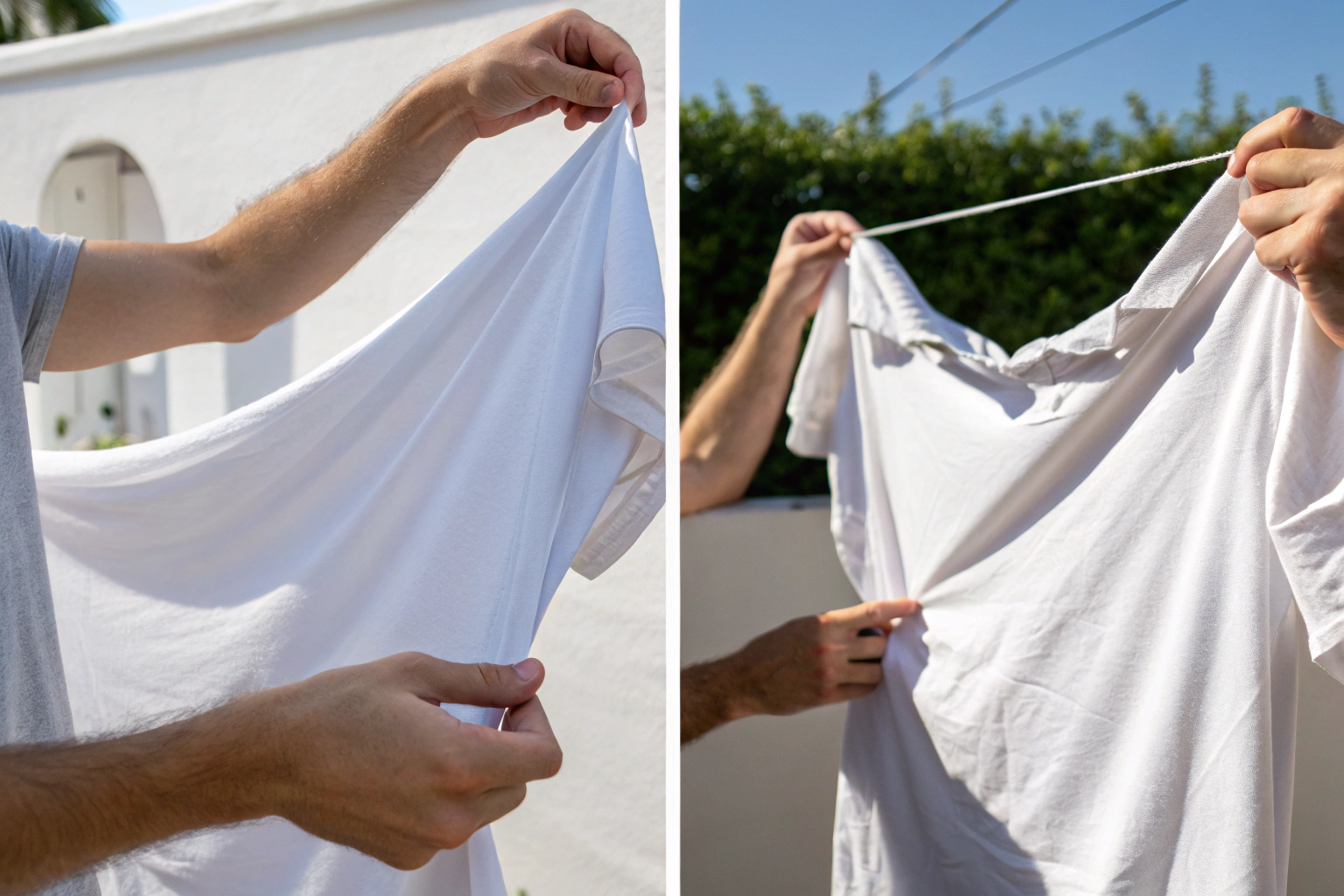
The stretch test is my go-to, and here’s exactly how to do it properly. Hold the fabric between both hands, one hand near each edge, and pull gently along the width (from selvedge to selvedge). Then try the same thing along the length. A woven fabric will have virtually no give in either direction—it might move slightly on the bias if you pull diagonally, but straight on? Nothing. A knit fabric will stretch noticeably, often 15-25% or more, and then spring back when you release.
But here’s what most people don’t realize: the stretch test also tells you about recovery. After you stretch that knit, watch how it behaves when you let go. Does it snap back immediately, or does it stay slightly elongated? High-quality knits from reliable suppliers like Shanghai Fumao use properly stabilized yarns and finishing processes that ensure excellent recovery. Cheap knits? They’ll stretch out and stay stretched, which means your garments will bag at the knees and elbows after two wears.
This matters tremendously for summer dresses. A client from Toronto learned this the hard way before coming to us. They’d ordered 3,000 units of what they thought was a stable jersey dress from another supplier. The fabric passed the initial stretch test, but after garment construction, the dresses stretched out permanently at the hips. When they sent us the fabric for analysis, our CNAS-certified lab found the recovery rate was below 60%. We recommended a modified knit structure with a small amount of elastane and a different finishing compacting process. The next batch? Recovery rate above 95%. The stretch test isn’t just about identifying the fabric type—it’s your first quality check.
How Do Professional Buyers Use the "Fray Test" During Market Visits?
Walk through any major textile trade show—whether it’s in Shanghai, Paris, or New York—and watch the experienced buyers. They’re not just feeling fabrics randomly. They have a system. One of their first moves is to take the fabric between thumb and forefinger and rub the cut edge firmly. If tiny fibers or threads start coming loose immediately, they know it’s a woven. If the edge stays intact or just curls up, it’s a knit. This takes about two seconds, and it never lies.
The fray test reveals something else too: the quality of the construction. With wovens, how quickly and how badly it frays tells you about the thread count and the twist of the yarns. A high-quality woven with tightly twisted yarns and a dense construction will fray slowly and cleanly. A cheap, loosely constructed woven will practically disintegrate at the edge with minimal rubbing. I’ve stood at our booth at the Canton Fair and watched buyers silently perform this test on our samples. The ones who nod approvingly after seeing minimal fray? Those are the ones who understand real quality.
For knits, the edge behavior is equally informative. When you rub a knit edge, you’re checking for something different: running or laddering. If you see a run starting from the edge and traveling down the fabric, that’s a red flag. It indicates poor stitch structure or incorrect needle size used during knitting. In our factory, we run what’s called a "laddering test" on every batch of knit fabric before it ships. We literally pull at the edge with a standardized force to see if the loops will break and run. If it fails, the whole lot gets rejected.

Why Do Experienced Sourcing Managers Always Check the Fabric Corners?
This is a little trick that separates the beginners from the veterans. Take any fabric swatch or sample and look at the corner where two cut edges meet. For woven fabrics, that corner will be slightly fuzzy or have tiny loose threads hanging from both sides. It might even have a small gap forming where the weft yarns have started to slip out. For knits, that corner will be rounded and curled, like the corner of a t-shirt that’s been washed many times.
The corner test combines both visual inspection and structural behavior. In a woven fabric, the intersection of cut edges is the weakest point because you’ve severed both the warp and weft yarns. Those loose ends have nothing holding them in place anymore. In a knit, even though you’ve cut the loops, the surrounding loops still hold their neighbors in place to some degree. The fabric might curl at the corner, but it won’t unravel in the same way.
I remember visiting a fabric supplier in Shaoxing with a German client back in 2022. We were there to audit a potential partner for organic cotton shirting. My client, who had been sourcing for over 25 years, didn’t even pull out her loupe. She just picked up a sample, looked at the corner, and handed it back to the sales manager with a slight frown. Later she told me, "The corner was too neat. That means they cut it with a hot cutter, which seals the edges temporarily. It hides how badly the fabric frays." She was absolutely right. When we requested an uncut sample from the middle of the roll, it frayed like crazy. That attention to detail saved her company from a disastrous bulk order.
Can Digital Images Reveal Fabric Construction Accurately for Remote Sourcing?
This question comes up constantly, especially since COVID changed how we source. More buyers are doing virtual showroom visits and requesting video samples. So can you tell knit from woven through a photo or video? Partially, yes, but you need to know what to ask for.
First, request a video, not just photos. Ask the supplier to hold the fabric up to a strong light source and slowly rotate it. In a woven fabric, you’ll see the light coming through in a consistent, grid-like pattern—tiny pinholes of light where the warp and weft cross. In a knit, the light transmission is more diffuse and irregular because the loop structure creates varying thicknesses. We do this routinely for our remote clients at Shanghai Fumao, using a standardized light box so they can see exactly what they’re getting.
Second, ask for a "stretch and release" video. Have the supplier hold the fabric widthwise, stretch it to about 80% of its maximum, then release it slowly on camera. You’ll see the knit snap back while the woven simply goes slack or doesn’t move at all. For an extra check, request a close-up of the edge after cutting. A good supplier won’t mind doing these quick demonstrations. If they hesitate or make excuses, that’s a red flag.
Just last month, a startup founder from Austin emailed me, panicked about a sample she’d received from another Chinese supplier. The photos looked beautiful, but the fabric felt wrong. She sent me the images, and I could immediately tell from the slightly uneven surface reflection and the way the light caught the tiny loops that it was a knit, not the woven she’d specified. We sent her reference videos showing the difference using our own fabrics, and she was able to confront the supplier before placing a bulk order. That’s the power of knowing what to look for, even through a screen.
What Are the Common Mistakes New Designers Make When Identifying Fabrics?
I’ve seen literally hundreds of new designers make the same mistakes when trying to identify fabrics. The most common? Relying entirely on feel without looking at structure. A heavy sweater knit can feel thick and stable like a woven. A fine gauze woven can feel delicate and fluid like a knit. If you only go by hand feel, you’ll be wrong about 30% of the time. That’s a scary statistic when you’re placing orders worth tens of thousands of dollars.
The second mistake is testing on small swatches without considering the full roll behavior. A 4×4 inch square of woven fabric might not show significant fraying, and a small knit square might not curl dramatically. But when you get 500 yards of that same fabric, those behaviors become major production issues. I always tell clients: if you’re testing samples, ask for at least a half-yard piece. Test it. Wash it. Abuse it. See what it really does before you commit.
The third mistake is forgetting about blends and specialty finishes. A cotton-spandex woven can have noticeable stretch, fooling someone into thinking it’s a knit. A stabilized knit with heavy finishing can feel almost papery and rigid like a woven. This is where experience and documentation matter. At our facility, every single fabric we produce comes with a technical data sheet that clearly states construction type, weight, composition, and expected behavior. We don’t leave it to guesswork.

Why Does Everyone Get Bamboo Fabric Construction Wrong?
Bamboo fabric is probably the most misidentified textile in my experience. Designers hear "bamboo" and immediately think "soft, drapey, probably a knit." And yes, bamboo jersey is incredibly popular for loungewear and t-shirts. But bamboo viscose can also be woven into beautiful, crisp shirting and dress fabrics that have a completely different hand feel and performance.
The confusion comes from the fiber itself. Bamboo is a regenerated cellulose fiber, similar to viscose or Tencel. The fiber doesn’t determine the construction—the knitting or weaving process does. So you can have a bamboo knit that stretches and curls at the edges, and a bamboo woven that frays and holds its shape. I’ve had clients argue with me, insisting that the bamboo shirting sample we sent must be a knit because "bamboo is supposed to be stretchy." It takes actual demonstration with a magnifying glass to convince them.
Here’s how to tell them apart quickly. Take that bamboo fabric and stretch it widthwise. If it’s a knit, it will stretch significantly. If it’s a woven, it will resist. Then look at the surface under good light. The knit will show those characteristic V-shaped loops, while the woven will show the perpendicular grain. Finally, check the edge. The knit curls, the woven frays. Three seconds, and you’ll know exactly what you’re dealing with, regardless of what the fiber content label says.
Can Double Knits and Fine Wovens Trick Even Experienced Eyes?
Absolutely. This is where the lines blur, and even I have to pause sometimes. Double knits, like Ponte di Roma, are constructed with two layers of interlocking loops, making them much thicker and more stable than single knits. They drape differently, they resist curling, and they can feel remarkably similar to a lightweight woven like a crepe or a fine twill. I’ve seen buyers pick up a Ponte sample and swear it’s a woven until they actually try to fray the edge.
On the flip side, high-thread-count woven fabrics, especially in fine yarns like Egyptian cotton or silk, can have an incredibly soft, fluid hand that mimics knits. A silk charmeuse, for example, drapes and flows like a dream, but it’s absolutely a woven construction. The edge will fray, and there’s no significant stretch in the width. I keep a reference board in my office with side-by-side comparisons of tricky fabrics—Ponte next to a fine wool crepe, double-faced satin next to an interlock knit—specifically to train clients who are struggling with identification.
The solution when you’re uncertain? Don’t guess. Do the full test sequence: edge check, stretch test, visual inspection under magnification. If you’re still unsure, ask for the fabric’s technical specifications. Any reputable supplier, whether it’s Shanghai Fumao or another established mill, will provide complete construction details. We include this information in every single quote we send, because we’d rather you know exactly what you’re getting than have a surprise later. One confused client who thinks they bought a woven but received a knit is one client too many.
How Does Fabric Identification Prevent Costly Production Errors?
Let me tell you about a disaster that happened to a client before they found us. They were a mid-sized brand in the UK, and they’d designed a beautiful summer collection featuring five different dresses. They sourced what they thought was a stable linen-cotton woven for all five styles from a supplier who shall remain nameless. They placed an order for 12,000 yards, paid a deposit, and waited. When the fabric arrived, their cutter immediately noticed problems. The fabric wasn’t cutting cleanly, the edges were fraying excessively, and when they sewed a test garment, it didn’t hold the intended shape.
They finally had the fabric tested and discovered it wasn’t a woven at all. It was a heavy-weight knit that had been aggressively finished to look and feel like a woven. Their patterns, designed for zero-stretch woven construction, were completely wrong. The dresses either didn’t fit or stretched out of shape immediately. They had to scrap the entire collection, losing over $80,000 in fabric, labor, and missed sales. All because they didn’t confirm the fabric construction before bulk production.
That story haunts me, which is why I’m so passionate about education. At Shanghai Fumao, we have multiple checkpoints specifically to prevent this. When you place an order, we don’t just send bulk fabric. We send production samples from the actual yarn lot for your approval. We include clearly labeled construction details. Our QC team verifies every roll against the technical specifications before it’s packed. And we provide photo documentation of the testing process. It might seem like overkill, but when you’ve seen the alternative, you understand why it matters.

What Happens When You Cut Woven Patterns on Knit Fabric by Mistake?
This is the nightmare scenario. You’ve spent weeks perfecting your patterns, grading for specific measurements, calculating fabric utilization. Your cutter lays out the fabric and starts cutting, not realizing it’s a knit. Immediately, problems emerge. The fabric shifts and distorts on the cutting table because knits have less dimensional stability. The cut pieces don’t match the pattern shape—they’re longer in some places, narrower in others. When the sewing operator tries to assemble the garment, the seams pucker or stretch unevenly.
The final garments are a disaster. They don’t fit the size specifications. The necklines gape. The hems wave. The shoulders don’t sit properly. And worst of all, when customers try them on, the garments stretch out permanently in the first few hours of wear. Your return rate skyrockets, your brand reputation suffers, and you’re left with thousands of dollars of unsellable inventory. I’ve seen brands fold over mistakes like this. It’s not dramatic—it’s real.
The technical reason? Woven patterns are designed with specific ease allowances that assume the fabric won’t stretch during wear. Knit patterns require negative ease—the pattern is actually smaller than the body because the fabric stretches to fit. If you apply woven pattern logic to knit fabric, you end up with garments that are simultaneously too big (because the fabric stretched during sewing) and too tight (because there’s no negative ease built in). It’s a mathematical impossibility to get a good fit.
How Do We Prevent This at Shanghai Fumao’s Quality Control?
Prevention starts long before the fabric reaches your cutting table. First, we require all clients to approve a "strike-off" or lab dip, but also a handloom sample or a cut-and-sew sample from the actual production fabric construction. This isn’t just about color—it’s about confirming the fabric behaves as expected. For a recent order from a Canadian activewear brand, we sent them three different knit constructions that all looked similar but had different stretch and recovery properties. They tested them, chose one, and only then did we proceed.
Second, our fabric inspection process includes a construction verification step. Every batch is checked against the technical specs using our CNAS-accredited testing equipment. We measure courses and wales per inch for knits, ends and picks per inch for wovens. If those numbers don’t match the approved sample, the batch is quarantined and we inform the client immediately. We don’t assume, we verify.
Third, we label everything clearly. Every roll has a sticker that includes the construction type (K for knit, W for woven), the specific structure (jersey, rib, poplin, twill), and the testing data. We also provide a QR code that links to the full technical report. This might sound like a lot, but when you’re dealing with dozens or hundreds of rolls, that clear labeling prevents mix-ups in your own warehouse. It’s about building systems that protect your investment at every stage.
Conclusion
Identifying whether a fabric is knitted or woven in just three seconds isn’t just a party trick for textile nerds. It’s a fundamental skill that protects your designs, your production timelines, and your profit margins. By training your eyes to spot the loop structure versus the grid pattern, by using the stretch test to feel the difference, and by always checking the edge for fraying or curling, you build a mental database that serves you in every sourcing decision. These quick checks cost nothing but can save everything.
At Shanghai Fumao, we’ve built our reputation on transparency and expertise. With over two decades in Keqiao, the heart of China’s textile industry, we don’t just sell fabric—we educate our partners so they can make informed decisions. Our integrated supply chain, from weaving and knitting through dyeing and finishing, gives us complete control over quality and construction. And our CNAS-accredited lab ensures that every claim we make about our fabrics is backed by verifiable data.
Whether you’re a seasoned buyer or launching your first collection, understanding fabric construction is your first step toward production success. Don’t leave it to chance. Partner with a supplier who values clarity as much as you do.
Contact our Business Director, Elaine, today to discuss your upcoming projects. She and her team are ready to provide samples, technical specifications, and expert guidance tailored to your specific needs. Email her directly at: elaine@fumaoclothing.com. Let’s build something great together.