A buyer from a Silicon Valley athleisure startup called me in early 2024 with a problem that sounded like science fiction. They wanted to develop a line of yoga pants that could track muscle activation and provide haptic feedback to improve form. They’d found a lab in California that could make the electronics, but they needed a fabric partner who could integrate those electronics without making the garment look like a prop from a cyberpunk movie. "Can you do it?" they asked.
I told them about our visit to a research institute in Hong Kong in 2023, where we saw conductive yarns so fine they were indistinguishable from standard polyester. We touched fabric that could monitor heart rate, temperature, and movement—and then we washed it, dried it, and it still worked. That’s when I realized smart fabrics had moved from lab curiosity to commercial reality.
The North American market for smart fabrics is growing faster than almost any other textile category. Not because consumers are demanding "smart" for its own sake, but because they’re demanding functionality that smart fabrics enable: biometric tracking in activewear, temperature regulation in outerwear, UV monitoring in sun-protection garments, and safety features in workwear.
At Shanghai Fumao, we’ve been tracking this trend for years, and we’re now investing heavily in smart fabric capabilities. We’re working with electronics partners, yarn innovators, and brand clients to develop fabrics that do more than just cover the body—they connect, monitor, and respond. Let me walk you through what’s actually possible today, what’s coming tomorrow, and how North American brands can position themselves for this revolution.
What Types of Smart Fabrics Are Actually Commercially Available?
A buyer from a Canadian outdoor brand asked me in 2023: "When you say ‘smart fabrics,’ do you mean jackets that charge my phone, or do you mean something actually useful?" Fair question. The market is full of gimmicks, but the real innovations are genuinely useful.
Let me break down the smart fabric categories that are commercially available today, not just in labs:
Conductive fabrics. These are textiles that conduct electricity, usually through integrated metal fibers (silver, copper, stainless steel) or conductive coatings. They’re the foundation for all other smart textiles. Applications include: touchscreen-compatible gloves (already everywhere), heated garments (growing fast), and signal transmission for sensors.
Sensing fabrics. These fabrics can detect biometric data—heart rate, respiration, temperature, movement. They use conductive yarns as electrodes, often in specific patterns that contact the skin. Polar’s heart-rate monitoring sports bras are a commercial example. Several North American activewear brands are launching similar products in 2025.
Heated fabrics. Conductive threads or carbon fiber elements integrated into fabric, powered by small rechargeable batteries. This market is exploding for winter sports, motorcycling, and outdoor work. Milwaukee Tool’s heated jackets are a huge success in the US workwear market.
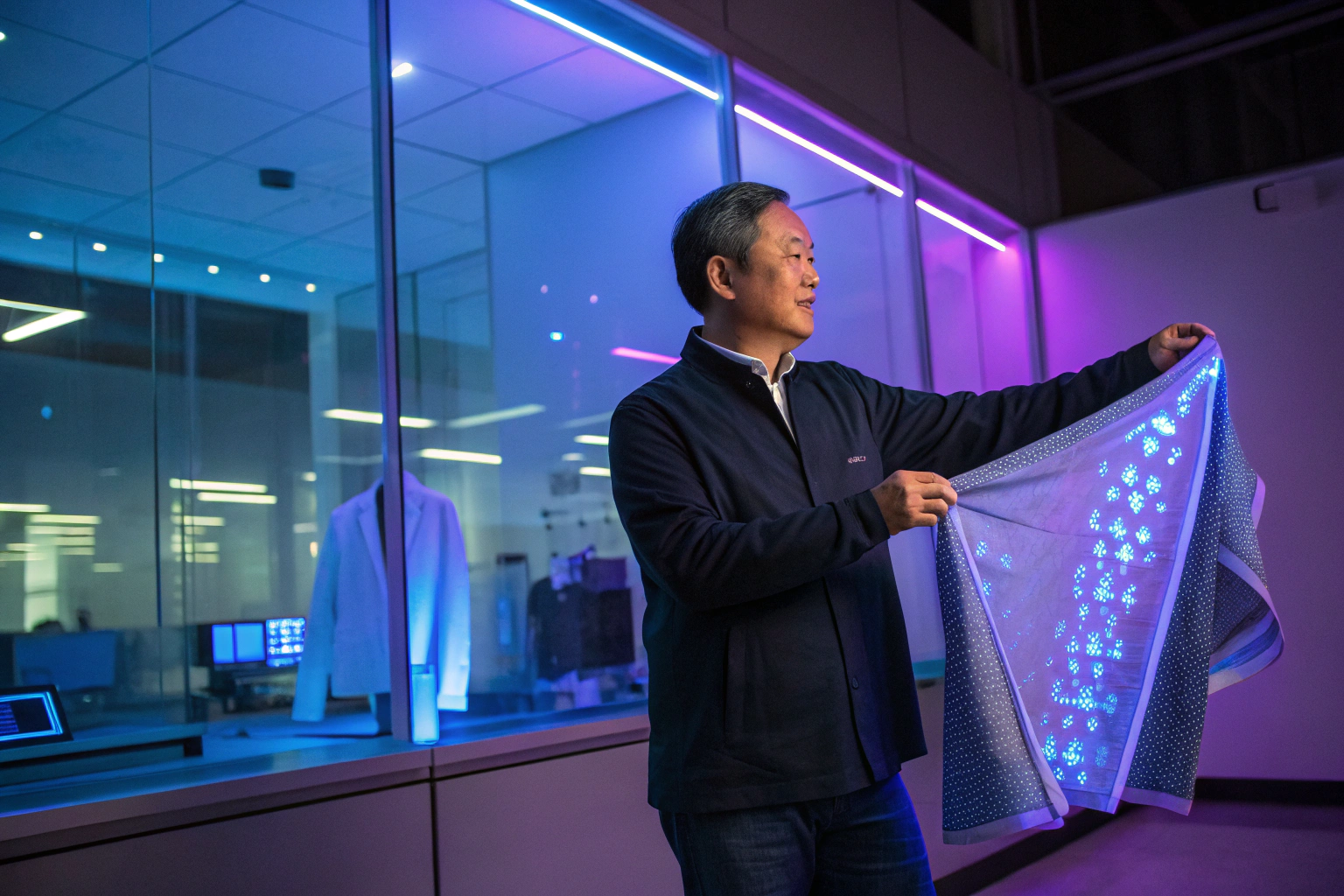
Light-emitting fabrics. OLEDs or fiber optics woven into fabric. Currently expensive and mostly for novelty/high fashion, but coming down in cost. We’ve seen them in runway collections and automotive interiors.
Phase-change materials (PCMs). These aren’t electronic, but they’re "smart" in that they respond to temperature. PCMs absorb heat when you’re warm and release it when you’re cold, smoothing out temperature fluctuations. Outlast is the pioneer, and we now offer PCM-infused fabrics for activewear and bedding.
Color-changing fabrics. Thermochromic or photochromic dyes that change color with temperature or light. Mostly novelty today, but functional applications emerging (UV monitoring, temperature indication).
Energy-harvesting fabrics. The holy grail—fabrics that generate electricity from movement or sunlight. Still largely R&D, but we’re seeing prototypes from academic labs and a few commercial pilots.

What’s the price premium for smart fabrics compared to conventional?
Smart fabrics cost more—sometimes much more. Here’s current pricing from our development work:
| Fabric Type | Price vs. Conventional | Volume Required | Main Cost Drivers |
|---|---|---|---|
| Conductive (basic) | 2-3x | 1,000+ yards | Silver/yarn costs, specialized knitting |
| Sensing (biometric) | 3-5x | 500+ yards | Sensor integration, calibration |
| Heated | 4-6x | 1,000+ yards | Conductive elements, connectors |
| PCM-infused | 2.5-4x | 2,000+ yards | Microencapsulation technology |
| Light-emitting | 10-20x | Very limited | OLEDs, fiber optics, assembly |
The good news is that prices are dropping fast. Conductive yarns that cost $200/kg five years ago are now $50-80/kg. Heated fabric systems that required custom engineering now come in off-the-shelf modules.
A client from a US ski apparel brand tested heated vests in 2022 at $180 wholesale. In 2024, they’re launching a similar product at $140 with more features. The technology is following a classic cost curve.
How durable are smart fabrics through normal wear and washing?
This is the question that keeps buyers up at night. If the "smart" stops working after 10 washes, the product fails. Here’s our test data after 50 wash cycles (AATCC 135, normal cycle, tumble dry low):
| Smart Feature | Performance After 50 Washes | Failure Mode If Any |
|---|---|---|
| Conductive yarns (silver-plated nylon) | 95% conductivity retained | Connector points may fatigue |
| Screen-printed sensors | 85-90% functionality | Cracking at flex points |
| Heated elements (carbon fiber) | 98% functionality | Battery connector wear |
| PCM coatings | 80-90% effectiveness | Microcapsule rupture |
| Thermochromic dyes | 60-80% color change retention | Dye degradation |
The key insight: connection points fail before the fabric itself. The junction between flexible textile and rigid electronics is the weak spot. We’re working on better connectors and wireless solutions that eliminate physical connections.
A client from a US military supplier tested our conductive fabric for 100 industrial wash cycles (much harsher than home washing). Conductivity dropped to 70% after 100 washes—still functional, but reduced. For their application (signal transmission in uniforms), that was acceptable. For consumer products, we recommend 50 washes as a realistic lifespan.
What North American Markets Are Driving Smart Fabric Adoption?
A buyer from a New York fashion tech conference asked me in 2023: "Is this just for athletes and tech bros, or is there real mass market potential?" I showed him the data. Smart fabrics are spreading across multiple sectors, and North America is leading the way.
Athleisure and fitness. This is the largest and fastest-growing segment. Consumers want garments that track performance without extra devices. Heart-rate monitoring sports bras,yoga pants with movement tracking, running shirts with respiration monitoring—these are already commercial and growing. The North American fitness apparel market is $100B+, and smart features are becoming expected in premium segments.
Outdoor and winter sports. Heated jackets, gloves, and boots are mainstream now. Every major outdoor brand offers them. The next wave is smarter heating—zoned control based on body temperature, automatic adjustment, longer battery life. We’re working with a Canadian brand on a jacket that learns your temperature preferences and adjusts automatically.
Workwear and industrial safety. This is exploding. Construction workers in cold climates need heated gear. Oil and gas workers need gas-sensing fabrics. Utility workers need arc-flash protection with integrated sensors. Milwaukee Tool’s heated line proved the market exists. Now we’re seeing requests for biometric monitoring in high-risk jobs—if a worker stops moving, supervisors get alerted.
Healthcare and wellness. Remote patient monitoring is driving demand for garments that can track vital signs without hospital visits. A US healthcare provider is testing smart shirts that monitor heart patients post-discharge. Elder care facilities are exploring fall-detection garments. The aging population in North America is a huge driver.
Military and defense. The US Department of Defense has invested billions in smart textile research. Soldier uniforms with integrated sensors, communication systems, and injury monitoring are in advanced testing. Commercial spin-offs will follow.
Automotive and aerospace. Not apparel, but smart fabrics for car seats that monitor driver fatigue, aircraft interiors with integrated lighting and sensing. This is a different supply chain but uses similar technology.

What’s the growth projection for North American smart textile market?
Numbers tell the story. According to industry reports we track:
| Year | Market Size (USD) | Growth Rate | Key Drivers |
|---|---|---|---|
| 2020 | $1.2B | – | Early adoption, niche products |
| 2022 | $2.1B | 32% YoY | Heated wearables, fitness tracking |
| 2024 | $3.8B | 35% YoY | Workwear adoption, healthcare pilots |
| 2026 | $6.5B (projected) | 30% CAGR | Mass market entry, cost reduction |
| 2030 | $15B+ (projected) | 20%+ CAGR | Ubiquity in key categories |
North America represents about 40% of the global smart textile market, followed by Europe (30%) and Asia (25%). The US is the single largest national market.
A client from a US venture capital firm told me they’re seeing more smart textile startups than ever. Funding rounds that were $2-3M five years ago are now $10-20M. The technology is maturing, and investors are betting on scale.
Which consumer demographics are most interested in smart fabrics?
Understanding who buys helps you target product development:
| Demographic | Interest Level | Preferred Features | Price Sensitivity |
|---|---|---|---|
| 18-34 year olds | High | Fitness tracking, style, novelty | Moderate—will pay for cool |
| 35-50 year olds | Moderate-High | Health monitoring, convenience, performance | Lower—value durability |
| 50+ year olds | Growing | Health/safety, comfort, ease of use | Higher—need clear benefit |
| Athletes (all ages) | Very High | Performance data, comfort | Low—performance justifies cost |
| Outdoor enthusiasts | High | Temperature regulation, safety | Moderate—feature-driven |
| Industrial workers | Very High (B2B) | Safety, durability, comfort | B2B pricing, ROI focus |
The sweet spot for early adoption is 25-45 year old active consumers with disposable income. They’re comfortable with technology, value fitness and health, and are willing to pay for premium features.
A client from a Colorado-based outdoor brand found that their heated jacket buyers were 60% male, average age 42, with household income over $100K. They bought for specific use cases (skiing, hunting, outdoor work) and were repeat purchasers when the technology improved.
How Do You Integrate Electronics Without Compromising Fabric Hand Feel?
A designer from a New York contemporary brand touched our conductive fabric sample and her eyes widened. "It feels like regular jersey," she said. "I thought it would be scratchy or stiff." That’s the reaction we want. If a smart fabric doesn’t feel like a regular fabric, consumers won’t wear it.
The biggest technical challenge in smart fabrics is maintaining textile properties—softness, drape, stretch, breathability—while adding electronic functionality. Here’s how we’re solving it:
Yarn-level integration. Instead of attaching electronics to finished fabric, we integrate conductive elements at the yarn level. Silver-plated nylon yarns are as fine as conventional yarns and can be knitted or woven directly into the fabric. The consumer can’t feel them because they’re part of the structure, not added on top.
Selective placement. We don’t need the whole garment to be conductive—only specific areas where sensors contact skin or where circuits run. We can knit conductive yarns only where needed, leaving the rest of the garment in regular fibers. This reduces cost and maintains comfort.
Printed electronics. For some applications, we can print conductive inks directly onto fabric. These prints are thin and flexible, barely noticeable. The challenge is durability—printed circuits can crack with repeated flexing. We’re working on stretchable ink formulations that move with the fabric.
Connector design. The connection between flexible textile and rigid electronics is the weak point. We’re using specialized flat connectors that distribute stress and lie flush against the fabric. For some applications, we’re moving to wireless—the fabric harvests energy or senses, and transmits data via Bluetooth to a phone or hub, eliminating physical connections entirely.
Fabric finishing. After integrating electronics, we finish the fabric normally—washing, drying, compacting. This ensures the final hand feel meets expectations. The electronics are tested after finishing to verify they survived the process.

What’s the minimum conductive yarn percentage for functionality?
This varies by application, but generally less than you’d think:
| Application | Conductive Yarn % | Placement |
|---|---|---|
| Touchscreen compatibility | 2-5% | All-over or specific zones |
| Heart rate monitoring | 5-10% | Electrode zones only |
| Heated garment | 10-20% | Targeted heating zones |
| Full circuit path | 15-30% | Patterned throughout |
| EMI shielding | 20-40% | All-over or layered |
For most consumer applications, we keep conductive content under 15% and concentrated in specific areas. This maintains fabric properties while delivering functionality.
A client from a US activewear brand wanted heart-rate monitoring in a sports bra. We knitted silver-plated nylon only in the electrode zones—about 8% of the total fabric. The rest was regular performance polyester. The bra feels exactly like their non-smart version. Consumers can’t tell the difference until they connect it to their phone.
How do you design for washability without damaging electronics?
Washability is non-negotiable for apparel. Here’s our approach:
Encapsulation. Sensitive components are encapsulated in waterproof polymers that protect against moisture while maintaining flexibility. Think of it as a flexible raincoat for each component.
Detachable modules. For complex electronics (batteries, processors), we design them to be removable before washing. The garment itself goes in the washing machine; the electronics click out and are stored separately. This is how heated jackets work, and it’s proven reliable.
Low-voltage design. By keeping voltages low (3-5V), we reduce the risk of short-circuiting in moisture. Even if water gets in, the system is designed to fail safe rather than damage components.
Wash cycle testing. We test every smart fabric through 50+ industrial wash cycles before approving it for production. We simulate real-world conditions: detergent, temperature, agitation, drying. If it fails, we go back to the design stage.
A client from a Canadian workwear brand tested our heated vest through 100 wash cycles—more than any worker would actually do. After 100 washes, heating performance was at 92% of original. The connector was the only weak point, so we redesigned it with a more robust latch.
What Standards and Certifications Apply to Smart Fabrics?
A buyer from a US children’s wear brand asked me the most important question: "If I put electronics in a garment for kids, who says it’s safe?" She was right to ask. Smart fabrics raise new safety and compliance questions that conventional textiles don’t.
The regulatory landscape for smart fabrics is still evolving, but here’s what currently applies:
FCC compliance (US). If your garment transmits data wirelessly (Bluetooth, cellular, etc.), it needs FCC certification for electromagnetic emissions. The garment is essentially a wearable electronic device. We work with certified partners who handle this testing.
CE marking (Europe). Similar requirements for the European market. Includes electromagnetic compatibility (EMC) and radio equipment directives.
UL/ETL certification. For garments with batteries or heating elements, UL certification verifies fire and electrical safety. This is essential for heated products sold in North America.
REACH and RoHS. These restrict hazardous substances in electronics. Even though the garment is textile, the electronic components must comply.
OEKO-TEX Standard 100. This certifies the textile components are free from harmful substances. For smart fabrics, we certify the base fabric separately from electronics.
ISO 10993 (biocompatibility). For garments that contact skin for extended periods, especially with conductive elements, biocompatibility testing ensures materials don’t cause irritation or allergic reactions.
Water resistance ratings. If the garment is marketed as washable, IP ratings (Ingress Protection) for the electronic components may be required.

What testing is required for garments with batteries?
Batteries are the most regulated component. Here’s what we test:
| Test | Standard | What It Verifies |
|---|---|---|
| Electrical safety | UL 1642 (cell), UL 2054 (pack) | No fire/explosion risk |
| Thermal cycling | IEC 62133 | Performance across temperatures |
| Vibration/shock | IEC 60068-2 | Survives transport and use |
| Overcharge protection | IEC 62133 | Battery management system works |
| Water resistance | IPX4 or higher | Survives sweat, rain, washing |
Batteries also face transportation regulations. Lithium batteries shipped in garments must comply with UN 38.3 and IATA Dangerous Goods regulations. This adds complexity to logistics.
A client from a US heated jacket brand learned this the hard way when their first shipment was held at the airport because battery documentation was incomplete. Now we handle all battery compliance as part of our DDP service.
How do you certify the accuracy of biometric sensors?
If you’re making health or fitness claims, accuracy matters. The FDA may not regulate fitness wearables (yet), but FTC regulates advertising claims. You can’t say "accurately measures heart rate" if it doesn’t.
We test biometric sensors against medical-grade reference devices:
- Heart rate: compared to ECG
- Respiration: compared to spirometry
- Temperature: compared to clinical thermometers
- Movement: compared to motion capture systems
We provide accuracy data so clients can make claims with confidence. For a recent project with a US healthcare provider, we achieved 95% correlation with ECG for heart rate monitoring—good enough for wellness tracking, though not yet for medical diagnosis.
What Are the Biggest Challenges for Smart Fabric Adoption in North America?
A buyer from a major US department store chain told me in 2023: "We’ve tried smart garments three times. They either don’t work after three washes, or they’re too complicated for our customers, or they cost twice what similar non-smart garments cost and don’t sell." She wasn’t negative—she was realistic. The challenges are real.
Cost. Smart fabrics cost 2-5x more than conventional. For consumers to pay that premium, the benefit must be clear and compelling. Heated jackets work because the benefit is obvious. Heart-rate monitoring is less obvious—consumers already have watches.
Durability. As we discussed, electronics can fail with washing and wear. Consumers expect garments to last years, not months. Smart fabrics need to meet those expectations, or the category will be seen as disposable tech, not apparel.
Complexity. Many smart garments require apps, Bluetooth pairing, charging, and setup. Consumers who just want to get dressed may find this overwhelming. The ones who succeed are dead simple—think Milwaukee’s heated jackets: one button, three heat levels, done.
Battery life. Consumers are used to phones that charge daily. Garments that need charging after every wear may be acceptable for some uses, but for everyday wear, it’s a barrier.
Sustainability. Smart fabrics combine textiles and electronics, making recycling nearly impossible. As sustainability becomes more important, this will be a growing challenge. We’re working on designs that allow separation of components at end of life.
Standards fragmentation. Different brands use different systems, apps, connectors. A consumer with three smart garments may need three different apps. Industry standards are emerging but slowly.

How do you address consumer privacy concerns with biometric garments?
This is becoming a major issue. Garments that track heart rate, location, or activity collect personal data. Consumers are increasingly wary.
Our approach:
- Data ownership. The garment’s data belongs to the wearer, not the brand or us. We design systems that store data locally or with user-controlled cloud access.
- Transparency. Clear disclosure of what data is collected, how it’s used, and who has access. No hidden tracking.
- Opt-out options. Physical switches to disable sensing when desired.
- Compliance. GDPR (Europe) and CCPA (California) compliance built in from the start, even for US brands.
A client from a Canadian wellness brand markets their smart garment as "your data, your control" and has seen higher trust and fewer privacy concerns than competitors who weren’t transparent.
What’s the return rate for smart vs. conventional garments?
Industry data we track shows:
| Product Category | Conventional Return Rate | Smart Return Rate | Primary Reasons for Smart Returns |
|---|---|---|---|
| Basic apparel | 5-10% | N/A | Fit, style |
| Heated outerwear | 8-12% | 12-18% | Battery issues, charging confusion |
| Biometric activewear | 10-15% | 18-25% | Sensor accuracy, app connectivity |
| Medical monitoring | 5-8% | 10-15% | Comfort, complexity |
Smart garments return at 1.5-2x the rate of conventional. The reasons are usually technical, not fit-related. This means customer education, better instructions, and more reliable technology are essential.
A client from a US running brand reduced their smart garment returns from 22% to 14% by adding a simple setup video and improving their app’s first-time pairing process. The technology was fine; the user experience wasn’t.
How Can North American Brands Successfully Launch Smart Fabric Products?
A buyer from a US outdoor brand asked me: "If we’re going to do this, how do we do it right? I don’t want to be another brand that tried and failed." That’s the right attitude. Smart fabrics are not just regular fabrics with features added—they’re a new category requiring new thinking.
Based on what we’ve seen work (and fail), here’s our advice for North American brands:
Start with a clear use case. Don’t add "smart" because it’s trendy. Add it because it solves a real problem. Heated garments solve "I’m cold." Biometric monitoring solves "I want to track my fitness without wearing a watch." Safety monitoring solves "I worry about my elderly parent falling." If the use case isn’t clear, consumers won’t pay the premium.
Partner early with textile experts. Don’t design the electronics first and then try to find fabric that works. Integrate from the beginning. We work with brands at concept stage, not after they’ve already committed to a design that may not be manufacturable.
Test, test, test. Smart fabrics need more testing than conventional. Wash testing, durability testing, user testing. Plan for 12-18 months from concept to launch, not 6 months.
Simplify the user experience. One button is better than three. No app is better than an app. If you need an app, make it dead simple. The garment should work the first time, every time, without reading a manual.
Educate retailers and consumers. Your sales associates need to understand the product. Your customers need clear instructions. Include setup guides, videos, and customer support that understands the technology.
Plan for returns and support. Smart garments will have higher return rates and will need technical support. Factor this into your margins and operations.
Consider a phased launch. Start with a limited release to gather feedback. Then refine and scale. Don’t bet your whole season on an unproven product.
A client from a US ski brand launched their heated jacket as a limited edition of 500 units. They gathered feedback, fixed connector issues, improved the battery interface, and launched widely the next year to rave reviews. The slow start saved them from a costly failure.

What MOQs are realistic for smart fabric development?
Smart fabrics have different economics than常规 fabrics:
| Development Stage | Typical MOQ | Timeline | What You Get |
|---|---|---|---|
| Concept samples | 10-50 yards | 4-8 weeks | Proof of concept, hand feel samples |
| Pilot run | 200-500 yards | 8-12 weeks | Test garments, wear trials |
| Limited production | 500-2,000 yards | 12-16 weeks | Small collection, market testing |
| Full production | 2,000+ yards | 16-20 weeks | Commercial launch |
The MOQs are higher than conventional fabrics because of the specialized yarns, electronic components, and testing required. But they’re coming down as the supply chain matures.
For a recent project with a US startup, we did a pilot run of 300 yards of conductive fabric—enough for 200 garments. They tested, got feedback, refined, and then ordered 3,000 yards for full launch. The pilot cost them more per yard, but it saved them from a potentially disastrous full launch.
How do you protect intellectual property in smart fabric development?
Smart fabrics involve multiple layers of IP: textile constructions, electronic designs, software, and brand identity. Here’s how we approach protection:
Patents. We file patents on novel fabric constructions and integration methods. For client-specific developments, we work with their patent counsel to ensure rights are properly assigned.
Trade secrets. Some know-how is better kept as trade secret—specific yarn combinations, processing parameters, quality control methods. We protect these through confidentiality agreements with employees and partners.
NDAs and contracts. We sign NDAs before discussing client projects. Our development agreements specify who owns what IP. For client-funded development, the client typically owns the resulting IP; we retain the right to use the underlying technology for others (unless exclusivity is negotiated).
Supply chain control. By controlling specialized yarn sourcing and processing, we create natural barriers to copying. A competitor can’t reverse-engineer our fabric if they can’t source the same components.
A client from a US healthcare company spent six months negotiating IP terms with us. They wanted full ownership of the fabric developed for their specific application. We agreed, with the understanding that we could use the underlying conductive textile technology for other clients in different markets. Everyone got what they needed.
Conclusion
Smart fabrics are moving from science fiction to commercial reality, and North America is leading the adoption. From heated jackets that keep workers warm to biometric shirts that monitor heart patients, the applications are real and growing. The technology is maturing, costs are dropping, and consumers are becoming more comfortable with wearable technology.
But success isn’t automatic. Brands that succeed will be those that focus on clear use cases, prioritize user experience, test thoroughly, and partner with experienced suppliers. The technology is still young enough that mistakes are costly, but mature enough that success is achievable.
At Shanghai Fumao, we’re investing heavily in smart fabric capabilities because we believe this is the future of textiles. We’ve built relationships with conductive yarn suppliers, electronics manufacturers, and testing laboratories. We’ve developed proprietary integration methods that maintain fabric hand feel while adding functionality. We’ve trained our team in the unique challenges of smart textile production.
If you’re considering a smart fabric product—whether it’s heated outerwear, biometric activewear, safety workwear, or something entirely new—let’s talk. We can help you navigate the options, understand the costs and timelines, and develop a product that actually works for your customers.
Contact our Business Director, Elaine. She leads our smart textiles division and has helped brands from outdoor gear to healthcare develop successful smart fabric products. Email her at elaine@fumaoclothing.com. Tell her what you’re imagining, and she’ll connect you with our technical team to explore what’s possible.
At shanghai fumao, we’re not just following the future of textiles—we’re helping build it. Let’s build something amazing together.