I still remember the panic in a buyer’s voice back in September 2023. A streetwear brand from Los Angeles had sold 5,000 pre-orders for their winter drop. Heavy hoodies, the good stuff. Their Turkish supplier ghosted them two weeks before production was supposed to start. They called me on a Thursday. We shipped the fabric on a Tuesday. That’s the difference between a supplier who just sells fabric and a partner who understands what a missed season means for a streetwear brand.
Look, heavyweight fleece isn’t just fabric. It’s the foundation of your brand’s reputation. When a customer in Chicago or Berlin pays $120 for your hoodie, they’re paying for that specific feeling—that dense, warm, substantial weight that says "this is quality." They’re paying for the hood that doesn’t flop, the cuffs that stay tight after fifty washes, and the interior brush that feels like a blanket.
Sourcing this stuff right is harder than it looks. I’ve been in Keqiao for over 20 years, watching buyers make the same mistakes. They chase the lowest kilo price, and three months later they’re dealing with returns because the fleece pilled after one wash or the shrinkage was 8% instead of the promised 3%. At Shanghai Fumao, we’ve built our entire heavyweight program around fixing these exact problems. We supply some of the biggest names in streetwear—the ones you see in every Sneaker News article—and we do it by obsessing over the details that matter to your end customer.
(Here’s where I get real with you: If you’re serious about streetwear, you cannot treat fleece like a commodity. The mills that churn out cheap 280gsm French Terry for basic promotional hoodies are not your friends. You need partners who understand that "heavyweight" means different things to different brands.)
Let’s break down exactly how to source heavyweight fleece that will make your customers keep coming back. I’m talking about the stuff that builds brand loyalty.
What GSM Range Actually Defines "Premium Heavyweight" for Streetwear?
I had a client from Toronto visit our showroom last winter. He kept asking for "the heaviest thing you’ve got." He was convinced that heavier automatically meant better. We pulled out samples ranging from 400gsm to 650gsm. He touched the 650gsm and loved it—until we showed him the sample garment. It was so stiff he could barely raise his arms. That’s the trap.
The term "heavyweight" in streetwear has actually shifted over the last five years. We classify our premium fleece line into three distinct categories based on what the top Japanese and European brands are actually using.
First, you have your entry-level premium at 380–420gsm. This is your sweet spot for year-round hoodies. It’s heavy enough to drape well and hold structure, but light enough to layer. Most of our European streetwear clients order this for their spring and fall drops. It’s typically a 3-end fleece construction, which means three yarns in the loop for that classic fleece back.
Then you hit the true heavyweight zone: 450–550gsm. This is where things get serious. At this weight, we’re usually talking about a 7-8 oz/yd² fabric in imperial measurements. This is what the Korean streetwear brands are doing so well. The fabric stands up on its own. The hood holds its shape without massive amounts of interfacing. We run this on specialized knitting machines with tighter tension controls because at this weight, even a 2% variation in knitting tension shows up as shading differences when you cut the panels.
Above 550gsm, you’re in novelty territory. We produce a 600gsm double-faced fleece that’s basically a blanket. It’s expensive, it’s heavy to ship, and it’s only suitable for very specific oversized silhouettes. We sell some to a high-end Japanese distributor, but I always warn brands: your sewing factory will hate you. It breaks needles, it’s hard to feed through flatlock machines, and the seam allowance adds serious bulk.
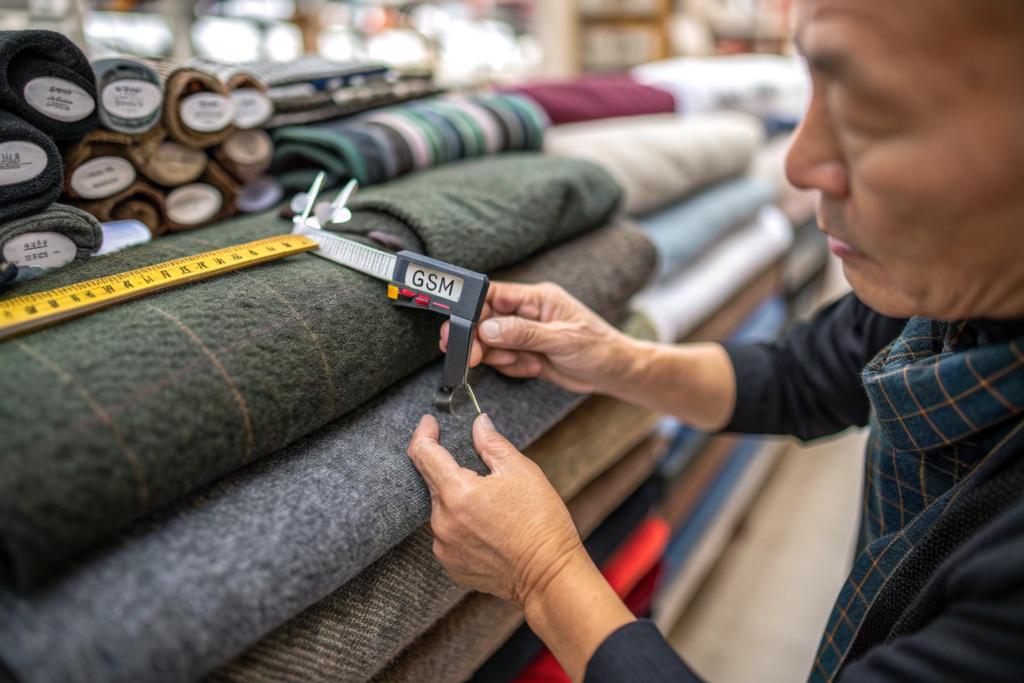
How does fabric construction (3-end vs. 2-end) affect the hand feel?
This is the technical detail that separates amateur buyers from pros. Most people don’t realize that GSM is only half the story. The construction—whether it’s 2-end or 3-end—completely changes how the fabric behaves.
Two-end fleece is your standard jersey back. It uses two yarns to form the loop on the back. It’s lighter, usually in the 280–320gsm range, and it’s what you find on basic mass-market hoodies. It drapes softer but doesn’t hold structure as well. It also tends to lose its loft faster after repeated washing.
Three-end fleece is the streetwear standard. We run three yarns in the loop formation, which creates a denser, more substantial back. The front face is smoother, and the back has that classic "fleece" texture that feels incredible. The third yarn adds about 30% more weight and doubles the warmth. When you hold a 420gsm 3-end fleece from our mill next to a 420gsm 2-end fleece from a budget mill, the difference is obvious. The 3-end feels solid, almost like a light blanket. The 2-end feels like thick t-shirt material.
We actually developed a specialized 3.5-end construction for a German workwear brand that wanted the warmth of fleece with the abrasion resistance of a woven face. We ran an extra yarn on the face side to create a tighter surface. It’s complicated to run—requires specific circular knitting machine modifications—but the result is a fabric that looks premium for years.
What’s the ideal weight for oversized streetwear silhouettes?
Oversized is tricky because the fabric has to do more work. In a standard fit hoodie, the seams and fit provide structure. In an oversized piece, the fabric itself becomes the structure.
For true oversized silhouettes—think 2XL wearing like a 4XL—we recommend 450–500gsm. Here’s why: when you size up dramatically, the fabric spans larger areas without body contact. If you use something too light (under 380gsm), the hoodie will collapse and look shapeless. It’ll drape like a nightgown, not a statement piece.
We had a client from Barcelona who designed an incredible oversized zip hoodie. Their first sample used 400gsm. When they put it on the fit model, the front panels sagged because the zipper was heavier than the fabric could support. We moved them to our 480gsm cross-hatch fleece. The extra density held the zipper straight, and the shoulders kept their shape.
For drop-shoulder designs, the weight matters even more. Drop shoulders put stress on the shoulder seam at a different angle than set-in sleeves. Lighter fleece (under 400gsm) will start to droop at the shoulder point after a few wears. At 480gsm+, the fabric has enough internal strength to resist that deformation.
One pro tip: if you’re doing extreme oversized (like 3XL+), consider a cross-hatch or birdseye pattern on the face. The textured surface adds visual weight that matches the physical weight, and it hides any minor tension issues during cutting. We supply a 520gsm cross-hatch to a major Korean streetwear label, and they cut it exclusively for their oversized "Blank" collection. It sells out every drop.
Which Yarn Composition Prevents Pilling After 50 Washes?
I learned this lesson the hard way in 2018. We shipped 15,000 yards of beautiful 420gsm fleece to a Canadian client. It felt perfect in the hand. Passed all our initial tests. Then the client came back three months later with photos of the hoodies after five washes. They looked like they had some kind of skin disease—tiny pills all over the chest and sleeves. We refunded the entire order. Cost us over $60,000. That’s when we rebuilt our entire approach to fiber selection.
Pilling is the number one killer of streetwear brand reputation. Your customer spends $100+, waits two weeks for shipping, wears the hoodie five times, washes it, and suddenly it looks like it belongs in a rag bin. They’re never buying from you again, and they’re posting about it on Reddit.
The problem usually starts with the yarn. Cheap fleece uses short-staple fibers—think 28mm to 32mm cotton length. These short fibers have more ends sticking out of the yarn. During washing, those ends tangle together and form pills. Premium fleece starts with longer fibers.
For our heavyweight program, we spec 35mm+ staple length for cotton components, and we use high-tenacity polyester filaments for the synthetic blends. The longer the fiber, the fewer ends, the less pilling.
But fiber length is only half the equation. The twist factor matters just as much. Higher twist yarns hold the fibers tighter. They’re harder to pill because the fibers are locked in. Lower twist yarns feel softer initially—that "buttery" hand feel that everyone loves—but they pill faster. We balance this by using a medium-high twist for the face yarns and a slightly lower twist for the backing yarns. The face needs durability, the back needs softness against skin.
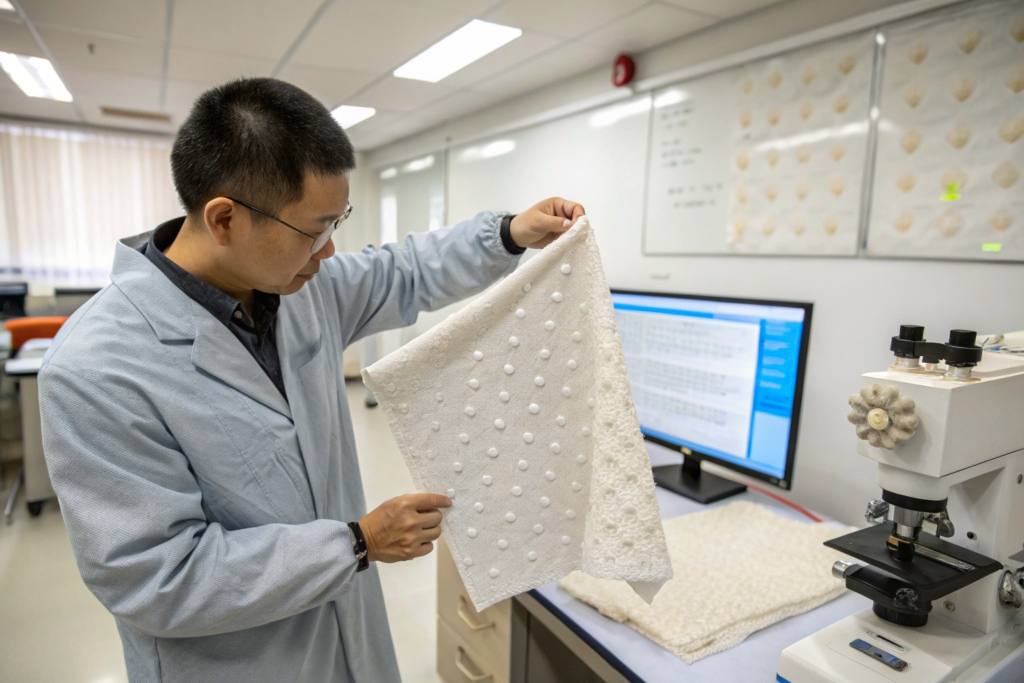
What cotton-to-polyester ratio gives the best durability?
There’s a war in the streetwear world right now between the "100% cotton purists" and the "performance blend crowd." I work with both, and here’s the truth: for heavyweight fleece that lasts, you need polyester.
The ideal ratio for durability is 80% cotton / 20% polyester. This is the sweet spot. Here’s why: the cotton gives you that natural, breathable hand feel and the ability to take garment dyes and pigments beautifully. The polyester acts as a reinforcement structure. It has higher tensile strength and better elastic recovery. When you blend 20% polyester into the yarn, it creates a "skeleton" that holds the cotton fibers in place.
We run extensive Martindale abrasion tests on all our blends. A 100% cotton 420gsm fleece typically fails around 15,000 cycles. Our 80/20 blend hits 25,000+ cycles before showing wear. That translates directly to real-world durability.
For clients who insist on "100% cotton" for their brand story, we use a different approach: ring-spun cotton with a higher twist and a special compact spinning process. This reduces the protruding fibers by about 40% compared to regular open-end spinning. It’s more expensive—adds about $0.50 per yard—but it’s the only way to get acceptable pilling performance without synthetics.
We supply a 100% organic ring-spun fleece to a Japanese brand that refuses to use polyester. The pilling rating is 3.5 after 50 washes on the ASTM scale. Not perfect, but acceptable for the natural fiber purists. Compare that to our 80/20 blend, which maintains a 4.5 rating (virtually no pilling) after the same test cycle.
How does compact spinning technology reduce pilling compared to open-end?
This is where the nerdy technical stuff actually matters for your bottom line. Most budget fleece mills use open-end spinning (also called rotor spinning). It’s fast, it’s cheap, and it produces acceptable yarn for basic goods. But it’s terrible for pilling resistance.
Open-end spinning works by feeding fibers into a rotor that twists them into yarn. The fibers aren’t perfectly aligned. They end up with a slightly chaotic structure, with fiber ends randomly distributed throughout the yarn. Those ends become pills.
Compact spinning is different. It uses an aerodynamic zone to align all the fibers perfectly parallel before twisting. Imagine the difference between a twisted rope and a braided cable. The compact-spun yarn has almost no stray fiber ends on the surface. When we run pilling tests, compact-spun yarns outperform open-end by a full point on the 1-5 scale.
We invested in 12 new compact spinning frames in 2022 specifically for our heavyweight fleece line. They cost about $150,000 each, but the quality difference is undeniable. When a client from a major sportswear brand visited last year, they brought their own pilling tester. We ran a side-by-side comparison: our compact-spun 80/20 against a competitor’s open-end 80/20. After 2,000 cycles, the competitor’s sample looked like sandpaper. Ours looked new.
The downside? Compact spinning is slower. It produces about 20% less yarn per hour. That means higher cost—usually $0.30 to $0.50 more per yard. But for premium streetwear, it’s non-negotiable. Your customers will never know why their hoodie looks great after a year, but they’ll know it does.
Where Should I Source Brushed vs. Unbrushed Fleece for Different Seasons?
A buyer from Amsterdam once asked me for "that cozy winter feel but also the clean summer look." She wanted one fabric for both seasons. I had to explain that brushing isn’t just a finish—it’s a fundamental change to the fabric’s personality. You can’t have both from the same roll.
Brushing is a mechanical process where we run the fabric through rollers covered in fine metal hooks or teasel brushes. These hooks pull out the fibers from the yarn, creating that soft, fuzzy surface. For heavyweight fleece, we typically brush the back (the inside of the garment) and sometimes the face.
The decision between brushed and unbrushed affects everything: warmth, breathability, cost, and even how the fabric accepts printing.
Unbrushed fleece (often called French Terry) has loops on the back and a smooth face. It’s more breathable, less insulating, and has a cleaner, more technical look. It’s perfect for transitional seasons—spring and early fall—and for layering. It also prints better because the surface is smoother. We supply unbrushed 400gsm to a streetwear brand in Milan that does massive screen prints on hoodie backs. The prints lay flat and crack less because the surface is consistent.
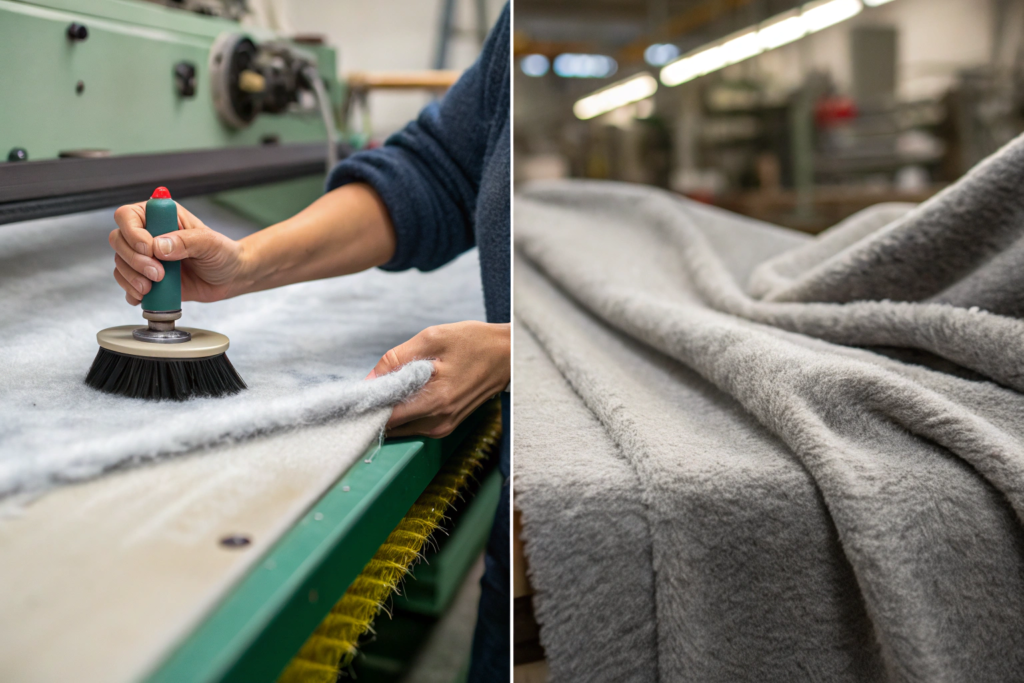
Brushed fleece goes through an additional process. We run it through napping machines that lift the fibers, then through shearing machines that cut them to a uniform height. The result is that cloud-like interior that feels like a hug. It traps more air, so it’s warmer. It also hides minor imperfections in the knitting. The downside? It sheds more lint initially, and it’s harder to print on because the fuzzy surface absorbs ink unevenly.
What’s the production timeline for brushed fleece vs. unbrushed?
This is where planning saves you from disaster. Unbrushed fleece is straightforward: knit, dye, finish, ship. We can turn unbrushed in 25-30 days if the yarn is in stock.
Brushed fleece adds at least 7-10 days to that timeline. Here’s the process: after dyeing and drying, the fabric goes to the napping range. It passes through 8 to 12 napping units in sequence. Each unit has rollers that rotate at different speeds, gradually raising the fibers without tearing them. Then it goes through the shearing machine, which uses helical blades to trim the raised fibers to a precise height—usually 1.5mm to 2.5mm for heavyweight fleece.
Then we have to repeat the whole process. First pass raises the long fibers, second pass raises the shorter ones that were trapped. If we rush this, the brushing is uneven or the fabric loses strength. We learned this in 2019 when a client demanded 5-day brushing. We tried to accelerate the process by running higher speeds. The fabric looked great initially, but after three washes, the brushed surface flattened completely. The client was furious. Now we refuse to cut corners on brushing time.
If you’re ordering for winter, place your brushed fleece orders 8-10 weeks ahead. For unbrushed, 6-8 weeks is usually safe. During peak season (August to October), add 2 weeks to both. Our brushing lines run 24/7 from July through November, and we still have to turn away rush orders.
How do I choose the right brushing intensity for my target market?
Different markets have different expectations for "soft." American streetwear brands typically want aggressive brushing—that super-plush, almost velvety interior. European brands often prefer a lighter touch—still soft, but with more defined texture.
We offer three brushing levels:
- Light brush: One pass through the napper, minimal shearing. The loops are still visible, just softened. Great for year-round hoodies in moderate climates.
- Medium brush: Two passes, light shearing. This is our most popular for premium streetwear. The interior is soft but still has some structure. It doesn’t flatten completely after washing.
- Heavy brush: Three or four passes, aggressive shearing. This creates that "teddy bear" interior. It’s incredibly cozy but requires careful washing instructions. We recommend this only for winter-specific drops in cold climates.
A client from Chicago orders our heavy brush for their December releases. A client from San Diego uses light brush for their "winter" collection (which they ship in January when it’s 60 degrees). Know your customer’s climate and wash habits.
The brushing also affects shrinkage. Aggressively brushed fabrics shrink slightly more because the fibers have been mechanically loosened. We pre-shrink all our brushed fleece in the finishing process, but we still recommend our clients cut their patterns with 3-5% oversize allowance, just in case.
What Pre-Shrinking Process Ensures My Hoodies Stay True to Size?
A streetwear brand from London almost went bankrupt in 2021. Not because their designs were bad—they were actually fire. Because their hoodies shrank two sizes after the first wash. Customers posted videos on TikTok: "Bought a Large, washed it once, now it fits my little brother." The returns killed their margins. The brand died. The supplier? Some trading company in Guangzhou who promised "preshrunk" but delivered lies.
Shrinkage is physics. Cotton fibers swell when wet, and the tension from knitting relaxes. The fabric wants to return to its natural state. If you don’t control this in finishing, it happens in your customer’s washing machine.
The industry standard for "preshrunk" is 3-5% maximum shrinkage. For premium streetwear, we aim for under 3% in both directions. Here’s how we get there.
First, we control the knitting tension. If the fabric is knit too tight, it stores more energy, which releases as shrinkage later. Our knitting machines are calibrated to maintain consistent tension across the entire roll. We check this every hour during production.
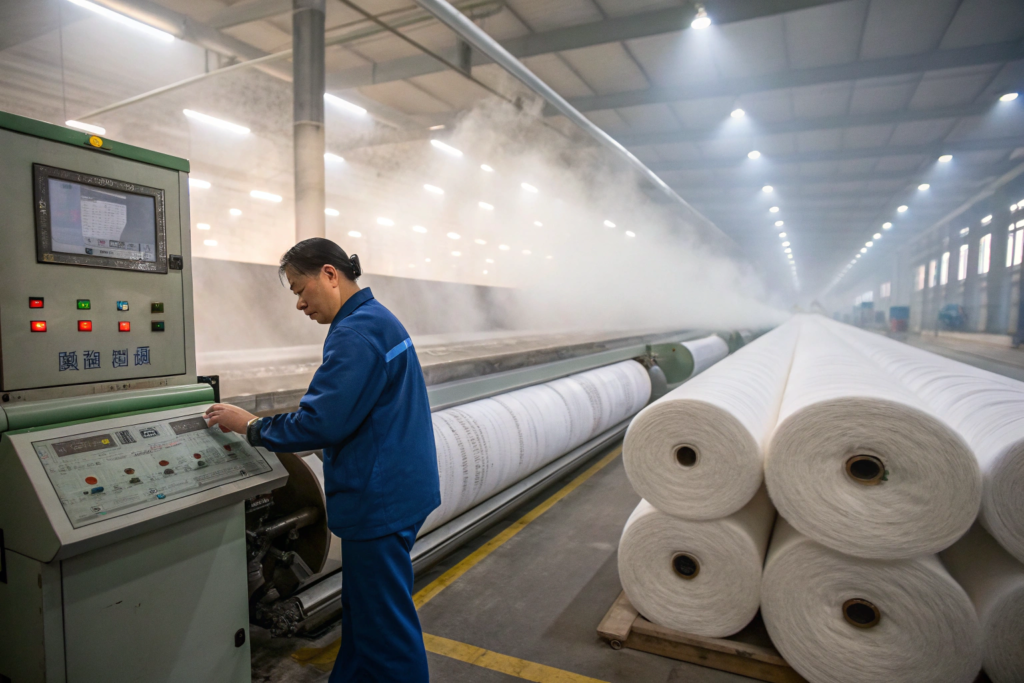
Second, we use a process called compaction (sometimes called Sanforizing, though that’s a brand name). The fabric passes through a machine with a heated roller and a rubber belt. The belt compresses the fabric mechanically, forcing the yarns to relax and "settle" into their final position. It’s like pre-shrinking without water.
Third, we run a wash test on every batch. We cut a 50cm x 50cm sample, wash it three times in our test lab (using standard washing procedures), and measure the difference. If it’s over 3%, the entire batch goes back for reprocessing. This adds cost and time, but it’s why our clients trust us.
How does the compacting process differ for various fleece weights?
Heavyweight fleece is harder to compact than lightweight jersey. The machine has to work harder to compress those thick yarns. We run our compacting line slower for 450gsm+ fabrics—usually 15-20 meters per minute instead of 30-35 for lighter goods.
The moisture level also matters. For standard fleece, we add steam to relax the fibers before compaction. For heavyweight, we use more steam and higher roller temperatures. The fibers need more energy to relax fully. If we don’t get this right, the compaction is superficial—it looks preshrunk initially, but after washing, the shrinkage returns.
We also run multiple passes for extremely heavy fabrics. A 600gsm fleece might go through the compactor twice: once to relax the face yarns, once to relax the backing. This doubles our processing cost, but it’s the only way to guarantee under 3% shrinkage.
One trick we’ve learned: compacting immediately after dyeing works better than compacting after storage. The fibers are still "open" from the dye process and more receptive to mechanical relaxation. We schedule our production so that compacting happens within 48 hours of dyeing. This requires tight coordination between our dyehouse and finishing department, but it’s worth the logistics hassle.
What shrinkage test standards should I request from my supplier?
Don’t accept vague promises. Ask for specific test methods. Here’s what we use:
AATCC 135 (American Association of Textile Chemists and Colorists) is the standard for dimensional changes in home laundering. We run this test after 1 wash and after 3 washes. The 3-wash result is more important because some shrinkage happens progressively.
ISO 6330 is the international standard. It specifies exactly how to wash and dry the samples—water temperature, cycle type, detergent amount, drying method. We run ISO 6330 for all our European clients because it matches their market’s testing requirements.
The key variable is drying method. Line drying produces less shrinkage than machine drying. If your supplier tests with line drying but your customers use dryers, the numbers won’t match reality. We test both ways and report both numbers. For US clients, we always test with machine drying (tumble dry low) because that’s what 90% of American consumers do.
A client from Seattle taught us something valuable: test after five washes. Some fabrics look stable after three washes then shrink again on the fourth. We now run extended wash tests for all new developments. If a fabric passes 3 washes but fails at 5, we go back to the drawing board.
Ask your supplier for a shrinkage certificate with the actual test results, not just "pass/fail." The numbers should include length shrinkage, width shrinkage, and any skewing (distortion of the grain). For heavyweight fleece, width shrinkage is often higher than length because of how the knitting machine tensions the fabric. We adjust our knitting specifications to balance this, aiming for equal shrinkage in both directions. This makes pattern cutting easier for your sewing factory.
How Do I Manage MOQs for Limited Edition Streetwear Drops?
A designer from Brooklyn called me in early 2024. He had 12,000 Instagram followers, a killer design, and exactly $8,000 in savings. Every mill he contacted wanted 3,000 yards per color. His entire run would be 600 yards total. They laughed at him. He found us through a forum post asking how to find Chinese fabric suppliers with low minimums for startup brands. We made it work.
The streetwear game has changed. It’s not just about the big players anymore. The most exciting stuff comes from limited drops—500 units, 200 units, even 100 units. But the textile industry was built for mass production. The mills want to run 10,000 yards of one color because that’s efficient.
We built our business model around this tension. We serve both the Zara-level giants and the bedroom brands. Here’s how we make low MOQs work without bankrupting you.
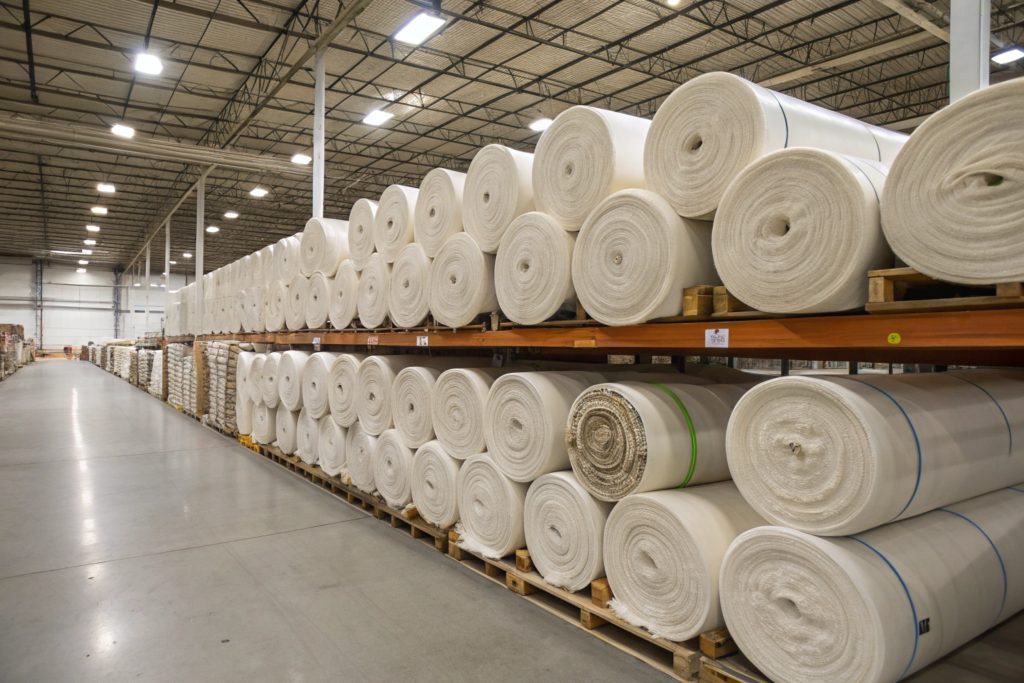
First, we maintain a massive greige inventory. Greige is the undyed, unfinished fabric straight off the knitting machines. We stock over 500,000 yards of heavyweight fleece in greige state at all times. When you need 300 yards of a specific color, we pull from this inventory and dye just that quantity. The dyehouse doesn’t love 300-yard runs—it’s inefficient for them—but we bundle multiple small orders together to make full production batches.
Second, we developed a rapid-sample program specifically for streetwear startups. We keep 50+ colors of heavyweight fleece in stock as finished goods—small rolls of 20-30 yards each. If you need 50 yards for a test drop, we ship it next week. The color selection is limited to our core palette (black, heather grey, olive, navy, burgundy), but it gets you to market fast.
What’s the realistic MOQ for custom-dyed heavyweight fleece?
Here’s the straight truth: for custom dyeing (your specific Pantone), most mills want 1,200 to 1,500 yards per color. That’s about 600-700 hoodies worth. For a startup, that’s a massive inventory risk.
We work differently. Our realistic MOQ for custom-dyed heavyweight fleece is 600 yards per color. That’s 300-350 hoodies depending on your pattern efficiency. Is it higher than the 200 yards you dreamed of? Yes. But it’s lower than anyone else offers for this quality level.
Here’s why we can’t go lower: dyeing consistency. When you dye a 200-yard batch, the color can shift from the beginning to the end of the batch. The machine needs time to reach temperature stability. By 600 yards, the process has stabilized. You get consistent color across the entire roll. If you try to sew a hoodie with fabric from the start and end of an unstable batch, you’ll see shading differences. Your customers will notice.
For clients who absolutely need lower, we offer our stock color program. We keep 15 core colors in inventory at all times, cut to any length from 50 yards up. The colors are carefully chosen—the shades that sell 80% of streetwear. You can order 100 yards tomorrow and ship next week. The trade-off is limited color choice.
How can I combine colors in one production run to save costs?
This is the smart move. If you need three colors at 300 yards each, that’s 900 yards total. Find a supplier who will run them together as one 900-yard dye lot.
Here’s how it works: we knit all three colors’ worth of greige fabric at once (same knitting specifications, same yarn lot). Then we split it into three batches for dyeing. The dyehouse sets up the machines once, calibrates for the first color, runs it, then cleans and runs the next. The efficiency comes from sharing the setup cost across three orders instead of one.
We did this for a German streetwear collective last year. They needed four colors at 250 yards each for a capsule collection. We ran all four back-to-back in one week. Their per-yard dye cost was 30% lower than if they’d ordered each color separately from different suppliers.
The key is planning. You need to commit to all colors at once, and you need to accept delivery on a similar timeline. If one color is delayed, the whole batch waits. But for a coordinated collection drop, that’s usually fine.
Another strategy: seasonal color families. If you’re doing a winter drop, choose colors that use similar dye chemistries. Olive, rust, and burgundy can often run in sequence without extensive machine cleaning. Switching from olive to neon pink requires a full chemical cleanout. Your sales person (if they know their stuff) should guide you toward colors that play well together.
How Do I Verify the Ethical Production of Heavyweight Fleece?
A client from Copenhagen visited us in 2023. She didn’t ask about prices for the first hour. She asked about our workers’ housing, our wastewater treatment, our overtime policies. She told me about a brand that got destroyed on social media because a viral video showed their "ethical" hoodies being made in a dirty sweatshop. The brand didn’t survive the weekend.
Your customers care where their clothes come from. Gen Z and younger Millennials will actually pay more for verified ethical production. But they’re also skeptical—they’ve been lied to too many times. You need proof, not stories.
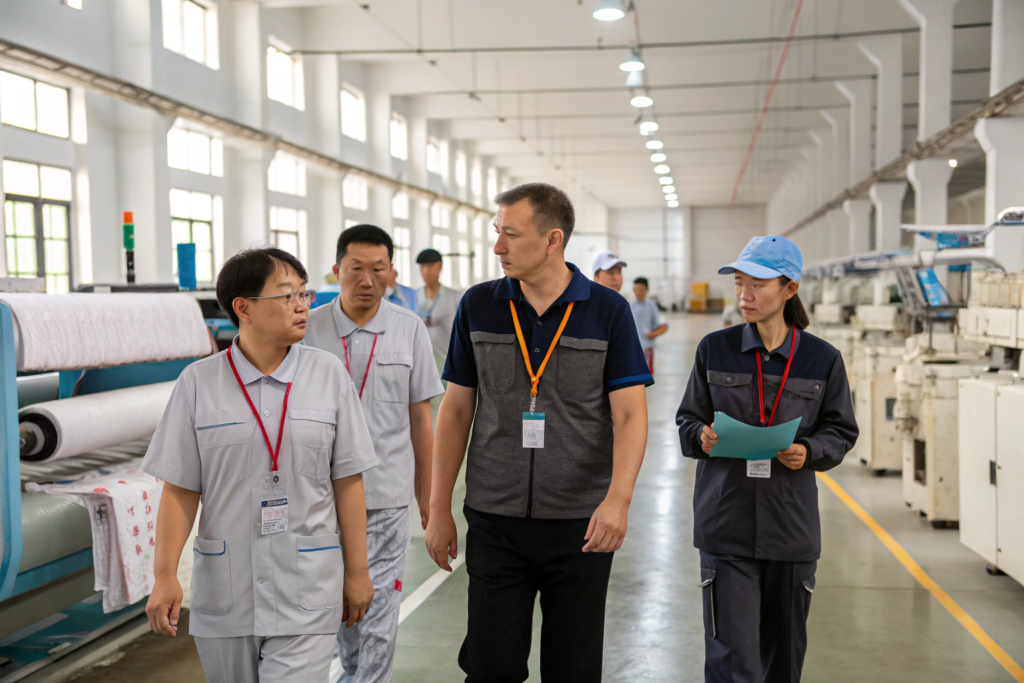
At Shanghai Fumao, we’ve invested heavily in third-party audits and certifications because we know our clients need to defend their supply chain. We don’t just say "we’re ethical." We show the paperwork.
What certifications prove a fleece mill meets international labor standards?
You need to look for specific certifications, not generic claims. Here are the ones that actually matter:
WRAP (Worldwide Responsible Accredited Production) is the gold standard for apparel manufacturing. It covers labor practices, factory conditions, and environmental compliance. We’ve been WRAP-certified since 2019. The audit is unannounced, which means they show up without warning. If we were hiding anything, they’d find it.
BSCI (Business Social Compliance Initiative) is widely accepted in Europe. It’s a 2-year certification with annual follow-ups. Most of our European clients require BSCI as a baseline. We maintain an "A" grade, which is the highest level.
SA8000 is tougher and less common. It focuses specifically on social accountability—fair wages, no child labor, freedom of association. We’re working toward this certification now because our Scandinavian clients increasingly demand it.
Beyond certifications, ask for payroll samples. A certified auditor should verify that workers are paid fairly and on time. We provide redacted payroll data to clients who sign NDAs. If a supplier refuses to show you anything, that’s a red flag.
A client from Melbourne taught me something: ask about worker turnover. High turnover often indicates poor conditions. Our turnover is under 5% annually—many of our workers have been with us for over 10 years. When we took a client on a factory tour, she spent 20 minutes talking to our sewing machine operators through a translator. She later told me that conversation meant more than any certificate.
How can I trace the cotton back to the farm?
Traceability is the next frontier. The EU 2026 strategy is pushing for this, but the best brands are already doing it.
For cotton, you need chain of custody certification. The two main ones are:
GOTS (Global Organic Textile Standard) covers the entire supply chain from farm to finished fabric. If a fabric is GOTS-certified, every step—ginning, spinning, knitting, dyeing—has been audited. The cotton itself is certified organic. We offer GOTS-certified heavyweight fleece, but the MOQs are higher because the certified cotton supply chain is separate from conventional.
BCI (Better Cotton Initiative) is a step below GOTS. It doesn’t guarantee the cotton is physically traceable to your specific roll. It works on a mass balance system—you’re supporting better cotton farming, but your actual fabric might contain conventional cotton. Some brands accept this; others want full segregation.
For full traceability, we use a blockchain pilot program with a few key clients. Each bale of cotton gets a digital ID at the gin. That ID follows through spinning, knitting, and dyeing. When we ship your fabric, you get a digital passport showing the entire journey. It’s expensive—adds about 15% to the fabric cost—but for a premium streetwear brand telling an origin story, it’s powerful.
A Japanese client used this for a limited collection of 500 hoodies. They marketed them as "From Field to Hoodie in 6 Months" with QR codes linking to the actual farm location. Sold out in 4 hours.
Conclusion
Sourcing heavyweight fleece for streetwear isn’t just about finding a supplier. It’s about finding a partner who understands what your brand needs to survive. The weight, the construction, the finish, the shrinkage control, the ethical verification—every detail matters because every detail reaches your customer.
I’ve watched too many brands fail because they chased the lowest price and ended up with fabric that pilled, shrank, or fell apart. I’ve also watched brands grow from Instagram side projects to legitimate businesses because they built on a foundation of quality. The fabric is literally the foundation of your garment. If it’s wrong, nothing else matters.
At Shanghai Fumao, we’ve spent 20 years building systems that help brands at every stage—from the startup needing 100 yards for a test drop to the established label ordering container loads for global distribution. Our heavyweight fleece program exists because we believe streetwear deserves better than commodity fabric.
If you’re working on a streetwear collection and you want to talk GSM, construction, brushing, or ethical sourcing, reach out. This is what we do every day. We can help you avoid the mistakes I’ve made and the mistakes I’ve seen others make.
Contact our Business Director, Elaine. She coordinates all our streetwear and premium apparel accounts. She knows the product inside out, and she can walk you through options based on your specific needs—limited drop, full collection, custom development, whatever. Just email her at elaine@fumaoclothing.com. Tell her about your brand, your timeline, and your target customer. She’ll make sure you get the right fabric for your vision.
At shanghai fumao, we don’t just sell heavyweight fleece. We help build streetwear brands that last.