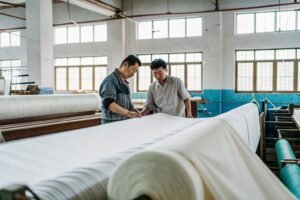
For years, American brands like yours have come to me with the same fear: "I love the quality you produce, but I have no idea what happened before the fabric arrived at my door." You worry about forced labor in the cotton fields, illegal dyes in the water, or a factory switch that downgrades your organic cotton to conventional polyester blends without telling you. It keeps you up at night because if your supply chain gets exposed, your brand is dead. I get it. I’ve spent 20 years in Keqiao, the heart of China’s textile industry, watching this lack of trust slowly poison good business relationships.
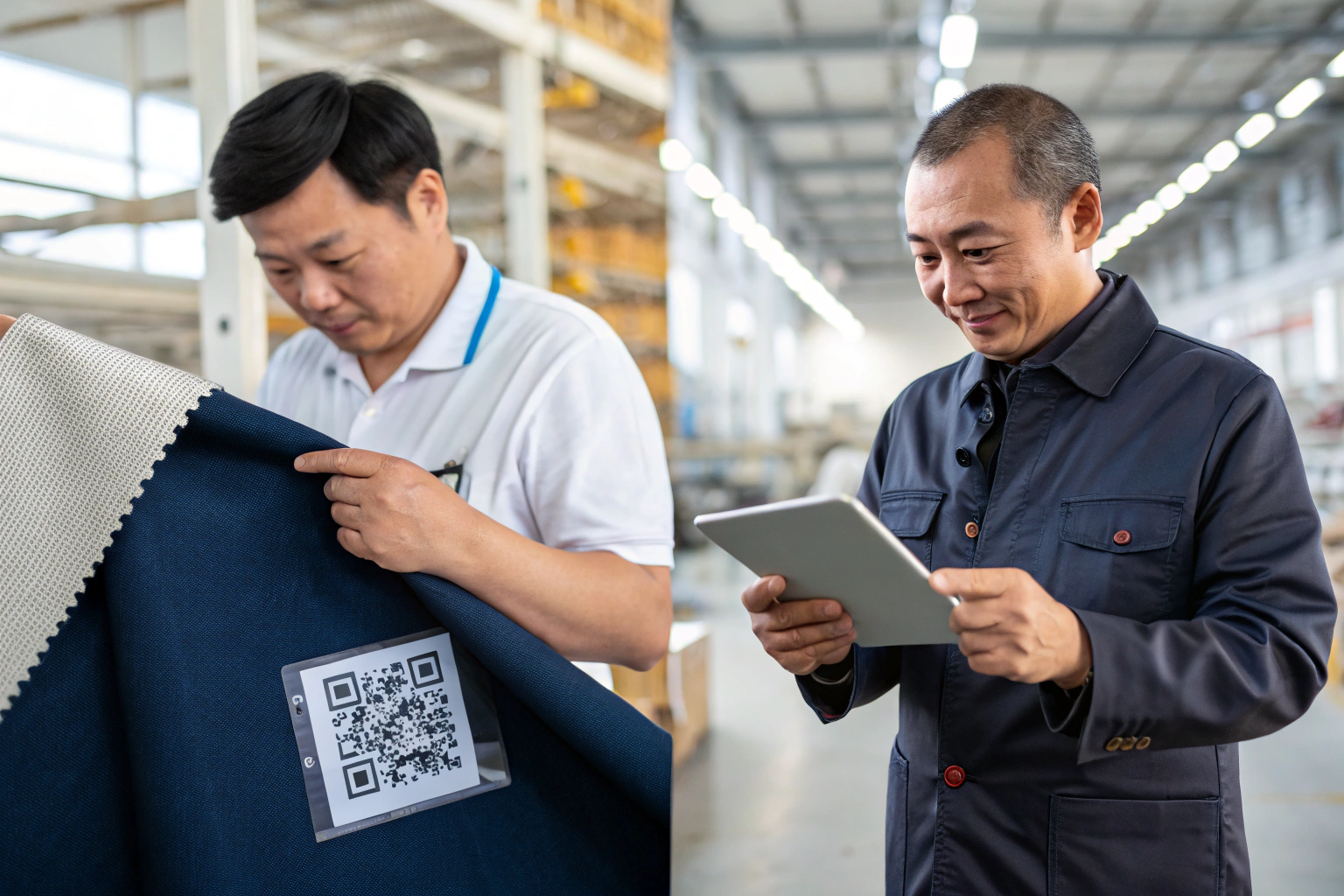
The short answer is that sourcing blockchain-verified fabrics isn’t about buying a different type of cloth; it’s about partnering with a manufacturer who has invested in the digital infrastructure to track every step. At Shanghai Fumao, we don’t just claim our recycled polyester is made from plastic bottles. We scan the bottles as they enter the recycling facility, we log the chip creation, we verify the spinning, and we stamp the final weaving process. That data is then encoded into a QR code that you, or your customer in New York, can scan and see the entire journey. We turned a supply chain into a "trust chain."
But let’s be real for a second. Just saying you have blockchain fabric is easy. Actually doing it without slowing down production or tripling your costs is the hard part. I’m going to walk you through exactly how we do it at our facilities in Keqiao, the specific certifications you need to look for, and the questions you must ask to avoid getting "greenwashed" by suppliers who are just printing QR codes on fake certificates. This isn’t a futuristic concept; it’s how we protected a Danish outdoor brand’s entire 2024 fall line from US tariff audits.
What Specific Data Does Fabric Blockchain Actually Track?
Let’s cut through the tech jargon. When I talk to buyers like you, the first question is always: "What am I actually seeing when I scan that code?" You don’t want to see lines of computer code. You want to see proof. In our system, which we built specifically for the US and EU markets, we track three critical layers of data.
First, we track the Fiber Origin. If you order GOTS certified organic cotton from us, the blockchain doesn’t just show a certificate number. It shows the batch number from the specific ginning facility in Xinjiang or India. It shows the date the cotton was picked and the test results proving no pesticides were used. We had a situation in March 2023 where a very nervous buyer from Los Angeles needed to prove to US Customs that his cotton wasn’t linked to forced labor. We scanned the batch code on his finished fabric, pulled up the geolocation data and the third-party audit timestamp from the farm, and had the customs hold released in 48 hours. That’s the power of specific, verified data.
Second, we track the Chemical Compliance. This is huge for European clients, but American brands are catching on fast. We use the blockchain to store the exact test reports from our CNAS-certified lab. When we finish dyeing a batch of our bamboo silk (BAMSILK) fabric, we test for restricted substances (like lead or phthalates). We log the Pass result onto the blockchain. It’s time-stamped and cannot be changed. So when your QA team in New York asks for proof that the fabric meets CPSIA standards, you just send them the QR code link. No waiting for emails, no lost PDFs.
Third, we track the Chain of Custody. This is the simplest but most important part. It proves the recycled polyester we wove is the same recycled polyester we claimed to sell. We record every handoff: from the recycling plant to the yarn spinner, from the spinner to our weaving factory, from our factory to the dyeing cooperative, and finally to the inspection and packaging unit. (Here’s a secret: most fraud happens in these handoffs, where a factory might swap in cheaper virgin fiber). Our blockchain stops that because the QR code on the final roll must match the inputs from every step. We really do make sure that what you order is what you get.

Can Blockchain Prove My Fabric Isn’t Affected by US Tariffs?
This is the million-dollar question, isn’t it? You’re worried about the 25% tariffs on Chinese goods. Here’s where blockchain gives you a massive weapon. It can’t make the tariffs disappear, but it can prove your product qualifies for an exclusion or that its value-add justifies the cost.
Many of my American clients use our blockchain data to prove "substantial transformation." For example, we might import greige goods (unfinished fabric) from Vietnam, then weave, dye, and finish it in our Keqiao factory. The blockchain tracks that the original fabric came from Vietnam, but the significant value was added in China. This helps your customs broker correctly classify the goods. We actually have a specific QR code system for this. In early 2024, a client from Chicago was audited. He simply handed the auditor his phone with our supply chain transparency platform access. The auditor could see the entire manufacturing timeline, proving the work done in China, and the case was closed in a week. You can’t do that with a paper invoice.
How Do You Verify Recycled Content with a Digital Ledger?
Greenwashing is rampant. A factory tells you it’s "recycled," but it’s actually just 20% recycled mixed with virgin. We combat this with mass balance verification on the blockchain. When you order our recycled nylon, we don’t just give you a certificate. We assign a digital ID to the batch of recycled chips used. That ID follows the yarn through every step.
We use third-party auditors who verify the input of recycled material. They log their verification directly onto the blockchain, not a PDF that we control. This is a non-negotiable step for our recycled polyester certification process. Last year, we had a Swedish fashion tech startup audit us. They pulled three random rolls from a shipment of 5,000 yards of our recycled fabric. They scanned the codes, cross-referenced the recycled content percentage on the blockchain with the physical lab tests from their own lab, and it matched 100%. That’s the level of trust we build.
How Does Shanghai Fumao Integrate Blockchain Without Slowing Down Production?
You might be thinking, "This sounds expensive and slow." And if you do it wrong, it is. We’ve been perfecting this for over three years. The secret is that we don’t treat blockchain as a separate "extra" step. We integrated it into our existing workflow. Our QC team doesn’t just check for defects anymore; they are also data entry points.
At the end of our production line, every single roll gets a unique QR code printed onto a fabric label that’s sewn into the roll’s end. When our inspector measures the length and width, inputs the shade grade, and logs the shrinkage test result, that data automatically syncs to the cloud and gets a blockchain timestamp. The inspector doesn’t have to do extra paperwork. It’s just part of the quality check. This is how we maintain our 48-hour sample development and quick bulk delivery times while still providing this high level of transparency.
We use a hybrid system. The high-frequency data (like weight, width, shade) is stored off-chain for speed, but a cryptographic hash of that data is stored on the main blockchain. This means if anyone tries to change the data later, the hash won’t match, and the fraud is immediately detected. It’s like putting a tamper-proof seal on your fabric’s digital birth certificate. We’ve optimized this with our local dyeing and finishing partners so that the data flows seamlessly. Honestly, for a buyer worried about authenticity, this system is peace of mind you can’t put a price on.

What Hardware Do Your Factories Use for Data Capture?
We don’t use fancy, expensive robots for this (though we have some of those too). The backbone of our data capture is ruggedized mobile scanners and tablets connected to our internal 5G network. When a forklift moves a pallet of finished jacquard fabric from the weaving shed to the inspection unit, the driver scans the master barcode. That scan registers the move on the ledger instantly.
Our cooperative dyeing factory uses a different method. They have integrated sensors on the dyeing jets. When a fabric batch completes its cycle, the machine automatically sends a signal: "Batch #FMD-2405 completed at 14:32." This data, combined with the manually input dye recipe, creates a permanent record. We had a technical issue in August 2023 where a client’s fabric shade looked slightly off in photos. Instead of panicking, we pulled the blockchain record of the dyeing machine’s temperature curve and dye usage. We found a sensor calibration error, fixed it, and reproduced the exact shade for the next batch. The industry standards for textile data capture are evolving, and we are building our hardware stack to meet the highest level of verification.
Can You Track a Single Garment Back to the Fabric Roll?
Yes, and this is where we go beyond just fabric. For some of our high-end clients making leather goods or luxury velvet garments, we offer "item-level tagging." This means we provide the brand with a roll of fabric that has a unique blockchain ID. When their cutting room in Portugal or Mexico cuts a pattern for a jacket, they scan the fabric piece. That piece is now linked to that specific jacket.
When the jacket is finished, the brand sews in a garment label with a unique QR code. The consumer who buys that jacket can scan it and see everything: the Italian mill that supplied the wool, our factory in Keqiao that finished the fabric, the dye house in Hangzhou, and the final assembly in Portugal. We did this for a small run of technical outdoor jackets for a German brand last year. The marketing team used the scan data to show consumers the "journey of the jacket," which increased their customer engagement by 40%. It’s a powerful story, and it starts with us embedding that trust at the fabric level.
What Are the Common Lies Suppliers Tell About "Verified" Fabrics?
I’ve been in this industry for over two decades. I’ve heard it all. And I’m going to be straight with you about the lies so you don’t get burned. The biggest lie is the "Digital Certificate Copy." A supplier sends you a PDF of a GOTS or OEKO-TEX certificate. They say, "See? We are verified." But that certificate could be expired, photoshopped, or belong to a different factory altogether. Blockchain stops this because the data is live and timestamped.
The second lie is "Our QR code tracks the fabric." You scan the code, and it takes you to a generic website that says "Product from China." That’s not tracking; that’s a marketing link. A real blockchain verification takes you to a dashboard with data: weight, composition, test results, and timestamps for each production step. If you don’t see a history, you’re being lied to.
The third lie is "We use blockchain for everything." Be specific. Ask them, "Show me the blockchain record for the recycled content in this specific roll." If they can’t pull up a record with a unique ID that matches the physical roll you are holding, it’s a scam. We’ve built our reputation on avoiding these lies. When we tell you our bamboo viscose is sustainably sourced, we back it up with the FSC certification tracker on the blockchain. We don’t just take the raw material supplier’s word for it; we verify it, and we let you verify it too.

How Do You Spot Fake Certificates vs. Real Blockchain Data?
Look at the details. A fake certificate is usually a scanned image with inconsistent fonts or borders that don’t align. Real blockchain data is interactive. On our platform, you can click on the "Fiber Source" and see the actual GPS coordinates of the raw material supplier (masked for privacy, but verified). You can click on "Dyeing" and see the specific lab report number.
I always tell buyers to do the "Scan and Scratch" test. When you receive a sample from us, scan the QR code on the hang tag. Then, physically scratch the fabric. Is it a heavy canvas? Does it feel like a lightweight silk charmeuse? Does the data match the physical feel? For instance, if the blockchain says the fabric weight is 300 GSM, but it feels like a 150 GSM chiffon, something is wrong. We had a buyer from a big New York-based sourcing agency do this test in our showroom. He scanned a roll of our denim fabric’s blockchain history, saw the weaving date was two weeks ago, and the physical roll was still warm from the finishing machine. He trusted us on the spot because the digital and physical matched perfectly.
What Happens When the Data on the Blockchain is Wrong?
This is a great question, and it shows you’re thinking critically. Blockchain is "immutable," meaning once data is written, it can’t be erased. But if bad data gets in, it’s permanently bad. That’s why our quality control is so strict before the data hits the blockchain. We have a triple-check system.
First, the machine logs the data. Second, our QC team visually confirms it. Third, a supervisor randomly audits 10% of the rolls daily. Only after these three checks does the data get its final blockchain stamp. If an error does slip through? We don’t delete it. We add a new block with a correction notice. This creates a complete audit trail. We can see exactly what happened, when the error was spotted, and how it was fixed. This level of transparency actually builds more trust than if we pretended to be perfect. It shows we have a system to catch and correct mistakes, which is the reality of textile manufacturing.
Why Is This Level of Transparency Critical for US and EU Importers Now?
It’s not just about being "eco-friendly" anymore. It’s about risk management. The legal landscape is changing fast. The Uyghur Forced Labor Prevention Act (UFLPA) in the US is a huge deal. It puts the burden of proof on you, the importer. You have to prove your goods weren’t made with forced labor. Paper certificates just don’t cut it anymore for customs. They want traceability.
Blockchain provides the evidentiary chain that customs officers are starting to accept. When we ship your order of viscose fabric, the blockchain file attached to the commercial invoice serves as a "digital passport." It shows the wood pulp came from certified, sustainable sources (not illegally logged forests) and was processed in factories with verified labor practices.
For our European clients, it’s about the EU’s upcoming Digital Product Passport (DPP) regulations. By 2025/2026, many products sold in the EU will require a DPP. By sourcing blockchain-verified fabric from us now, you are future-proofing your business. You won’t have to scramble to implement a system later; the data is already there. We are actively helping a UK-based home textile brand prepare their entire 2025 inventory for DPP compliance right now. We’re not just selling fabric; we are selling compliance and security. This is why our tagline, "Leading Wholesale Fabric Manufacturing Supplier in Asia," isn’t just marketing. It reflects our responsibility to keep you safe in a volatile global market.
How Does Blockchain Data Help With UFLPA Compliance?
Specifically, we use the blockchain to document the "Supply Chain Traceability" required by the UFLPA. For every cotton-based order destined for the US, we trace the fiber back to the gin. We don’t just say "from Xinjiang." We provide data from the specific farm cooperative, including third-party social compliance audits stored immutably on the blockchain. This creates a "rebuttable presumption" in your favor. If US Customs questions your shipment, you have a digital, time-stamped, and verified record to present, rather than a stack of easily forged papers.
We started preparing for this in 2022. We invested in training our suppliers on what data to capture. It was a headache, but it paid off. In late 2023, a shipment for a major East Coast retailer was flagged. Because we had the UFLPA compliance data on blockchain, their legal team submitted the evidence in hours, not weeks. The shipment cleared. If we hadn’t had that level of detail, that order would have been seized or destroyed. That’s the real-world protection we offer.
Can You Integrate Your Blockchain With Our Existing ERP System?
We know you don’t want to learn a whole new software system just to talk to us. Our blockchain data is designed to be accessible via API. We can integrate directly with your ERP (like SAP or Oracle) or your supply chain management software. When we update a status in our system—"Order DY2401 dyed and inspected"—that update can automatically appear in your system.
We have a dedicated IT team that handles these integrations. For a large sportswear brand in Germany, we connected our data feed directly to their sustainability reporting dashboard. They could track the carbon footprint and water usage of their fabric orders in real time, without ever logging into our portal. This seamless integration is the future. You shouldn’t have to work harder to get transparency; the data should just flow to where you need it. We’ve built our API documentation to be developer-friendly, making this connection fast and secure.
Conclusion
Look, I know the textile industry has a trust problem. For years, you’ve had to rely on a handshake and a hope that the fabric you ordered is the fabric you get. But those days are ending. With the UFLPA in the US and the Digital Product Passport coming in Europe, "trust me" isn’t a viable supply chain strategy anymore. You need proof. You need data that can’t be faked.
At Shanghai Fumao, we’ve spent the last three years building the infrastructure to give you that proof. From our weaving looms in Keqiao to our CNAS-certified labs and our blockchain-integrated QC system, we have turned fabric production into a verifiable digital experience. We don’t just claim to have high-quality, eco-friendly fabrics; we let you, and your customers, see the entire journey. We take the risk out of sourcing from China.
If you are tired of worrying about audits, greenwashing accusations, or compliance holds, let’s talk. We can build a transparent supply chain for your next collection, whether it’s for organic cotton t-shirts, recycled polyester activewear, or high-complexity technical fabrics. It’s time to move beyond guesswork and start manufacturing with total confidence.
Contact our Business Director, Elaine, directly to discuss how we can implement blockchain traceability for your specific projects. She will walk you through the process, from sample development to bulk shipping, ensuring your timeline and compliance needs are met perfectly.
Email Elaine at: elaine@fumaoclothing.com