
I remember a phone call that still makes my stomach drop. It was 2019, a client in Texas—let’s call him Mark—had just shipped his first container of denim jackets from China. He was excited. The product looked great, the price was right. Then the bills started arriving. Customs brokerage fees. Harbor maintenance fees. MPF fees. Inland freight. Storage charges because his warehouse wasn’t ready. By the time those jackets landed on his dock, his total landed cost was 22% higher than he’d budgeted. His margin? Gone. He called me, frustrated, asking "Why didn’t anyone tell me about all these extra costs?"
That’s the problem with Ex Works or FOB shipping. You see the freight quote, but you don’t see the avalanche of hidden fees waiting on the other side. And for a first-time importer—or even an experienced one—those surprises can destroy a season’s profits.
This is why DDP—Delivered Duty Paid—has become the go-to choice for smart brands importing clothes to the USA in 2026. It’s not just convenient; it’s the safest way to know exactly what you’re paying, protect yourself from customs issues, and actually sleep while your container is on the water.
What exactly does DDP shipping mean for US importers?
You’ve probably seen DDP on freight quotes and wondered: "Is that just a marketing term, or does it actually change how my goods ship?" The difference is fundamental, and understanding it could save you thousands.
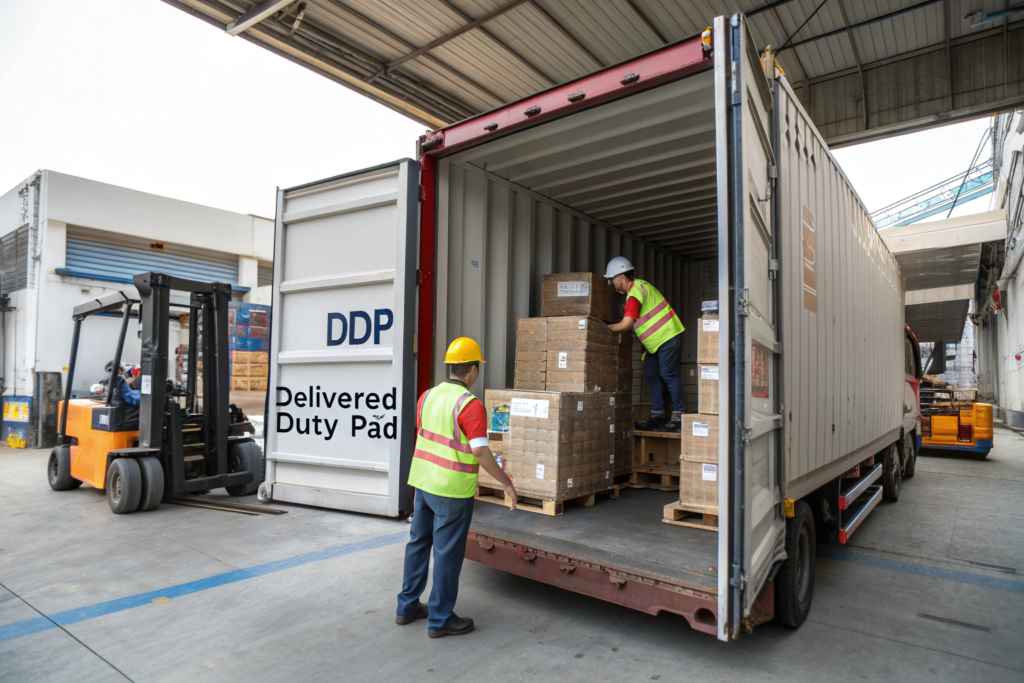
DDP stands for Delivered Duty Paid. In plain English: the seller (that’s us, the factory or our forwarder) takes full responsibility for getting your goods to your door—including all shipping costs, export/import customs clearance, and payment of duties and taxes. You pay one price, and the goods show up at your warehouse. That’s it. No surprises, no extra invoices months later.
Under normal Incoterms like FOB or EXW, you own the risk and cost once the goods leave our factory. You pay for the truck to the port, the ocean freight, the insurance, the US customs clearance, the duties, and the truck to your door. Each of those steps involves separate vendors, separate invoices, and separate opportunities for something to go wrong or cost more than expected. With DDP, we handle all of that. We quote you a door-to-door price, and we eat any cost overruns. For a US buyer in 2026, with customs enforcement tightening and freight rates still volatile, that predictability is gold. If you’re new to Incoterms, this official ICC guide to Incoterms 2024 is worth reading.
Who pays the US import duties under DDP?
We do. That’s the "Duty Paid" part. When we ship DDP, we calculate the duty rate for your product under the HTS (Harmonized Tariff Schedule) code, include it in our price, and pay it to US Customs on your behalf before the goods are released. You never see a bill from customs. For you, this means:
- No cash flow hit for duty payments
- No risk of customs holding your goods for payment
- No surprise classifications with higher duty rates
But here’s the catch: we have to be absolutely certain about your product’s classification. If we under-declare the duty and customs audits later, we pay the penalty—not you. That’s why we insist on reviewing your product specs carefully before quoting DDP. A good example of how classification works is on the US Customs ruling database for apparel, which shows how specific garments get classified.
What’s the difference between DDP and DAP?
DAP—Delivered at Place—means we deliver the goods to your door, but you pay the duties and taxes upon arrival. The forwarder will contact you for payment before customs releases the goods. This sounds similar, but the risk is different. With DAP, if you’re slow to pay the duty, your goods sit at customs, racking up storage fees. With DDP, it’s all prepaid—the goods clear and move seamlessly. DAP is slightly cheaper because we don’t have to advance the duty money for you, but DDP is safer because there’s no last-minute payment delay. For most US importers, especially smaller brands, the small premium for DDP is worth the peace of mind.
How does DDP protect me from customs clearance nightmares?
US Customs is not a place you want to learn by making mistakes. If your paperwork is wrong, they don’t send a polite email—they hold your container, charge storage, and demand bonds and penalties. DDP puts that risk on us, where it belongs.
When you ship DDP, we handle the entire US customs clearance process. That means we classify your goods, we file the ISF (Importer Security Filing) 72 hours before loading, we post the customs bond (required for all imports over $2,500), and we communicate with the customs broker. If there’s a problem—a missing document, a classification dispute, a random inspection—we fix it. Your goods keep moving while we handle the paperwork.
I’ve seen buyers try to clear customs themselves to save money. It rarely ends well. US Customs has strict rules about labeling, fiber content, country of origin, and even the way the garment is constructed for flammability standards. If your commercial invoice doesn’t match the harmonized code exactly, you get a hold. If your country of origin label is missing or wrong, you get a hold. If Customs decides to verify your duty rate, you wait. With DDP, we’ve already vetted all this before the ship sails. We know what documentation CBP requires because we work with US brokers every single day.

What happens if customs inspects my DDP shipment?
We handle it. If your container gets pulled for examination, our broker manages the process. They arrange for the container to be moved to the inspection facility, they provide any additional documents requested, and they coordinate with the customs officer. You might get a delay of a few days, but you won’t get a surprise bill for thousands in exam fees—those are included in our DDP cost structure. And if the inspection finds a problem—say, the fiber content doesn’t match the label—we work with you and the factory to resolve it. The risk of non-compliance stays with us. The CBP website’s import basics page explains the examination process, but experiencing it is another story entirely.
How do you ensure my goods comply with US labeling laws?
This is critical. US labeling laws (under the Textile Fiber Products Identification Act) are specific: fiber content must be listed in descending order by weight, the country of origin must be in English, and the manufacturer or dealer identifier must be registered. We’ve been shipping to the US for 20+ years—we know these rules. Before your bulk production starts, we review your label artwork. We check the fiber percentages against our mill test reports. We confirm the RN number or company name is correct. We do this because if your labels are wrong, Customs can seize the entire shipment or demand they be re-labeled under bond. And that’s expensive. We’d rather catch it before cutting. For reference, the Federal Trade Commission’s labeling requirements are the official source.
Why does DDP give me more accurate total landed cost?
Mark, my Texas client, thought he knew his landed cost. He had the FOB price, the freight quote, and a rough idea of duty. What he missed was everything else. DDP eliminates "everything else."
With DDP, your total landed cost is the price on the invoice. Period. There are no "ancillary charges" arriving by mail three months later. No "unforeseen port fees." No "fuel surcharges" that somehow doubled. One price, one payment, one predictable number you can use to set your wholesale and retail prices with confidence.
Let me break down what’s actually included in a DDP price, compared to what you’d pay piecemeal under FOB:
- Export costs: Factory to Chinese port, export customs, terminal handling
- Ocean freight: Full container load (FCL) or less-than-container (LCL) shipping
- Insurance: Coverage for loss or damage during transit
- US import customs clearance: Broker fees, bond fees, ISF filing
- Duties and taxes: All MPF (Merchandise Processing Fee), HMF (Harbor Maintenance Fee), and actual duties
- Inland freight: Port to your warehouse or door
If you quoted FOB, you’d get separate bills for each of these from different vendors—the forwarder, the customs broker, the trucker, and the government. Each bill has its own fees, its own surprises. DDP collapses all that risk into one number we guarantee.

What hidden fees disappear with DDP?
The ones that hurt the most:
- Storage/detention: If your goods arrive and your warehouse isn’t ready, or if customs delays clearance, the container sits at the port costing you $100-$300 per day. With DDP, we coordinate the arrival to minimize storage—and if there’s a delay, we cover it.
- Exam fees: If customs randomly inspects, there’s a fee for the exam, plus possible demurrage. We cover that.
- Bond charges: Every importer needs a continuous or single-entry bond. If you’re not set up, that’s a last-minute rush fee. We already have bonds in place.
- Currency fluctuation: If the dollar weakens between shipment and duty payment, your duty cost in USD goes up. We quote in USD, so we absorb that risk.
I had a UK client who shipped FOB to New York and got hit with a "port congestion surcharge" of $1,200 that appeared on his forwarder’s invoice three months later. He had no way to budget for it. With DDP, that doesn’t happen. For a full list of potential fees, the Federal Maritime Commission’s consumer advisory is eye-opening.
How do you calculate duty rates so accurately?
We have a dedicated logistics team that does nothing but classification. They look at your garment—the fiber composition, the construction (woven vs knit), the intended use (men’s vs women’s, cotton vs synthetic)—and assign the correct HTS code. Then they check for any special trade programs (like exclusions or duty drawbacks) that might apply. Then they apply the current duty rate from the US Harmonized Tariff Schedule. We build that into our quote. If we guess wrong and the actual duty is higher, we eat the difference. That’s our risk, not yours. This USITC tariff database is what we use, but interpreting it correctly takes years of experience.
When does DDP NOT make sense for US importers?
I’ve been advocating for DDP, but I’m not saying it’s always the right choice. There are situations where FOB or EXW makes more sense. Being honest about those helps you make the right call.
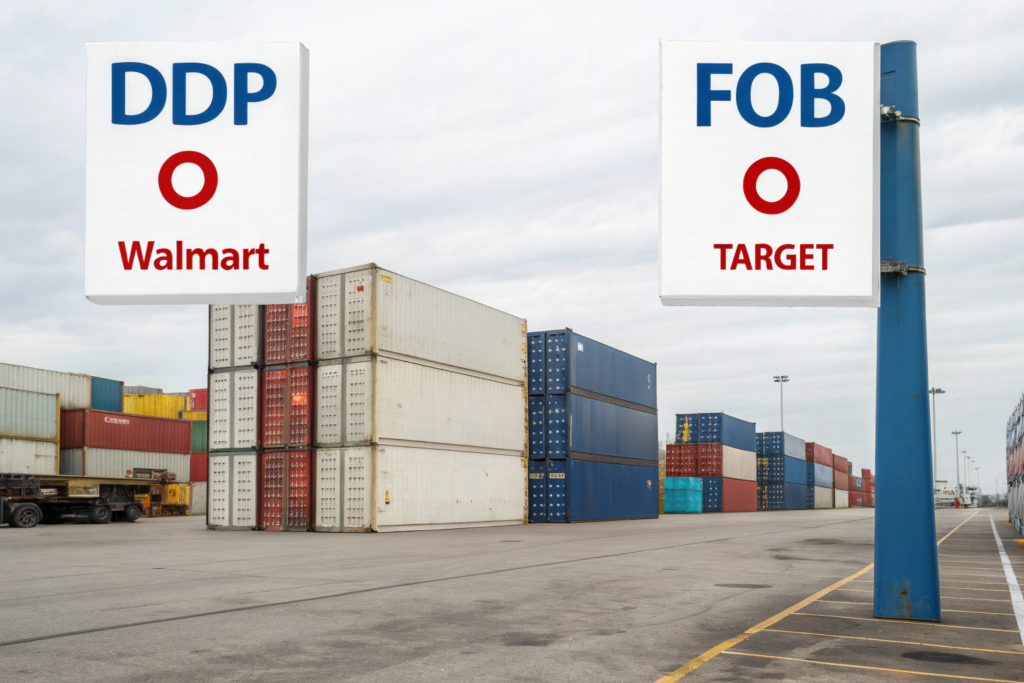
DDP is less common for very large importers—Walmart, Target, major chains—who have their own customs brokerage departments and prefer to control every step. It’s also more expensive than FOB on paper because we’re charging for the service and risk we take. And for repeat shipments of identical products where you know exactly what to expect, FOB can save a few percent.
The premium for DDP typically runs 3-7% higher than managing it yourself with FOB. For a small or mid-sized brand, that premium is worth every penny for the peace of mind. But if you’re shipping 50 containers a year of the same t-shirts, and you have a customs broker on retainer, you might be better off handling clearance yourself. The key is knowing your own capabilities and risk tolerance.
What if I have my own US customs broker?
If you already work with a broker you trust, you might prefer to keep using them. In that case, we can ship DDP "exclusive of duty" or DAP—we deliver to your door, but your broker handles clearance and pays the duty. This gives you the convenience of door delivery while keeping your existing broker relationship. Just tell us upfront, and we’ll coordinate with your broker. We do this for several clients who have long-term relationships with specific brokers. The key is communication—your broker needs to know the shipment is coming, and we need their bond information.
Does DDP work for samples and small parcels?
Yes, absolutely. For small DHL or FedEx shipments, DDP is actually the default for many express carriers. They handle clearance and bill the shipper for duties. This is why you sometimes get a surprise bill from DHL weeks after receiving a sample—that’s DDP not being properly arranged. When we ship samples DDP, we pay the carrier upfront, so you never get that bill. For small brands just starting, this is huge. You can order 10 samples, pay one price, and not worry about customs forms or surprise invoices. The FedEx guide to DDP shipping explains how it works for express parcels.
Conclusion
DDP shipping isn’t just a checkbox on a freight quote. It’s a risk management strategy. It protects you from hidden fees, customs complications, and the administrative headache of managing multiple vendors. It gives you one number to budget against and one throat to choke if something goes wrong. In 2026, with supply chains still recovering and US customs enforcement getting more sophisticated, that simplicity is worth real money.
At Shanghai Fumao, we ship DDP to the US every single week. We have the customs bonds, the broker relationships, and the classification expertise to make it seamless. We’ve seen every problem—misclassified goods, missing documents, port congestion, duty rate disputes—and we know how to solve them before they become your problem.
If you’re tired of surprise fees and customs anxiety, let’s talk DDP. We’ll quote you a door-to-door price, explain exactly what’s included, and handle every step. You focus on selling your clothes; we’ll focus on getting them to your door.
Reach out to our Business Director, Elaine. She oversees our logistics team and can walk you through a DDP quote for your next collection. Ask her for a comparison—FOB vs DDP—and see for yourself how the numbers stack up when all the hidden costs are included.
Email Elaine directly at: elaine@fumaoclothing.com. Let’s make importing simple again.