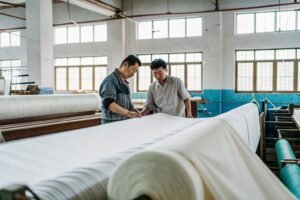
I learned the difference between knitted and woven terry the hard way. In 2017, a client from Australia ordered 10,000 meters of "terry fabric" for beach towels. We delivered what we thought was terry. But when they received it, they said it was wrong. It stretched too much. It did not cut straight. They could not sew the edges properly. I flew to meet them. I looked at their sample. It was woven terry. What we sent was knitted terry. Both are called "terry." But they are completely different. We had to redo the order. Cost us a lot. That experience taught me: you must know the difference.
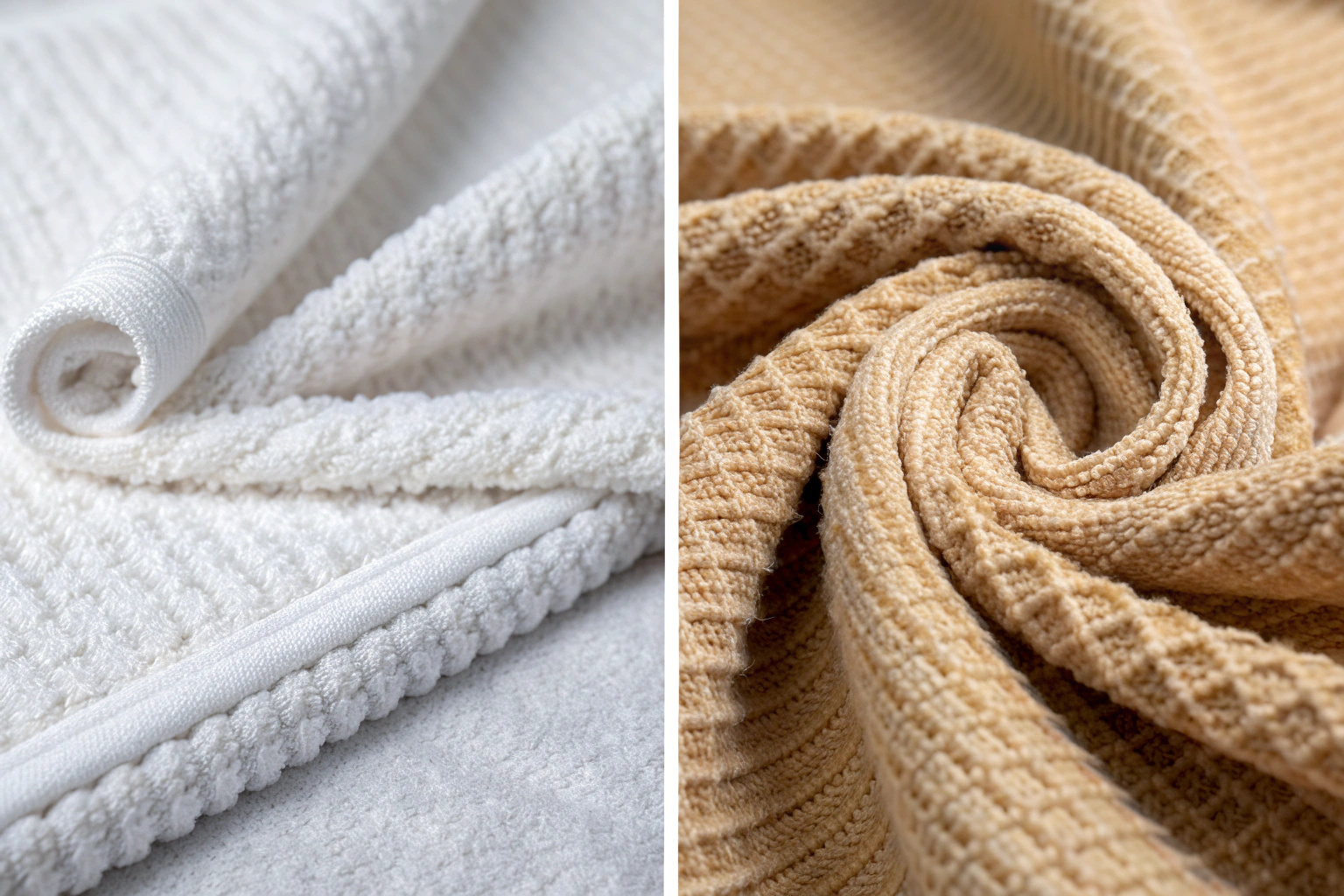
So, what is the difference between knitted terry and woven terry cloth? In simple terms: knitted terry is made by knitting, creating a stretchy, soft fabric with loops on one side. Woven terry is made by weaving, creating a stable, durable fabric with loops on one or both sides. They look similar, but they perform differently. In this guide, I will explain the construction, properties, applications, and how to choose between them. Because if you are sourcing towels, robes, or baby products, you need to know which terry is right for you.
How are knitted terry and woven terry constructed?
The difference starts with how the fabric is made.
Knitted terry:
- Made on a circular knitting machine or flat knitting machine.
- The base is a knit structure (usually jersey or fleece).
- Loops are formed by feeding an extra yarn that is knitted into the base but left as loops on one side.
- The loops can be on one side (single-sided terry) or both sides (double-sided terry, sometimes called French terry when loops are on one side and the other side is smooth).
- Because it is knitted, the fabric has natural stretch and recovery.
Woven terry:
- Made on a special loom (terry loom) that weaves the fabric.
- The base is a woven structure (usually a plain weave or twill).
- Loops are formed by feeding an extra weft or warp yarn with controlled tension, creating loops on one or both sides.
- The loops are held in place by the woven ground.
- Because it is woven, the fabric has minimal stretch and is dimensionally stable.
Loop formation:
- In both, the loops are what make terry absorbent. They create surface area to trap water.
- The height of the loops (pile height) can be varied. Higher loops = more absorbent, but also heavier.
- Loop density: More loops per square inch = more absorbent.

What about the back of the fabric?
- Knitted terry: The back can be smooth (if it’s French terry) or have loops (if double-sided). The knit structure is visible.
- Woven terry: The back usually has the same loop structure (if double-sided) or a woven back (if single-sided). The woven ground is visible.
What are the key properties of each?
Here is how they compare based on our testing and client feedback.
Stretch and recovery:
- Knitted terry: Has stretch, especially in the width direction. Good for garments that need to move (robes, baby clothes). Can stretch out of shape if not well-made.
- Woven terry: Very little stretch. Dimensionally stable. Holds shape well. Good for towels that need to stay flat.
Absorbency:
- Both can be highly absorbent. Absorbency depends on fiber (cotton is best), loop height, and loop density. Generally, woven terry can achieve higher loop density, so it can be more absorbent per square inch. But high-quality knitted terry is also very absorbent.
Softness:
- Knitted terry: Often feels softer initially because the knit base is more flexible. Good for next-to-skin applications.
- Woven terry: Can be soft, but the woven base is firmer. Often softens with washing.
Durability:
- Woven terry: More durable. The woven structure holds loops firmly. Resists pulling and snagging.
- Knitted terry: Less durable. Loops can be pulled out more easily. The knit structure can run or ladder if damaged.
Weight:
- Both come in various weights. Typical towel weights: 300-600 gsm. Woven terry can go heavier (up to 700+ gsm for luxury towels). Knitted terry is often lighter for apparel.
Drying time:
- Similar if same fiber and weight. But knitted terry may dry slightly faster due to more air space in the knit structure.
Edge curling:
- Knitted terry: Tends to curl at cut edges. Must be hemmed or finished well.
- Woven terry: Does not curl. Cuts cleanly.
Sewability:
- Woven terry: Easy to sew, stable.
- Knitted terry: Requires care. Use ballpoint needles, stretch stitches, and proper tension to avoid skipped stitches and puckering.

Which one is more expensive?
Cost depends on many factors: fiber, weight, loop density, finishing. Generally:
- Basic knitted terry (like French terry for apparel) can be less expensive than high-quality woven terry for towels.
- High-end knitted terry (organic cotton, double-sided) can be comparable to woven.
- Woven terry requires specialized looms, so for very high-quality towels, it is often the choice.
For bulk production, woven terry is more common for towels, knitted terry for apparel.
What are the typical applications for each?
Both are called "terry," but they serve different markets.
Woven terry is best for:
- Bath towels: The classic. Woven terry is stable, absorbent, and durable. It holds its shape wash after wash.
- Beach towels: Large, flat, often with printed designs. Woven terry prints well.
- Washcloths and hand towels: Small, stable, easy to sew.
- Robes (if woven): Some robes are made from woven terry, but they are less stretchy.
- Hotel towels: High durability required. Woven terry is the standard.
Knitted terry is best for:
- Bathrobes: The stretch and softness make robes comfortable and easy to move in.
- Baby clothes: Hooded towels, baby wraps, changing pads. Soft and gentle.
- Activewear: French terry (loops inside, smooth outside) is used for sweatshirts, joggers, and hoodies. It wicks sweat.
- Baby bibs and burp cloths: Soft and absorbent.
- Cleaning cloths: Sometimes knitted terry is used for its stretch.
Both can be used for:
- Spa products: Headbands, wristbands, slippers.
- Pet towels: But woven is more durable for claws.

What about French terry?
French terry is a type of knitted terry. It has loops on one side (usually the inside) and a smooth surface on the other. It is very popular for sweatshirts, joggers, and loungewear. It is soft, warm, and absorbent on the inside, but looks smooth on the outside. We supply a lot of French terry to activewear brands.
How do you choose the right one for your product?
When clients ask me which to choose, I ask these questions.
1. What is the end use?
- Towel (bath, beach, kitchen) → Woven terry.
- Robe, loungewear, baby clothes → Knitted terry.
- Sweatshirt, hoodie → Knitted French terry.
- High-end luxury towel → Woven terry (high GSM).
2. Do you need stretch?
- Yes (garments that need to move) → Knitted terry.
- No (flat goods, towels) → Woven terry.
3. How important is dimensional stability?
- Very important (towels that must stay flat) → Woven terry.
- Less important (robes can stretch a bit) → Knitted terry.
4. What is your sewing capability?
- If you are set up for knits (ballpoint needles, stretch stitches) → Knitted terry.
- If you sew wovens (standard needles) → Woven terry.
5. What is your budget?
- For basic, soft apparel → Knitted terry can be cost-effective.
- For premium towels → Woven terry is the standard.
6. What fiber?
- Both can be cotton, bamboo, polyester, blends. Cotton is best for absorbency.

A real example
In 2022, a client from Canada wanted to make a line of "spa robes." They wanted something soft, absorbent, and comfortable. They considered both. We made samples: one in woven terry, one in knitted terry. The woven terry robe was stable but felt stiff. The knitted terry robe was soft and stretchy. They chose knitted terry. It sold well. For their bath towels, they used woven terry. Best of both worlds.
How do you source terry fabric from China?
If you want to source terry fabric from China, here is what you need to know.
Find a supplier who knows the difference: Not all suppliers understand both types. Ask specifically: "Do you supply woven terry? Knitted terry?" If they hesitate, they may not be specialists. At Shanghai Fumao, we supply both. We have mills for each.
Specify the weight: Terry is often sold by weight (grams per square meter). For towels, common weights: 400-600 gsm. For robes, 300-450 gsm. For baby items, 250-350 gsm. Specify your desired weight.
Specify loop height and density: For woven terry, you can specify loops per inch. Higher loops = more absorbent. For knitted terry, specify the yarn count and stitch density.
Fiber content: Cotton is standard. But you can also get bamboo, polyester, or blends. Cotton is most absorbent. Bamboo is softer. Polyester dries faster but is less absorbent.
Color: Terry fabric can be dyed in many colors. For towels, solid colors are common. For apparel, heathers and prints are popular. For custom colors, we do lab dips.
Finishing: Terry fabric may need special finishing:
- Shearing: Cutting the loops to a uniform height.
- Brushing: Softening the surface.
- Anti-pill treatment: For knitted terry.
- Pre-shrinking: Essential for both to control shrinkage.
MOQs:
- Stock fabrics: 100-500 meters per color.
- Custom dye: 3,000 meters per color.
- Custom knit/woven: 3,000-5,000 meters per specification.
Lead times:
- Stock: 1-2 weeks.
- Custom dye: 8-10 weeks.
- Custom fabric development: 12-16 weeks.

What are the common pitfalls?
- Confusing the two: Specify "knitted" or "woven" clearly. Do not just say "terry."
- Ignoring shrinkage: Terry fabric, especially cotton, shrinks. Pre-shrink or account for it.
- Not testing absorbency: If absorbency is critical, test. We can provide absorbency test reports (sink time, water pickup).
- Assuming all cotton is the same: Egyptian cotton, Supima, organic, regular. They differ in quality and price. Specify.
- Forgetting about the selvage: Woven terry has selvage edges that may be different. Plan cutting accordingly.
How do we at Fumao Fabric ensure quality in terry fabrics?
At Shanghai Fumao, we have extensive experience with both knitted and woven terry. Here is how we ensure quality.
For woven terry:
- We check loom settings for consistent loop height.
- We test loop pull resistance (how easily loops pull out).
- We measure absorbency (sink test, water pickup).
- We check for defects like missing loops, broken picks, and shade variation.
For knitted terry:
- We check stitch density and loop uniformity.
- We test for pilling (especially for apparel).
- We check stretch and recovery.
- We ensure the knit does not run or ladder.
For both:
- We test shrinkage (AATCC 135). We pre-shrink to minimize.
- We test colorfastness to washing, light, and rubbing.
- We provide GSM (weight) verification.
- We inspect for defects.
Client story: A US brand making baby hooded towels orders our knitted terry. They test every shipment for absorbency and softness. We have never failed. They have been with us for 3 years.
Conclusion
Knitted terry and woven terry are both wonderful fabrics. But they are not interchangeable. Knitted terry is soft, stretchy, and best for apparel. Woven terry is stable, durable, and best for towels. Choosing the right one ensures your product performs as expected and your customers are happy.
At Shanghai Fumao, we supply both. We have the mills, the expertise, and the quality control to deliver terry fabric that meets your needs. Whether you need 500 meters of French terry for a clothing line, or 50,000 meters of woven terry for hotel towels, we can help.
If you are sourcing terry fabric, contact our Business Director, Elaine, directly. She manages our terry fabric division and has worked with towel manufacturers, apparel brands, and baby product companies worldwide. Email her at elaine@fumaoclothing.com. Tell her about your product, your desired weight, and your quantity. She will send you samples, discuss the differences, and help you choose the right terry for your project. Because at Shanghai Fumao, we believe that the right fabric makes all the difference. And terry is no exception.