I’ll be honest with you—when clients first started asking me about EMI shielding fabrics about ten years ago, I thought they were talking about some niche military application. But today? This is one of the fastest-growing requests we get at Shanghai Fumao. From medical device manufacturers to tech startups building smart clothing, everyone suddenly wants to know how to block electromagnetic interference with fabric.
Here’s the reality we’re all living in: our world is drowning in electromagnetic radiation. Wi-Fi signals, 5G towers, Bluetooth devices, power lines—they’re everywhere. And for certain applications, that’s a real problem. I had a client from Germany last year who was developing protective curtains for a hospital radiology department. Standard polyester curtains were useless. They needed something that could actually block harmful scatter radiation while still looking like normal window treatments. That’s a completely different ballgame.
So what fabrics actually work for EMI reduction? Based on what we’re producing right now in our Keqiao facility, working with everyone from aerospace contractors to fashion tech startups, I’m going to break down exactly what works, what doesn’t, and how to choose the right solution for your specific application.
How Do Fabrics Actually Block Electromagnetic Radiation?
Before we dive into specific materials, you need to understand the basic physics. EMI shielding isn’t magic—it’s about creating a conductive barrier that either reflects or absorbs electromagnetic waves. Think of it like building a raincoat for electrons.

What’s the difference between reflection and absorption in EMI fabrics?
This is where most people get confused. They think all shielding fabrics work the same way. They don’t.
Reflective shielding works exactly like it sounds—the fabric bounces electromagnetic waves away. This is typically achieved with highly conductive materials like copper, silver, or nickel. The waves hit the conductive surface and ricochet off. For applications like protecting sensitive electronics in a server room, reflection is usually what you want.
Absorption is different. Some fabrics, particularly those containing magnetic materials like ferrites or certain stainless steel alloys, actually soak up electromagnetic energy and convert it to tiny amounts of heat. This is crucial for military and stealth applications where you don’t want to reflect signals—you want to disappear entirely.
I remember working with a defense contractor in 2022 who needed fabric for drone stealth applications. They didn’t want reflective material because that would actually make the drone MORE visible to certain radar systems. We ended up developing a specialized non-woven fabric with embedded magnetic particles that absorbed specific frequency ranges. It was one of the most technically challenging projects we’ve ever done, and it taught me that "shielding" means very different things to different customers.
Why does fabric construction matter as much as the material itself?
Here’s something the textbooks won’t tell you: a solid sheet of copper is a perfect EMI shield, but you can’t wear it, drape it, or sew it into a garment. The challenge is turning conductive materials into something that actually behaves like fabric.
We work with three main construction methods:
Woven conductive fabrics: These are exactly what they sound like—fabrics woven from conductive yarns. The shielding effectiveness depends heavily on the weave density. A plain weave with tight construction will block more than a loose twill. We’ve produced silver-plated nylon fabrics with over 99% shielding effectiveness at certain frequencies because the weave was tight enough to eliminate gaps.
Non-woven conductive fabrics: These are typically fleece-like materials where conductive particles or fibers are bonded together. They’re less durable than wovens but can be engineered for specific absorption properties. We use these for applications like lining electronic device cases.
Coated fabrics: Sometimes we start with a conventional fabric—polyester, cotton, whatever—and apply a conductive coating. This is cheaper but less durable. The coating can crack or wear off over time. For disposable medical applications, it’s perfect. For military gear that needs to last years? Not so much.
The construction method determines everything about how the fabric performs, feels, and lasts. You need to understand how different textile constructions affect EMI shielding effectiveness before you can make an informed choice.
What Are the Most Effective Conductive Materials for EMI Fabrics?
Now let’s talk about the actual materials we use. This is where the science gets really interesting—and where costs can vary dramatically.

Why is silver the gold standard for high-performance EMI shielding?
Silver is simply the most conductive metal on earth. Period. When we need maximum shielding in the thinnest possible fabric, silver is our go-to.
We produce silver-plated nylon fabrics where a thin layer of pure silver is electrochemically bonded to every nylon filament. The result is a fabric that feels almost like normal nylon but conducts electricity better than many solid metal sheets. For medical applications like MRI suite drapes or protective garments for pacemaker patients, this is often the only solution that works.
But there’s a catch: silver is expensive. And I mean REALLY expensive. When silver prices spiked in 2023, we had to renegotiate contracts with several clients because our raw material costs literally doubled overnight. We also have to be careful about oxidation. Silver tarnishes over time, which can reduce shielding effectiveness. For long-term applications, we sometimes recommend protective coatings or alternative materials.
For a Swiss medical device company last year, we developed a silver-plated fabric specifically for use in surgical gowns worn during fluoroscopy procedures. The doctors needed protection from scatter radiation, but they also needed to move freely and not overheat. Our fabric provided over 99.9% shielding at diagnostic X-ray frequencies while remaining breathable and lightweight. That’s the kind of performance only silver can deliver.
When does stainless steel make more sense than silver?
Here’s where experience matters. Sometimes stainless steel is actually the smarter choice, even though it’s less conductive.
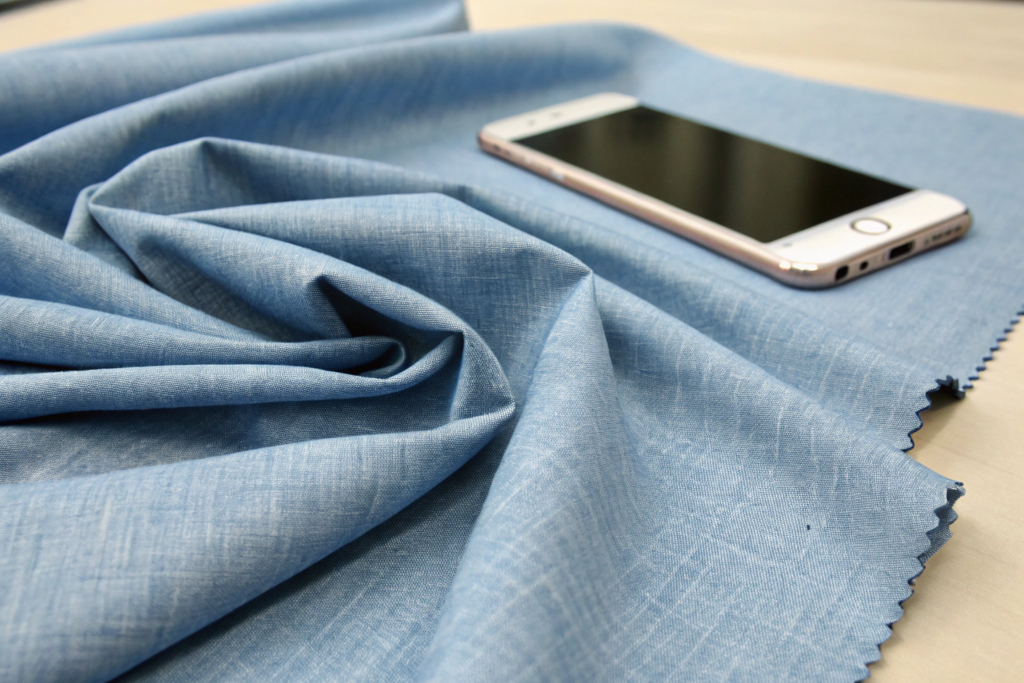
Stainless steel fibers can be blended with conventional textiles like cotton or polyester to create fabrics that offer decent shielding while looking and feeling almost normal. We produce a popular fabric that’s 80% cotton and 20% stainless steel fiber. It looks like a regular chambray shirt fabric, but it blocks enough EMI to protect sensitive electronics when used as a pouch or bag.
The advantages? Stainless steel is cheap, durable, and doesn’t oxidize. It’s also magnetic, which means it can provide absorption shielding that silver can’t. For applications like protecting credit cards from RFID skimming, stainless steel blends work perfectly at a fraction of the cost of silver.
I had a client from Japan who needed fabric for anti-theft bags. Pickpockets use RFID scanners to steal credit card information through regular fabric. We developed a stainless steel mesh that could be laminated between two layers of fashionable exterior fabric. The bags looked great, but the interior mesh blocked all RFID signals. The client sold over 50,000 units in the first year. Sometimes the best solution isn’t the most expensive one—it’s the one that solves the specific problem at the right price point.
The key is knowing how to select between silver and stainless steel for specific EMI applications. Each has its place, and we help our clients navigate that decision every day.
How Do You Test and Verify EMI Shielding Performance?
This is where the rubber meets the road. Anyone can claim their fabric shields EMI. Proving it requires serious laboratory testing.
What is shielding effectiveness and how is it measured?
Shielding effectiveness (SE) is measured in decibels (dB). It’s a logarithmic scale, which means small number differences represent huge performance gaps.
Here’s a rough guide:
- 10 dB blocks about 90% of radiation
- 20 dB blocks 99%
- 30 dB blocks 99.9%
- 40 dB blocks 99.99%
Most commercial applications need 20-30 dB. Military and medical applications often require 40 dB or higher.
We test every batch of EMI fabric in our CNAS-accredited lab using a method called the coaxial transmission line test. Basically, we put a sample of fabric between two chambers, blast one side with electromagnetic energy across a range of frequencies, and measure what comes out the other side. The test takes hours and generates detailed frequency-specific performance data.
I remember testing a sample from a competitor for a client who was considering switching suppliers. The competitor claimed 30 dB shielding. Our tests showed barely 15 dB at the frequencies the client actually needed. The difference wasn’t dishonesty—it was that the competitor tested at different frequencies and used a different test method. That’s why standardized testing matters so much.
What frequency ranges matter for different applications?
This is critical: a fabric that blocks Wi-Fi signals might do nothing against power line frequencies, and vice versa.
For consumer applications like RFID blocking, we test at 13.56 MHz (the frequency used by many contactless payment systems) and 860-960 MHz (UHF RFID used in supply chain).
For medical applications, we test across a broad range because X-ray and MRI shielding requirements are completely different. X-ray shielding actually requires heavy elements like lead or barium—conductivity doesn’t help much. For MRI suites, we need to block both the powerful static magnetic field and the radio frequency pulses used for imaging.
For military and telecommunications applications, we test up into the gigahertz range. 5G signals operate at multiple frequencies, some as high as 39 GHz. A fabric that works at 2.4 GHz (Wi-Fi) might be completely transparent at 28 GHz (5G mmWave).
We maintain detailed test data for every fabric we produce, and we share it openly with clients. If you’re sourcing EMI fabric, you absolutely must understand the specific frequency requirements of your application and verify test reports accordingly. Don’t just trust a generic "EMI shielding" claim—ask for the frequency-specific data.
What Practical Applications Are Driving EMI Fabric Innovation?
The market for EMI fabrics is exploding, and we’re seeing new applications every month. Here’s what’s actually happening in the real world.

How are smart clothing manufacturers using EMI fabrics?
This is fascinating. As clothing gets smarter—with embedded sensors, heating elements, and communication devices—the electronics inside need protection from external interference and also need to prevent their own signals from leaking out.
We work with several sportswear brands developing biometric monitoring garments. These shirts have sensors that track heart rate, breathing, and movement, then transmit that data via Bluetooth to a smartphone. The problem? The human body is mostly water, which messes with antenna performance. By incorporating conductive fabrics into specific areas of the garment, we can actually improve antenna efficiency while reducing interference.
For a Swedish sportswear company in 2023, we developed a compression shirt with integrated ECG monitoring. The challenge was that muscle movement created electrical noise that overwhelmed the tiny heart signals. We designed a conductive fabric layer that acted as both a shield against external interference and a ground plane for the electronics. The final product could capture clinical-grade ECG data during intense exercise. That’s not just clothing—that’s a medical device you can wear to the gym.
What’s happening in architectural and automotive EMI shielding?
Buildings and cars are becoming giant electronic devices, and they need protection too.
We supply EMI shielding fabrics for use in wall coverings and window treatments in hospitals, data centers, and government buildings. A hospital operating room filled with sensitive monitoring equipment needs to be isolated from external radio interference. We’ve developed specialized curtain fabrics that look like normal hospital drapes but provide over 30 dB of shielding across critical frequencies.
In the automotive world, the shift to electric vehicles has created massive new demands. EV motors and inverters generate enormous electromagnetic noise that can interfere with everything from radio reception to critical safety systems. We produce non-woven shielding materials that line the battery compartments and motor housings of several major EV brands. These materials absorb electromagnetic noise before it can escape and cause problems.
I toured an EV factory in Germany last year and saw our fabric being installed in real time. Workers were placing custom-cut shielding materials into battery packs with the same care as assembling a precision watch. It was surreal seeing fabric playing such a critical role in cutting-edge technology, but that’s exactly where we are today. The line between textiles and electronics is disappearing.
The automotive applications require understanding specific automotive EMI shielding standards like CISPR 25, which are different from general commercial requirements. We help our clients navigate these specifications every day.
Conclusion
So what are the best fabrics for reducing electromagnetic interference? The answer, as with most things in textiles, is that it depends. It depends on your frequency requirements, your durability needs, your budget, and your application. Silver-plated fabrics offer maximum performance at premium prices. Stainless steel blends provide excellent value for many applications. Coated fabrics work for disposable or short-term use. And the construction—woven, non-woven, or coated—determines how the fabric behaves in the real world.
At Shanghai Fumao, we’ve been at the forefront of this technology for over a decade. We’ve supplied EMI shielding fabrics to military contractors, medical device manufacturers, consumer electronics companies, and automotive giants. We’ve learned that every client has unique requirements, and there’s no one-size-fits-all solution.
What we offer is expertise. We help you navigate the technical specifications, we test thoroughly in our accredited lab, and we produce fabrics that actually perform as promised. Whether you need a small batch for prototyping or container-load quantities for mass production, we have the capability to deliver.
Ready to solve your EMI shielding challenge? Reach out to our Business Director, Elaine, directly. She and her team can guide you through the entire process, from selecting the right material to ensuring it meets your specific frequency and performance requirements. Drop her an email at elaine@fumaoclothing.com to start a conversation about your next project. Let’s build something that protects what matters.