I remember the call from a German sportswear brand in 2022 that completely changed how I think about sustainability certifications. They’d been sourcing from us for years—great relationship, consistent quality, fair pricing. Then their new sustainability director reviewed our certifications and found we had OEKO-TEX Standard 100 (product safety) but not STeP (responsible production). She explained that for their 2025 sustainability goals, STeP was becoming mandatory. They couldn’t guarantee future business without it. That conversation launched us into an 18-month journey to achieve STeP certification, and it taught me that product safety and production responsibility are two completely different things—and both matter.
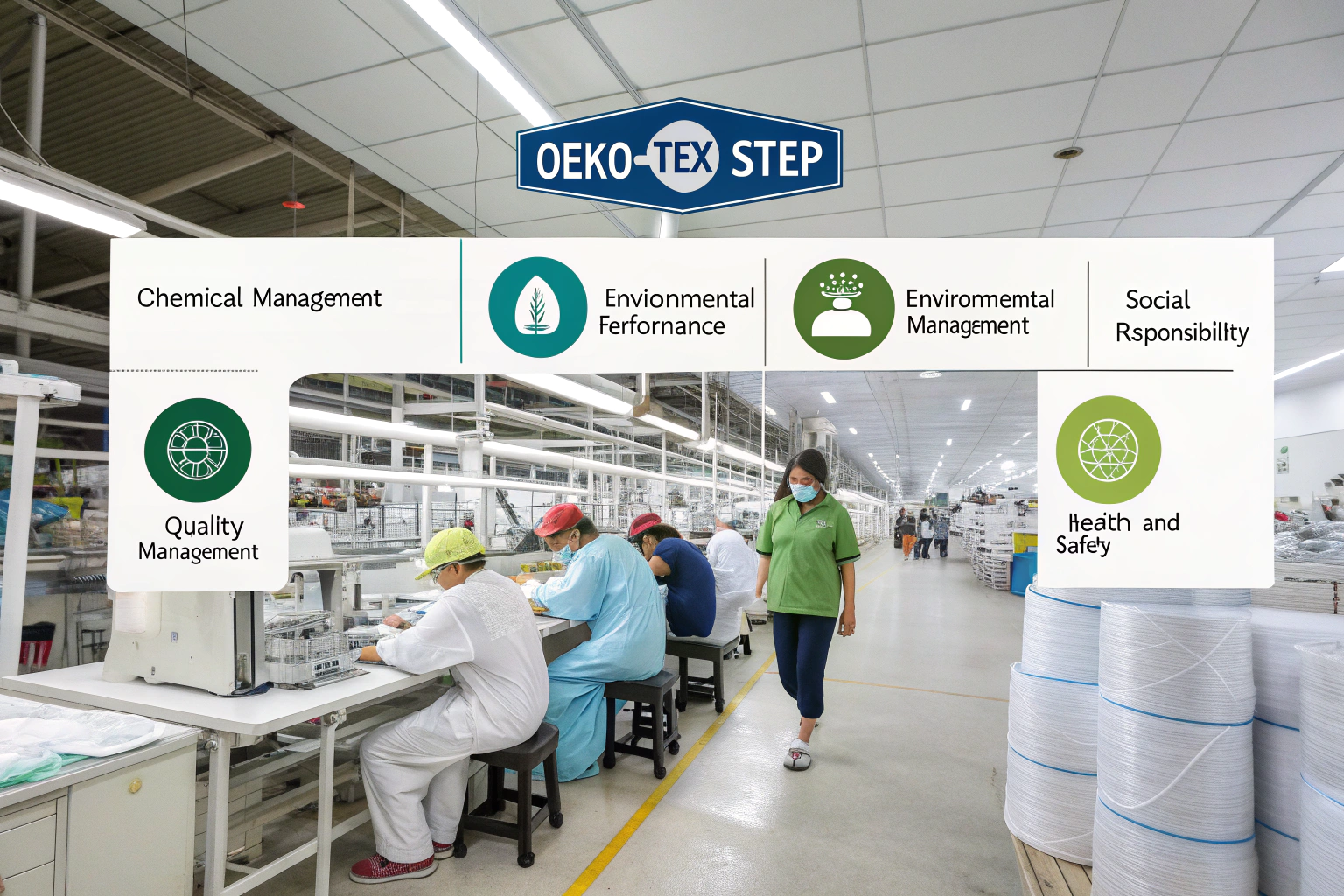
OEKO-TEX STeP (Sustainable Textile Production) is a certification system for textile facilities, not products. While OEKO-TEX Standard 100 certifies that a finished fabric is free from harmful substances, STeP certifies that the factory making it operates responsibly across six key areas: chemical management, environmental performance, environmental management, social responsibility, quality management, and health and safety.
The difference is fundamental. Standard 100 tells your customers the fabric won’t harm them. STeP tells them the fabric wasn’t made by harming workers or the environment. Both are increasingly required by major brands and retailers, especially in Europe.
At Shanghai Fumao, we achieved STeP certification in 2023 after extensive preparation and investment. I’ve learned what it actually takes, what it actually means, and how buyers should evaluate it. Let me walk you through everything you need to know.
What Is OEKO-TEX STeP Certification?
STeP isn’t a single requirement—it’s a comprehensive assessment of how a facility operates. Understanding what it covers helps you evaluate what it means when a supplier claims to be STeP-certified.

What are the six modules of STeP certification?
STeP evaluates facilities across six interconnected areas:
Module 1: Chemical Management
- How chemicals are selected, purchased, stored, handled, and disposed
- Inventory of all chemicals used on-site
- Safety data sheets for every chemical
- Worker training on safe chemical handling
- Elimination of restricted substances from production
Module 2: Environmental Performance
- Air emissions (from boilers, finishing equipment, etc.)
- Wastewater quality (treatment before discharge)
- Energy consumption and efficiency
- Water consumption and conservation
- Waste generation and disposal
- Noise pollution
Module 3: Environmental Management
- Environmental policy and commitment
- Environmental management system (formal processes)
- Continuous improvement targets
- Employee training and awareness
- Emergency preparedness for environmental incidents
Module 4: Social Responsibility
- Fair wages and working hours
- No child labor, no forced labor
- Freedom of association and collective bargaining
- Non-discrimination policies
- Grievance mechanisms for workers
- Worker housing conditions (if provided)
Module 5: Quality Management
- Quality policy and objectives
- Process control and documentation
- Traceability systems (raw material to finished product)
- Customer complaint handling
- Continuous improvement processes
Module 6: Health and Safety
- Worker safety training
- Personal protective equipment
- Machine guarding and safe operation
- Emergency preparedness (fire, chemical spills)
- Occupational health monitoring
- Ergonomic considerations
Each module is scored, and facilities receive an overall rating (Level 1-3) based on performance across all six. Level 3 is the highest achievable.
For a Swiss medical textile client, we provide our STeP certificate showing Level 2 achievement across all modules. They don’t need Level 3 for their requirements, but they need documented compliance with all six areas. STeP comprehensiveness is its strength.
How is STeP different from other facility certifications?
Several certifications assess facility responsibility, but they differ in scope and rigor:
STeP vs. ISO 14001 (Environmental Management):
- ISO 14001 covers environmental management systems only
- STeP covers environment PLUS chemicals, social responsibility, quality, health and safety
- STeP is textile-specific; ISO 14001 is general
STeP vs. BSCI (Business Social Compliance Initiative):
- BSCI focuses on social compliance (worker rights, working conditions)
- STeP covers social responsibility plus environment, chemicals, quality, health and safety
- BSCI is broader (all industries); STeP is textile-specific with deeper requirements
STeP vs. Higg FEM (Facility Environmental Module):
- Higg FEM focuses on environmental performance
- STeP covers environment plus social, chemicals, quality, health and safety
- STeP requires third-party audit; Higg FEM is self-assessment (though verification available)
STeP vs. ZDHC (Zero Discharge of Hazardous Chemicals):
- ZDHC focuses on chemical management and wastewater
- STeP covers chemicals plus all other areas
- Many facilities have both—STeP for comprehensive certification, ZDHC for chemical-specific reporting
For a Danish fashion brand, we maintain both STeP certification and ZDHC membership. STeP provides comprehensive facility assurance; ZDHC provides detailed chemical data for their reporting. Different certifications serve different purposes.
What does STeP certification mean for fabric buyers?
When a supplier is STeP-certified, it means:
Verified compliance: An independent third-party auditor has visited the facility and verified that it meets STeP requirements across all six modules. This isn’t self-declaration—it’s audited reality.
Continuous improvement: STeP requires documented improvement over time. Certification isn’t one-time; it must be maintained through regular audits and demonstrated progress.
Transparency: STeP-certified facilities must be transparent about their operations—chemicals used, environmental data, worker conditions. This information is available to buyers.
Reduced audit fatigue: Brands that accept STeP don’t need to conduct their own facility audits. The certification serves as third-party verification, saving time and money for both parties.
Supply chain credibility: Using STeP-certified suppliers strengthens a brand’s own sustainability claims. It provides evidence that responsibility extends beyond finished products to actual production.
For a UK retailer with 500+ suppliers, they use STeP certification as a baseline requirement for all textile facilities. They still audit some suppliers for specific risks, but STeP reduces their audit burden by 70%. STeP streamlines responsible sourcing.
How Do You Verify a Supplier’s STeP Certification?
Not all claims are equal. Some suppliers claim "STeP-compliant" or "working toward STeP" without actual certification. Here’s how to verify.

What documentation should you request?
When a supplier claims STeP certification, request:
Current certificate: Valid for 3 years, with issue and expiry dates clearly shown. Check that it hasn’t expired.
Certificate scope: Which facility(es) are covered? STeP certifies specific production sites, not entire companies. Ensure your fabric comes from the certified facility.
Audit level: Level 1 (entry), 2 (good), or 3 (excellent). Higher levels indicate better performance. Level 2 is common and acceptable for most buyers; Level 3 is exceptional.
Modules covered: All six modules are required for certification. Some facilities may have partial certification (rare). Full certification covers all six.
Audit body: Which organization conducted the audit? OEKO-tex-approved auditors include testing institutes like TESTEX, Hohenstein, and others.
Audit date: More recent audits (within last 12 months) indicate active maintenance. Certificates are valid 3 years but annual surveillance audits occur.
For a French luxury brand, we provide our STeP certificate plus the full audit report (confidentially) showing detailed scores for each module. They use this for their own sustainability reporting. Full documentation builds trust.
How do you search the OEKO-TEX database?
OEKO-TEX maintains a public database of certified facilities:
- Visit the OEKO-TEX Buyers’ Guide (www.oeko-tex.com/buyers-guide)
- Search by company name, certificate number, or product type
- Verify that the facility appears with current certification
- Check the certification level and scope
If a supplier isn’t in the database, they’re not currently certified. "Application pending" or "working toward" doesn’t count—only actual certification.
For a US brand new to STeP, we walked them through the database search and showed them how to verify our certification independently. They now use this for all supplier verification. Public database prevents false claims.
What red flags indicate problems?
Watch for these warning signs:
Expired certificate: STeP certificates are valid 3 years. Expired means no current certification.
Wrong facility: Certificate covers a different location than where your fabric is made.
Limited scope: Some facilities certify only部分 operations (e.g., dyehouse only, not weaving). Ensure your entire production chain is covered.
Vague claims: "STeP-compliant" or "following STeP principles" without certificate means nothing.
No database listing: If they’re certified, they’re in the database. No exceptions.
Refusal to share: A certified supplier should readily share certificate and basic audit information. Refusal suggests problems.
For a Swedish brand that almost signed with a supplier claiming STeP certification, we helped them check the database—no listing. The supplier had applied but not yet passed audit. They were honest about it when challenged, but the brand saved months of assuming certification existed. Verification prevents assumptions.
What Does STeP Certification Cost Suppliers—and Buyers?
Certification isn’t free, and those costs ultimately affect pricing. Understanding the investment helps you evaluate whether pricing is reasonable.

What investments do suppliers make for STeP?
Achieving STeP requires significant investment:
Audit fees: Initial certification audit costs $5,000-15,000 depending on facility size and complexity. Annual surveillance audits add ongoing costs.
Chemical management: Many facilities need to upgrade chemical storage, labeling, and documentation systems. Some must eliminate problematic chemicals entirely, requiring new sourcing relationships.
Environmental upgrades: Wastewater treatment, air emissions controls, energy efficiency improvements—these can cost tens of thousands to millions depending on facility starting point.
Social compliance: Improving worker conditions—wages, housing, benefits—adds ongoing operational costs. Some facilities need significant upgrades to meet STeP social requirements.
Training: Worker training across all six modules requires time and resources. Documentation systems require staff time to maintain.
Consultant support: Many facilities hire consultants to guide them through certification, adding $10,000-30,000+.
For our own STeP journey at Shanghai Fumao, we invested approximately $150,000 over 18 months in facility upgrades, training, and certification costs. This doesn’t include ongoing operational costs of maintaining higher standards. Certification requires real investment.
How does certification affect fabric pricing?
The costs of certification ultimately flow through to pricing:
Direct cost increase: Audit fees, consultant costs, and ongoing compliance expenses add 2-5% to production costs for most facilities.
Operational cost increase: Better chemicals (safer but often more expensive), improved wastewater treatment (energy, chemicals), higher worker wages—these add ongoing costs.
Efficiency gains: Some investments (energy efficiency, waste reduction) reduce costs over time, offsetting increases.
Market access: Certified facilities can command premium pricing because brands need them. Supply and demand affects pricing.
Scale matters: Larger facilities spread certification costs across more production, minimizing per-unit impact.
For our clients, STeP-certified fabrics typically cost 3-8% more than equivalent non-certified fabrics. The premium varies by product and volume. Most brands find the premium acceptable given the compliance and marketing value. Certification has real but manageable cost.
Is STeP worth the premium?
For most serious brands, yes—for several reasons:
Regulatory pressure: EU regulations increasingly require supply chain transparency. STeP provides documented compliance.
Retailer requirements: Major retailers (H&M, Zara, etc.) increasingly require facility-level certifications like STeP or equivalents.
Consumer expectations: Growing segment of consumers expects responsible production, not just safe products.
Risk reduction: STeP audits identify problems before they become scandals. Prevention is cheaper than crisis management.
Efficiency: Using STeP-certified suppliers reduces your own audit burden and simplifies compliance reporting.
Marketing value: STeP certification can be communicated to customers, differentiating your brand.
For a Norwegian brand we work with, the 5% premium for STeP-certified fabric is easily justified by access to German retailers who require it. Without certification, they couldn’t sell in that market at all. Market access alone justifies investment.
How Do You Integrate STeP Requirements Into Your Sourcing?
Once you’ve decided to prioritize STeP, you need to integrate it into your sourcing process. This requires planning and communication.

How do you request STeP certification from suppliers?
In your RFQ or initial communication:
-
State requirement clearly: "All fabrics must be produced in OEKO-TEX STeP-certified facilities (Level 2 minimum)."
-
Request documentation: "Please provide current STeP certificate(s) for all production facilities involved in this order."
-
Specify scope: "Certification must cover weaving/knitting, dyeing, finishing, and any other wet processing."
-
Set timeline: "Certificates must be valid through expected production dates. Renewals must be provided if expiration occurs during production."
-
Explain consequences: "Orders cannot be placed with facilities lacking current STeP certification."
For a Dutch client, we include STeP requirements in our annual supply agreement, with specific language about certificate validity and audit requirements. Clear requirements prevent misunderstanding.
How do you handle mixed supply chains?
Not all facilities in your supply chain may be certified:
Primary production: At minimum, the facility performing final finishing (where chemical risks are highest) should be certified.
Multi-stage production: If fabric is woven at one facility, dyed at another, and finished at a third, all need certification for full chain credibility.
Component suppliers: Zippers, threads, labels—these may not need STeP (different product categories), but should have appropriate certifications (like Standard 100).
Grey areas: For some products, full chain certification may not be available. Assess risk and prioritize highest-impact stages.
For a Canadian brand, we identified that their main fabric supplier (us) is STeP-certified, but their trim supplier isn’t (trims are Standard 100 certified only). They accept this as reasonable given trim production scale. Prioritize where risk is highest.
How do you maintain compliance over time?
STeP certification isn’t one-time. Maintain compliance through:
Annual verification: Request updated certificates annually (or check database). Set calendar reminders for expiry dates.
Audit report review: For critical suppliers, request summary audit reports to see trends—improving, declining, or stable?
Corrective actions: If audit identifies issues, request corrective action plan and follow-up.
Escalation: If a supplier loses certification, have contingency plans—alternative certified sources, timeline for recertification, etc.
Continuous improvement: STeP requires documented improvement over time. Ask suppliers about their improvement targets and progress.
For a Swiss client, we provide annual STeP updates and a summary of our improvement initiatives (reduced water consumption, increased renewable energy, etc.). They incorporate this into their sustainability reporting. Ongoing engagement maintains trust.
STeP certification represents a significant commitment from suppliers—and significant value for buyers. It provides third-party verification that production is responsible across environmental, social, and quality dimensions. For brands serious about sustainability, it’s becoming essential.
Conclusion
Sourcing OEKO-TEX STeP certified fabrics requires understanding what STeP actually covers: six comprehensive modules (Chemical Management, Environmental Performance, Environmental Management, Social Responsibility, Quality Management, Health and Safety) that together ensure responsible production. Verification involves requesting current certificates, checking the OEKO-TEX public database, and ensuring certification covers all relevant facilities and processes. Costs are real (typically 3-8% premium) but justified by regulatory compliance, retailer requirements, risk reduction, and marketing value. Integrating STeP into sourcing requires clear requirements, handling of mixed supply chains, and ongoing monitoring.
The difference between STeP-certified and non-certified suppliers isn’t just paperwork—it’s demonstrated commitment to responsible production. For brands building long-term sustainability credibility, that commitment matters.
If you’re looking to source fabrics from STeP-certified facilities and want to work with a supplier who understands the certification inside and out, I invite you to reach out to us at Shanghai Fumao. We achieved STeP certification in 2023 after extensive preparation and investment. We know what it takes to maintain it, and we’re committed to continuous improvement across all six modules. Contact our Business Director, Elaine, directly at elaine@fumaoclothing.com. Tell her about your sustainability requirements, your target markets, and your certification needs. She’ll connect you with our compliance team, and we’ll provide the documentation you need to verify our STeP status.
Because responsible production isn’t just about making fabric—it’s about how you make it. And we’re proud to do it the right way.