I remember the call from a Florida-based golf brand owner in 2021 that still makes me wince. He’d developed what he thought was the perfect golf polo—great colors, perfect fit, beautiful logo embroidery. Then his customers started wearing them on the course. Within hours, they were soaked with sweat, sticking to skin, uncomfortable and embarrassing. The fabric looked like performance material but performed like regular cotton. He’d sourced from a general apparel supplier who promised "moisture-wicking" but delivered fabric that was just polyester with a fancy name. That $150,000 mistake taught him—and reinforced for me—that golf and tennis apparel isn’t just clothing. It’s performance equipment.
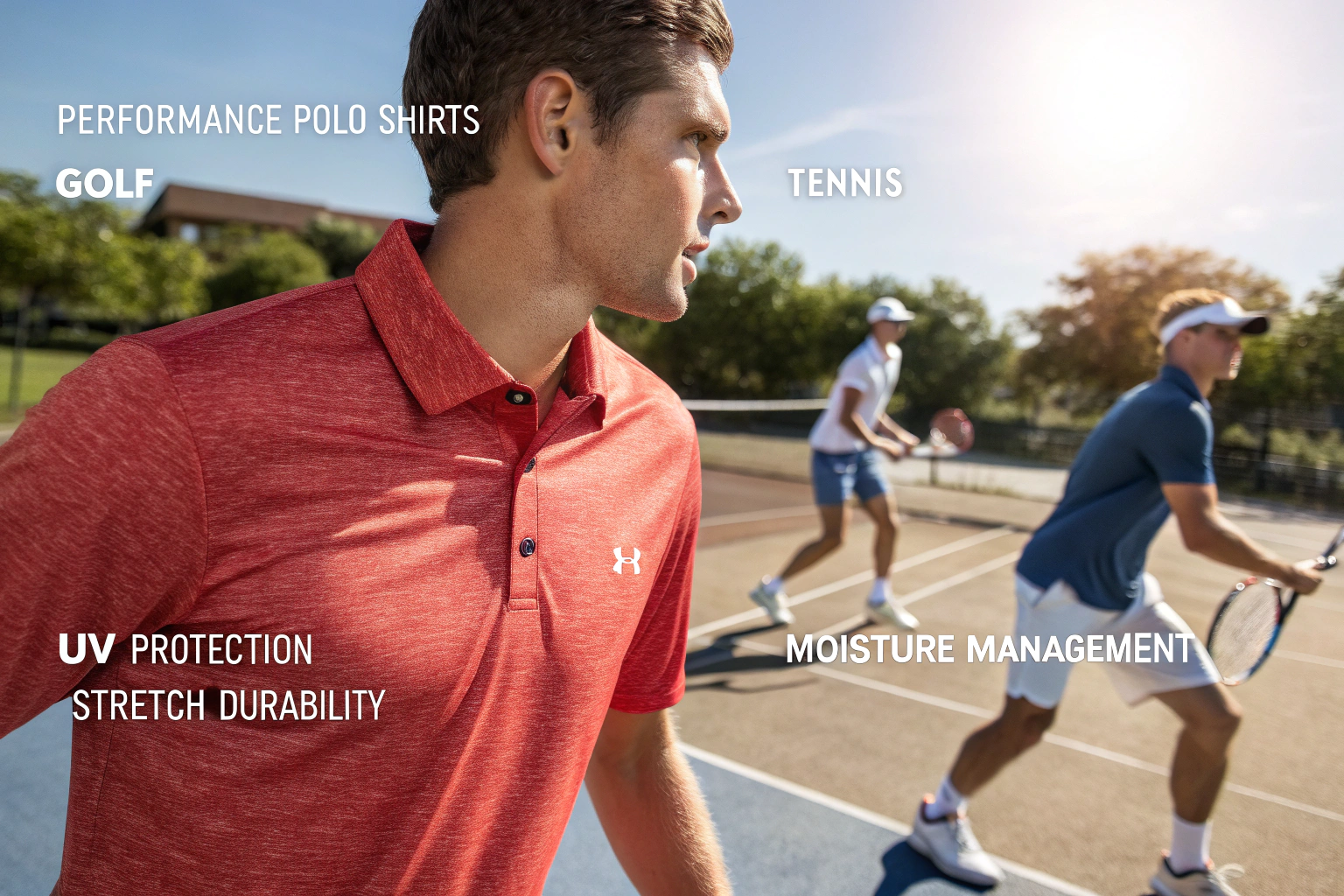
Golf and tennis players have demanding requirements that regular sportswear doesn’t address. They’re outdoors for hours (sun exposure). They swing repeatedly (stretch and recovery needed). They sweat (moisture management critical). They want to look good (style matters). And they’re often wearing the same clothes for socializing after play (versatility required).
At Shanghai Fumao, we’ve supplied performance fabrics to golf and tennis brands across North America, Europe, and Asia. The requirements are specific, and getting them right separates apparel that players love from apparel that sits on clearance racks. Let me walk you through what actually matters.
What Performance Properties Matter Most for Golf and Tennis Apparel?
Golf and tennis share some requirements but differ in others. Understanding both helps you design for your specific sport.
Why is moisture management critical for both sports?
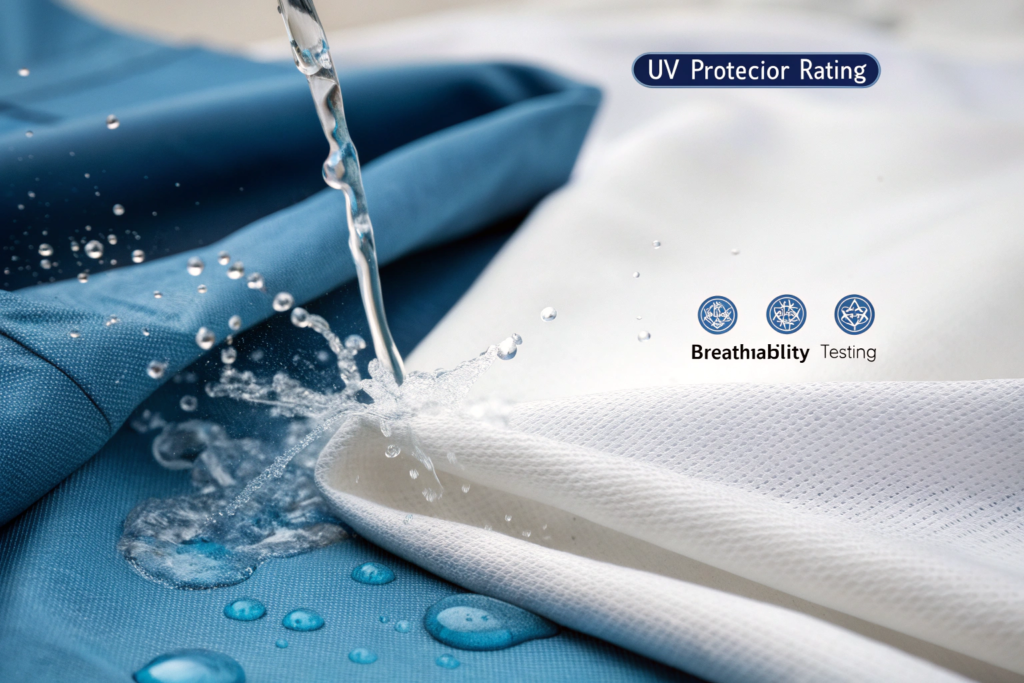
Golf and tennis are both played outdoors, often in warm conditions, with significant physical exertion. Sweat management isn’t just about comfort—it affects performance:
Wet fabric sticks to skin, restricting movement and distracting players.
Evaporative cooling only works if sweat can move away from skin and evaporate. Saturated fabric blocks this process.
Appearance matters—players don’t want to look like they just ran through a sprinkler, especially in social club settings.
Key moisture management specifications:
Moisture wicking: Fabric should pull sweat from skin to outer surface. Measured by vertical wicking test (mm/30min). Good performance: 100mm+ in 30 minutes.
Drying time: How quickly fabric dries after saturation. Critical for comfort during play. Good performance: 30-60 minutes to air-dry.
Moisture vapor transmission rate (MVTR) : How easily sweat vapor passes through fabric. Measured in g/m²/24hr. Good performance: 8,000-15,000+.
For a Texas golf brand (hot, humid conditions), we developed fabric with 120mm wicking height and 12,000 MVTR. Players report staying comfortable through 18 holes even in 95°F weather. Moisture management is non-negotiable.
How much stretch do golf and tennis apparel need?
Both sports require significant stretch, but the patterns differ:
Golf: The golf swing requires stretch across shoulders and back, plus some stretch in sleeves. Primary direction: bias and cross-grain.
Tennis: Tennis requires multi-directional stretch—reaching for shots, lunging, overhead serves. Four-way stretch (length and width) is essential.
Key stretch specifications:
Fabric stretch %: Minimum 20-30% in required directions. For tennis, 40-50% four-way stretch preferred.
Recovery %: How well fabric returns to original shape after stretching. Minimum 90% recovery after 100% stretch.
Growth %: Permanent stretch after repeated use. Should be under 3-5%.
For a California tennis brand, we developed a fabric with 45% four-way stretch and 95% recovery using a polyester-spandex blend (88% polyester, 12% spandex) in a specialized knit structure. Players report no bagging or sagging even after hours of play. Stretch without recovery is worthless.
What about UV protection?
Golf and tennis players spend hours in direct sun. UV protection isn’t optional—it’s health protection.
UPF rating (Ultraviolet Protection Factor): Measures how much UV radiation fabric blocks. UPF 50+ blocks 98% of UV rays, the highest standard rating.
Factors affecting UPF:
- Fiber type: Polyester has natural UV resistance; cotton has almost none.
- Construction density: Tighter weaves/knits block more UV.
- Color: Darker colors absorb more UV than light colors.
- Finishes: UV-absorbing finishes can boost protection.
- Stretch: Stretched fabric blocks less UV (important for activewear).
For an Australian golf brand (extreme sun exposure), we specify UPF 50+ for all fabrics, tested after stretching to simulate actual wear conditions. Standard tests on relaxed fabric underestimate real-world protection. Sun protection is health protection.
What Fabric Types Work Best for Golf and Tennis?
Different constructions suit different applications. Understanding the options helps you choose the right foundation for your designs.
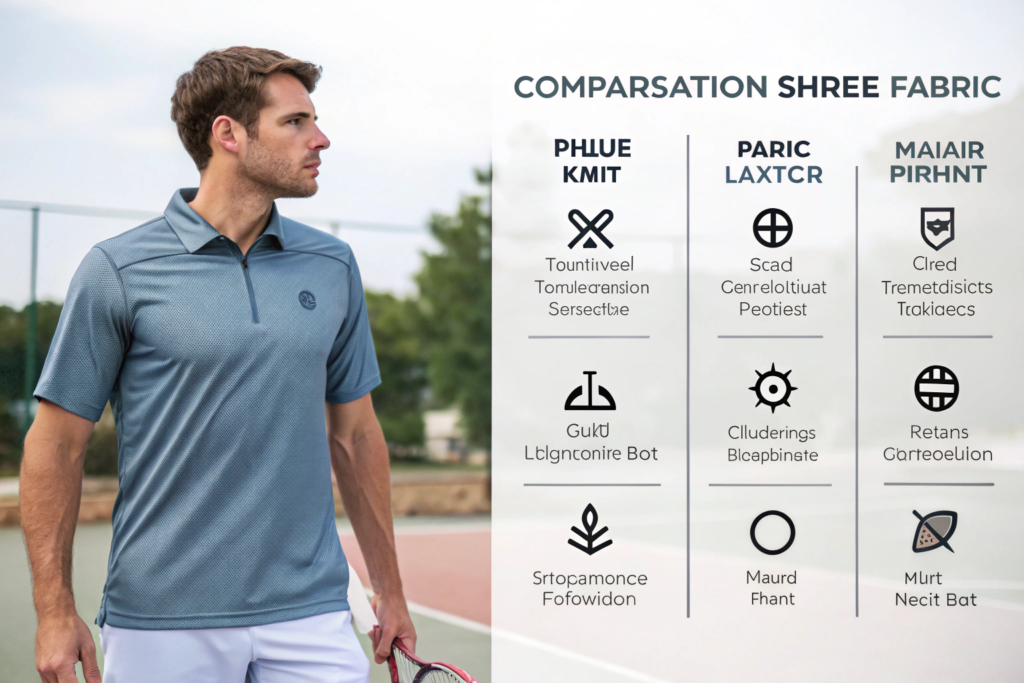
Why is pique knit the traditional choice for golf?
Pique knit is the classic golf polo fabric—textured, breathable, structured. Its characteristics:
Advantages:
- Textured surface reduces skin contact (less sticky when sweaty)
- Good structure holds collar shape (important for polos)
- Breathable due to textured construction
- Traditional golf aesthetic (what players expect)
- Durable, holds color well
Disadvantages:
- Less stretch than jersey knits
- Can be heavier than performance alternatives
- More expensive to produce than basic jersey
Modern pique fabrics often blend polyester with spandex for stretch and performance while maintaining the traditional look.
For a UK golf heritage brand, we developed a polyester-spandex pique that looks traditional but performs like modern activewear. Members at traditional clubs accept it because it looks right; younger players appreciate the performance. Tradition meets technology.
When does jersey knit make sense for tennis?
Jersey knit (smooth surface) offers different advantages:
Advantages:
- Maximum stretch potential (ideal for four-way stretch)
- Smooth surface for printing (logos, designs)
- Lightweight, comfortable
- Lower cost than pique
- Excellent moisture transport (smooth surface doesn’t trap moisture)
Disadvantages:
- Can show sweat more visibly (smooth surface)
- Less structured, may not hold collar shape as well
- Can cling more than textured fabrics
Jersey is increasingly popular for both sports, especially for performance-focused lines and for garments that will be printed rather than embroidered.
For a US tennis brand targeting competitive players, we use jersey knits exclusively—maximum stretch, excellent moisture management, and the smooth surface shows off their bold graphic designs. Application should drive construction choice.
What about mesh and ventilation zones?
Strategic ventilation is becoming standard in premium golf and tennis apparel:
Mesh panels: Open-knit structures placed in high-sweat zones (underarms, back, sides) for maximum breathability.
Zoned construction: Different knit structures in different areas of the same garment—dense where coverage matters, open where ventilation needed.
Laser-cut perforations: For fabrics that can’t be knitted with mesh, laser-cut holes create ventilation.
For a South African cricket client (similar requirements, extreme heat), we developed a shirt with mesh panels across the entire back and underarms. Core temperature of players dropped 2°C compared to standard shirts in testing. Ventilation is active cooling.
What Technical Specifications Should You Provide?
Clear specifications prevent the kind of disappointment my Florida client experienced. Here’s what to include in your tech pack.
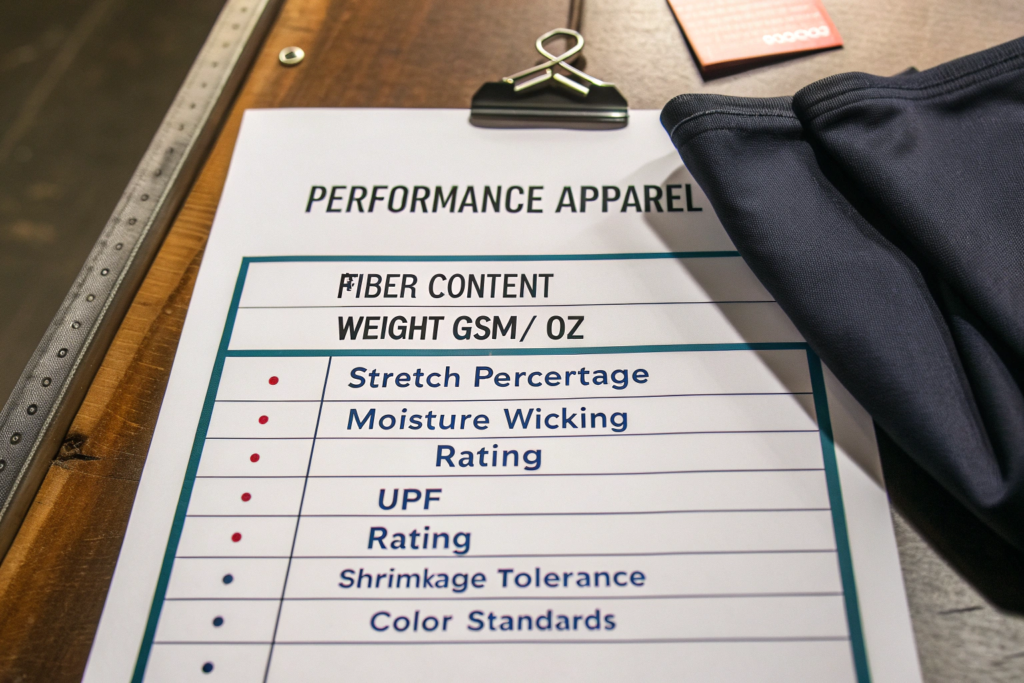
How do you specify moisture-wicking performance?
Don’t just write "moisture-wicking." Specify:
Test method: AATCC 197 (vertical wicking), AATCC 195 (liquid moisture management), or ISO 13029.
Acceptance criteria: Minimum wicking height (e.g., 100mm in 30 minutes), minimum MVTR (e.g., 10,000 g/m²/24hr), maximum drying time (e.g., 45 minutes to air-dry).
Durability requirement: Performance after 20, 30, or 50 washes. Many fabrics wick well when new but lose performance after laundering.
For a Canadian golf brand, we specify AATCC 197 wicking of 120mm minimum after 30 washes. This ensures that garments perform throughout their useful life, not just on day one. Durability testing prevents performance fade.
What stretch specifications prevent sagging?
Stretch specification should include:
Stretch % : In warp and weft directions (for wovens) or length and width (for knits). Specify minimum % at specific force (e.g., 30% stretch at 10N force).
Recovery % : After stretching to specified %, what % recovery? Minimum 90% after 100% stretch.
Growth % : Permanent deformation after repeated stretching. Maximum 3-5%.
Test method: ASTM D3107 (for wovens) or ASTM D2594 (for knits).
For a German tennis brand, we specify 40% stretch in both directions with 95% recovery after 100% stretch and 3% maximum growth. This ensures garments maintain fit through years of play. Precision prevents bagging.
What shrinkage tolerance is acceptable?
Shrinkage is critical for fitted athletic apparel. Specify:
Wash shrinkage: After 3 washes (standard) or 5 washes (premium), measured per AATCC 135 or ISO 6330.
Tolerance: Typically 3% maximum in both directions for quality apparel. 2% for premium.
Dimensional stability: After washing and drying, garment should return to specified measurements within tolerance.
For a US golf brand, we maintain 2% maximum shrinkage after 5 washes. Their fit is precise—baggy doesn’t work, too tight doesn’t work. Tight control prevents returns. Shrinkage control preserves fit.
What Quality Considerations Are Unique to Sport Apparel?
Sport apparel faces demands that casual wear doesn’t. Understanding these helps you specify appropriate quality levels.
How do you test durability for sports use?
Sport apparel needs specialized durability testing:
Abrasion resistance: Simulates friction against clubs, rackets, bags, and seating. Martindale test (ASTM D4966) with minimum 20,000-30,000 cycles.
Seam strength: Seams must withstand stretching during play. Test per ASTM D1683, minimum 150N typically.
Pilling resistance: Constant movement causes friction that can pill fabrics. Minimum Grade 3-4 after 100 hours.
Colorfastness to perspiration: Sweat can extract dyes, staining skin and fading garments. Test per AATCC 15, minimum Grade 4.
For a Japanese tennis brand, we test every batch for colorfastness to acidic and alkaline perspiration. Their players sweat heavily; we need to ensure colors stay on garments, not on skin. Sport-specific testing prevents sport-specific failures.
What about color consistency across seasons?
Golf and tennis apparel is often sold in collections that span multiple seasons. Color consistency matters:
Season-to-season matching: Garments from different production runs should match within acceptable tolerances (ΔE <1.0 for critical colors, <1.5 for standard).
Fading resistance: UPF-rated fabrics may fade with sun exposure, affecting both appearance and protection.
Metamerism: Colors that match under one light (store lighting) but not another (sunlight) cause returns.
For a Swedish golf brand, we provide spectrophotometer data with every shipment, allowing their quality team to verify color consistency against archived standards. Color control maintains brand consistency.
How do you ensure comfort during extended wear?
Golf and tennis players may wear garments for 4-6 hours continuously. Comfort factors:
Next-to-skin feel: Fabric must feel comfortable against skin, even when sweaty. Subjective but testable through wear trials.
Seam placement: Seams should avoid friction points (shoulders, underarms) where movement causes chafing.
Tagless labeling: Printed labels prevent neck irritation.
Odor control: Antimicrobial treatments prevent bacterial growth that causes odor. Silver-based or zinc-based treatments common.
For a US country club uniform program (staff wearing polos for 8-hour shifts), we developed fabric with silver-based antimicrobial treatment and tagless labels. Staff reported significantly less odor and irritation at end of shift. Comfort is productivity.
Sourcing fabric for golf and tennis apparel requires understanding the specific demands of these sports. Moisture management, stretch and recovery, UV protection, and durability all matter more than in general apparel. The right fabric makes players comfortable, confident, and focused on their game. The wrong fabric distracts, irritates, and disappoints.
Conclusion
Sourcing fabric for custom golf and tennis apparel requires specifying performance properties that matter for these specific sports: moisture management (wicking, drying time, breathability), stretch and recovery (minimum 20-40% with 90%+ recovery), UV protection (UPF 50+ for outdoor sports), and durability (abrasion resistance, seam strength, colorfastness to sweat and sun). Fabric construction choices—pique knit for traditional golf aesthetic, jersey knit for maximum stretch and printability, mesh for ventilation—affect performance and appearance. Clear specifications (test methods, acceptance criteria, durability requirements) prevent disappointment. Quality considerations unique to sport apparel (sport-specific testing, color consistency, extended-wear comfort) protect your brand reputation.
The difference between sport apparel that performs and sport apparel that merely exists is in these details. Investing in proper specifications and working with suppliers who understand them pays off in customer satisfaction and repeat business.
If you’re developing golf or tennis apparel and want to ensure your products perform on the course or court, I invite you to reach out to us at Shanghai Fumao. We’ve supplied performance fabrics to sportswear brands across four continents. We understand the moisture management, the stretch engineering, the UV protection requirements, and the durability testing that separates great sport apparel from disappointing imitations. Contact our Business Director, Elaine, directly at elaine@fumaoclothing.com. Tell her about your sport, your target players, and your performance requirements. She’ll connect you with our sportswear specialists, and we’ll help you develop fabrics that help your customers play their best.
Because when your customer steps up to tee off or serve, they shouldn’t be thinking about their clothes. They should be thinking about the game. The right fabric makes that possible.