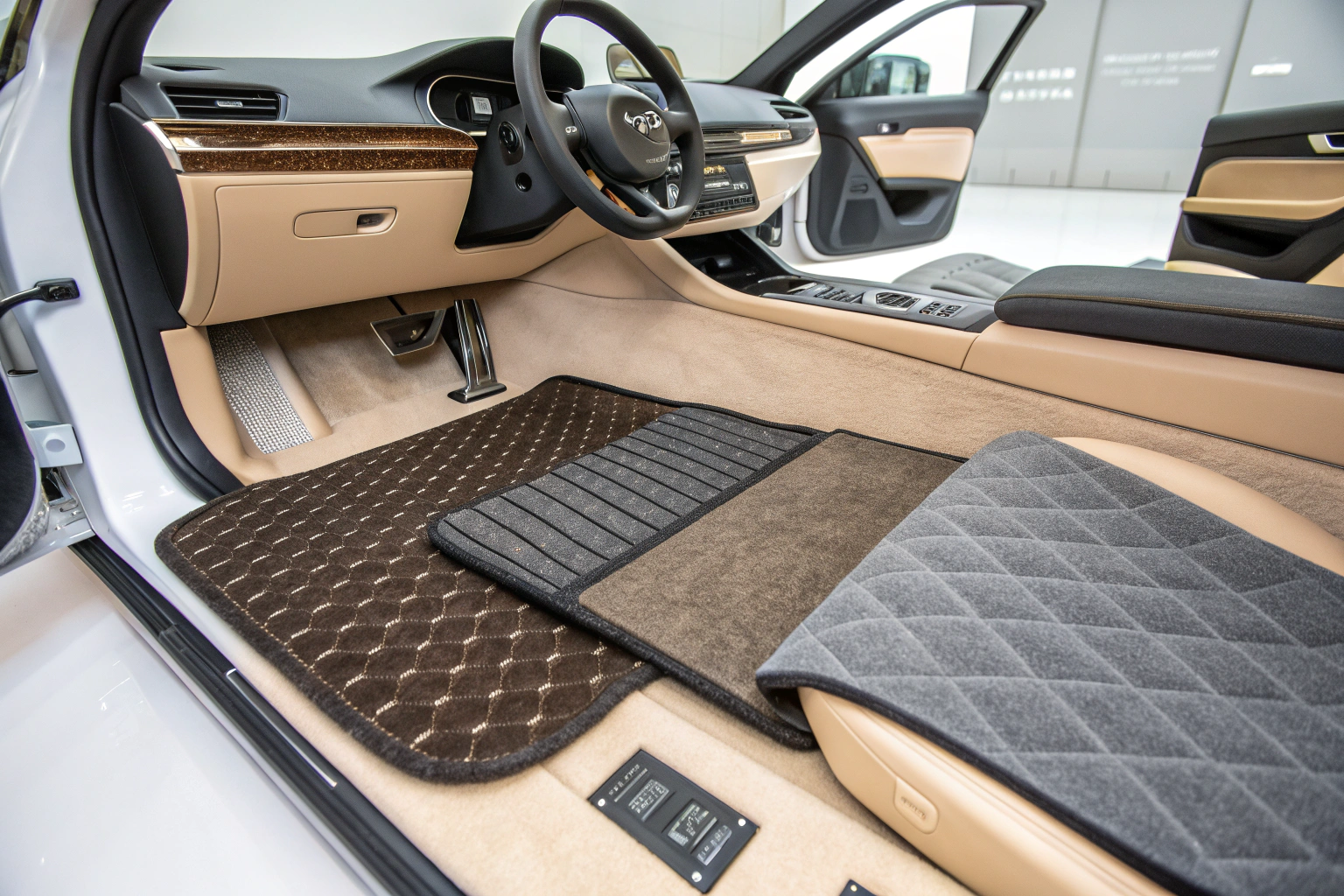
A few years ago, I got a frantic call from a client in Germany. He ran a company that customized luxury vans—the kind with massage seats and mini-bars. His problem? The vans were too loud. The beautiful hardwood floors and leather seats looked amazing, but the road noise was driving his clients crazy. He asked me: "Can you make a fabric that actually stops sound?" I told him, "Fabric alone won’t stop sound. But the right fabric composite? That’s a different story."
Sound-dampening in vehicles is not about blocking noise completely—that’s impossible with fabric. It’s about absorbing sound energy and converting it into heat. It’s about stopping that annoying drone on the highway and making the cabin feel peaceful. At Shanghai Fumao, we’ve been supplying acoustic materials to the automotive aftermarket for years. We make the carpets, the headliner fabrics, and the specialized composites that go inside door panels.
Here’s the reality: most people think any thick fabric will dampen sound. Wrong. You need the right fiber, the right weight, the right backing, and often, the right combination of materials. In this post, I’m going to walk you through the science of acoustic fabrics, the specific materials that work, and how to install them for maximum effect. Whether you’re restoring a classic car or building a luxury RV, this is what you need to know.
What Makes a Fabric Good at Absorbing Sound?
Sound is vibration. It travels through the air as waves. When those waves hit a hard surface—like metal or plastic—they bounce back. That’s echo. When they hit a soft, porous surface, they get trapped. The energy of the wave vibrates the fibers, turning sound into tiny amounts of heat. That’s absorption.
The key is porosity and density. The fabric needs to have open spaces for the sound waves to enter, but enough fiber density to create friction. If it’s too open, the sound passes through. If it’s too solid, the sound bounces off.

Why is non-woven fabric often better than woven for acoustics?
Woven fabrics have a regular, ordered structure. The yarns are packed tight. Sound waves hit them and often reflect. Non-woven fabrics—think of felt or needled punch materials—are a random mess of fibers. They’re like a tangled web. When a sound wave enters this web, it bounces around randomly, hitting fiber after fiber, losing energy each time. That’s why the best acoustic materials are non-wovens. We make a heavy needle-punch polyester felt specifically for automotive use. It’s about 500 GSM (grams per square meter) and 10mm thick. In our impedance tube tests (ASTM E1050), it absorbs about 60% of sound at 1000 Hz—that’s the mid-range frequency of road noise. For a client in Michigan making sound-deadening kits for trucks, this felt is their core product. There’s good data on non-woven acoustic performance from EDANA, the nonwovens association.
What is the Noise Reduction Coefficient (NRC) and why does it matter?
NRC is a single number that tells you how much sound a material absorbs. It’s an average of how much sound is absorbed at four different frequencies (250, 500, 1000, and 2000 Hz). An NRC of 0 means perfect reflection. An NRC of 1 means perfect absorption. Carpet on a concrete floor might have an NRC of 0.3. Our heavy automotive felt has an NRC of 0.65. That’s good for a fabric. But here’s the catch: NRC tests are done in labs, not in cars. In a real vehicle, the sound field is complex. Still, it’s the best benchmark we have. When a Brazilian client asked us for a fabric to line their speaker boxes, we targeted an NRC of 0.7. We achieved it with a 15mm thick polyester fiber blend. The ASTM C423 standard governs this test, and we use it to validate our materials.
Which Specific Fabrics Work Best for Different Vehicle Areas?
You can’t use the same fabric everywhere. The floor needs to resist moisture and abrasion. The headliner needs to be lightweight so it doesn’t sag. The trunk needs to handle heavy loads. We match the material to the location and the type of noise.
Let’s break down the zones and the best fabrics for each.
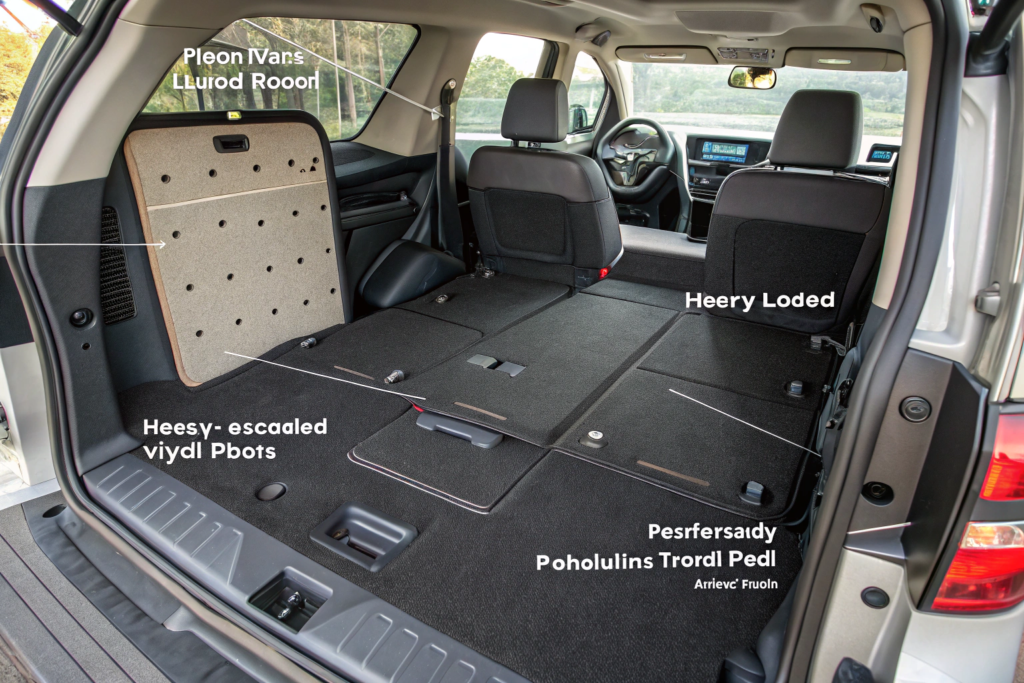
What goes under the carpet for maximum floor damping?
The carpet itself is mostly for aesthetics. The real sound killer is underneath. We use a combination of mass-loaded vinyl (MLV) and closed-cell foam, often covered with a heavy felt. MLV is a dense, flexible sheet—it’s heavy, about 1 pound per square foot. It blocks sound transmission (the "mass law"). The felt and foam absorb sound. For a client in Texas building a sound-proofing kit for Jeeps, we supplied a three-layer composite: 2mm MLV, 5mm closed-cell foam, and a 500g needled polyester felt facing. The felt faces the cabin, the MLV blocks noise from the road, and the foam decouples the layers. Installation is critical—you have to cover every inch of the metal floor, or sound leaks through. For more on automotive mass-loaded vinyl applications, Sound Deadener Showdown is a great resource from an industry expert.
What fabric is used for headliners to prevent drumming?
Headliners have a different job. They stop the roof from "drumming"—that booming sound when rain hits or wind passes over. They also have to be lightweight. The standard is a polyurethane foam laminated to a decorative fabric, usually a polyester knit or non-woven. The foam is typically 5-10mm thick and acts as the sound absorber. The fabric is perforated with tiny holes to let sound through to the foam. We make a headliner material that’s a trilaminate: a scrim (thin fabric) on the back, foam in the middle, and a non-woven facing. It’s compression molded to fit the roof curve. For a Chinese EV manufacturer, we supplied a headliner with an added "acoustic membrane"—a thin layer of butyl rubber between the foam and the scrim. It added 20% more damping at low frequencies (engine rumble). The SAE International standards cover automotive interior material testing, including headliners.
Can you use natural fibers like jute or hemp for sound dampening?
Absolutely, and it’s becoming popular again. Jute and hemp felts are natural, renewable, and they have excellent acoustic properties because of their coarse, irregular fibers. They were used in cars for decades before synthetics took over. We supply a "shoddy pad" made from recycled jute and cotton fibers for trunk liners and wheel well covers. It’s cheap, it works, and it’s sustainable. For a European classic car restorer, we provided a jute felt underlay for the carpets of a 1960s Mercedes. It was exactly what the factory used. The downside? Natural fibers can absorb moisture and rot if they stay wet. They also have a distinct smell when new—some people love it, some hate it. For modern cars, we often treat them with an anti-microbial and anti-fungal finish. Research from North Carolina State University’s College of Textiles has explored the acoustic properties of natural fiber composites extensively.
How Do You Install Acoustic Fabrics Correctly?
You can buy the best acoustic fabric in the world, but if you install it wrong, it’s useless. Gaps are the enemy. Air leaks are the enemy. We’ve seen people spend thousands on materials and then leave a 1-inch gap around a wire harness, and all that noise pours in.
The goal is 100% coverage of the metal panels. Every inch. And you have to use the right adhesive or mechanical fasteners so the material doesn’t sag over time.
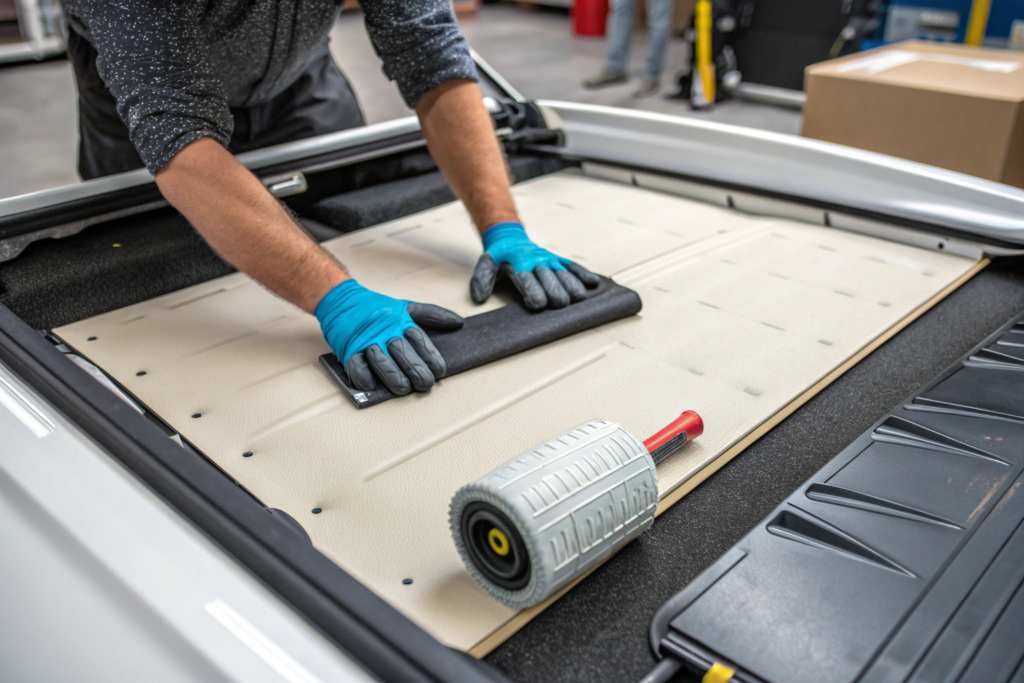
Should you use adhesive or mechanical fasteners?
It depends on the location. For vertical surfaces like door panels, a high-tack, heat-resistant spray adhesive is best. Automotive temperatures can hit 80°C (176°F) inside a closed car in summer. If the adhesive softens, the material slides down. We recommend adhesives rated for continuous high heat. For horizontal surfaces like floors, the weight of the material and the carpet usually hold it in place, but we still recommend tacking it down at the edges. For headliners, they are usually compression-fit with trim pieces, but we often add a few dots of adhesive to prevent sagging in the center. A client from Florida learned this the hard way. His beautifully restored muscle car had a headliner that sagged after one hot summer. He hadn’t used enough adhesive. We sent him a heat-activated spray adhesive, and the replacement has held for three years. The 3M Automotive Aftermarket catalog has a range of products specifically for this.
How do you treat complex curves and vertical panels?
You can’t just lay a flat piece of felt into a curved door panel. It will bridge the curves and leave air gaps. You have to use "conforming" materials. Closed-cell foams are good because they are flexible. For really complex shapes, we use thermoformable felts. These are needle-punch felts impregnated with a low-melt thermoplastic fiber. You heat them up (with a heat gun or in an oven), and they become moldable. You press them into the shape, and when they cool, they hold it. We used this for a boat builder in Sweden who needed acoustic panels for a curved engine compartment. The thermoformable felt held the shape perfectly and killed the diesel noise. For more on thermoforming acoustic materials, Autex has some good case studies.
What About Fabrics for Speaker Grilles and Audio?
If you’re an audiophile, the fabric covering your speakers matters. It has to protect the speaker from dust and damage, but it absolutely cannot block the sound. That means it has to be "acoustically transparent."
We supply a lot of speaker grille fabric to car audio installers. It’s usually a very open weave—monofilament polyester or a coarse mesh. The goal is to have as little material in front of the driver as possible.
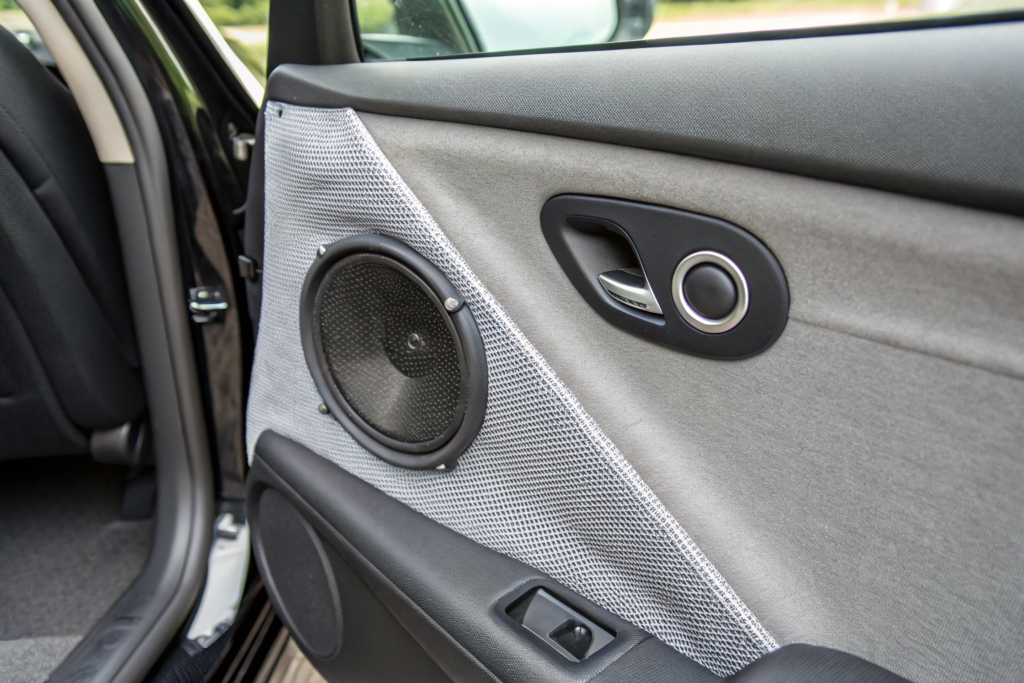
What makes a fabric "acoustically transparent"?
Open Area Percentage. That’s the amount of the fabric that is open space versus solid fiber. A good speaker grille fabric might have an open area of 60-70%. The fibers are thin and the weave is loose. Sound waves pass through with minimal reflection or absorption. We test this using a microphone and a speaker in an anechoic chamber. We measure the frequency response with and without the fabric. A good fabric will show less than 1dB of loss across the frequency range. We had a client in the UK building high-end custom speakers for luxury cars. They were using a standard black polyester mesh, but it was attenuating the high frequencies. We switched them to a monofilament polyester with a much higher open area. The highs came back. There’s a good technical explanation of acoustic transparency in fabrics on Acoustic Frontiers.
Can you match custom colors to car interiors for speaker grilles?
Yes, and this is a big deal for customizers. Nobody wants a black speaker grille in a tan leather interior. We can dye the monofilament polyester to match almost any automotive color. The challenge is that dyeing can fill in some of the open area if not done carefully. We use a "solution-dyed" approach where possible. The color is added to the polymer before the fiber is extruded. It’s part of the fiber, so it won’t fade and it doesn’t clog the weave. For a Concours d’Elegance restoration of a 1930s Duesenberg, we matched the speaker grille fabric to the original Beige color using this method. The owner was thrilled.
Conclusion
The best fabrics for sound-dampening in vehicles aren’t magic. They’re engineered materials designed to do a specific job: absorb sound energy, block its transmission, or let it pass through cleanly. From heavy mass-loaded vinyl on the floor to acoustically transparent mesh over the speakers, every material has a role.
At Shanghai Fumao, we’ve been in this game for a long time. We supply the felt, the composites, the foams, and the grille fabrics that make vehicles quieter and more comfortable. We understand the acoustic tests, the thermal requirements, and the installation challenges. Whether you’re building a silent luxury EV, restoring a classic, or just trying to make your daily driver more peaceful, we can help.
If you have a project that needs acoustic materials, let’s talk. We can help you choose the right fabric for each zone, provide samples for testing, and ship exactly what you need.
Contact our Business Director, Elaine. She’s handled projects for automotive OEMs and custom shops alike. Her email is elaine@fumaoclothing.com. Let’s make your ride quieter.