I remember a frustrating call with a buyer named Michael a few years ago. He had ordered a beautiful line of bright red scarves. They looked perfect in the showroom. But after the first customer wore one with a white shirt, the disaster happened. The red dye rubbed off onto the collar. The customer was furious. The store returned the entire batch. Michael asked me, "Why didn’t we catch this before shipping? Isn’t there a test for this?" There is. It is called colorfastness to crocking, and Michael learned its importance the hard way.
To evaluate the colorfastness to crocking and washing of fabrics, you need to use standardized test methods that simulate real-world conditions. For crocking (color transfer from rubbing), the standard test is AATCC 8 or ISO 105-X12, which uses a crockmeter to rub the fabric with a white test cloth, wet or dry, and then rates the color transfer. For washing, the standard is AATCC 61 or ISO 105-C06, which subjects the fabric to a simulated wash in a launder-Ometer and then evaluates color change and staining. At Shanghai Fumao Clothing, we perform these tests on every new fabric to ensure our clients’ products will perform in the real world.
You might think a fabric that looks good in the roll is good to go. But color is not permanent just because it looks bright. It needs to be bonded to the fiber in a way that resists the forces of daily use. Let me walk you through how we evaluate these critical properties and why they matter for your products.
What Is Colorfastness to Crocking and Why Does It Matter?
Crocking is the term we use for color rubbing off. It is what happened to Michael’s red scarves. It is different from bleeding in the wash. It happens from friction, from rubbing against another surface. Think of a dark blue jean rubbing against a light-colored car seat. That blue transfer is crocking. It is a major quality issue.
Colorfastness to crocking is the resistance of a fabric’s color to transfer onto another surface through rubbing. It matters because it directly affects the user experience. No one wants a new scarf to stain their coat collar. No one wants a baseball cap to leave a blue mark on their forehead when they sweat. Poor crocking performance leads to returns, bad reviews, and a damaged brand reputation. It is a fundamental quality parameter for any colored textile, especially those in high-friction areas like cuffs, collars, and accessories.
Crocking can be either dry or wet. Dry crocking is color transfer from a dry fabric. This often happens with dark, intense colors where excess dye is loosely held on the fiber surface. Wet crocking is often more severe. When the fabric is wet, moisture can act as a carrier, pulling dye molecules out of the fiber and onto the adjacent surface. This is why a sweaty forehead or a damp shirt collar can be a disaster for a poorly dyed garment. Understanding the difference is key to diagnosing problems and finding solutions.

What Causes Poor Colorfastness to Crocking?
The main cause is inadequate dye penetration or fixation. Think of dyeing like painting a wall. If you just spray the surface, the paint can be scraped off. If you soak the paint deep into the plaster, it becomes part of the wall. The same is true for fabric. If the dye does not fully penetrate the fiber and is only sitting on the surface, it will rub off easily. This can happen with certain dye classes, with dark colors that require high dye concentrations, or with poor dyeing processes where the time, temperature, or chemicals are not optimized. It can also be caused by insufficient washing after dyeing, leaving unfixed dye on the fabric surface.
Which Fabrics Are Most Prone to Crocking?
Dark colors are generally more prone to crocking than light colors. A deep black, navy, or red requires a high concentration of dye. It is harder for the fiber to absorb and hold all that dye, so more of it ends up loosely attached to the surface. Certain fibers are also more challenging. Cotton, for example, can be difficult to dye to deep, rich shades with good crocking fastness. Some synthetic fibers can also be problematic if the wrong dye class is used. Fabrics with a napped or brushed surface, like flannel or sueded fabrics, have more fiber ends on the surface, which can release color more easily when rubbed. This is why testing is so critical for these product types.
How Is Colorfastness to Crocking Tested?
You cannot just rub the fabric with your finger and guess. That is not reliable. There is a specific, standardized machine and procedure for this. It takes the guesswork out and gives you a number you can trust. For Michael, this test would have saved his entire order.
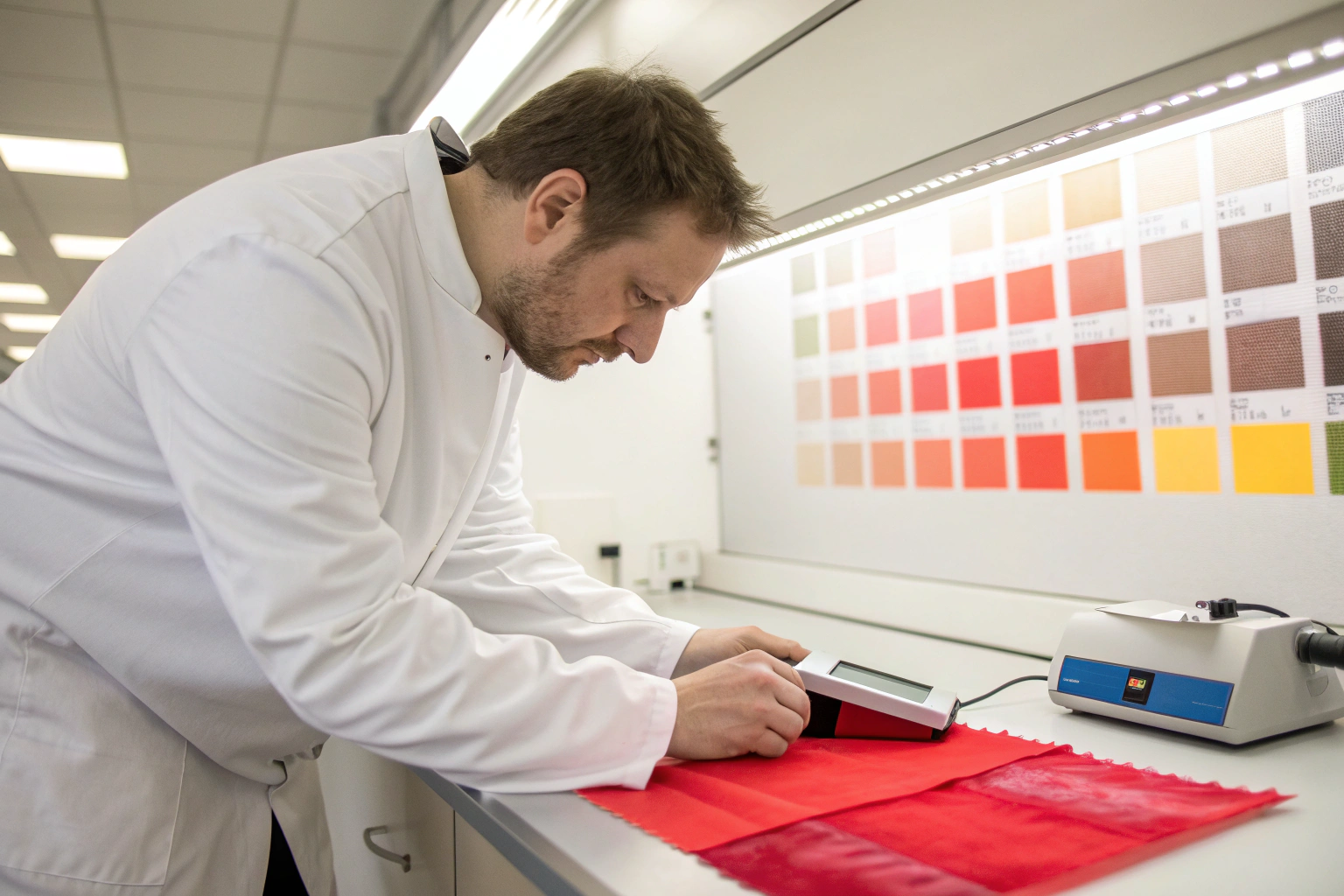
The standard test for colorfastness to crocking is performed using a crockmeter. This machine rubs a white test cloth against the fabric sample under controlled pressure and for a set number of strokes. There are two versions: a dry test and a wet test. For the wet test, the white test cloth is moistened with distilled water. After the rubbing, the white cloth is compared to a standard gray scale for staining. The result is a rating from 1 (very poor, severe staining) to 5 (excellent, no staining). A rating of 3.5 or higher is generally considered acceptable for most apparel and accessory applications.
There are two main types of crockmeters. The most common is the rotary crockmeter, which uses a cylindrical finger that rotates back and forth in a straight line. This is the standard for most fabrics. For pile fabrics like velvet or corduroy, a different method, AATCC 116, uses a rotary crockmeter with a smaller, rotating finger to better test the surface. The choice of method depends on the fabric construction. A good testing laboratory will know which method is appropriate. The key is consistency. The test must be done exactly the same way every time to get reliable, comparable results.

What Is a Crockmeter and How Does It Work?
A crockmeter is a simple but precise mechanical device. It consists of a base to hold the fabric sample securely, and an arm that holds a weighted finger. This finger is covered with a standard white crock test cloth. For the test, you place your fabric flat on the base. You lower the arm so the finger rests on the fabric with a specific force (usually 9 Newtons). Then, you crank a handle or start a motor that moves the finger back and forth across the fabric for 10 complete strokes. This simulates the friction of rubbing against another surface. The white cloth is then removed and evaluated. It is a simple simulation of a real-world problem.
How Do You Read the Results of a Crocking Test?
The results are read by comparing the stained white test cloth to a standard Gray Scale for Staining. This scale has pairs of gray chips, ranging from 5 (no difference, no stain) to 1 (very different, severe stain). A technician places the stained cloth next to the scale and finds the closest match. A rating of 5 is perfect. A rating of 4 is good. A rating of 3.5 is often the minimum acceptable for many brands. Anything below 3.5 is considered poor and likely to cause problems in the field. For wet crocking, a slightly lower rating is sometimes acceptable, but 3.0 is often the minimum. These ratings are objective, standardized, and can be compared across different labs.
What Is Colorfastness to Washing and Why Does It Matter?
Crocking is about rubbing. Washing is about water, detergent, and agitation. It is a different type of stress on the color. A fabric might pass a crocking test but fail in the wash. Or vice versa. You need to test for both. Michael’s scarves might have passed a wash test but failed the crocking test because the issue was surface dye, not dye penetration.
Colorfastness to washing is the resistance of a fabric’s color to fading, bleeding, and staining other items during the laundering process. It matters because it determines how a garment will look after its first wash and after many washes. Will the bright red scarf turn pink? Will it turn the other white clothes in the load pink as well? Poor wash fastness leads to faded, dull products and ruined laundry. It is a primary driver of customer dissatisfaction. Testing ensures that the color is bonded securely enough to withstand the rigors of home or commercial laundry.
Wash fastness is not a single property. It includes several aspects: color change (how much the original color fades or changes), staining (how much color transfers to other fabrics in the wash), and sometimes the effect on the fabric’s hand feel. A fabric might have excellent resistance to color change but poor resistance to staining. Both matter. A dark pair of pants that does not fade but turns all your underwear blue is still a failed product. A comprehensive wash fastness test evaluates all these aspects.

What Causes Poor Colorfastness to Washing?
Similar to crocking, poor wash fastness is usually caused by inadequate dye fixation. The dye molecules are not securely bonded to the fiber molecules. During washing, the combination of water, detergent, heat, and mechanical agitation provides the energy for these loosely held dye molecules to detach and migrate. Some dye classes are inherently less wash-fast than others. For example, direct dyes on cotton have poor wash fastness, while fiber-reactive dyes on cotton have excellent wash fastness. The dyeing process itself is also critical. If the dyeing temperature is too low, or the time is too short, the dye will not fully react, and wash fastness will suffer.
Which Fabrics Are Most Prone to Bleeding in the Wash?
Dark, vibrant colors are again the highest risk. Deep reds, blues, and blacks are the most common culprits. Certain fibers are also more challenging. Cotton, especially when dyed with direct dyes, can bleed significantly. Some silk and wool dyes can also bleed, especially in warm water. Fabrics made from multiple fiber types can be tricky, as a dye that works for one fiber may not be fast on another. This is why a well-managed dye house with experienced technicians is so important. They know which dye classes and which processes to use for each fiber and each color to achieve the required wash fastness.
How Is Colorfastness to Washing Tested?
Testing for wash fastness is more complex than crocking. It tries to simulate the real washing process in a controlled, repeatable way. There is a machine for this, and it is used in textile labs all over the world. It is the only way to be sure before you ship.
The standard test for colorfastness to washing is performed using a machine called a Launder-Ometer. This device consists of sealed stainless steel containers that rotate in a heated water bath. A fabric sample is placed in a container along with a specified amount of detergent, steel balls to simulate agitation, and a multifiber test fabric (a strip containing different fiber types like cotton, wool, nylon, polyester, etc.). The container is rotated at a set temperature for a set time (e.g., 45 minutes at 49°C or 120°F). After the test, the original fabric is compared to the washed fabric for color change, and the multifiber strip is evaluated for staining.
The specific conditions of the test (temperature, time, detergent type, number of steel balls) are specified by the standard being followed, such as AATCC 61 or ISO 105-C06. These standards have different "test options" that simulate different washing conditions, from gentle hand washing to harsh commercial laundering. A common test is AATCC 61 2A, which simulates five home machine washings at 49°C (120°F). By choosing the right test option, you can predict how a fabric will perform over its lifetime. This allows you to set quality standards that match your product’s intended care instructions.

What Is a Launder-Ometer?
A Launder-Ometer is a laboratory instrument designed to simulate the mechanical and chemical actions of a washing machine in a controlled, reproducible way. It consists of a water bath that can be heated to precise temperatures, and a rotating shaft that holds multiple sealed canisters. Each canister contains your fabric sample, a specified amount of detergent solution, and stainless steel balls that provide mechanical agitation as the canisters tumble. It is a standardized way to subject small fabric samples to the stresses of laundering. This allows textile chemists and quality control teams to evaluate wash fastness without having to wash full-size garments.
How Do You Read the Results of a Wash Test?
The results are read using two different gray scales. First, to evaluate color change, the washed fabric sample is compared side-by-side with an unwashed original sample. This is matched against the Gray Scale for Color Change, which ranges from 5 (no change) to 1 (severe change). Second, to evaluate staining, the multifiber test fabric is examined. Each fiber strip (cotton, wool, etc.) is compared to the Gray Scale for Staining, again rating from 5 (no stain) to 1 (severe stain). A good quality fabric will typically have a rating of 4 or 5 for both color change and staining on all fiber types. A rating of 3.5 is often the minimum acceptable for commercial products.
How Can You Improve Colorfastness in Your Products?
So, you have tested your fabric, and the results are not good. What now? Is the fabric unusable? Not necessarily. There are steps you can take, both in the dyeing process and in the finishing, to improve colorfastness. It is better to fix the problem at the source than to deal with returns later.
To improve colorfastness, start with the right dye for the fiber. Use fiber-reactive dyes for cotton, acid dyes for wool and nylon, and disperse dyes for polyester. Ensure the dyeing process is optimized for time and temperature to allow full dye penetration and fixation. After dyeing, a thorough washing and scouring process is essential to remove any unfixed dye from the fiber surface. Finally, the use of fixing agents or after-treatments can help lock the dye in place. At Shanghai Fumao Clothing, we work with our dye houses to optimize these parameters for every order.
For fabrics that are inherently prone to poor crocking, like deep indigo denim or high-color-intensity fabrics, special finishing techniques can help. One common method is to apply a clear, protective topcoat or resin to the fabric surface. This acts as a barrier, reducing the friction that causes crocking and helping to hold loose dye particles in place. However, this can affect the hand feel of the fabric, making it stiffer. Another approach is to use enzymes or bio-polishing to remove loose surface fibers that can contribute to crocking. The best solution depends on the specific fabric and the desired end use.

What Role Do Fixing Agents Play?
Fixing agents, also called dye fixatives, are chemicals applied after dyeing to improve wash and crock fastness. They work by forming a chemical bridge between the dye molecule and the fiber molecule, or by forming a larger, insoluble complex with the dye that is trapped inside the fiber. For direct dyes on cotton, fixing agents are almost essential to achieve acceptable wash fastness. For fiber-reactive dyes, they can provide an extra margin of safety. However, fixing agents are not a magic bullet. They cannot fix a fundamentally bad dyeing job. They are a tool to enhance performance, not to salvage a failure. They can also sometimes affect the shade or the hand feel, so they must be used carefully.
How Does Fabric Construction Affect Colorfastness?
Fabric construction plays a role, particularly in crocking. Tightly woven fabrics with a smooth surface, like a poplin, tend to have better crocking resistance than loosely woven or textured fabrics. A loose weave has more fiber ends and more surface area for the rubbing finger to snag and release color. Napped or brushed fabrics, like flannel or fleece, are particularly challenging. The napping process brings many fiber ends to the surface, and these ends can easily release color when rubbed. If you are working with these fabrics, you need to be especially vigilant in testing and may need to accept a slightly lower crocking standard or use special finishing treatments.
Conclusion
Evaluating colorfastness to crocking and washing is not just a technical exercise. It is a critical step in protecting your brand’s reputation and ensuring customer satisfaction. A beautiful product that bleeds or fades is a failed product. By using standardized tests like AATCC 8 for crocking and AATCC 61 for washing, you can identify problems before they reach your customer. You can work with your suppliers to optimize dyeing processes, select the right dyes, and apply the right finishes to ensure your colors stay where they belong: on the fabric.
If you are sourcing fabrics and need to ensure they meet the highest standards for colorfastness, we are here to help. We have the testing expertise and the mill relationships to deliver products that perform. Please contact our Business Director, Elaine, at elaine@fumaoclothing.com. Let’s make sure your colors stay brilliant, wash after wash.