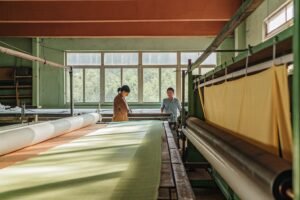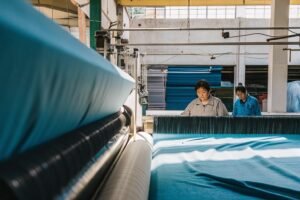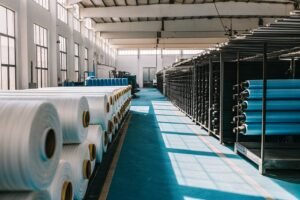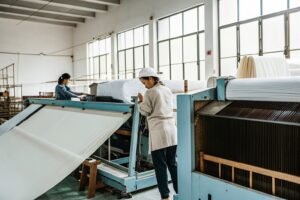
I never thought I’d be writing about fabric and soundproofing when I started in this business 20 years ago. Back then, it was all about making sure a satin felt smooth or a denim held its color. But around 2018, something shifted. We started getting inquiries from a completely new type of client—not fashion brands, but interior designers, architects, and even a tech company from Silicon Valley. They all had the same question: "Can you make fabric that helps quiet a room?"
The short answer is yes, but it’s not the same as the fabric we make for dresses or shirts. You can’t just hang any old tapestry on the wall and expect it to absorb echo. The best fabrics for acoustic panels and soundproofing are specifically engineered to trap air and convert sound energy into heat. It’s a science. And for the last few years, at Shanghai Fumao, we’ve been working with clients in Europe and North America to develop textiles that do exactly that, while also looking good enough for a high-end hotel lobby or a home recording studio.
In this post, I’m going to break down what makes a fabric "acoustic," which materials actually work, and how we manufacture them here in China. We’ll cover the difference between soundproofing (blocking sound) and sound absorption (reducing echo), the role of fabric weight and weave, and why recycled materials are becoming the standard. I’ll also share some real examples from our production lines—like the time in 2022 when we helped a German automotive supplier develop acoustic headliner fabric that met both fire safety standards and their sustainability goals. Let’s get into it.
How Does Fabric Actually Absorb Sound?
Before we dive into specific fabrics, you need to understand the physics. Sound travels in waves. When those waves hit a hard surface like glass, concrete, or drywall, they bounce back. That’s echo. When they hit a soft, porous material, the energy of the wave gets converted into a tiny amount of heat as the fibers vibrate and the air moves through the material. This is sound absorption.
The key to good sound absorption is airflow resistivity. You want a fabric that allows air to penetrate it, but not too easily. If the fabric is too open (like a loose gauze), the sound waves just pass through and hit the wall behind, still causing echo. If it’s too dense and coated (like a waterproof polyester), the sound bounces right off. The sweet spot is a fabric with a complex, fibrous structure that traps air and creates friction.
We measure this with the Noise Reduction Coefficient (NRC), a rating between 0 and 1. An NRC of 0 means the material reflects all sound (like glass). An NRC of 1 means it absorbs all sound (like special acoustic foam). Most good acoustic fabrics, when wrapped around a core of fiberglass or foam, will achieve an NRC of 0.75 to 0.95. But the fabric itself has to be "acoustically transparent" to allow the sound to reach that core. That’s the first rule: the fabric is the gateway. For a deep dive into acoustic testing methods, the Acoustical Society of America publishes a lot of technical papers on this.

What’s the difference between soundproofing and sound absorption?
This is the most common mix-up I hear from clients. Let me clear it up. Soundproofing is about stopping sound from traveling from one space to another. Think of a recording studio that needs to keep street noise out. That requires mass and airtight construction—thick concrete walls, double layers of drywall with green glue in between, heavy mass-loaded vinyl. Fabric alone cannot soundproof a room. It’s just not heavy enough.
Sound absorption, on the other hand, is about controlling the sound inside a room. It reduces reverberation and echo, making speech clearer and the space feel calmer. That’s where acoustic panels wrapped in fabric come in. They soak up the sound waves so they don’t bounce around. I had a client from New York in 2021 who owned a restaurant with terrible noise complaints. Customers couldn’t hear each other talk. They thought they needed soundproofing. What they actually needed was absorption. We supplied them with 200 yards of a heavy, textured wool blend fabric that we make for acoustic panels. They wrapped their existing wall panels with it, and the difference was night and day. The noise level dropped, and the vibe became much more intimate. You can read more about the difference between these two concepts on this construction and architecture blog. It’s a great resource for understanding the basics before you start ordering materials.
What Natural Fibers Work Best for Acoustic Panels?
When people think "acoustic fabric," they often imagine that scratchy, boring gray material you see in old office cubicles. But that’s changing fast. Natural fibers are making a huge comeback because they offer excellent acoustic properties along with sustainability and aesthetics. At our factory in Keqiao, we’ve been developing more and more natural fiber blends for acoustic applications, especially for European clients who demand eco-certifications.
Wool is the king of natural acoustic fibers. It’s naturally crimped, which means the fibers have a wavy structure that creates millions of tiny air pockets. When sound waves hit wool, they get trapped in these pockets and the friction converts the energy to heat. Wool also has excellent fire resistance naturally—it’s harder to ignite than synthetics and self-extinguishes. We worked with a British theater company in 2023 to supply wool-blend fabric for their new performance space. They needed fabric that would absorb sound to prevent echoes during plays, but also had to meet strict fire safety standards for public buildings. Wool checked both boxes. Plus, it regulates humidity, which is a bonus for any indoor space. For more on wool’s technical properties, check out this sheep farmers cooperative blog about wool insulation. It’s not a competitor, but they explain the science well.
Cotton can work, but it has limitations. Standard cotton fabric is usually too thin and smooth to absorb sound effectively. However, recycled cotton felt or heavy cotton duck canvas can be effective. The key is thickness and density. A thick, needled cotton felt—where the fibers are mechanically tangled together without weaving—can achieve decent NRC ratings. We produced a run of recycled cotton felt panels for a sustainable office fit-out in Amsterdam last year. The client loved that the material came from recycled textile waste, and the acoustic performance met their needs for open-plan office noise reduction. The downside? Cotton is more flammable than wool and requires chemical treatment to meet fire codes, which can defeat the eco-purpose. That’s something to weigh carefully.

How does hemp fabric compare to wool for acoustic applications?
Hemp is an up-and-comer in the textile world, and for good reason. It’s incredibly sustainable—it grows fast, requires little water, and doesn’t need pesticides. For acoustic applications, hemp fibers are naturally coarse and hollow, which gives them good sound-absorbing properties. When we make a hemp fabric for panels, we usually keep it in a heavier weight, around 400-500 GSM, and often in a plain weave or a felted construction.
Compared to wool, hemp is stiffer. It doesn’t have the same natural crimp, so the handle is rougher. But that stiffness can be an advantage for certain panel designs where you want the fabric to hold a sharp fold or shape without stretching. Hemp also has natural anti-microbial properties, which is great for humid environments. We supplied hemp-blend acoustic fabric to a resort in Thailand in late 2022. They wanted something that could handle the humidity without molding and that looked natural and earthy. The hemp worked perfectly. The NRC wasn’t quite as high as wool—maybe 0.7 compared to wool’s 0.85 in similar constructions—but for their needs, it was more than sufficient. This sustainable building materials forum has some interesting discussions from contractors who’ve used hemp for sound absorption. Worth a read if you’re considering natural options.
Why Are Recycled Polyester Fabrics Dominating the Acoustic Market?
Walk into any commercial building these days—offices, hotels, co-working spaces—and chances are the acoustic panels are wrapped in something made from recycled polyester (rPET). There’s a reason for this. It’s not just about the sustainability story, though that’s a big part of it. Recycled polyester offers a combination of performance, consistency, and cost that’s hard to beat.
First, the acoustic performance. Polyester fibers can be engineered to specific thicknesses and shapes. For acoustic fabric, we often use a non-woven construction—think of a thick felt, but made from recycled plastic bottles. This structure is full of interconnected air pockets. Sound waves enter the material and bounce around inside, losing energy. The NRC of a good quality PET felt can be 0.8 or higher, depending on thickness. We make panels from 6mm to 24mm thick, and the thicker they are, the better they absorb lower frequencies.
Second, the consistency. Natural fibers have variability. One batch of wool might be slightly different from the next based on the season, the sheep, or the processing. Recycled polyester, made in a factory, is incredibly consistent. We can guarantee the same GSM, the same thickness, and the same acoustic performance roll after roll. This matters for large commercial projects where you need predictability. In 2023, we supplied over 10,000 meters of recycled polyester acoustic fabric to a hotel chain renovating properties across Scandinavia. They needed the exact same fabric for 15 different locations over six months. With rPET, we could do that. For more on how recycled polyester is made from bottles, this plastics recycling industry blog has a good explainer.

How do we achieve different colors and textures in recycled acoustic fabrics?
One complaint we used to hear about recycled polyester was that it looked… well, recycled. It had that dull, matte, slightly industrial appearance. But manufacturing has come a long way. Now, we can create stunning colors and textures that rival any natural fiber.
The color comes from either solution-dyeing or piece-dyeing. Solution-dyeing is our preferred method for acoustic fabrics because it’s more sustainable and colorfast. We add the pigment to the molten polymer before it’s extruded into fibers. This means the color is throughout the entire fiber, not just on the surface. The fabric won’t fade in sunlight, which is crucial for panels near windows. It also uses less water and chemicals than traditional dyeing. For a tech company in California, we developed a custom sage green for their office panels using solution-dyed rPET. Two years later, the panels facing the window still look the same as the day they were installed.
Texture comes from the manufacturing process. We can make smooth, velvety surfaces by using finer denier fibers and a calendering finish (running it through hot rollers). Or we can make a more rugged, textured surface by using coarser fibers and skipping the calendering. We also do needle-punching, where thousands of barbed needles punch into the felt, entangling the fibers and creating a dimensional surface. This process can even create patterns. For a boutique hotel in Miami in 2022, we created a wave pattern on their acoustic panels just by varying the depth of the needle-punching. It looked incredible and performed acoustically. If you’re curious about different texturing techniques, this non-woven textile machinery blog shows how it’s done on an industrial scale.
What fire safety standards must acoustic fabrics meet for commercial use?
This is non-negotiable. If you’re putting fabric on walls in any commercial or public building, it has to meet strict fire codes. Different countries have different standards, and we test to all of them in our lab.
In the US, the key standard is ASTM E84, the "Steiner Tunnel Test." It measures flame spread and smoke density. For most commercial applications, you need a Class A rating, which means a flame spread index of 25 or less and a smoke developed index of 450 or less. Our recycled polyester acoustic fabrics consistently achieve Class A when tested. We also test to California Technical Bulletin 117 (TB117), which is required for upholstered furniture and often applies to wall panels too.
In Europe, the standard is EN 13501-1, with classes from A1 (non-combustible) to F (easily flammable). Acoustic fabrics typically aim for B-s2, d0 or C-s2, d0. The "s" stands for smoke production, and the "d" for flaming droplets. Polyester can melt and drip, which is why we sometimes add fire-retardant treatments or blend with natural fibers like wool to improve the rating.
We learned this the hard way years ago when a shipment to a Canadian client was held up at customs because our test reports weren’t formatted correctly for their local regulations. Now, we pre-check every order. When a client from London ordered panels for a school in 2023, we ran the EN 13501-1 tests first and provided the certification with the shipment. No delays. For a detailed breakdown of these standards, the National Fire Protection Association (NFPA) website is the ultimate authority. And this commercial building safety blog has a good summary of what architects need to know.
How Do We Manufacture Acoustic Panels with Custom Fabric Wrapping?
This is where the rubber meets the road. You’ve chosen your fabric—maybe a beautiful recycled polyester felt in a custom color. Now, how does it actually become a finished acoustic panel that can be installed on a wall? At Shanghai Fumao, we don’t just sell the fabric; we can help coordinate the entire panel manufacturing process through our partners, ensuring quality from fiber to finished product.
The core of most acoustic panels is either fiberglass or high-density acoustic foam. Fiberglass is the traditional choice—it’s cheap, effective, and has a high NRC. But it’s also itchy to handle and not great from a health perspective. More and more, our clients are asking for PET felt cores. These are made from recycled polyester, just like the fabric, and they’re completely recyclable at the end of life. They’re also safer to handle during manufacturing. We worked with a Dutch design firm in 2023 to create panels with a 100% recycled PET core and a 100% recycled PET fabric wrap. It was a closed-loop product, which was a huge selling point for their client, a sustainable bank.
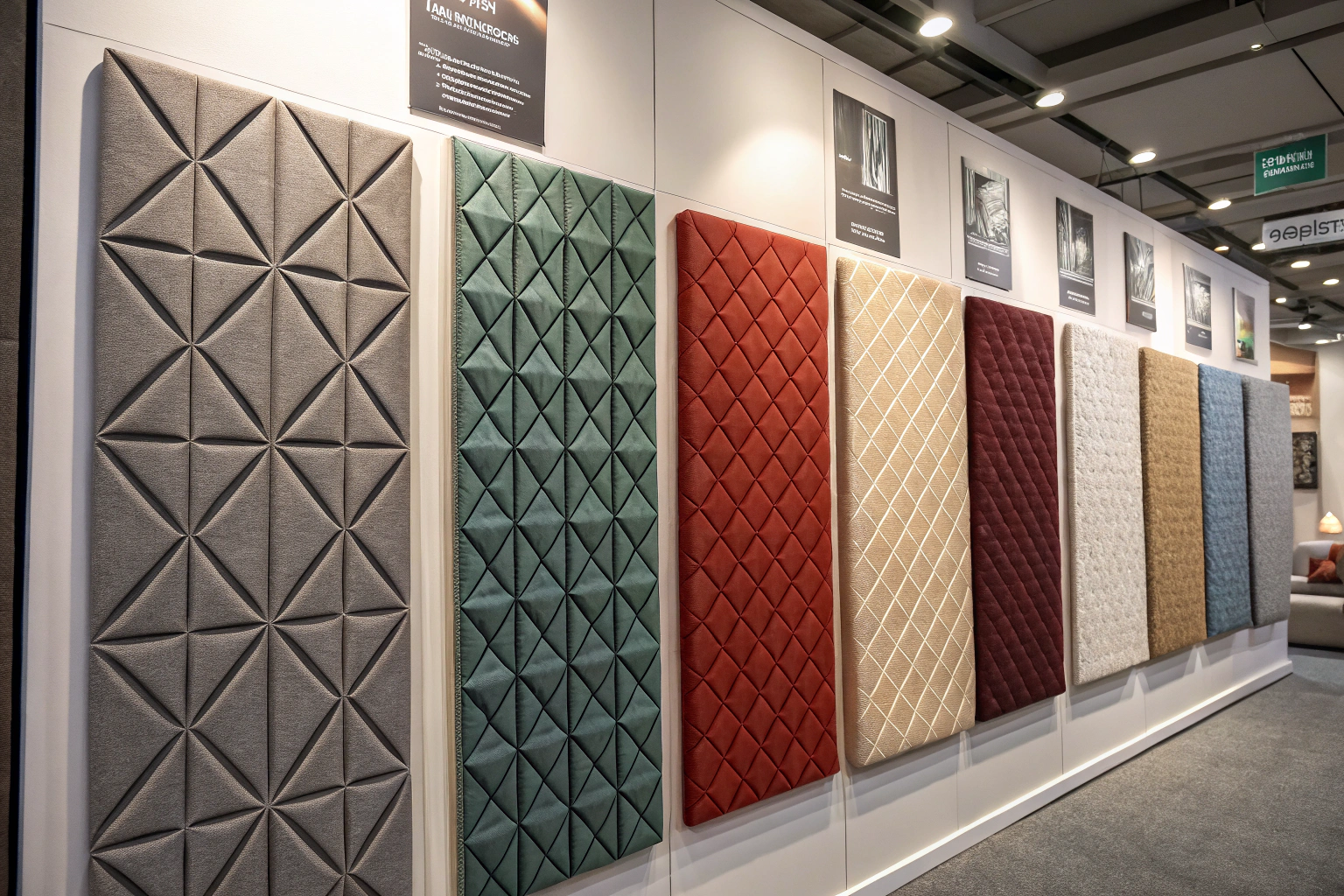
The wrapping process requires skill. The fabric has to be stretched evenly over the core to avoid wrinkles or distortion of the pattern. For acoustic fabrics, you also have to be careful not to compress the fabric too much, or you’ll close up the air pockets and reduce the sound absorption. We use a combination of heat and tension. For fabric-wrapped panels, we often apply a light adhesive to the core and then stretch the fabric around it, stapling it to a wooden or aluminum frame on the back. For thicker felt panels, we can sometimes CNC-cut the felt itself into shapes and use it as both the core and the covering, which simplifies the process.

What’s the lead time for custom acoustic fabric production?
Timing is everything in construction and renovation projects. If the fabric is late, the whole project gets delayed. Based on our experience, here’s a realistic timeline.
For stock fabrics—colors and weights we run regularly—we can ship samples within 48 hours and bulk fabric within 2-3 weeks. We keep popular acoustic fabrics in stock because we know architects often need them fast. For custom colors or custom blends, you need to add 2-4 weeks for development and strike-offs, then another 3-5 weeks for bulk production. So total lead time for a custom acoustic fabric project is usually 6-9 weeks, plus shipping.
We had a client from Austin, Texas, who needed 5,000 yards of a custom-colored recycled polyester for a new corporate headquarters. They came to us in April 2024. We did color matching, sent strike-offs, got approval, and shipped the fabric by mid-June. They had their panels manufactured locally and installed by August. It was tight, but it worked because they planned ahead. If you’re working on a project, factor in the Chinese New Year shutdown (usually 3-4 weeks in January/February) and Golden Week (1 week in October). We always advise clients to complete pre-production at least 6 weeks before any major holiday to avoid delays. This construction project management blog has some good tips on timing orders from China.
How do we ensure color consistency across thousands of yards for large projects?
Color consistency is the biggest headache in large-scale textile projects. Imagine 1,000 panels going up in a lobby, and five of them are slightly off-color. It would ruin the whole aesthetic. For acoustic panels, where the fabric is the main visual element, consistency is critical.
We use a few methods to guarantee it. First, as I mentioned, solution-dyeing is our preference. Because the color is in the polymer, there’s virtually no variation between batches. If we’re piece-dyeing, we dye all the fabric for a single project in the same batch if possible. If we need multiple batches, we hold "shade bands"—physical standards—and we test each batch against that standard under standardized lighting conditions in our lab. We use a spectrophotometer to measure the color numerically, not just by eye. This removes subjectivity.
We also practice "cutting and sewing" of dye lots. If a project requires 10,000 yards, we might dye it in two 5,000-yard lots. We’ll then take fabric from the end of lot one and the beginning of lot two, sew them together, and check if the seam is visible. If it is, we go back and adjust. For a massive project in Dubai in 2022, we produced 50,000 yards of acoustic fabric in 10 batches over 4 months. Every batch matched because we controlled the process tightly and communicated constantly with the dyer. For more on color management in textiles, this color science blog explains the technology behind it.
Conclusion
Sourcing fabric for soundproofing and acoustic panels is a specialized field that goes far beyond traditional textiles. It requires understanding the physics of sound absorption, the properties of fibers—whether natural wool or recycled polyester—and the manufacturing processes that create effective acoustic materials. You need fabric that is acoustically transparent, durable, fire-safe, and visually appealing. And when you’re sourcing from overseas, you need a partner who can guarantee consistency, provide certified test results, and navigate the complexities of international shipping and customs.
At Shanghai Fumao, we’ve built our reputation on exactly that kind of partnership. With over two decades in Keqiao, the heart of China’s textile industry, we have the manufacturing muscle, the technical expertise, and the quality control systems to deliver acoustic fabrics that perform. Whether you’re an architect designing a quiet office, a contractor outfitting a hotel, or a manufacturer building acoustic panels for resale, we can help.
We’re not just selling fabric; we’re providing a solution. We can handle everything from fiber selection and custom color development to lab testing and logistics. If you have a project in mind and need fabric that looks good and quiets a space, let’s talk. Please contact our Business Director, Elaine, at elaine@fumaoclothing.com. Let’s make your space sound as good as it looks.