You’re shopping for a new wardrobe staple. A sleek blouse catches your eye—it drapes perfectly, resists wrinkles, and has a vibrant color. The tag says "100% Polyester." Your mind might flash to words like "cheap," "plastic," or "unbreathable." But what if everything you think you know about this ubiquitous fabric is outdated, or just plain wrong? Polyester is the world’s most produced fiber, yet it’s also the most misunderstood. So, what exactly is it, and why does it dominate your closet and the global textile industry?
Polyester is a synthetic fabric made from purified terephthalic acid (PTA) and monoethylene glycol (MEG), which are petroleum-derived polymers. Its molecular chain is engineered for strength, resilience, and versatility. The core advantages that have cemented its dominance are exceptional durability, high wrinkle and shrink resistance, quick-drying properties, and superb color retention. However, common myths—such as it being universally uncomfortable, unbreathable, and irredeemably unsustainable—often overshadow a more nuanced reality where advanced engineering and recycling are transforming its profile.
This guide will dissect polyester from molecule to marketplace. We’ll explain its manufacturing process, break down its true technical properties versus perceptions, analyze its environmental impact with a focus on modern solutions like rPET, and provide clear guidelines on how to source and specify high-quality polyester for your projects. Let’s separate the plastic from the potential.
From Petrochemicals to Polymer: How is Polyester Actually Made?
To understand polyester’s properties, you need to start at the beginning. It’s not simply "liquid plastic poured into thread." It’s a precise chemical polymerization followed by sophisticated mechanical processing. The journey from oil to fabric involves three key stages, each giving polyester its defining characteristics.
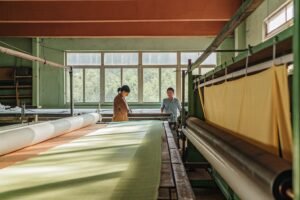
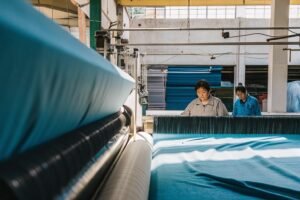
The process begins with crude oil refinement. Key components are separated and processed into the two main monomers: PTA (a powder) and MEG (a liquid). These are not the fabrics you wear; they’re the chemical building blocks. In 2022, we toured a state-of-the-art polymerization plant in China. Seeing the scale and computer-controlled precision—where temperature and pressure are managed to within fractions of a degree—drove home that this is advanced materials science, not a simple craft.

What Happens in the Polymerization and Spinning Stages?
- Polymerization: PTA and MEG are combined in a reactor under high temperature and vacuum. They undergo a condensation reaction, forming long-chain polymers of polyethylene terephthalate (PET). This molten polymer is then extruded, cooled, and cut into tiny chips or pellets. Think of these as the "raw plastic beads" before they become fiber.
- Melt Spinning: The PET chips are dried, melted again, and forced through a metal plate called a spinneret, which is full of tiny holes. As the molten polymer exits each hole, it solidifies into a continuous filament. The size and shape of the hole determine the filament’s denier (thickness) and cross-section (round, trilobal, hollow). A trilobal cross-section filament, for instance, is engineered to scatter light, giving the fabric a softer, more natural luster rather than a cheap plastic shine.
Quality Insight: The consistency of the chips and the precision of the spinning process are what separate premium polyester from commodity-grade. Inconsistent chip viscosity leads to weak spots in the filament. We source our filament yarns from Tier 1 suppliers who control this upstream process, because you can’t fix bad polymer with good weaving.
How Does Drawing, Texturing, and Finishing Create the Final Yarn?
The freshly spun filaments are strong but have little stretch and a stiff hand. They need to be "drawn" and processed.
- Drawing: Filaments are stretched to several times their original length. This aligns the polymer molecules along the fiber axis, dramatically increasing tensile strength and reducing elongation (stretch). This is why polyester thread is so strong.
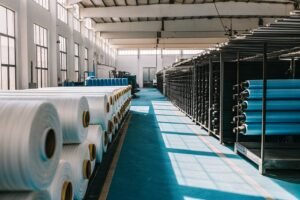
- Texturing: To make the yarn bulkier, softer, and more absorbent (for wicking), the smooth filaments are crimped, coiled, or looped using air jets or false-twist methods. This creates texture and air pockets within the yarn. Most apparel polyester is textured.
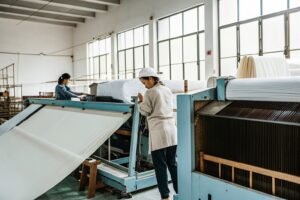
- Finishing: The yarn can be dyed at this stage (solution dyed) for extreme colorfastness, or it can be woven/knitted into fabric first and then piece-dyed. Finishes like moisture-wicking, anti-static, or anti-microbial treatments are also applied here.
The Game Changer – Recycled Polyester (rPET): The process for recycled polyester yarn from post-consumer bottles diverges here. Instead of virgin PET chips, cleaned and flaked recycled plastic serves as the feedstock. It’s melted, re-polymerized to ensure chain strength, and then spun identically. The key is the quality of the feedstock and the filtration during melting to remove impurities. Our rPET supplier uses a proprietary filtration system that allows them to produce filaments as fine and strong as virgin, debunking the myth that recycled is always inferior.
Debunking Myths: What Are Polyester’s Real Properties vs. Perception?
Polyester suffers from a legacy problem. The early generations (1970s-90s) were indeed often stiff, shiny, and uncomfortable. But fiber science has advanced dramatically. Let’s confront the big myths with current facts.

Myth 1: "Polyester is Uncomfortable and Unbreathable."
- Reality: Comfort and breathability are functions of fabric construction, not just fiber. A tightly woven 100% cotton canvas is less breathable than a loose, open-knit polyester mesh.
- The Engineering: Modern polyester is engineered for comfort. Microfiber polyester (filaments finer than silk) is incredibly soft. Moisture-wicking finishes and capillary-action yarn structures pull sweat away from the skin to the fabric’s surface where it evaporates. This is why it dominates performance activewear—it keeps you drier, which is more important than just "breathable."
- Data Point: In a 2023 test for a athleisure client, our high-quality polyester jersey had a moisture vapor transmission rate (MVTR) 25% higher than a standard cotton jersey of the same weight. The polyester felt cooler and drier during exercise.
Myth 2: "Polyester is Weak and Pills Easily."
- Reality: Polyester has excellent tensile strength and abrasion resistance—often outperforming cotton and rayon. Pilling is a surface fuzzing caused when short fibers break and tangle. Because polyester filaments are long and strong, high-quality polyester pills less than many natural fibers.
- The Catch: Pilling occurs in blends where weaker fibers (like short-staple cotton) break and are anchored by the strong polyester fibers. It can also happen in low-quality polyester where filaments are brittle.
- Sourcing Tip: To minimize pilling, look for fabrics made from continuous filament yarns (not spun/staple yarns) and with a tight construction. Ask your supplier for pilling test results (Martindale or Random Tumble). Our standard for knitwear is a minimum 20,000 rubs on the Martindale test.
Myth 3: "Polyester is Always Bad for the Environment."
This is the most complex myth. Virgin polyester’s downsides are real: it’s derived from non-renewable petroleum, and it sheds microplastics during washing. However, the narrative is shifting.
- The Problem (Virgin): Fossil fuel dependency, energy-intensive production, and microfiber pollution.
- The Solutions & Nuances:
- Recycled Polyester (rPET): Diverts plastic waste from landfills and oceans. It uses 50-85% less energy than virgin polyester and reduces petroleum consumption. It’s a crucial circular economy solution.
- Biomass-Based Polyesters: Emerging technologies create PET precursors from sugarcane or corn, though these are not yet mainstream.
- Longevity & Care: A durable polyester garment that lasts 10 years and is washed cold has a lower overall footprint than a delicate, frequently washed natural fiber garment that lasts 2.
- Mitigation: Guppyfriend bags or washing machine filters can capture microfibers. Brands like Patagonia fund research into this.
Our Stance at Fumao: We actively promote rPET and are investing in closed-loop recycling partnerships for post-industrial polyester waste. We believe the future is in making the existing plastic in our world circulate, not in digging up more oil.
The Unbeatable Advantages: Why Does Industry Love Polyester?
Despite the myths, polyester’s functional benefits make it indispensable. It solves problems that natural fibers often cannot, especially at scale and price point.

What are its Key Performance Properties?
- Durability & Shape Retention: High tensile and abrasion resistance. It doesn’t tear easily and maintains its shape wash after wash. It has very low shrinkage (<3% with proper heat-setting).
- Wrinkle Resistance: The polymer chains have a "memory." When heat-set during finishing, they lock into that shape. Wrinkles from packing "fall out" easily.
- Quick Drying & Hydrophobic Nature: It absorbs very little water (only about 0.4% of its weight), so it dries incredibly fast. This is a core feature for activewear, outerwear, and travel clothing.
- Superb Color Affinity: It can be dyed with disperse dyes at high temperatures, resulting in brilliant, colorfast hues that resist fading from washing and sunlight better than most natural fibers.
- Versatility: It can be engineered to mimic the hand of silk, cotton, or wool. It can be woven, knitted, made into fleece, or non-wovens.
Case Study – The Fast Fashion Enabler: A European value retailer needs a dress that can be dyed a perfect, on-trend color, survive global shipping without wrinkling, arrive ready to hang, and retain its color after 20 home washes—all for a target FOB of $9. Only polyester (or a polyester blend) can reliably hit all these technical and cost targets at their volume. This isn’t an endorsement of the model, but an explanation of its dominance.
How Does it Function in Blends?
Polyester is rarely used alone in fashion. Blends leverage the strengths of multiple fibers.
- Polyester/Cotton (65/35 or 50/50): The classic blend. Cotton provides softness and breathability; polyester provides strength, wrinkle resistance, and reduces shrinkage. It’s the workhorse of casual shirting and bed linens.
- Polyester/Wool: Adds durability and shape retention to wool’s warmth and drape. Common in suits and uniforms.
- Polyester/Rayon: Rayon adds drape and a luxurious feel; polyester adds durability and stability to the often-weaker rayon.
How to Source High-Quality Polyester: A Buyer’s Guide
Not all polyester is created equal. The difference between a luxury-feel polyester and a cheap one is in the specifications. Here’s how to buy smart.

What Technical Specifications Should You Demand?
- Denier and Filament Count (Denier/Filament – D/F): This is the most important indicator of hand. Lower denier with high filament count = softer fabric. Example: 75D/144F is much softer than 75D/36F. The same weight is split into more, finer filaments. For a silky feel, look for microdenier (like 20D or lower).
- Fabric Construction: Is it woven (e.g., taffeta, crepe) or knitted (jersey, mesh)? What is the weave/knit pattern? This determines drape, stretch, and breathability.
- Weight (GSM or Oz/Yd²): Dictates drape and opacity. A 60 GSM polyester chiffon is sheer and flowy; a 220 GSM polyester double-knit is substantial and structured.
- Finish: What functional finish is applied? Moisture-wicking? Anti-microbial? UV protection? A "peach skin" finish? Get the specific name and test method.
- Certifications: For sustainability, ask for GRS (Global Recycled Standard) certification for rPET content. For safety, OEKO-TEX Standard 100.
Red Flags: Suppliers who cannot provide a TDS, who only talk in generalities ("soft feel"), or who offer prices significantly below market average for a given spec. You are likely getting inferior polymer, poor spin finish, or inconsistent dyeing.
How to Physically Test a Polyester Sample?
Don’t just look—interrogate it.
- The Stretch and Recovery Test: Stretch it widthwise. Does it recover completely, or does it remain baggy? Poor recovery indicates bad heat-setting.
- The Snag Test: Gently drag a rough fingernail across it. Does it snag easily? Fine filaments can be delicate if not properly bonded.
- The Drape Test: Hold it up. Does it fall in stiff folds or soft, fluid rolls?
- The Color Rub Test: Rub a white cloth vigorously on a colored area. Is there color transfer? This tests colorfastness to crocking.
A Lesson from Production: We had a client complain about "static cling" in a polyester lining. The supplier had used a basic spin finish. We switched them to a lining with a permanent anti-static finish incorporated into the polymer, which solved the problem permanently. The spec sheet made the difference.
Conclusion
Polyester fabric is a testament to human engineering—a material born from petroleum, refined through complex chemistry, and capable of remarkable performance. Its undeniable advantages of durability, easy care, color vitality, and versatility have rightfully earned it a central place in the global textile landscape. However, its legacy is weighed down by legitimate environmental concerns and outdated perceptions of discomfort. The path forward lies in embracing this duality: leveraging its technical strengths for appropriate applications while relentlessly pursuing innovation in recycling, biodegradable variants, and responsible production practices to mitigate its ecological footprint.
The smart approach is neither blanket rejection nor uncritical acceptance. It is informed specification—choosing high-quality, finely engineered polyester or recycled alternatives where their performance benefits are paramount, and pairing them with sustainable manufacturing partners. At Shanghai Fumao, we navigate this complex landscape daily, offering everything from premium luxury-feel polyesters to GRS-certified rPET fabrics, because we believe in providing the right tool for the job. If you are looking to source polyester with clarity on its properties, advantages, and a commitment to better practices, contact our Business Director, Elaine, at elaine@fumaoclothing.com.