You’ve sourced a breathtaking lace with intricate floral motifs for your high-end collection. The swatch was perfect. But when the 500-meter roll arrives, you see broken patterns, inconsistent shading, and snags that turn your dream fabric into a nightmare of waste and delayed shipments. For lace with complex designs, standard fabric inspection isn’t enough. A single misplaced thread or a tension flaw in the net ground can ruin an entire garment panel. How do you catch these invisible defects before they sabotage your production line?
Managing quality control for intricate lace requires a specialized, multi-stage protocol that moves beyond simple visual checks to include tension analysis, pattern alignment verification, and material-specific stress tests. The core of effective QC lies in implementing a “3-Stage Verification” process: Pre-Production (validating the digital design and base yarns), In-Process (monitoring the embroidery or weaving in real-time), and Pre-Shipment (conducting a meticulous, backlit inspection of every meter). Success depends on partnering with suppliers who have the technical infrastructure and cultural commitment to treat intricate lace as a precision product, not a commodity.
This guide will break down a professional QC framework. You’ll learn the critical checkpoints for intricate lace, how to communicate standards to your supplier, the essential tools for inspection, and how to structure contracts to protect your quality interests. Let’s build a system that ensures every meter of lace is as flawless as the initial sample.
Why is Standard Fabric Inspection Useless for Intricate Lace?
If you’re using the standard “4-point system” or a quick visual pass to check lace, you’re missing up to 90% of critical defects. Conventional inspection is designed for uniform fabrics like denim or poplin, looking for stains, holes, and color streaks. Intricate lace, however, fails in more subtle, pattern-specific ways. A defect isn’t just a stain; it’s a motif missing a petal, a net ground with inconsistent tension causing puckering, or a misalignment in the pattern repeat that makes seams impossible to match.
The financial impact is disproportionate. A small, hidden flaw in a repeating pattern can force you to cut around it, wasting far more fabric than a simple hole in a solid fabric. In 2023, a European bridal brand we worked with discovered this the hard way with a previous supplier. The lace had a 30cm pattern repeat, but a nearly invisible “jump” in the embroidery alignment occurred every 5 meters. When cutting the long train sections, the pattern didn’t match, rendering 15% of the expensive lace unusable. Our audit revealed their QC only checked for visible snags, not pattern continuity.
What are the Hidden Defects in Pattern Alignment and Continuity?
For intricate lace, the pattern is the product. Defects here are often systemic, not random.
- Pattern Jump or Misalignment: This is when the embroidered or woven pattern subtly shifts off its registration along the length of the fabric. On a 1-meter swatch, it’s invisible. Over 50 meters, it means the rose at one end of the roll won’t line up with the rose at the other end, making continuous cutting for long garments impossible. This is a machine calibration issue.
- Inconsistent Pattern Definition: The clarity of the motifs can vary. Some areas might look sharp, while others appear fuzzy or blurry. This is often caused by uneven thread tension during embroidery, worn-out needles, or low-quality base yarns. It results in a patchy, low-quality appearance across the fabric.
- Broken or Incomplete Motifs: A single thread break in a complex embroidery machine can mean a leaf or flower detail is missing. On a busy pattern, this can be incredibly hard to spot with the naked eye but becomes glaringly obvious when a garment panel is cut and that section is front and center.
The Solution: Demand a pattern repeat inspection report for engineered lace. At Shanghai Fumao, for any lace with a repeat over 10cm, we run a full roll through a scanner and use software to compare every repeat against the master digital file. This is the only way to catch alignment “drift.” For a New York-based eveningwear client last August, this process flagged a 0.5mm drift per repeat in a sample roll. We recalibrated the machines before bulk production, saving them an estimated $12,000 in wasted fabric.
How Do Net Ground Tension and Yarn Quality Cause Invisible Problems?
The background net (or the “brides” in guipure) is the foundation. If it’s flawed, the entire structure is compromised.
- Uneven Net Tension: If the ground net is knitted or woven with inconsistent tension, it will have areas that are tighter or looser. This causes the lace to pucker or distort when laid flat. When you try to sew it to a stable lining, it will gather or ripple, creating an unsightly finish. You can’t press this out.
- Low-Yarn Quality and Snagging: Intricate lace uses fine denier yarns. Low-quality yarns with poor twist or strength will break easily or “pill.” They are also highly prone to snagging. A simple brush against a rough surface can pull a thread, distorting an entire motif. This is a performance failure.
Pro QC Method: The “Drape and Pull” Test. Take a 1×1 meter sample. Drape it over a rounded edge (like your arm). Does it fall evenly? Then, gently pull it diagonally. Does it recover its shape, or does the net distort permanently? This simple test reveals tension and recovery issues in seconds. We integrated this into our pre-shipment physical validation for delicate textiles after a batch of lace for a lingerie line failed in wear-testing. The net stretched out over time. Now, it’s a standard checkpoint.
What is the 3-Stage QC Protocol for Intricate Lace?
To catch defects at the source, you need a QC protocol that intervenes at every stage of production. Waiting to inspect the final roll is too late. This 3-stage protocol—Pre-Production, In-Process, and Pre-Shipment—creates multiple layers of defense. It transforms QC from a policing action into a collaborative process of quality building.
Think of it like building a watch. You wouldn’t assemble all the tiny gears and then check if it tells time. You verify the gear specifications first (Pre-Production), monitor the cutting and assembly (In-Process), and finally, test the complete watch’s function (Pre-Shipment). Each stage has distinct goals and methods.
What Must Be Verified in the Pre-Production Stage?
This stage is about preventing errors before a single meter is produced. It’s the most critical and most often skipped stage by brands.
- Digital File Audit: The supplier must provide and you must approve the final digital embroidery or weaving file. Check: Are all motifs closed? Is the stitch density consistent? Is the pattern repeat clearly marked? Any error here is replicated infinitely.
- Raw Material Approval: Insist on approving the yarns. Get skein samples of the specific thread (brand, denier, luster) and the base net material. Test them for colorfastness (ISO 105-C06), snag resistance (ASTM D3939), and tensile strength. A client once had lace that discolored under sweat; the root cause was unapproved, low-cost thread.
- Lab Dip and Handfeel Approval: For dyed laces, the lab dip is non-negotiable. For the lace itself, a “bulk production approval sample” (minimum 1 full meter) must be signed off. This sample sets the benchmark for all subsequent quality checks. At Shanghai Fumao, we call this the “Gold Standard” sample. We keep it sealed in our lab, and the final inspection team compares bulk rolls against it under controlled lighting (D65).
Actionable Tip: In your purchase order, make payment of the deposit contingent on your written approval of these three pre-production items. This formalizes the process and gives you leverage.
How is Effective In-Process Monitoring Conducted?
This is about catching drifts in quality during the manufacturing run. It requires the supplier to have internal QC checkpoints on the factory floor.
- First-Piece and Periodic Inspection: When a production run starts, the first 3-5 meters are cut and thoroughly inspected against the Gold Standard sample. Then, at regular intervals (e.g., every 500 meters), another sample is taken. This checks for machine drift, thread lot changes, or needle wear.
- Machine Parameter Logs: A reliable supplier will log key machine parameters (tension, speed, temperature for heat-setting) throughout the run. A significant deviation can explain a quality shift. Ask to see these logs if an issue arises.
- Operator Training: The machine operators are the first line of defense. They must be trained to spot and stop the machine for common defects like thread breaks or pattern jumps. A culture of quality on the floor is irreplaceable.
Real Example: Our cooperative embroidery factory uses a real-time monitoring system for multi-head embroidery machines. If one head has a thread break, the system alerts the operator immediately and pauses that head, preventing meters of defective lace from being produced. This technology reduced thread-break-related defects by over 70% for our clients’ intricate lace orders.
What Tools and Checks are Non-Negotiable in Final Inspection?
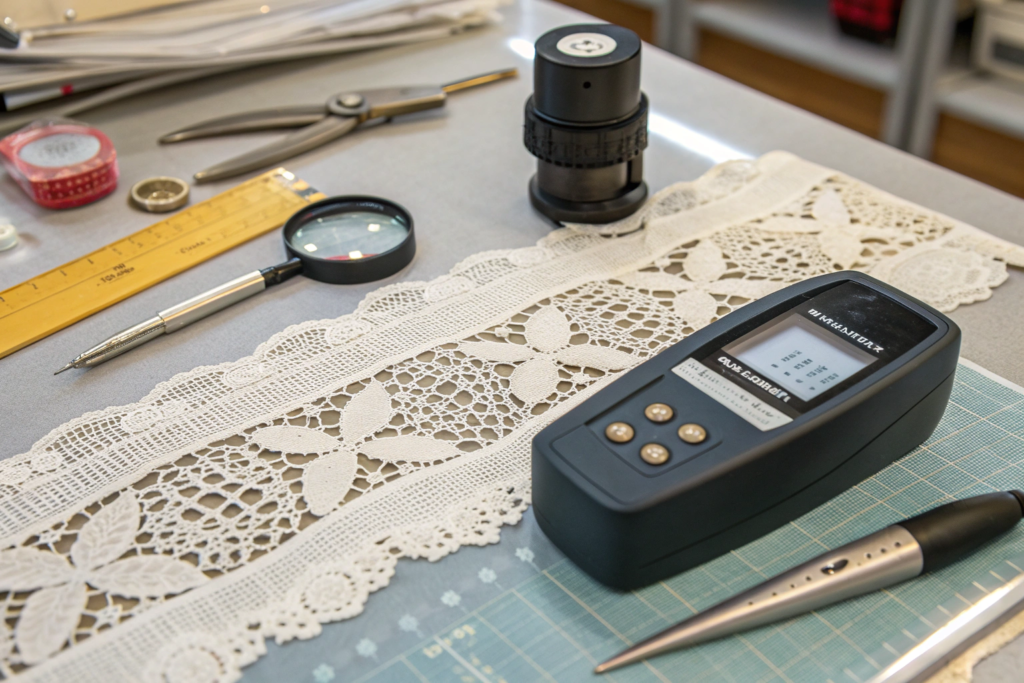
The Pre-Shipment Inspection (PSI) is your last line of defense. This is a 100% inspection of the bulk rolls before they are packed. It must be systematic, tool-assisted, and documented. Never accept a “random check” or a supplier’s generic “QC passed” sticker for intricate lace.
This inspection must simulate how you will use the fabric: it must be checked for visual defects, measured for consistency, and tested for performance. Relying on the human eye alone is insufficient. You need technology to augment judgment.
Why is a Backlit Inspection Table the Most Critical Tool?
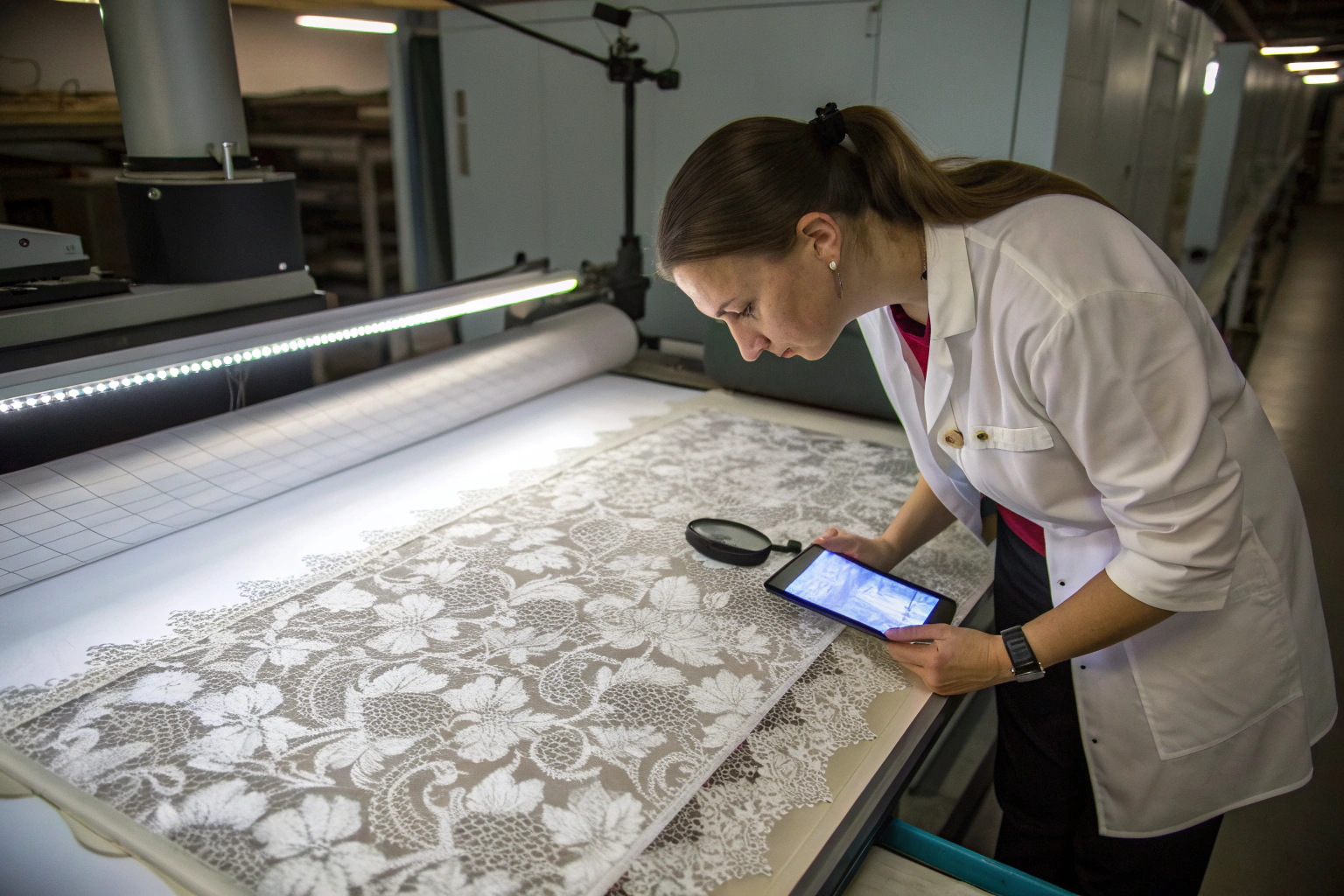
A backlit inspection table is not optional; it is the single most important tool for lace QC. It turns the fabric into an X-ray, revealing hidden flaws that are invisible under normal light.
- Reveals: Pattern jumps, inconsistent net density, broken motifs, uneven embroidery density, and minute contaminations.
- Method: The fabric is slowly scrolled over the lit surface. Inspectors must be trained to look for interruptions in the pattern’s rhythm and light/dark areas indicating tension changes. The standard is to inspect at a pace slower than 20 meters per minute.
- Documentation: Major defects should be marked with a non-transferable sticker at the selvedge. A detailed inspection report should note the defect type, location (meter mark), and severity for each roll.
Our Standard: We perform a 100% backlit inspection on all intricate lace orders. For a recent order of French-style Leavers lace, this process identified subtle “start-up” defects at the beginning of each new thread cone—a flaw that would have caused consistent imperfections in every garment’s hem area. We cut these sections out before shipping.
What Physical Tests Guarantee Performance and Consistency?
The lace must not only look good but also perform in garment construction and wear.
- GSM (Weight) Check: Take samples from the beginning, middle, and end of multiple rolls. Cut with a precision die cutter and weigh. The weight must be within ±5% of the approved sample’s GSM. A significant variance indicates inconsistent material density.
- Color Consistency and Fastness: Use a spectrophotometer to measure color against the standard. Check rub fastness (dry and wet) and, for bridal or eveningwear, perspiration colorfastness testing for delicate fabrics. A lace that changes color when wet with sweat is a disaster.
- Shrinkage Test: Wash or steam a sample according to the garment’s care instructions. Measure dimensional change. Uncontrolled shrinkage will ruin pattern matching after the first clean.
- Snag Test: Use a simple mace snag tester or even a Velcro tab dragged gently under weight across the fabric. Intricate lace is prone to snagging, but it must have a reasonable resistance.
Case Study: A Miami swimwear brand wanted to use a delicate lace as an overlay. Our standard PSI included a chlorinated water resistance test, which the sample failed spectacularly. We collaborated with our finishing plant to apply a proprietary protective coating. The re-tested lace passed, allowing the client to proceed safely. This is why pre-agreed test protocols are vital.
How to Structure Your Supplier Agreement for Ironclad QC?
Your quality standards are only as strong as the contract that enforces them. Vague terms like “good quality” or “similar to sample” are invitations for dispute. Your purchase order and terms must be specific, measurable, and include clear recourse for failure.
This is where you move from making requests to setting enforceable rules. It aligns expectations and protects your financial investment. A supplier who is serious about quality will have no issue agreeing to these terms.

How to Define Acceptable Quality Levels (AQL) for Lace?
For lace, the standard AQL for textiles (usually 2.5 for major defects) is often too lenient. You need a custom AQL that reflects the zero-tolerance for certain flaw types.
- Critical Defects (AQL 0): Defects that render the garment unsellable. For lace, this includes: Pattern misalignment affecting seam matching, Broken motifs in conspicuous areas, Irreparable snags or holes. Presence of any critical defect in a shipment lot should be grounds for rejection of the entire lot.
- Major Defects (AQL 1.0-1.5): Defects that significantly affect appearance or performance but might be workable. E.g., Minor pattern blurring, Small stains that might be cut around, Moderate color variation within a roll. Define the maximum percentage of affected meters per roll.
- Minor Defects (AQL 4.0): Small imperfections unlikely to affect the final garment.
Key: Your PO must state, “Quality standards and AQL as per attached Inspection Specification Sheet and Approved Gold Standard Sample #XYZ.” The spec sheet should have photos of defect examples.
What Inspection Rights and Remedies Should Your Contract Include?
These clauses give you control and a clear path if things go wrong.
- Right to Inspect: “Buyer or its appointed third-party inspector (e.g., SGS, QIMA) shall have the right to conduct in-process and pre-shipment inspection at the supplier’s facility. Supplier shall provide full access and cooperation.”
- Shipment Hold Authority: “No goods shall be shipped prior to buyer’s written approval of the pre-shipment inspection report.”
- Clear Remedies: Specify what happens if QC fails. For example: “For lots failing inspection, buyer may choose to: a) Require 100% sorting and repair at supplier’s cost; b) Cancel the order and receive a full refund of deposit; c) Negotiate a discounted price for accepted goods.”
- Retained Samples: “Supplier shall retain 1-meter samples from the beginning and end of each production lot for a period of 1 year for reference in case of latent defects.”
The Fumao Commitment: We build these terms into our standard contracts because we’re confident in our process. In fact, we often propose a joint quality review session with key clients before production starts, to align exactly on defect classification. For a major French brand, this session alone eliminated 95% of potential quality disputes, because we were speaking the same technical language from day one.
Conclusion
Managing quality control for lace with intricate patterns is a disciplined, technical process that must be proactive, not reactive. It begins with the understanding that standard inspection methods fail for such complex materials, necessitating a hunt for hidden defects in pattern alignment and net tension. The solution is a rigorous 3-Stage protocol: validating designs and materials pre-production, monitoring machine stability in-process, and executing a tool-driven final inspection on a backlit table with physical performance tests. Ultimately, this systematic approach must be underpinned by a clear supplier agreement that defines precise quality levels, inspection rights, and remedies, transforming subjective judgment into enforceable standards.
True quality assurance transforms a sourcing challenge into a competitive advantage, ensuring that every garment delivers on the promise of its design. At Shanghai Fumao, our integrated manufacturing and CNAS-accredited lab allow us to execute this level of QC not as an added service, but as a fundamental part of our production DNA. We don’t just sell lace; we deliver certified quality. If you are looking for a partner who understands that intricate beauty requires intricate quality control, let’s discuss your next project. Contact our Business Director, Elaine, at elaine@fumaoclothing.com to establish a quality protocol for your collection.