
You’ve just received a fabric tech pack from a potential supplier. It’s a 20-page PDF filled with numbers, diagrams, and jargon. Do you know if this fabric will meet your quality standards? Can you spot the red flags that will lead to costly production failures? Most buyers glance at the composition and price, but professional sourcers know the devil—and the savings—are in the details. Reading a tech pack isn’t about checking boxes; it’s about forensic analysis.
Reading a fabric tech pack like a professional sourcer means systematically analyzing it across four pillars: Material Integrity & Compliance, Physical Performance Specifications, Visual & Aesthetic Accuracy, and Production Feasibility & Cost Drivers. You must cross-reference every data point, question vague terms, and visualize how each specification translates to real-world fabric behavior and manufacturing outcomes.
After 20 years of reviewing and creating thousands of tech packs in Keqiao, I can tell you that most production disputes stem from ambiguities in this document. A client once rejected a $50,000 shipment because the "soft hand-feel" described was subjective; the tech pack had no measurable specification for stiffness. Let me guide you through a professional’s method to deconstruct a tech pack, turning it from a confusing document into a powerful tool for risk management and quality assurance.
What Are the Non-Negotiable Sections of a Professional Tech Pack?
A complete fabric tech pack is a comprehensive contract. Missing sections are a major red flag. Here’s what must be present and how to evaluate each:
1. Cover Page & Basic Identification: This should clearly state the Fabric Code/Name, Season, Brand, Supplier, and Date. Check the revision history. A tech pack without version control is a recipe for confusion. The latest version should be prominently marked.
2. Material Specification Sheet: The heart of the document. It must include:
- Full Fiber Composition: Not just "100% Cotton" but the specific type (e.g., GOTS-certified Organic Combed Cotton, 40/1 Ne). Percentages must add up to 100%.
- Fabric Construction: For wovens: Weave Type (Plain, Twill, Satin), Warp/Weft Yarn Details, Ends/Picks per Inch (EPI/PPI). For knits: Knit Structure (Jersey, Rib), Gauge (Needles per Inch), and Course/Wale Count.
- Fabric Weight: In GSM (grams per square meter) or Oz/Yd². Ensure the testing method is stated (e.g., ASTM D3776). A variance tolerance should be specified (e.g., ±5%).
- Fabric Width: In inches or centimeters, with tolerance (e.g., 58/59").
- Color Standards: Must have Pantone TPX/TCX number, Lab Dip submission requirements, and approved physical swatch references. Digital color codes alone are insufficient due to monitor variations.
3. Physical & Chemical Performance Test Requirements: This section separates amateurs from pros. It must list specific test methods and pass/fail criteria for:
- Colorfastness: To washing, rubbing (dry/wet), light, perspiration.
- Dimensional Stability/Shrinkage: After washing and drying (e.g., AATCC 135).
- Physical Strength: Tensile strength, tear strength, seam slippage.
- Special Performance: As needed: pilling resistance, water repellency, UV resistance, etc.
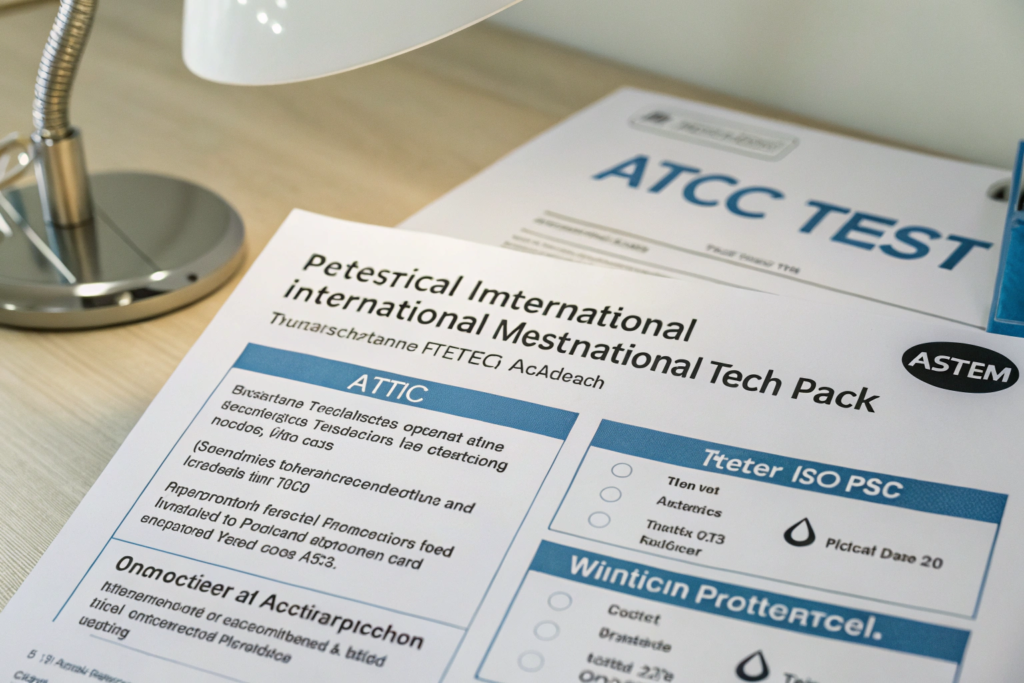
A professional tech pack will reference international standards (AATCC, ISO, ASTM). If it just says "good colorfastness," that’s a major warning. For a recent client sourcing outdoor fabrics, we insisted the tech pack include AATCC Test Method 35 for water resistance at a minimum of 50 psi, not just "waterproof." This precise specification prevented a later dispute.
How Do You Decode Yarn and Construction Details?
This is where fabric quality is born. Look beyond the basics.
- Yarn Count (Ne, Nm, Denier): This indicates fineness. A higher ‘Ne’ for cotton means a finer yarn, leading to a softer, lighter fabric. If the tech pack says "30/1 Ne" but your reference fabric uses "40/1 Ne," your bulk fabric will be noticeably coarser and heavier, even if the composition is the same.
- Yarn Twist (TPI – Twists Per Inch): Low twist yarns are softer but weaker and more prone to pilling. High twist yarns are stronger, have a crisper hand, and can create crepe textures. A tech pack for a durable shirting should specify a higher twist.
- EPI/PPI (Ends/Picks per Inch): This density directly affects drape, durability, and cost. Higher density means tighter weave, less shrinkage, better durability, but higher cost. Compare these numbers to a known good sample. If a tech pack for poplin lists 68 EPI but your standard is 100 EPI, the fabric will be inferior.
For a linen-blend fabric, a client’s tech pack originally just said "55% Linen, 45% Cotton." We asked for the yarn details. The linen yarn was a short-staple, low-grade type. We suggested a switch to a longer-staple, wet-spun linen yarn (specifying the count and twist), which drastically improved the fabric’s smoothness and reduced shedding. This level of detail is often found in advanced textile engineering resources.
What Questions to Ask About Finishes and Treatments?
Finishes are the "secret sauce" that define hand-feel and performance. The tech pack must name the finish and its key property.
- Generic vs. Proprietary: "Softener" is generic. "Amino-silicone softener for a drapey, slick hand" is better. Even better: "Eco-friendly, ZDHC MRSL-compliant softener, achieving a 3.5 on the Kawabata Hand Evaluation System for stiffness."
- Performance Finishes: Must have test parameters. Don’t accept "wrinkle-resistant." Demand: "Wrinkle-resistant finish achieving a 3.5+ rating on AATCC Test Method 128 after 5 home launderings."
- Environmental & Safety Compliance: The tech pack should list relevant restricted substance lists (RSLs) it complies with (e.g., ZDHC MRSL, OEKO-TEX Standard 100 Annex 6, EU REACH SVHC). If it’s a "PFC-free DWR," that must be explicitly stated.
Always ask: "Can you provide the Technical Data Sheet (TDS) and Safety Data Sheet (SDS) for the primary finishes used?" A reputable mill will provide these. We share them proactively for all functional finishes. This practice is standard in responsible chemical management frameworks.
How to Cross-Reference the Tech Pack with Physical Samples?
The tech pack is the theory; the sample is the reality. They must be in perfect agreement. Never approve a tech pack without the correlating bulk-procession sample (not just a small swatch) in hand.
The 5-Point Sample Verification Process:
- Visual Match Under Standard Light: Use a light box with D65 daylight simulation to compare the lab dip or strike-off to the tech pack’s Pantone and your standard. Check for metamerism (color shift under different light sources).
- Tactile Hand-Feel Assessment: Does the sample match the described hand (e.g., "soft," "crisp," "dry")? Use physical reference swatches for comparison. If the tech pack says "peach skin hand" but the sample feels like sandpaper, there’s a disconnect.
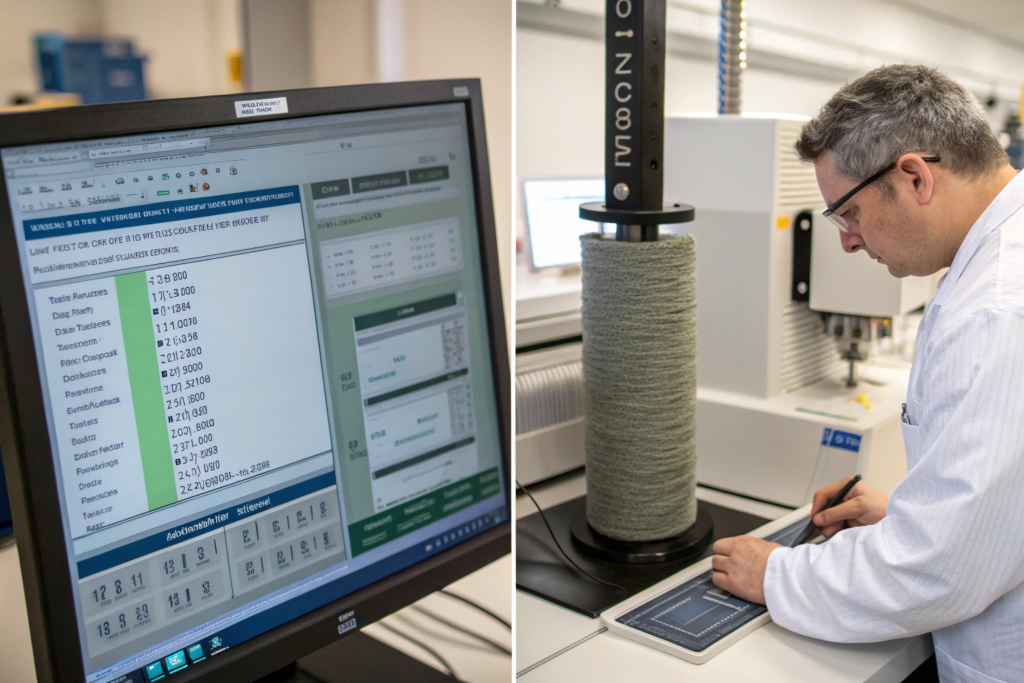
- Measurement Verification: Weigh a known area of the sample to verify GSM. Use a pick glass to count warp and weft threads to verify EPI/PPI. Measure the width.
- Performance Spot-Check: Do a quick rub test with a white cloth. Perform a simple shrinkage test by marking a 10cm square, washing, and drying it. While not a lab test, it can reveal immediate disasters.
- Construction Analysis: Examine the selvedge. Is it tight and even? Unravel a few threads to see if the yarn matches the described count and twist.
I once caught a major discrepancy for a client ordering a performance twill. The tech pack stated a "2-ply 30/2 Ne yarn" for durability. The sample felt too thin. Upon unraveling, we found it was a single-ply yarn. The supplier had substituted to cut costs, which would have led to premature tearing in the final garment. This forensic approach saved a six-figure order.
What Are the Key Red Flags in a Fabric Tech Pack?
Professional sourcers develop a sixth sense for warning signs:
- Vague Language: "High quality," "good strength," "excellent colorfastness." These are meaningless without quantified benchmarks.
- Missing Tolerances: No tolerance (±) for weight, width, or shrinkage implies the supplier either doesn’t measure carefully or won’t be held accountable for variation.
- Over-Promising Performance: A 100% cotton fabric claiming "zero shrinkage" is physically impossible. Be skeptical of unrealistic claims.
- Inconsistent Data: The sum of composition percentages not being 100%, or the fabric weight not logically aligning with the yarn count and density.
- No Reference to Testing Standards: Reliance on "in-house" tests without named international standards.
- Omitted Care Instructions: The recommended care method (e.g., wash temperature) should align with the performance tests. If the tech pack says "machine wash warm" but the shrinkage test was done in cold water, it’s a problem.
A tech pack containing these flags should be rejected for revision immediately. As highlighted in sourcing quality control checklists, ambiguity is the root cause of 80% of supplier disputes.
How to Use the Tech Pack for Cost Negotiation?
A detailed tech pack allows you to negotiate from a position of knowledge, not just on price per meter, but on value engineering.
- Identify Cost Drivers: Is the high cost coming from an exotic fiber? Can a similar aesthetic be achieved with a different yarn blend or construction? Example: A "silk-like" hand might be achieved with a fine micro-polyester instead of real silk, drastically cutting cost with minimal aesthetic loss.
- Challenge Over-Specification: Does your casual shirt really need a 120+ thread count percale? A lower, standard count might be perfectly adequate and cheaper.
- Batch Size and MOQ: The tech pack should specify the Minimum Order Quantity (MOQ). Understanding the components (yarn dyeing minimums, etc.) can help you negotiate a lower MOQ or a better price for a larger commitment.
For a startup brand, we reviewed their tech pack for a custom denim. They had specified a rare Japanese selvedge yarn with a very high MOQ. By suggesting a similar-quality yarn from our Turkish partner with a lower MOQ, we cut their fabric cost by 35% and the MOQ by 60%, making the project viable. This is the power of technical literacy.
What Do the Test Reports Really Tell You?
The attached or promised test reports are the proof of the tech pack’s promises. You must be able to read and interpret them. Don’t just look for a "PASS."
AATCC Gray Scale & Staining Scale: For colorfastness tests. Ratings go from 1 (severe change/staining) to 5 (no change/staining). For most apparel, a rating of 3-4 or higher is acceptable. A rating of 2 for washing fastness means the color will fade noticeably after a few washes.
Dimensional Stability Results: Usually shown as a percentage change (e.g., -3.5% in length, +1.2% in width). Negative means shrinkage, positive means growth. For woven cotton, less than ±3% is good. For knits, it can be higher. The tech pack should specify the maximum allowable shrinkage (e.g., "Shrinkage after 3 washes not to exceed 5%").
Physical Strength Numbers: Tensile strength in Newtons (N) or pounds-force (lbf). Compare these numbers to an established benchmark for that fabric type. A twill with a tear strength of 10N is likely too weak for workwear.
Special Test Results: For example, a Water Repellency Spray Test (AATCC 22) rating: 100 (no sticking/wetting), 90 (light wetting), 80 (partial wetting), etc. A rating of 80+ is generally good for light rain.
When we send test reports from our CNAS-accredited lab, we include a summary page explaining each result in plain language: "This fabric achieved a 4 on colorfastness to washing, meaning color loss will be minimal with proper care." This transparency builds trust. Understanding these scales is fundamental, as explained in materials testing interpretation guides.
How to Ensure the Bulk Fabric Matches the Approved Sample & Tech Pack?
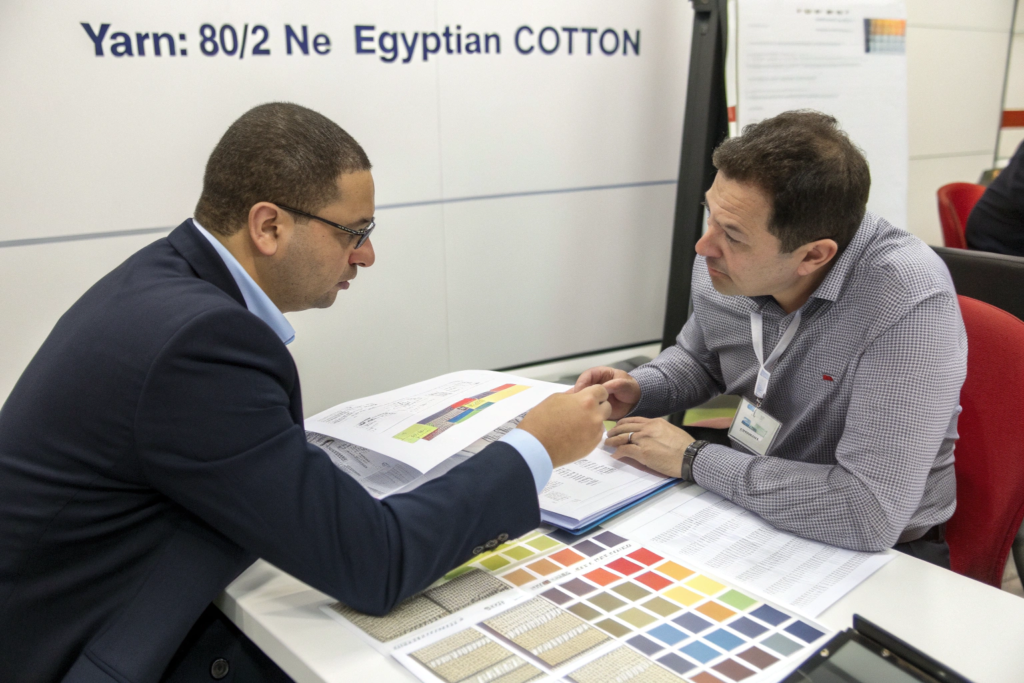
This is the ultimate challenge. The Golden Sample (approved bulk-procession sample) and the signed tech pack are your legal documents. The Bulk Fabric Inspection must verify against both.
Pre-Shipment Inspection (PSI) Protocol: Your inspector or QC team should use the tech pack as the checklist. They should:
- Randomly select rolls from the batch.
- Check composition via a quick burn test or fiber analysis if needed.
- Verify weight (GSM), width, and color against the golden sample under standard light.
- Check for visual defects (holes, stains, dye spots, weaving defects) per the acceptable defect standard (e.g., AQL 2.5) defined in the tech pack.
- Perform on-site quick tests for shrinkage and color rub, comparing results to the lab report.
At Shanghai Fumao, we provide a unique QR code for each bulk lot that links to the digital tech pack, the test reports, and even photos from the production line. This allows buyers to conduct a virtual audit. For a major German retailer, this system reduced their on-site inspection time by 50% because the data was already transparently available.
Conclusion
Reading a fabric tech pack like a professional is a critical skill that directly protects your profit margin and brand reputation. It transforms you from a passive recipient of information into an active director of quality. By mastering the details of material specifications, performance criteria, and testing protocols, you empower yourself to communicate clearly with suppliers, anticipate problems, and engineer both quality and cost-efficiency.
Remember, the most expensive fabric is the one that fails in production or in the hands of your customer. The time invested in dissecting a tech pack is the cheapest insurance you can buy.
If you’re facing a complex tech pack or need help developing a bulletproof specification for your next fabric, we can be your technical partner. At Shanghai Fumao, our development team specializes in translating design concepts into precise, manufacturable tech packs and then executing against them with full transparency. Contact our Business Director, Elaine, to discuss how we can bring clarity and reliability to your fabric sourcing.
You can contact Elaine at: elaine@fumaoclothing.com.