Your design is finalized, the tech pack is perfect, and the marketing campaign is ready to launch. But when you ask for fabric lead time, you get a vague answer that could mean 45 days or 90 days. The uncertainty is paralyzing. How can you plan a collection, coordinate manufacturing, and meet a retail deadline when you don’t know when the core material will arrive? This single timeline dictates everything in your supply chain.
The total lead time for bulk fabric production—from sourcing yarn to ready-to-ship fabric—typically ranges from 45 to 90+ days, depending on complexity, season, and supplier capacity. This timeline breaks down into: Yarn Procurement (5-20 days), Weaving/Knitting (10-25 days), Dyeing/Printing/Finishing (10-20 days), and Quality Control/Packing (5-10 days). Adding international shipping can extend this by 4-8 weeks. However, this is a best-case baseline; real-world variables can dramatically compress or stretch each phase.
Having managed thousands of bulk orders from Keqiao’s textile hub, I’ve seen this timeline challenged every season. The difference between a 50-day and a 75-day delivery often comes down to three factors: the precision of your initial specifications, your supplier’s vertical integration, and your strategic positioning within their production calendar. Let me unpack the standard timeline and the key levers you can pull to influence it.
What is the Standard Timeline for Each Production Stage?
Think of fabric production as a relay race, not a single sprint. Each stage depends on the previous one finishing smoothly, and a delay at any point compounds. Here’s the standard breakdown for a typical order of 5,000-10,000 meters of a custom woven fabric, assuming all approvals happen promptly.
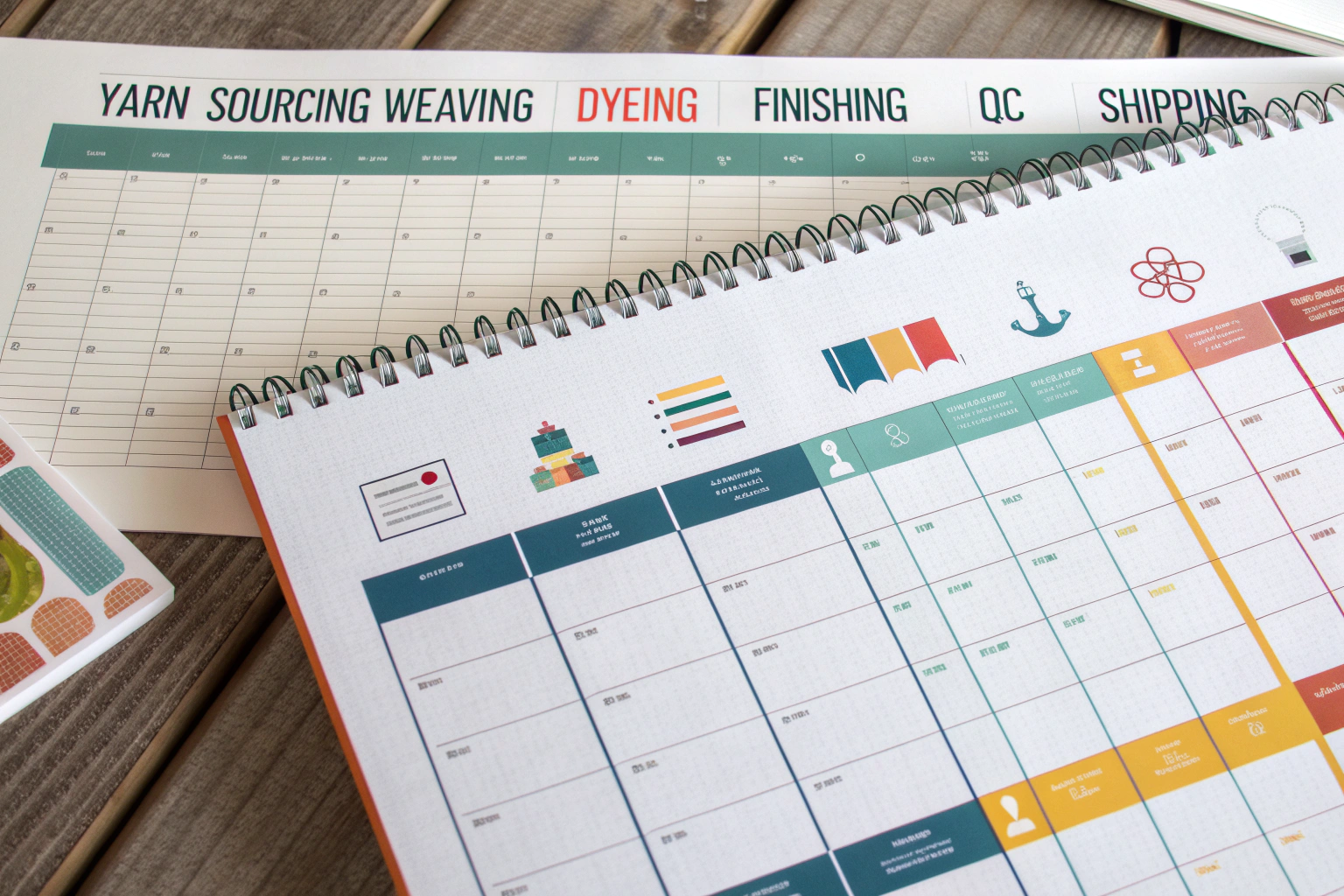
The process flows linearly: Yarn Sourcing & Preparation → Weaving/Knitting → Dyeing & Wet Processing → Finishing & Coating → Inspection & Packing. For a standard polyester-cotton poplin, this might take 45-55 days from order confirmation. For a complex multi-fiber jacquard with a specialty finish, it can easily reach 80-90 days. The critical path is often dyeing and finishing, as these are batch processes with chemical reaction times that can’t be rushed without compromising quality. A common bottleneck is the lab dip approval cycle; each round of revisions can add 3-5 days. Our most efficient clients provide not just Pantone codes, but physical fabric references, which cuts approval rounds by 50%.

How Long Does Yarn Sourcing and Preparation Take?
This first leg sets the pace. If your fabric uses common yarns (standard count combed cotton, regular polyester), your supplier likely has them in stock or on short-term contract, taking 5-7 days to arrive at the mill. If you require specialty yarns—GOTS-certified organic cotton, Tencel™, recycled cashmere blends, or custom-colored yarns—you’re looking at 15-25 days. The spinner may need to source the special fiber, schedule a production run, and then ship. For a US-based sustainable brand last fall, their request for a chlorine-resistant wool-nylon blend added 18 days to the timeline because the yarn spinner only produced that specialty blend once a month.
Furthermore, yarn needs "conditioning" before weaving/knitting. It must acclimate to the factory’s humidity and temperature to prevent later shrinkage issues. This can quietly add another 2-3 days. A detailed guide on Textile World’s technical articles explains why rushing this stage risks dimensional instability. The takeaway: your fabric’s uniqueness starts here, and so does its timeline.
What Are the Real Timelines for Weaving, Dyeing, and Finishing?
- Weaving/Knitting (10-25 days): A plain weave on high-speed looms can produce 5,000 meters in 7-10 days. A complex jacquard or dobby weave on slower, more specialized looms can take 20-25 days for the same quantity. Setting up the loom—threading thousands of warp yarns through heddles and reed according to your pattern—is a 1-3 day job itself. Knitting is generally faster for simple structures; a circular knitting machine can produce jersey fabric rapidly.
- Dyeing/Printing (10-20 days): This is the most variable stage. Dyeing a single solid color might take 5-7 days for the batch, including sample approval, dye bath preparation, dyeing, drying, and curing. Digital printing is faster (3-5 days for processing), but rotary screen printing requires engraving screens, which adds 5-7 days before printing even begins. If your design has 6 colors, that’s 6 screens to engrave.
- Finishing (5-15 days): A basic softening finish might take 2-3 days. A technical finish like wrinkle-resistance, water repellency (PFC-free), or enzyme stone-washing requires specialized equipment, chemical preparation, and precise curing, easily adding 10-15 days. For a recent order of flame-retardant (FR) fabric for European workwear, the FR application and mandatory third-party testing alone added 12 days to the schedule.
At Shanghai Fumao, our vertically integrated control over weaving and strategic partnerships with dyeing-finishing mills allow us to synchronize these stages. For a bulk order of our best-selling BAMsilK satin last month, we overlapped the final days of weaving with the preparation of the dye vats, saving 4 crucial days in the middle. This kind of orchestration is where integrated suppliers shine.
What Factors Can Drastically Extend Lead Time?
Even with a perfect plan, reality intervenes. Understanding these risk factors lets you build buffer time (we recommend +15%) into your critical path. The biggest delays come from Approval Loops, Peak Season Congestion, and Supply Chain Disruptions.
The single most controllable delay is the approval process. Each round of lab dip or strike-off approval that requires international couriering and internal team feedback can add a week. I’ve seen a project stuck for 21 days waiting for a "final" color approval because the brand’s marketing team got involved late. Digital approval platforms are a game-changer here. We now use a system where clients can view high-resolution, color-calibrated images of lab dips and prints online within 24 hours of production and give feedback instantly. This one change has cut average approval time by 60% for our tech-savvy clients. Forums for fashion production managers often stress this as the #1 bottleneck.

How Do Peak Seasons and Holidays Impact Timing?
China’s manufacturing calendar creates unavoidable tidal waves. Placing an order during the two peak production periods (March-May and August-October) can add 1-2 weeks to every stage due to factory overload. Conversely, ordering 6-8 weeks before the Chinese New Year (3-4 week shutdown) is a recipe for disaster, as factories rush to complete orders and workers leave early.
The smart strategy is to use the slower periods (June-July, November-December) for development and sampling, and place bulk orders immediately after Chinese New Year or in early March to get ahead of the spring peak. A European fast-fashion client now "books" production capacity with us in November for the following August delivery. This guaranteed slot in our production schedule ensures their timeline doesn’t balloon during the crunch. Missing these rhythms is the most common mistake new importers make.
When Do Quality Issues Cause Major Delays?
Quality control isn’t just a checkpoint; it’s a timeline safeguard. However, if major defects are found during final inspection—like consistent color shading, weaving faults, or failing a performance test—the entire batch might need rework or, in the worst case, re-production. This can mean a 20-30 day setback.
Proactive Mid-Production Inspection (MPI) is the solution. When about 20% of the fabric is produced, we inspect it for consistency. Catching a dye lot problem here means we can adjust the formula for the remaining 80%. Waiting for Final Inspection means 100% is wrong. For a Canadian brand’s large linen order, an MPI caught a looming issue with yarn tension variation. The loom was adjusted the same day, preventing a 15-day rejection and reweaving delay. Investing in this step, as discussed in supply chain quality assurance communities, saves far more time than it costs.
How Can You Actively Shorten the Lead Time?
You’re not powerless against the calendar. Strategic actions in sourcing, ordering, and communication can compress the timeline by 20-30%. The key is to make your order easier, more predictable, and more valuable for the supplier to prioritize.
Strategy 1: Design for Availability. Before finalizing your design, ask your supplier: "Which of these two fabrics has a shorter lead time?" Often, a similar aesthetic can be achieved with a yarn they have in stock or a weave structure that runs on faster machines. Choosing a stock base fabric and adding customization through printing or embroidery can slash weeks off yarn sourcing and weaving time.
Strategy 2: Consolidate and Standardize. Larger, simpler orders get priority. If you need the same fabric in 5 colors, ordering them all at once is more efficient than 5 separate orders. Using standard color palettes (like Pantone TPX) that mills dye regularly is faster than requesting a custom match to a unique physical sample.
Strategy 3: Implement Digital Workflows. Use online systems for tech pack submission, digital strike-off approvals, and centralized comment tracking. This eliminates FedEx delays and miscommunication. One of our Australian clients cut their total lead time from 70 to 52 days simply by moving all approvals to a shared digital platform, eliminating 18 days of physical sample mailing time.

What is the "Quick Response" (QR) Manufacturing Model?
Some suppliers, including us, offer a "Quick Response" or "Fast-Track" production line for clients willing to pay a 10-20% premium. This service reserves capacity, uses pre-approved yarn stockpiles, and prioritizes your order at every stage. It’s not magic—it’s paid prioritization. For a true emergency or a test-and-react fast-fashion model, it’s invaluable.
We recently activated this for an American e-commerce brand that had a style go viral. They needed an additional 8,000 meters of a specific rib knit within 30 days to restock. Our QR protocol used pre-dyed yarn from our strategic stock and dedicated knitting machines, delivering in 28 days—half the standard time. This model is dissected in case studies on lean manufacturing in textiles.
How Does Supplier Location and Integration Affect Speed?
Geography is destiny in logistics. A supplier located within a major textile cluster like Keqiao, Shaoxing, has an immense advantage. The yarn supplier, the dyehouse, and the finishing plant might be within a 10-mile radius. This cuts inter-factory transport from days to hours. An integrated supplier who controls weaving and has partnered mills for dyeing can synchronize schedules seamlessly.
Compare this to a trading company that sources weaving from one province, dyeing from another, and finishing from a third. Each handoff adds transport, communication lag, and scheduling friction, easily adding 10-15 days of hidden buffer time. When you ask for lead time, always ask: "Are you the factory, or do you coordinate multiple factories? Where are they located?" Our entire operation is in Keqiao. For a bulk order, grey fabric from our weaving facility can be at the dye house the same afternoon it’s cut off the loom.
What is the Realistic Total Timeline with Shipping?
The fabric isn’t "ready" until it’s at your designated port or warehouse. You must add logistics and shipping time to the production lead time. This phase is riddled with its own variables.
Production Lead Time (PTL): As discussed, 45-90 days.
Pre-shipment Documentation & Stuffing: 3-5 days for final inspection, issuing commercial invoices, packing lists, certificates, and booking container space.
Inland Transport to Port: 1-3 days.
Ocean Freight Transit: China to US West Coast: 14-18 days. China to EU (Rotterdam/Hamburg): 28-35 days. China to East Coast USA: 30-40 days via Panama/Suez.
Customs Clearance & Delivery: 3-7 days at destination, assuming no documentation errors.
Total Landed Timeline (from order to warehouse): For a 60-day production + shipping to EU, you’re looking at ~90-100 days total. For a US West Coast destination with 50-day production, it’s ~70-75 days.

Table: Sample End-to-End Timeline (5,000m Custom Woven Fabric to EU)
| Phase | Activity | Optimistic (Days) | With Buffer (Days) | Notes |
|---|---|---|---|---|
| 1. Pre-Production | Contract, Deposit, Yarn Order | 5 | 7 | Starts upon deposit receipt. |
| 2. Yarn Sourcing | Spinning & Delivery to Mill | 10 | 15 | For standard yarns. |
| 3. Weaving | Loom Setup & Production | 15 | 18 | For a plain/simple twill. |
| 4. Dyeing | Lab Dip, Approval, Bulk Dye | 12 | 15 | 1 round of digital approval. |
| 5. Finishing | Softening, Calendaring | 5 | 7 | Basic finish. |
| 6. QC & Packing | Final Inspection, Baling | 5 | 7 | Includes correction time. |
| Production Subtotal | 52 | 69 | ||
| 7. Logistics | Docs, Truck to Port, Load | 5 | 7 | |
| 8. Ocean Freight | Transit to Rotterdam | 30 | 35 | Includes port delays. |
| 9. Customs & Truck | Clearance, Delivery to EU WH | 5 | 7 | Smooth clearance. |
| Total Landed Time | 92 | 118 | ~3 to 4 months |
Note: This is a realistic example. A complex fabric or holiday period would push the "With Buffer" column further.
How Can You Mitigate Shipping and Customs Delays?
- Book Shipping Early: Secure container space as soon as you have a reliable production completion date. During peak season (Aug-Oct), space can be booked 4 weeks in advance.
- Perfect Your Documents: One typo in the Harmonized System (HS) code or value on the commercial invoice can hold your container in customs for weeks. Work with a supplier experienced in your target market. We provide pre-filled docs for major markets.
- Consider Air Freight for Critical Lots: For the first 20% of your order to start production lines, air freight (5-7 days) can be worth the cost to keep your garment factory running.
- Use a Reliable Freight Forwarder: Your supplier’s forwarder might be good, but sometimes using your own trusted partner with destination port expertise is better. We are flexible to work with either.
A recent case: A UK client had a container held in Felixstowe because the "organic cotton" claim on the invoice wasn’t backed by the GRS certificate being uploaded to customs in time. We now automatically email all relevant eco-certificates to the client and their forwarder the day the container ships. Learning from such real-world import/export logistics forums is key.
Conclusion
Understanding fabric lead time is about mastering a detailed, interconnected process. It’s not a single number but a cascade of stages, each with its own duration and vulnerability to delay. The standard 45-90 day production window is a framework that expands or contracts based on your fabric’s complexity, your approval efficiency, and the seasonal tides of global manufacturing.
Proactive management—through smart design choices, digital workflows, strategic timing, and a partnership with an integrated supplier—is the most powerful tool you have to control this timeline. Building in a realistic buffer and having contingency plans for shipping are not signs of poor planning; they are marks of experience.
If you need clarity and reliability in your fabric lead times, we should talk. At Shanghai Fumao, we provide transparent, stage-by-stage scheduling and proactive communication for every order. Our vertical integration in Keqiao and established logistics partnerships allow us to deliver on predictable timelines, even in a volatile world. To get a detailed lead time estimate for your next project, contact our Business Director, Elaine. She’ll connect you with our planning team for a realistic timeline based on your specific needs.
You can contact Elaine at: elaine@fumaoclothing.com.