Are you tired of sourcing fabrics that claim to be eco-friendly but can’t provide transparent, audited proof? Do you worry that hidden chemicals in your supply chain could lead to costly rejections or, worse, damage your brand’s reputation? You’re not alone. In today’s market, sustainability isn’t just a buzzword—it’s a business requirement backed by hard data and stringent certifications.
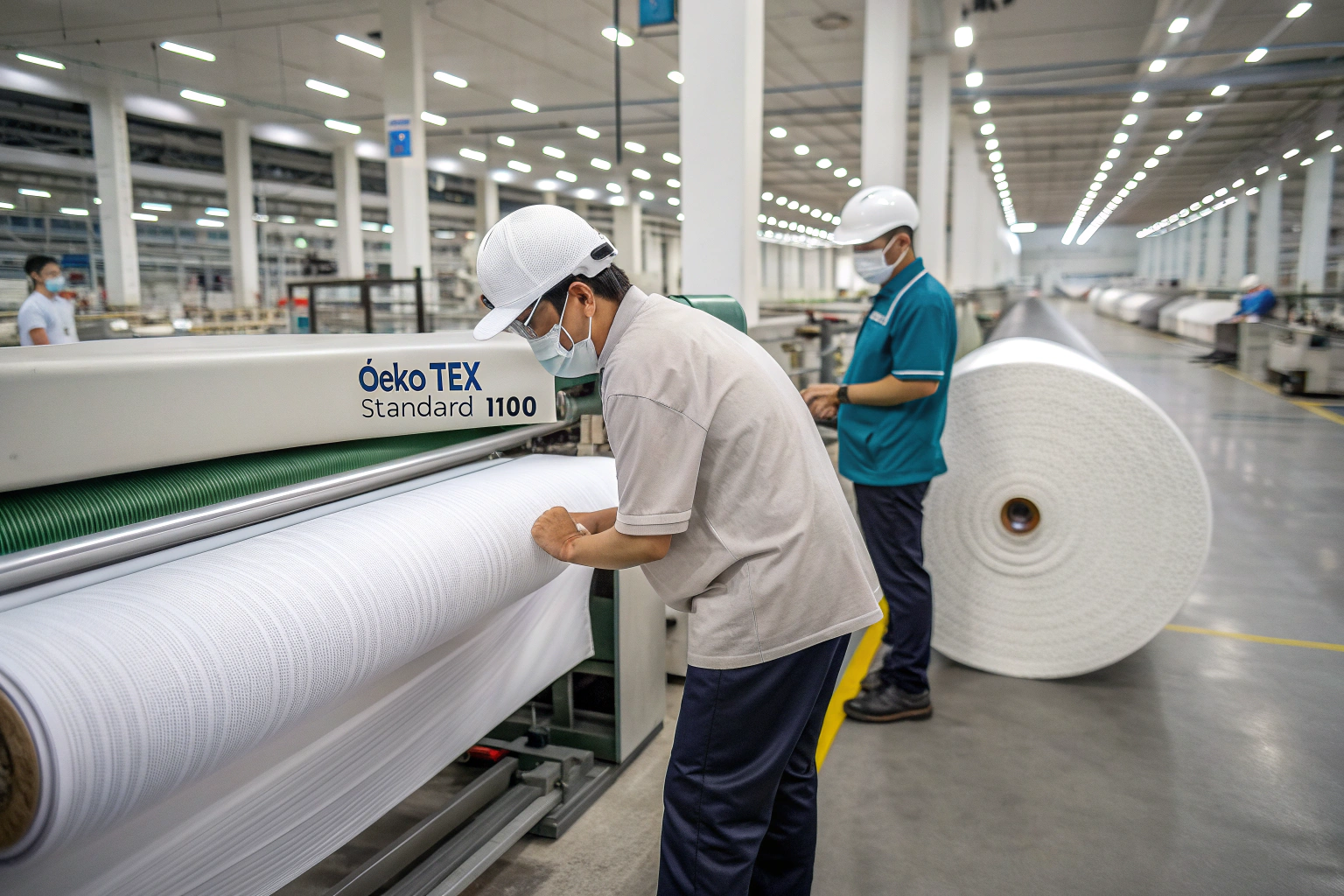
At Fumao Fabric, we don’t just talk about safety and sustainability; we engineer it into every meter of fabric we produce. Maintaining OEKO-TEX® STANDARD 100 certification across our diverse production lines—from weaving and dyeing to printing, embroidery, and coating—is a core operational discipline. It’s the concrete answer to buyer concerns about harmful substances, and it’s what separates true partners from mere suppliers. This rigorous, integrated approach is why brands that work with us enjoy a 98% pass rate on third-party lab tests, saving them from the financial and logistical nightmares of non-compliance.
But how do we turn a complex global standard into daily factory-floor reality? It’s more than just final product testing. It’s a holistic system of controlled inputs, certified processes, and continuous verification that runs through our entire vertically coordinated supply chain in Keqiao. This article will pull back the curtain on our five-line control system, showing you the exact checks and partnerships that ensure your fabric is safe from the first yarn to the final shipment. Let’s dive into the blueprint for trustworthy textile production.
What are the Key OEKO-TEX® Tests for Fashion Fabrics?
If you think OEKO-TEX® is just one test, you might be risking your order. The STANDARD 100 certification is actually a suite of over 100 individual tests, and the specific requirements vary dramatically based on how the fabric will be used. For fashion brands, understanding this product class system is the first step to bulletproof compliance.
The most critical distinction is between Product Class I (for babies) and Product Class IV (for decorative materials). For apparel fabrics (mostly Product Class II for items touching skin and III for non-skin contact), the limits for substances like pH value, formaldehyde, and heavy metals are stricter than for a curtain, but less strict than for a baby’s onesie. Getting this classification wrong from the start is a common and expensive mistake. Our advice? Always specify your end-use during the initial inquiry. For instance, a polyester lining (Class III) has different permissible limits than the same polyester used in a dress lining (Class II). We’ve seen clients accidentally test against the wrong class, causing unnecessary delays and fees.

Beyond the basics of pH and formaldehyde, what are the hidden chemical risks?
The real devil is in the details—or rather, in the dyes and auxiliaries. Azo dyes that can cleave into carcinogenic amines, allergenic disperse dyes, and pentachlorophenol (PCP) residues are high on the test list. But here’s the insider knowledge: the risk often comes from the combination of processes. For example, an embroidery thread from an unverified supplier or a custom print paste can introduce non-compliant substances into an otherwise safe fabric. That’s why our control starts upstream. We mandate that all our partner dye houses and printing factories provide MSDS (Material Safety Data Sheets) for every chemical they use, which we cross-reference against the OEKO-TEX® Restricted Substances List (RSL) before production even begins. This proactive screening is something you can learn more about from resources like the Sustainable Apparel Coalition’s Higg Index materials guide, which outlines best practices for chemical management that go hand-in-hand with certification goals.
How does fabric composition impact your testing strategy and cost?
Natural doesn’t automatically mean safe. While heavy metal limits are a prime concern for synthetics (from catalyst residues), natural fibers like cotton have their own pitfalls, such as pesticide residues or chlorinated phenols from storage. Blended fabrics (e.g., poly-cotton) require testing for the full spectrum of both synthetic and natural fiber hazards. This complexity impacts both timeline and cost. A common question we get is, “Why does testing take 2-3 weeks and cost several hundred dollars per article?” The answer lies in this compositional complexity. Each component (fiber, dye, print paste, coating) needs analysis. To manage this efficiently for our clients, Shanghai Fumao has established a streamlined process. We batch similar articles for testing with our accredited partner lab, often absorbing part of the cost for loyal clients, and we use a single annual certification to cover our base fabrics, which drastically reduces the per-order burden for our customers. For a deeper dive into managing testing costs, industry forums like Textile Genesis often discuss innovative approaches to supply chain transparency and certification efficiency.
How is Quality Control Integrated at Every Production Stage?
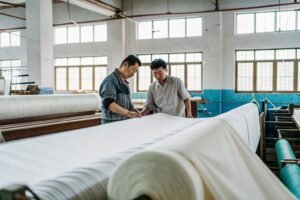
A certificate is a snapshot of a final product, but real safety is built through the process. At Fumao Fabric, our OEKO-TEX commitment is operationalized through a “Quality Gate” system at each of our five key production lines. Think of it as a relay race where each runner (production stage) must pass a baton (compliant semi-finished fabric) to the next, with a judge (our QC) at every handoff.
This system was born from a hard lesson. In early 2022, a European activewear brand received a shipment where the fabric passed lab tests, but the finished garments had a strong odor. The issue was traced back to a non-compliant softener applied at a subcontracted finishing stage after certification. It was a logistical and financial headache for everyone. Since then, we’ve made our control boundaries absolute: from the moment yarn enters our coordinated supply network until the final roll is packed, every chemical touchpoint is documented and audited. Our QC team doesn’t just inspect; they manage the process flow.

What specific checks happen at the weaving and dyeing stages?
The journey begins with raw material approval. For our weaving factory, we require Certificates of Conformity (CoCs) for all incoming yarns, especially concerning cotton pesticide residues or polyester antimony content. At the dyeing stage—handled by our long-term CNAS-certified partner factories—the control intensifies. We don’t just approve colors; we approve the recipe. Our technicians audit the dye house’s chemical inventory quarterly and randomly sample dyebaths for pH and heavy metal screening. We also insist on using OEKO-TEX® certified dyes and auxiliaries, which are more expensive but non-negotiable. A practical tip for buyers: always ask your supplier which stages they directly control versus subcontract. True integration, like ours at Shanghai Fumao, means having contractual quality agreements with every partner in the chain, ensuring they are an extension of your own standards. For a broader look at implementing such integrated quality systems, the American Association of Textile Chemists and Colorists (AATCC) online resources provide valuable technical monographs and test methods.
How do printing, embroidery, and coating introduce unique risks?
These “value-added” stages are often the highest risk for contamination. A beautiful print can contain banned phthalates in its plastisol, or an embroidery thread might use a non-compliant dye. Our solution is a “Locked Spec” protocol.
- Printing: For each print design, the factory must submit the exact ink/paste formula for our pre-approval. We keep a retained sample of the paste itself for traceability.
- Embroidery: We source threads only from a short list of OEKO-TEX® certified thread mills. The factory must provide the thread lot number for each batch.
- Coating: This is the most technical. Whether it’s a PU coating for waterproofing or a silver-ion antibacterial finish, we require a full technical data file from the chemical supplier. We then test the coated fabric not just for the intended function, but for any migratory substances.
Here’s a snapshot of our “Quality Gate” checklist at each stage:
| Production Stage | Key OEKO-TEX® Focus Points | Fumao’s Control Method |
|---|---|---|
| Weaving | Yarn residues (pesticides, antimony) | Incoming yarn CoC verification; Greige fabric pre-test. |
| Dyeing | Azo dyes, heavy metals, pH, formaldehyde | Approved chemical list; Dyebath spot checks; Lab dip certification. |
| Printing | Phthalates, heavy metals in pigments | Printed paste formula approval; Retained paste sample. |
| Embroidery | Allergenic disperse dyes in threads | Certified thread mill sourcing; Lot number tracking. |
| Coating/Finishing | Phenols, organotins, migratory chemicals | Full TDS from chemical supplier; Post-coating migration test. |
This table isn’t just for show—it’s the live document our QC team works from every day. It’s how we caught a potential issue last November with a batch of flame-retardant coating that had slightly elevated bromine levels before it was applied to a large order for a US workwear brand. Catching it there saved weeks of potential re-production.
Can Your Supplier Offer Both OEKO-TEX® and GOTS Certification?
For brands committed to deep sustainability, OEKO-TEX® for safety and GOTS (Global Organic Textile Standard) for organic integrity are the gold-standard duo. But here’s the reality: very few suppliers can efficiently manage both in parallel because the standards govern different parts of the chain and require separate, segregated workflows. The question isn’t just if they offer it, but how they prevent cross-contamination and manage the documentation nightmare.
At Fumao Fabric, we’ve invested in a parallel production system for this exact reason. Our GOTS-certified organic cotton fabrics are processed on designated days in our partner dye houses, using GOTS-approved chemicals, and stored in separate warehouse sections. The paperwork trail—from transaction certificates (TCs) for every batch of organic cotton to the GOTS wet processing certificate—is managed by a dedicated team. This isn’t cheap or easy, but it’s essential for credibility. We learned this through a 2023 project for a Scandinavian children’s wear brand that required both GOTS and OEKO-TEX® STANDARD 100 for their jersey line. Our ability to provide a seamless, auditable package for both certifications was the key reason they switched from their previous supplier in Pakistan.

What are the major logistical hurdles in achieving dual certification?
The biggest challenge is fiber traceability. GOTS requires proof that the organic fiber can be tracked from farm to final product. This means we must work with spinners who are also GOTS certified and can provide the necessary TCs. Any blend, even a 95% organic cotton/5% elastane for stretch, must follow strict GOTS blending rules and requires pre-approval. Furthermore, while OEKO-TEX® tests for harmful substances, GOTS has an additional list of prohibited chemicals and also sets strict environmental and social criteria for the factories. Aligning two sets of audits, permitted substances lists, and social compliance checks requires a supplier with significant operational maturity. For brands navigating this, the Global Organic Textile Standard official website is an indispensable resource for understanding the certification’s scope and finding certified suppliers at each stage.
How does dual certification impact lead times and minimum order quantities (MOQs)?
Honestly, it adds time and cost. Sourcing GOTS-certified raw materials has a longer lead time. Production must be scheduled in dedicated slots to avoid contamination. The certification and transaction processes themselves add administrative days. Typically, we advise clients to add 2-3 weeks to the standard timeline for a dual-certified order. MOQs are also higher, as the cost of certification and segregated production needs to be amortized. For GOTS, the standard dye lot MOQ applies, which is usually around 1000kg per color for knits. However, at Shanghai Fumao, we’ve structured our operations to keep these barriers as low as possible. We maintain a stock of GOTS-certified base fabrics in popular colors, which can drastically cut lead times for smaller, urgent orders. This hybrid model of stock plus made-to-order gives our clients flexibility without sacrificing integrity. Discussions on platforms like The Ethical Fashion Forum often highlight the challenges of MOQs for sustainable materials, validating the need for supplier-side solutions like ours.
What Documentation and Traceability Does Fumao Fabric Provide?
A certificate is just a piece of paper if you can’t trace it back to the specific roll of fabric on your cutting table. In the event of a customer audit or a regulatory inquiry, robust documentation and digital traceability are your only defense. This is where many suppliers fall short, offering a generic annual certificate that doesn’t link to your specific purchase order.
We treat documentation as a deliverable product. Every shipment from Fumao Fabric includes a comprehensive dossier. The crown jewel is the OEKO-TEX® certificate, which lists the specific certified articles, their product class, and the unique test number. But we go further. We provide mill test reports for key physical properties, a detailed packing list matching roll numbers to certificate items, and for GOTS orders, the all-important Transaction Certificate. (Here’s a pro tip: always match the weight on the GOTS TC to the weight of fabric you received—it’s a common audit check.)

How does Fumao’s QR code system enhance fabric traceability?
Two years ago, we implemented a digital traceability system. Every roll of fabric leaving our inspection factory now has a unique QR code label. When you scan this code with your phone, it doesn’t just show basic info. It pulls up a secure portal with that specific roll’s journey: the dye lot number, the production dates at each stage, the OEKO-TEX® test report applicable to that batch, and even the COC for the yarn. For our functional fabrics, it also includes performance test data from our CNAS lab, like moisture-wicking rates or UPF ratings. This system was a game-changer for a Canadian outdoor brand in late 2023. They could instantly provide their retail partners with verifiable proof of sustainability and safety claims, directly from the garment’s hangtag. This level of transparency is becoming the new normal, and resources like the FibreTrace blog discuss similar technologies shaping the future of supply chain visibility.
What should you do if a test failure or audit discrepancy occurs?
Even with the best systems, the unexpected can happen. A savvy buyer plans for this. Our protocol is clear: if any batch fails our internal pre-shipment check or a client’s independent test, we immediately initiate a “Root Cause and Containment” process. All production from the same input batch is quarantined. We work backwards through the QC gate records to identify the failure point—was it a contaminated chemical drum? A human error in weighing? The key is speed and transparency. We report our findings to the client within 48 hours, along with a corrective action plan. More importantly, because our system is traceable, we can precisely identify which rolls are affected, preventing a wholesale order cancellation. This process protects both of us. It’s built on the principle that shared risk requires shared visibility. Learning about crisis management in the textile supply chain can help buyers understand how to partner with suppliers who have robust contingency plans.
Conclusion
Navigating the complex world of textile certifications like OEKO-TEX® and GOTS isn’t about collecting logos for your marketing; it’s about implementing a rigorous, traceable system of safety and sustainability from the ground up. As we’ve seen, true compliance requires more than a final product test—it demands controlled inputs at every stage, from weaving and dyeing to the specialized risks of printing and coating. It requires a supplier with the operational depth to manage dual certifications without cross-contamination and the technological commitment to provide transparent, roll-level traceability.
The cost of getting this wrong is simply too high: rejected shipments, tarnished brand reputations, and lost consumer trust. The brands that thrive are those that partner with suppliers who treat certification as an integral part of production, not just a sales sticker. At Fumao Fabric, this philosophy is woven into our daily operations in Keqiao. Our five-line Quality Gate system, digital traceability, and dedicated parallel processing for organic standards are our concrete answers to these global challenges. We really do provide that end-to-end peace of mind.
Ready to simplify your sourcing and build a more resilient, transparent supply chain? Let Fumao Fabric be your certified partner from yarn to shipment. For a detailed discussion on how we can apply this controlled system to your next fabric or apparel order, reach out to our Business Director, Elaine. She and her team will guide you through a stress-free process. Contact Elaine directly at elaine@fumaoclothing.com to start the conversation today.