As a CEO, you face relentless pressure: from investors asking about ESG risk, from boards demanding supply chain resilience, from consumers questioning your ethics, and from regulators threatening penalties for non-compliance. You need more than verbal assurances from your supply chain; you need hard evidence you can present with confidence. That’s where our Certificate of Conformity and its integrated digital dossier transform from a quality document into a strategic executive asset. It’s not just for your QC manager; it’s your verified data source for compelling stakeholder narratives, risk mitigation reports, and value creation stories. In today’s landscape, a CEO who cannot substantiate their supply chain claims is a CEO facing existential risk.
Our certificate is engineered for the C-suite. It goes far beyond a "passed" stamp. Each certificate is a unique digital key that unlocks a live, auditable dossier containing data on sustainability, ethics, safety, and traceability. For you, this means turning the opaque, complex world of offshore manufacturing into clear, reportable metrics. When an investor asks, "How do you ensure no forced labor in your supply chain?" you can share a real-time BSCI audit report linked to that certificate. When a regulator queries a "carbon-neutral" claim, you can present the product-level Life Cycle Assessment (LCA) data attached to the batch. This isn’t about having paperwork; it’s about having executive-grade proof that aligns with global reporting frameworks like GRI, SASB, and the upcoming CSRD (Corporate Sustainability Reporting Directive).
Let me give you a tangible example: The CEO of a mid-sized fashion brand was preparing for a Series B funding round. A lead VC’s due diligence question was, "What is your exposure to physical climate risk in your Asian supply chain?" Using our certificates for their core fabric, the CEO didn’t just say "we have great partners." They presented our dossier showing that our dyeing partners’ facilities had flood risk assessments, water recycling rates, and verified backup power—data points directly from the certificate-linked portal. This demonstrable supply chain resilience became a key point in their valuation. The certificate provided the narrative backbone. That’s the power of moving from anecdote to evidence.
How to Leverage Certificate Data for Investor & Board Communications?
Investors and board members are increasingly metrics-driven. They want to see that ESG and operational risks are quantified and managed. Generic statements in an annual report no longer suffice. Our certificate data provides the granular, product-level evidence that supports your high-level strategic claims. It allows you to communicate with the precision that builds trust and justifies valuation premiums.
In your investor presentations and board packs, integrate data points unlocked by our certificates:
- For ESG/Sustainability Committees: "100% of our Spring ’24 core collection fabrics are sourced from partners with verified ZDHC MRSL compliance, reducing chemical risk. [Link to Certificate Dossier Example]."
- For Audit/Risk Committees: "Our primary fabric supplier maintains a 98.5% on-time delivery rate with full traceability. Incident response time for quality issues is under 48 hours due to real-time tracking. [Reference Certificate Batch ID #FM-2024-0456]."
- For Growth/Strategy Discussions: "Our partnership with Fumao provides access to co-development of innovative materials (e.g., biodegradable blends), giving us a 6-month first-mover advantage, as seen in Project X. [Reference Development Certificate & NDA]."
By anchoring statements to specific, verifiable certificates, you shift from making claims to demonstrating a system of control. This is what sophisticated investors pay for.

What KPIs Can Be Directly Sourced from Our Certificate Dossier?
Transform certificate data into boardroom KPIs:
| Stakeholder Concern | Your Strategic Claim | Supporting KPI from Fumao Certificate |
|---|---|---|
| Supply Chain Resilience | "We have a agile, low-risk supply chain." | Supplier Concentration Risk: % of total fabric spend covered by our vertically integrated, audited partner (Fumao). |
| Product Safety & Compliance | "Our products are safe and fully compliant." | 100% Pass Rate: % of fabric batches shipped with valid OEKO-TEX®/REACH test reports (accessible via certificate). |
| Scope 3 Carbon Reduction | "We are reducing our upstream carbon footprint." | Carbon Intensity: kg CO2e per meter of key fabric (from LCA data in dossier). Trend over time. |
| Ethical Sourcing | "We uphold human rights across our supply chain." | Social Audit Score: Average BSCI/SA8000 rating of our tier 1 & 2 suppliers (available for our units). |
This table turns abstract promises into measurable, reportable outcomes. For more on building such metrics, see the Sustainability Accounting Standards Board (SASB) standards for the apparel industry.
How to Use This in an Investor Due Diligence Data Room?
Create a dedicated "Supply Chain Verification" section in your virtual data room. Instead of bulky audit PDFs, provide limited-time access links to the certificate dossiers for your top 5 selling products from the last season. This allows investors to perform their own verification drill-down, seeing the full chain of evidence. This level of transparency is a powerful differentiator and de-risks the investment. Guides on preparing for ESG due diligence highlight the need for this exact type of accessible, third-party data.
How Does It Streamline Compliance with EU CSRD & Other Regulations?
The regulatory landscape is tightening dramatically. The EU’s Corporate Sustainability Reporting Directive (CSRD) requires detailed reporting on environmental and social impacts, including deep into the supply chain (Scope 3). National laws like the German Supply Chain Due Diligence Act and the incoming EU CSDDD impose legal liability. Our certificate system is pre-engineered to provide the data these regulations demand. For a CEO, this means turning a potential compliance cost center into a streamlined, manageable process.
The core requirement is double materiality—reporting on how sustainability issues affect your company and how your company impacts society/environment. Our certificates provide the upstream impact data. For example, CSRD requires disclosure on "pollution of water and air." Our dossier provides the specific wastewater treatment compliance certificates and chemical usage inventories from our dyeing partners. This is primary source data, not estimated averages.
What Specific CSRD Data Points Can You Extract?
From our certificate-linked data, you can directly report:
- ENV-1: Greenhouse Gas Emissions: Use the cradle-to-gate (yarn to fabric) carbon footprint data we provide for major fabric categories to calculate your Scope 3, Category 1 (Purchased Goods) emissions.
- ENV-3: Water and ENV-4: Pollution: Data on water consumption per kg of fabric and wastewater treatment compliance from our wet processing units.
- SOC-1: Own Workforce & SOC-2: Workers in Value Chain: The social audit reports (BSCI, etc.) for our manufacturing units provide evidence on working conditions, wages, and grievance mechanisms in your value chain.
This turns a daunting data-collection exercise into a structured data-retrieval process. The European Financial Reporting Advisory Group (EFRAG) draft standards detail these requirements.
How Does This Mitigate Legal Risk Under Due Diligence Laws?
Laws like the German LkSG require companies to establish risk management systems and perform regular risk analyses. If a violation is found in your supply chain, your certificate dossier is your proof of appropriate due diligence. It shows you selected a certified partner, stipulated requirements in contracts, and verified compliance through third-party audits and test reports. This is your "safe harbor" evidence. In a litigation or enforcement scenario, you can demonstrate a systematic, evidence-based approach. Legal analyses of the EU CSDDD liability provisions emphasize the importance of documented supply chain mapping and verification.
How to Build Consumer Trust & Brand Equity with Certificate Proof?
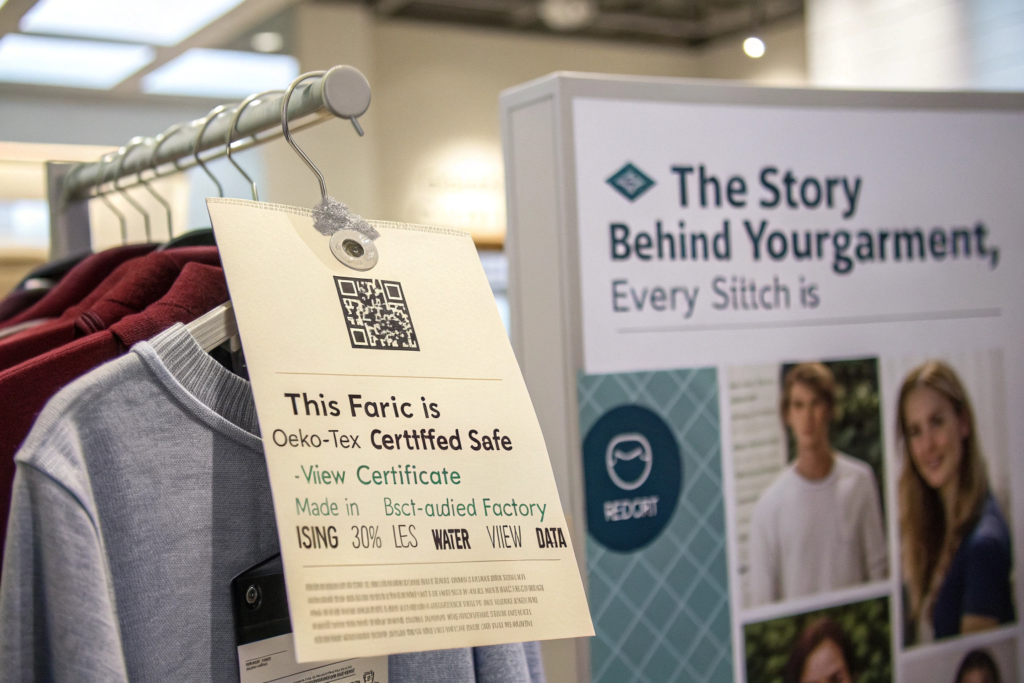
Today’s consumers, especially Gen Z and Millennials, are "proof-seeking." They are skeptical of greenwashing and demand authenticity. A CEO’s brand strategy must now include proactive proof-sharing. Our certificate data allows you to move from saying "we are sustainable" to showing "here is the proof, scan the QR code on your garment’s tag." This transparency builds unparalleled trust and turns customers into advocates.
Integrate our certificate transparency directly into the consumer experience:
- QR Codes on Hangtags: Each garment’s hangtag has a QR code linked to a consumer-friendly version of the certificate dossier. It shows a simplified story: "This fabric is OEKO-TEX® certified safe [View Certificate], made in a BSCI-audited factory [See Report], using 30% less water [View Data]."
- Marketing Campaigns: Build campaigns around "The Story Behind Your Garment." Use visuals from our supply chain (with permission) and data points from the certificates. "Every stitch is traceable."
- Crisis Response: If a negative story about supply chain ethics emerges, you can respond immediately with verified data, not just PR statements. This is brand armor.
What is the ROI of Marketing with Certificate Proof?
Transparency drives conversion and loyalty. Studies show consumers are willing to pay a premium for proven sustainability. By marketing your verifiable credentials, you:
- Increase Average Order Value (AOV): Consumers pay more for trust.
- Reduce Returns: Clear quality and size data (from shrinkage reports) lead to better-fit purchases.
- Enhance Brand Loyalty: Trust builds community and repeat purchases.
A direct-to-consumer brand using our QR code system reported a 15% increase in social media engagement and a measurable decrease in product-related customer service queries. Their marketing team used the certificate data as core content. Research from Nielsen on the sustainability premium supports this.
How to Use This in Annual Sustainability & Impact Reports?
Your public-facing sustainability report is a key credibility document. Populate it with verified data from our certificates:
- Infographics: Show a map of your transparent supply chain, with icons linked to the types of certificates held at each stage (e.g., GOTS at spinning, ZDHC at dyeing).
- Case Studies: Feature a best-selling product and "deconstruct" its lifecycle using the specific LCA and social audit data from its certificate.
- Progress Metrics: Show year-on-year improvement in the average carbon footprint of your fabrics, sourced from our batch data.
This makes your report specific, credible, and engaging, moving beyond corporate boilerplate. The Global Reporting Initiative (GRI) Standards provide a framework for such disclosure.
Why is it a Strategic Tool for M&A and Exit Planning?
If your strategic vision includes acquisition or an eventual exit, a clean, transparent, and defensible supply chain is a major value driver. Acquiring companies and PE firms conduct intense operational and ESG due diligence. A supply chain reliant on opaque, uncertified vendors is a massive liability that can derail a deal or reduce valuation. Our certificate ecosystem systematically de-risks your supply chain, making it an attractive, scalable asset.
During M&A due diligence, you will be asked to provide evidence of:
- Supply Chain Stability and Contingency Plans.
- Compliance with Current and Foreseeable Regulations.
- IP Protection and Quality Control Systems.
- ESG Performance and Risk Exposure.
Our integrated documentation provides ready-made answers. You can present a Supplier Portfolio Summary showing that your key material source (Fumao) is vertically integrated, financially stable, and has a track record of certificates and data sharing. This demonstrates that your business is built on a modern, auditable foundation.
How Does This Enhance Your Company’s Valuation?
Buyers pay for predictable future cash flows. Supply chain opacity is a source of unpredictability (e.g., risk of disruption, scandal, fine). By demonstrating a transparent, low-risk supply chain through our verified certificate data, you reduce the discount rate an acquirer might apply for operational risk. In some cases, strong ESG performance linked to verifiable data can command an ESG valuation premium. You are effectively selling a more secure, future-proofed business. Analysis by Mckinsey on ESG and valuation outlines this link.
What Should Be in the "Supply Chain" Section of Your Information Memorandum?
For a potential acquirer, include:
- Overview: "Our core fabrics are supplied under a strategic partnership with Shanghai Fumao, a vertically integrated manufacturer with full traceability."
- Key Evidence: "Representative certificate dossiers for our top 3 products are available for review in the data room [Links]. They include real-time quality, sustainability, and social compliance data."
- Risk Mitigation: "This partnership mitigates risks X, Y, Z and provides a platform for innovation."
This frames your supply chain as a competitive moat, not a vulnerability. Templates for investment memoranda in the consumer brands sector often now include such sections.
Conclusion
For a modern CEO, our certificate is not a compliance document to be filed away. It is a dynamic, data-rich strategic tool that addresses your most pressing stakeholder challenges: proving responsibility to investors, ensuring compliance with regulators, building authentic trust with consumers, and enhancing enterprise value for exit. It transforms your supply chain from a reputational liability into a demonstrable competitive advantage.
In an era where stakeholders demand proof, the CEO who can provide it leads from a position of strength and confidence. Our system is designed to put that proof at your fingertips.
Elevate your stakeholder reporting from statements to evidence. Schedule a briefing with our leadership team to see how CEOs are leveraging our transparency platform for strategic advantage. Contact our Business Director, Elaine, at elaine@fumaoclothing.com for a C-suite overview.