You’ve been told your fabric shipment is "OEKO-TEX® certified" and the supplier sends you a document titled "Transaction Certificate." It looks official, but does it actually protect you and validate your claim? Or is it just a piece of paper with a fancy letterhead? In global apparel sourcing, a Transaction Certificate (TC) is the legal and commercial bridge between a sustainability claim and the physical product in your warehouse. A missing or flawed clause in this document can render your entire "eco-friendly" collection unsellable, lead to customs seizures, and open you up to charges of greenwashing. So, what specific clauses must you scrutinize to ensure this document is a shield, not a liability?
A valid Transaction Certificate is a contract of traceability. Its core function is to provide an unbroken, auditable chain of custody for certified material (like GOTS organic cotton or GRS recycled polyester) from the certified supplier to you, the buyer. It’s not a general company certificate. Its validity hinges on precise, unambiguous clauses that lock in the who, what, when, and how much of the transaction. If any of these key clauses are vague, missing, or mismatched with your commercial documents, the TC is worthless. From our work at Shanghai Fumao with hundreds of global brands, we see that the most common point of failure isn’t the lack of a TC—it’s a TC missing the critical details that give it legal and practical power.
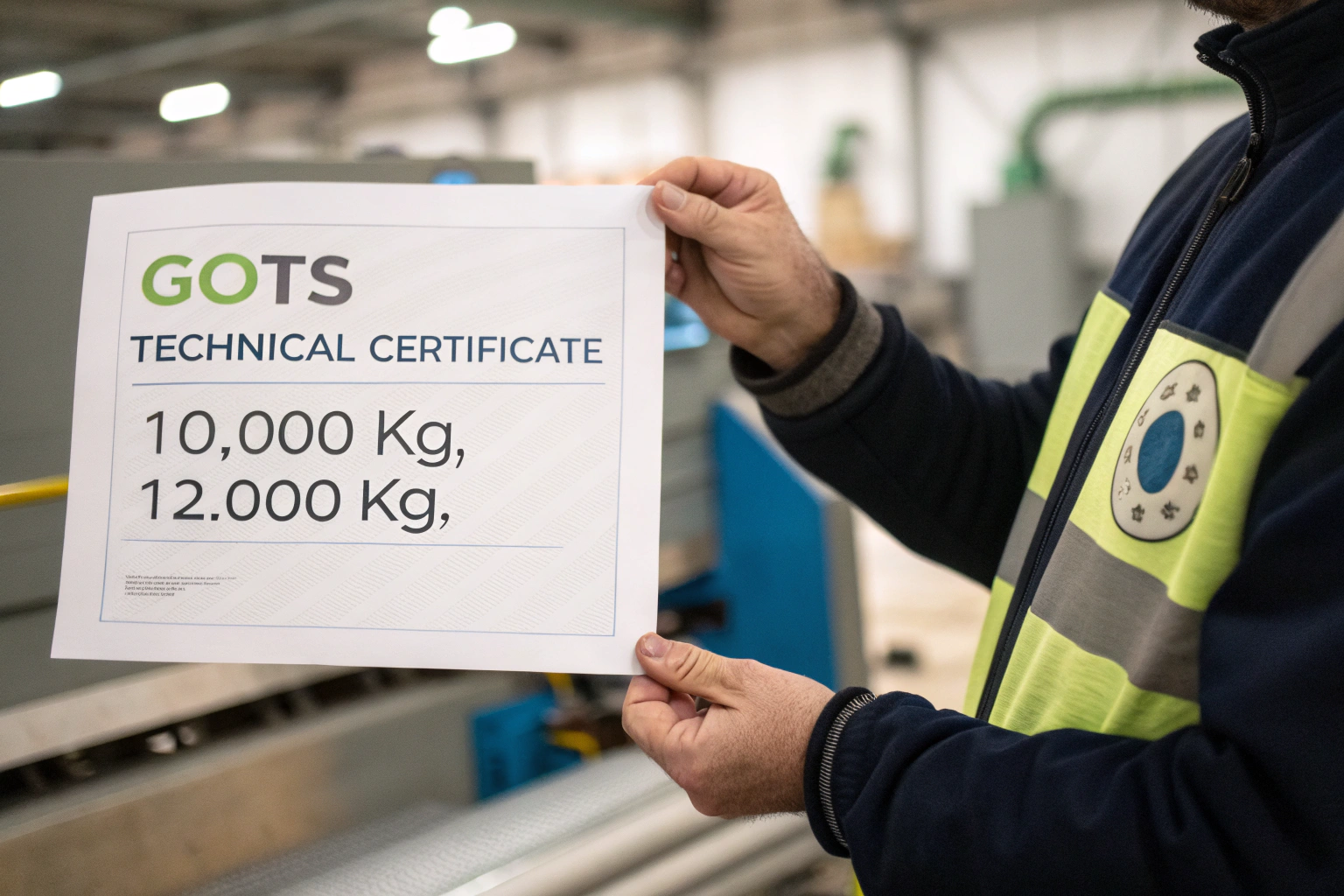
Let me give you a real example from last quarter: A client received a GOTS TC from another mill. It had all the right logos. But the "Quantity" clause simply stated "10,000 kg." Our client’s order was for 12,000 kg of fabric. The mill said, "Don’t worry, the extra 2,000 kg is also organic." But without a TC for the full quantity, they could only legally label 10,000 kg worth of garments as GOTS. The remaining fabric was a compliance black hole. That vague quantity clause cost them dearly. Every clause must be perfect.
What Identifying Information is Non-Negotiable?
The header of a TC is its fingerprint. This section must contain precise, verifiable identifiers that link the document irrevocably to a single, specific commercial transaction. Ambiguity here is the first sign of potential trouble. You must be able to cross-reference every piece of information with your Purchase Order (PO) and the supplier’s invoice. A mismatch is a deal-breaker.
The TC must clearly state:
- Certificate Number: A unique ID issued by the certification body (e.g., CU-123456). This is your primary key for database verification.
- Issuing Certification Body: The full, accredited name of the organization (e.g., "Control Union Certifications").
- Supplier (Seller) Details: The legal name and address of the certified entity that physically shipped the goods. This must be the mill/factory, not a trading company unless the trader is itself the certified holder of the material.
- Buyer (Purchaser) Details: Your company’s legal name and address as the recipient of the certified goods. If this is blank or says "To Whom It May Concern," the TC is generic and not tied to your transaction.
- Reference to Underlying Certificate: It must reference the supplier’s valid scope certificate number and its expiry date. This proves their right to issue TCs.

Why is the "Buyer" Clause Your Most Important Protection?
Your company name and address on the TC serve two critical functions. First, it establishes the chain of custody. It legally documents the transfer of certified material from the supplier to you. Second, it prevents certificate recycling. A supplier cannot use the same TC for multiple clients if each client’s name is on it. A TC without your details is not your transaction certificate; it’s a sample document. Always reject it. For more on this, see the Textile Exchange’s guidance on transaction certificates, which emphasizes buyer identification.
How to Verify the "Issuing Body" and "Certificate Number"?
This is your first authenticity check. Go to the official website of the certification body (e.g., controlunion.com, oeko-tex.com). Use their "certificate verification" tool. Enter the certificate number and the supplier’s name. The online record must match every detail on the paper TC: company name, address, product, validity dates. Any discrepancy means the document is falsified or invalid. We at Shanghai Fumao provide the direct URL to our live certificate entries in databases like the OEKO-TEX® Certification Check to make this step effortless for our clients.
What Do the Product Description & Quantity Clauses Actually Guarantee?
This is the heart of the transaction. The Product Description and Quantity clauses must be so specific that they can only refer to the exact goods you received. Vague descriptions like "knitted fabric" or round quantities like "approximately 10,000 kg" are red flags. These clauses are your proof that the certification applies to the specific material in your possession.
The Product Description should mirror your Tech Pack and PO:
- Full Material Composition: "95% GOTS Certified Organic Cotton, 5% Spandex."
- Construction: "Single Jersey, 180 GSM."
- State of Processing: "Dyed and Finished."
- Color (if applicable): "Heather Grey."
The Quantity must be exact and include the unit of measure:
- Net Weight (Mass): "5,430.50 kg" (for fiber or fabric by weight).
- Length/Area: "12,750.00 meters" or "8,500.00 square meters."
- Credit Weight (for Mass Balance): If using a standard like GRS that allows blending, the clause will state the credit weight of recycled content (e.g., "Credit Weight: 2,500 kg" on a 5,000 kg fabric with 50% recycled content).

How Does the "Mass Balance" Clause Work and What to Look For?
For recycled or organic content claims under mass balance systems (GRS, RCS), understanding this clause is critical. The TC will show two quantities:
- Total Shipment Weight: The physical weight of the goods you bought.
- Credit Weight: The weight of certified (recycled/organic) material assigned to you.
The ratio of Credit Weight to Total Weight gives your claimed percentage (e.g., 50%). The clause must state this clearly. Crucially, the supplier must have enough certified input in their system to cover all credits issued. You can ask to see their transaction certificate ledger for proof. Misunderstanding this is a major source of greenwashing. A clear explanation can be found in the GRS Standard Implementation Manual.
Why is Batch/Lot Number Traceability Essential?
The most robust TCs include a Batch or Lot Number that is physically marked on the fabric rolls or trim boxes. This creates a physical-digital link. You can take a roll from your warehouse, read its lot number, and find the exact TC that covers it. This is crucial for targeted recalls or audits. Without it, you have to assume all goods from that shipment are covered, which is riskier. Our TCs at Shanghai Fumao always include the Fumao Batch ID, which is printed on every roll tag and linked in our digital portal to all supporting test data.
What Dates and Validity Periods Legally Bind the Document?
A Transaction Certificate exists within a timeline defined by two key dates: the validity of the supplier’s underlying certification and the date of the transaction itself. If these dates are misaligned, the TC is invalid. These clauses are not administrative details; they are legal boundaries.
You must verify two date clauses:
- Validity Period of the Supplier’s Scope Certificate: The TC will reference the supplier’s main certificate number and its expiry date. The transaction date must fall within this validity period. A TC issued after the supplier’s certificate has expired is null and void, even if the transaction happened earlier.
- Date of Transaction/Issue: The date the TC was issued (which should be on or after the invoice date but before shipment). This timestamp is crucial for the certification body’s audit trail.

How to Handle the "Shipment Period" Clause?
Some TCs, especially for large orders shipped in lots, will specify a "Shipment Period" (e.g., "Goods to be shipped between 2024-08-01 and 2024-08-15"). This ensures the certified material is shipped within a controlled timeframe linked to the supplier’s inventory records. If you receive goods outside this window, their certified status is questionable. Always ensure your actual shipment date falls within this period or that a new, updated TC is issued.
What is the "First Expiry, First Out" (FEFO) Principle?
This is an internal control principle for suppliers, but a good TC system reflects it. It means the oldest certified material in their inventory is shipped first. While not always stated on the TC, you can infer good management if their TCs are issued sequentially and close to shipment dates. A supplier with messy date management is a risk for certification integrity. Resources on inventory management for certified goods explain FEFO in detail.
What Do the Declaration and Signature Clauses Represent?
The closing sections of a TC contain the legal declarations and authorized signatures that transform the document from an information sheet into a binding attestation. These clauses hold the issuer accountable. Their absence or weakness undermines the entire document.
Look for these two critical clauses:
- Supplier’s Declaration: A statement from the supplier attesting that the described goods comply with the relevant standard (e.g., GOTS, GRS), that they originate from their certified production, and that all information is accurate. Language like "We hereby declare that the above goods have been produced in compliance with…" is standard.
- Authorized Signature & Stamp: The TC must be signed by an individual specifically authorized by the supplier to issue TCs. It should also bear the company stamp or seal. An unsigned TC or one signed by a low-level salesperson is invalid. The signature is the supplier’s legal commitment to the truth of the document’s contents.

What is the Role of the Certification Body’s Disclaimer?
Often at the bottom, you’ll find a disclaimer from the certification body (CB). It typically states that the CB’s responsibility is only to the supplier (the certificate holder) for maintaining the management system, and that it does not guarantee the quality or specifications of individual shipments. This is important to understand: the TC proves the chain of custody and claim, but it is not a product quality guarantee. For quality, you still need separate test reports and inspections. This is why our full documentation package at Shanghai Fumao always includes both the TC and the batch-specific CNAS lab reports.
How to Verify the Authority of the Signatory?
While difficult for an outsider, you can ask the supplier for evidence that the person signing TCs is listed in their certification file as an authorized signatory. Reputable suppliers will have this documented in their Internal Control System (ICS) manual. In case of a major dispute or fraud investigation, this becomes a key point. For high-value transactions, it’s a reasonable due diligence question. Discussions on professional ethics in auditing and certification touch on the importance of authorized signatories.
How Does the TC Integrate with Your Commercial Documents?
The Transaction Certificate does not exist in a vacuum. Its true power is realized only when it is part of a coherent document package. Every data point on the TC must align perfectly with your Purchase Order (PO), the supplier’s Commercial Invoice, and the Packing List. This four-way match is what customs authorities, your auditors, and your own QC team will check.
Create a simple reconciliation table:
| Document | Key Matching Data Points |
|---|---|
| Your Purchase Order | Product Description, Quantity, PO Number |
| Commercial Invoice | Product Description, Quantity, Value, Invoice Number, Buyer/Supplier Details |
| Packing List | Quantity (number of cartons/pieces), Net/Gross Weight, Marks |
| Transaction Certificate | Product Description, Quantity, Buyer/Supplier Details, Date |
A discrepancy, like the invoice showing 15,000 meters and the TC showing 14,000 meters, means 1,000 meters are uncertified. This misalignment can break your green claim and cause customs delays.

What is the "One TC Per Shipment" Rule?
As a best practice, you should receive one unique TC for each commercial invoice/shipment. Do not accept a single TC covering multiple shipments over months. This fragments the traceability and makes it impossible to match goods to proof. Each container or air shipment should have its own TC with its own unique ID or at least a specific quantity listed. This is a hallmark of a well-managed certification system. Guidance from Control Union on transaction certification reinforces this practice.
How to Use the TC for Customs and Consumer Claims?
For customs, the TC (along with the invoice) is proof of the product’s nature for determining duty under preferential trade agreements or for verifying "organic" import claims. For consumer-facing claims, the TC is the foundational evidence behind your hangtag. You should be able to trace a garment’s hangtag claim back to the fabric TC, then to the yarn TC, and so on. This is the "document pyramid" that sustains your brand’s integrity in an audit. Failing to maintain this is a core risk under new EU Green Claims Directive enforcement.
Conclusion
A Transaction Certificate is a deceptively simple document with enormous legal and commercial weight. Its validity is not in its logos, but in the precision and completeness of its key clauses: the unambiguous identification of parties, the exact description and quantity of goods, the binding dates, and the accountable signatures. Treating it as a mere attachment is a critical error.
By mastering these clauses, you move from passively receiving a document to actively validating your supply chain’s most important claims. You transform the TC from a potential point of failure into your strongest tool for compliance, marketing, and risk management.
Don’t just collect certificates—validate them. Download our free "Transaction Certificate Clause-by-Clause Checklist" and audit your next TC in 5 minutes. For fabrics backed by impeccably clear and traceable documentation, contact our Business Director, Elaine, at elaine@fumaoclothing.com. See the difference precision makes.