
You’re finalizing a six-figure order with a garment factory. The price is negotiated, the samples are approved, and the deposit is about to be wired. But before you do, the factory manager sends over a document called a "Transaction Certificate" and asks you to sign it. You pause. Is this just another piece of administrative paperwork, or is it a document that could fundamentally alter your rights, risks, and recourse if something goes wrong? For countless importers, this moment of confusion has led to devastating financial losses and legal nightmares.
A Garment Factory Transaction Certificate (often called a "Sales Contract," "Work Order Confirmation," or "Proforma Invoice with Terms") is not a simple receipt. It is the de facto legal contract that governs your entire transaction. Its fine print—often overlooked in the rush to start production—defines payment terms, quality standards, liability for defects, delivery responsibilities, and dispute resolution mechanisms. At Shanghai Fumao, we work with hundreds of garment factories and have seen firsthand how a well-constructed certificate protects both parties, while a vague or one-sided one sets the stage for conflict. Let’s dissect this critical document so you can sign with your eyes wide open.
What Key Clauses Must You Scrutinize in the Certificate?
The devil is in the details—or in this case, the clauses. A Transaction Certificate can range from a one-page sheet with just price and quantity to a multi-page legal document. Regardless of length, you must verify the presence and wording of these five non-negotiable sections.
-
Product Specifications & Quality Benchmark Clause: This must go beyond stating "Ladies Knit Dress as per sample." It must explicitly reference and attach the final approved sample’s photos, the detailed tech pack (with tolerance limits for measurements), the specific fabric composition and quality standard (e.g., "Fabric to be 100% cotton, 200GSM, pre-shrunk, meeting CMIA Class B standards"), and lab dip/trim approvals. Vague language like "good quality" is worthless in a dispute. For instance, a client of ours in 2023 had a dispute where the factory used a cheaper 180GSM fabric instead of the specified 200GSM. Their weakly worded certificate said "cotton jersey," not the specific weight. They lost the claim. We now advise all partners to demand references to specific fabric quality standards like AQL levels in this clause.
-
Delivery and Incoterms Clause: This defines where your responsibility begins and ends. The certificate must state the exact Incoterms rule (e.g., FOB Shanghai, EXW Guangzhou, CIF Los Angeles). If it says "FOB," it must specify the port. Crucially, it must define the "Delivery Date" is the date goods are shipped (on-board the vessel) or received at your warehouse? A missing definition here is a classic trick—factories often claim they delivered when they shipped, even if ocean transit takes 30 extra days. Also, check for "Force Majeure" language that is too broad, allowing the factory to delay for almost any reason.
-
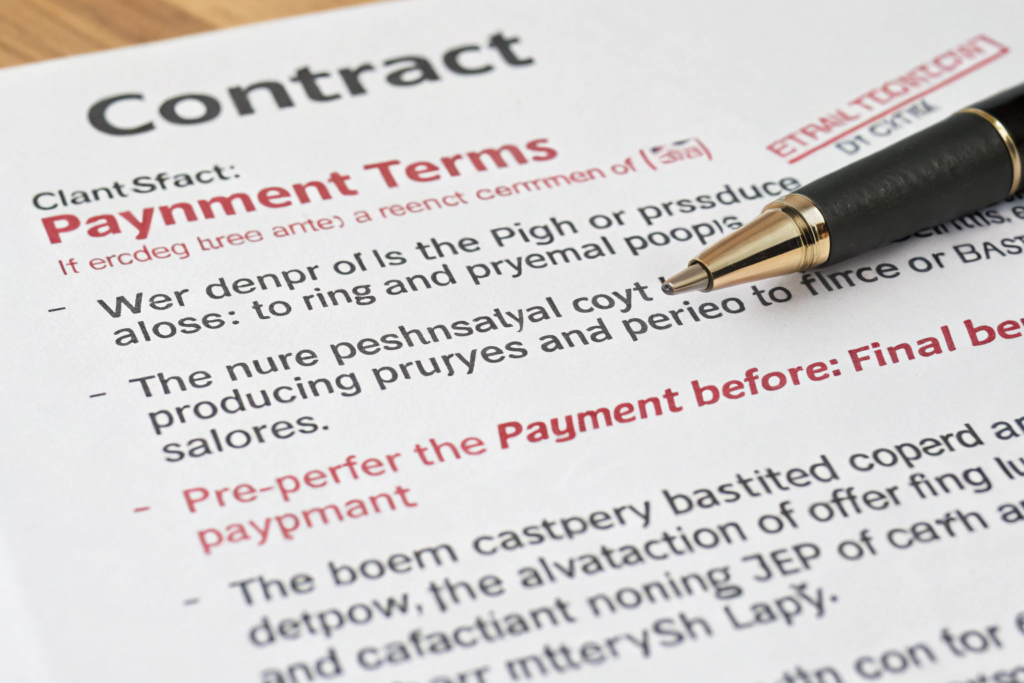
Payment Terms Clause: This is where financial risk is highest. Be wary of:
- High deposit percentages (e.g., 50% or more before production).
- "Final payment before shipment" terms, which leave you zero leverage if goods are defective.
- Lack of a mandatory pre-shipment inspection (PSI) right tied to the final payment.
The safest structure is: 30% deposit, 70% against copy of Bill of Lading after passing your PSI. Never agree to payment solely based on the factory’s "own inspection report."
What Are the Hidden Risks in Liability and Warranty Clauses?
The "As-Is" Trap and Limited Remedies.
Many factory certificates include a clause stating goods are sold "as-is" or limit the buyer’s remedy to "repair or replacement" of defective goods, excluding any consequential damages (like lost sales, air freight costs, or retailer fines). For you, this can be catastrophic. If defective garments cause you to miss a key season, this clause means you eat 100% of those losses. You must push to delete "as-is" and include language that holds the factory liable for all direct costs resulting from material and workmanship defects. This aligns their financial risk with their quality output.
How is Dispute Resolution Handled?
Avoid "Factory’s Local Court" at All Costs.
The certificate will specify the legal jurisdiction for disputes. If it says "disputes to be settled in the People’s Court of [Factory’s City]," you are at a severe disadvantage. Litigating in a factory’s hometown is expensive and unpredictable. Aim for neutral arbitration. A fair clause reads: "Disputes shall be finally settled under the Arbitration Rules of the Singapore International Arbitration Centre (SIARC)" or another reputable international body. While not perfect, it’s far more neutral. The cost of including this is zero; the cost of ignoring it can be limitless.
How Does This Certificate Interact with Fabric Certifications (Like CMIA)?
This is a critical intersection that most buyers miss. The garment factory’s Transaction Certificate typically covers the finished garment. Your fabric supplier’s documentation (like our CMIA certificate from Shanghai Fumao) covers the raw material. The factory’s certificate must bridge this gap to protect you.
If you are sourcing fabric directly (e.g., from us) and providing it to the factory for cutting/sewing (called "CMT" – Cut, Make, Trim), the factory’s certificate should state: "Factory’s responsibility is limited to cut, make, and trim workmanship. Fabric quality, composition, and safety certification (CMIA Certificate No. XYZ) are the responsibility of the buyer and provided fabric supplier. Factory warrants no liability for fabric-related failures." This clarifies the split of responsibility.
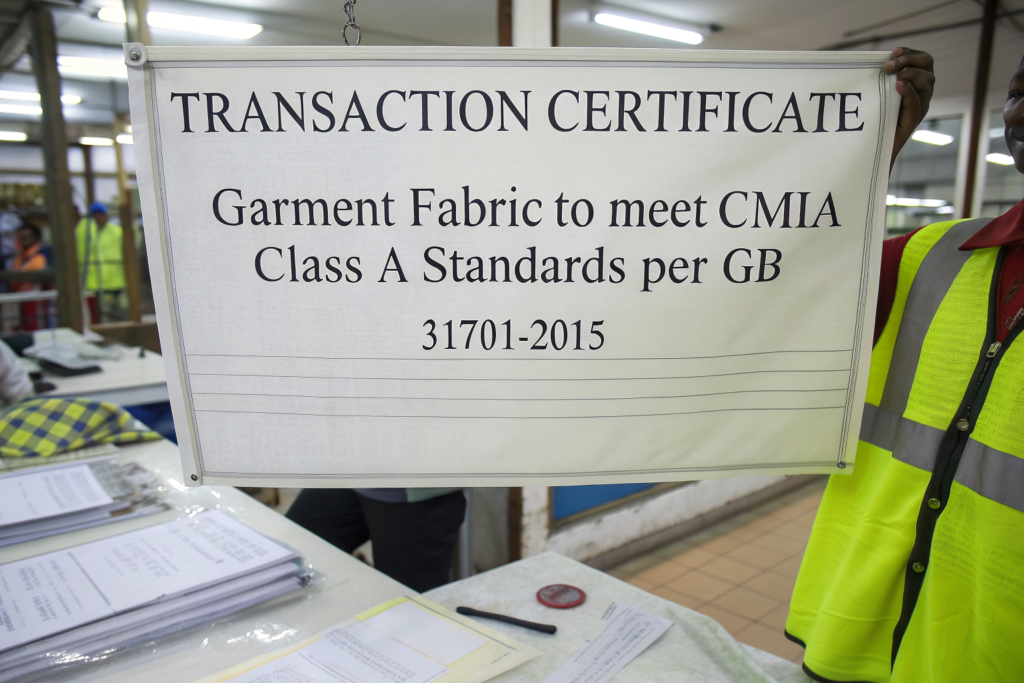
If the factory is sourcing fabric on your behalf (a "full-package" service), their Transaction Certificate becomes exponentially more important. It must warrant that all materials, including fabric, meet the specific standards you require (e.g., "Garment fabric to meet CMIA Class A standards per GB 31701-2015"). Crucially, you must require them to provide the original fabric CMIA certificates and test reports from their mill as a condition of final payment. Do not accept a verbal assurance. Without this, you have no chain of custody for safety compliance, which violates due diligence requirements for responsible apparel sourcing.
What is the "Conformity of Goods" Clause in This Context?
Your Receiving Inspection Right.
The certificate must grant you a clear, defined period (e.g., 14 days after receipt at your warehouse) to inspect the goods for conformity to the contract (quality, quantity, specs). It should state that non-conforming goods can be rejected for a full refund or replacement at the factory’s cost. This clause is your legal tool to act if you discover substandard fabric or workmanship after delivery. Its absence means you could be deemed to have accepted the goods upon delivery, waiving your right to claim.
Can the Certificate Mandate Specific Component Sources?
Yes, and It Should.
If you have approved specific components—like our certified recycled polyester fabric from Shanghai Fumao, or specific YKK zippers—list them by brand and product code in the certificate’s specification annex. Add a clause: "No substitutions permitted without prior written buyer approval." This prevents the factory from swapping in cheaper, non-compliant alternatives to boost their margin, a common and costly practice.
What Are the Red Flags in a Factory-Issued Certificate?
Some certificates are designed to protect the factory at your expense. Here are instant red flags that should make you pause and renegotiate:
- "All sales are final." This is an attempt to eliminate all your legal rights.
- "Buyer responsible for all shipping, customs, and taxes" without a defined Incoterm. This is dangerously vague.
- No detailed product specifications attached. The certificate just references "Order #123."
- "Factory’s inspection is final." This removes your right to an independent quality check.
- Payment terms of 100% before production. This is the highest risk scenario.
- A blank or vague "Remarks" section that the factory can fill in later.
- The document is only in Chinese. Insist on a bilingual version you can understand, and state that the English version governs.
If you encounter these, do not sign. Politely state that your company’s compliance requires a more detailed contract and propose using a mutually agreed international sales contract template. A professional factory will engage in this discussion; a risky one will resist.

How Should You Handle Revisions and Negotiations?
Be Professional, Not Confrontational.
Frame changes as standard business practice for clarity and mutual protection. Say: "To ensure we both have clear expectations and avoid future misunderstandings, let’s update a few clauses for precision. This protects both of us." Then provide clear, written mark-ups (e.g., using Word’s Track Changes). Always get the final, agreed version re-issued as a clean document with both parties’ official stamps/signatures. Keep every version for your records.
When Do You Need a Separate, Formal Contract?
For Large or Complex Orders.
For orders over a certain value (e.g., $50,000+) or with high complexity (multiple seasons, development obligations), a brief Transaction Certificate is insufficient. You should invest in a formal, comprehensive Manufacturing Agreement. This longer contract will cover intellectual property (who owns the design?), confidentiality, capacity reservation, and more detailed liability frameworks. It is worth the legal fees. For strategic partnerships, this is non-negotiable.
Conclusion
The Garment Factory Transaction Certificate is the blueprint of your business transaction. It is not a mere formality. A well-drafted certificate aligns incentives, defines quality, allocates risk fairly, and provides a clear path for resolution. A poor one leaves you exposed to unlimited liability and operational chaos.
Your action plan is simple:
- Never sign a blank, vague, or one-sided certificate.
- Insist on attaching all technical documents (tech pack, approved samples, lab dips).
- Clarify the chain of custody for fabric and component certifications.
- Negotiate fair payment terms linked to verified quality.
- Choose neutral arbitration for disputes.
Treat this document with the same seriousness as your sample approval. The few hours spent negotiating it can save your business from a catastrophe.
If you are seeking to simplify this process by working with a vertically integrated partner who controls the fabric quality and can provide clear, compliant documentation from the source, let’s talk. At Shanghai Fumao, we provide not only CMIA-certified fabrics but also support our clients in ensuring their factory contracts properly reflect the quality they are paying for.
To develop a safer, more transparent sourcing strategy with clear contractual foundations, contact our Business Director Elaine at elaine@fumaoclothing.com.