If you’re a garment manufacturer, brand owner, or sourcing agent, you operate on thin margins and thinner timelines. You might think, "My end market is the US or EU, not China. Why should CMIA, a Chinese standard, be non-negotiable for me?" That’s a fair question, until you consider the real-world domino effect: a fabric fails a basic safety test, your production line halts, your shipment is rejected at your customer’s warehouse, and suddenly, you’re liable for six-figure losses and a broken partnership. The cost of ignoring CMIA isn’t just a missed market opportunity—it’s an existential risk to your business’s operational continuity and reputation.
At Shanghai Fumao, we don’t treat CMIA as an optional add-on. We treat it as the foundational quality management system for every meter of fabric we produce. For our B2B clients—the factories and brands who transform our fabric into finished garments—this isn’t about bureaucracy. It’s about injecting predictability, security, and forensic traceability into a traditionally opaque supply chain. Let me explain why, from our perspective as your fabric partner, making CMIA non-negotiable is the most professional service we can provide.
How Does CMIA Protect Our Clients from Catastrophic Production Halts?
For a B2B garment client, time is the ultimate currency. A production line stopped for quality issues burns money by the minute. The most common and devastating halts come from late-stage fabric failures—issues that should have been caught at the raw material stage. CMIA compliance is our engineered solution to prevent these halts before they reach your cutting table.
Consider this real scenario from Q3 2023: A client in Vietnam was producing 50,000 units of children’s polyester fleece hoodies for a major European retailer. They sourced fabric from a non-CMIA-focused mill. Two weeks into cutting and sewing, the retailer’s mandated third-party inspector randomly tested the fabric and found formaldehyde levels at 28mg/kg. The contract limit was 20mg/kg. Result? Full production stop. All cut panels and WIP garments were quarantined. The factory faced air-freighting costs to meet the deadline, ate the fabric cost, and nearly lost the client. When they came to us for the re-order, we supplied CMIA-certified fabric from day one. The pre-shipment test? 18mg/kg. The production ran smoothly. The difference wasn’t luck; it was the systematic pre-testing and chemical control mandated by the CMIA framework.
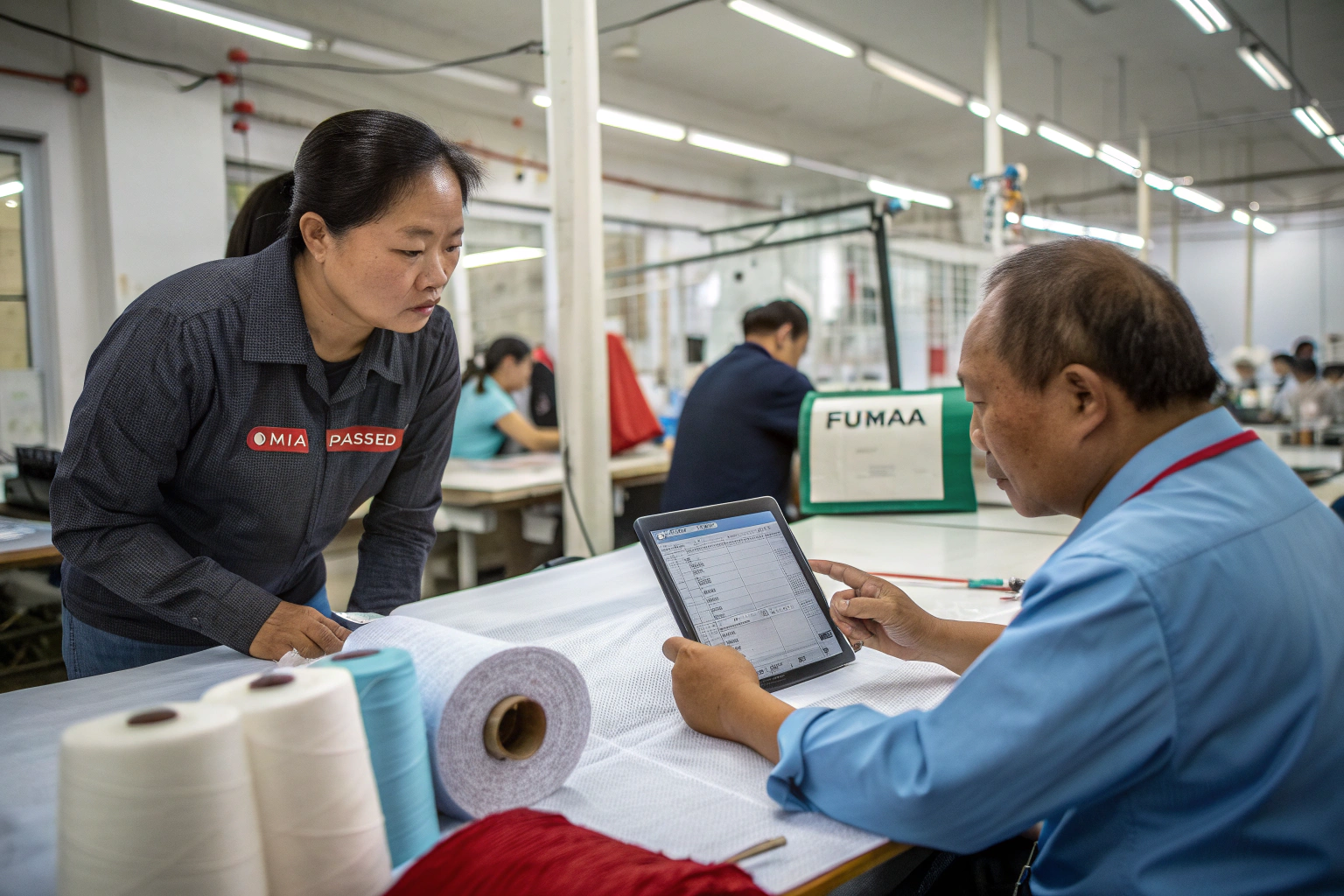
This is why CMIA is non-negotiable for us. It shifts the quality assurance burden upstream to us, the fabric producer, and away from your production floor. Our internal CNAS lab conducts the same battery of tests as an official CMIA lab. We catch and correct failures in our process, not yours. This guarantees that when the fabric arrives at your factory, its safety parameters are already locked in. You can schedule your cutting and sewing with confidence, protecting your most valuable asset: production line efficiency in garment manufacturing.

What is the "Hidden Tax" of Using Non-CMIA Fabric?
The Cost of Uncertainty.
Using uncertified fabric imposes a hidden "uncertainty tax" on your operations. It forces you to:
- Build in buffer time for potential fabric-related delays.
- Budget for emergency air freight to salvage timelines.
- Pay for your own pre-production testing on every batch, duplicating costs.
- Maintain higher inventory of backup fabrics "just in case."
CMIA-certified fabric from a disciplined supplier like Shanghai Fumao eliminates this tax. The certification is your pre-paid insurance policy, allowing for leaner, more predictable, and more profitable operations.
How Does CMIA Simplify Your Client (Retailer) Audits?
Providing Instant, Standardized Proof.
When your retail client (e.g., a brand like Columbia or Next) audits you, they demand proof of material safety. Presenting a CMIA certificate and full test report is a universal language of compliance. It’s a government-recognized document that instantly satisfies a huge portion of their questionnaire regarding substance restrictions. This simplifies your audit process, reduces back-and-forth, and strengthens your position as a reliable, tier-1 supplier. It’s a key tool for managing compliance in garment factory audits.
Why is CMIA Essential for Managing Legal and Financial Liability?
In today’s global supply chain, liability doesn’t stop at the fabric mill. As the garment manufacturer or brand of record, you bear the ultimate legal and financial responsibility for the finished product. If a consumer alleges harm or a regulator finds a banned substance, the liability lawsuit names you. Your contract with your fabric supplier may offer some recourse, but litigation in a foreign jurisdiction is a pyrrhic victory at best. CMIA certification is your first, strongest line of legal defense.
The CMIA certificate is a contractually enforceable document of conformance. When we, as Shanghai Fumao, provide you with a CMIA certificate for a fabric batch, we are legally attesting that it meets the published safety standards. This transfers a significant portion of the legal risk back to us. In the event of a non-conformity, you have clear, actionable evidence for claims. This is not theoretical. We had a client in Bangladesh whose finished garments were flagged by German customs for azo dye traces. Because they had used our CMIA-certified fabric and retained the batch-specific documents, they were able to immediately provide our certificate and test report to the authorities. The investigation swiftly moved upstream to a non-compliant thread supplier (not us), completely absolving our client and allowing their shipment to proceed after thread replacement.

How Does This Protect Your Brand’s Market Access?
Avoiding the "Banned List" at Customs.
Customs agencies worldwide are increasingly using automated risk systems. Shipments from certain origins or of certain product categories (like infant wear) are flagged for lab testing. A CMIA certificate, while a Chinese standard, is recognized as a rigorous testing protocol. Presenting it can expedite release by demonstrating due diligence. Without it, your shipment is a prime candidate for lengthy, costly holds. For B2B clients managing just-in-time inventory for global fashion brands, a single customs hold can collapse the entire delivery schedule to multiple stores.
What About Contracts with Your Downstream Clients?
Strengthening Your Own Terms.
When you contract with your brand clients, you can and should warrant that all materials meet international safety standards. Sourcing CMIA-certified fabric gives you the evidence to confidently make that warranty. It strengthens your contract, reduces your liability exposure, and allows you to negotiate better terms. You are no longer making a hope-based promise; you are providing a evidence-based guarantee.
How Does CMIA Certification Future-Proof Our Clients’ Businesses?
The apparel industry’s future is transparency, digitization, and stricter regulations. CMIA compliance isn’t about the past or present; it’s an infrastructure investment for the next decade.
The data architecture required for CMIA—batch IDs, chemical inventories, test results—is the exact data set needed for emerging frameworks like the EU’s Digital Product Passport (DPP). By building your supply chain on CMIA-certified materials today, you are passively collecting the forensic data you will need tomorrow. When DPPs become mandatory, you won’t be scrambling to retrofit a opaque supply chain; you’ll be partnering with suppliers like us who already operate a traceable system. This is a monumental competitive advantage in the coming era of full supply chain transparency in apparel.

How Does it Facilitate Sustainable and Ethical Sourcing Goals?
The Safety Foundation of ESG.
Environmental, Social, and Governance (ESG) reporting is now critical for accessing investment and premium retail partnerships. The "E" in ESG isn’t just about carbon and water; it’s about chemical management and pollution. CMIA’s stringent control over inputs directly contributes to cleaner wastewater and safer working environments in the dyeing and finishing stages. By specifying CMIA-certified fabrics, you are making a verifiable choice that supports the environmental pillar of your or your client’s ESG goals. This is increasingly a deciding factor for winning contracts with ESG-focused fashion brands.
Does it Enable Agile Responses to Market Changes?
Creating Optionality and Speed.
Markets shift. A line designed for Europe might need to be sold in Asia mid-season. If your garments are made from CMIA-certified fabrics, they already meet the core safety requirements for the Chinese market. This gives you and your clients optionality and agility. You’re not locked into a single geographic market. Furthermore, when a new substance is regulated (e.g., a new PFAS ban), suppliers operating a CMIA system can instantly identify and reformulate affected products because they maintain controlled chemical lists. This allows you to adapt while competitors are still diagnosing the problem.
Conclusion
For our B2B garment clients, CMIA certification is non-negotiable not because we say so, but because the logic of modern, responsible, and profitable manufacturing demands it. It is the difference between being a commodity subcontractor and being a strategic supply chain partner.
It protects your production flow from catastrophic disruptions, shields you from disproportionate liability, and builds the data-driven foundation required for the future of the industry. Choosing a fabric supplier who treats CMIA as core philosophy, like Shanghai Fumao, is one of the highest-leverage decisions you can make to de-risk and elevate your business.
In a world of uncertainty, we deliver certainty. That is our promise, and CMIA is the proven system that allows us to keep it.
Ready to eliminate fabric-related risk from your production? Let’s discuss how our CMIA-integrated system can bring stability and confidence to your factory floor.
Contact our Business Director, Elaine, at elaine@fumaoclothing.com to schedule a technical meeting focused on securing your supply chain.