When sourcing children’s apparel, nothing keeps a buyer up at night like chemical safety concerns. You’ve heard the horror stories: recalls due to phthalates, lawsuits over harmful substances, and brand reputations destroyed overnight. As a responsible brand, you demand assurances beyond basic fabric quality. You need to know: does China’s mandatory CMIA certification actually protect against specific dangers like phthalates in children’s wear, or is it just a bureaucratic hurdle that misses the real risks?
The short, critical answer is: Yes, CMIA certification does address phthalates, but with important limitations that every serious buyer must understand. While CMIA sets a crucial baseline for general textile safety, its specific approach to phthalates in children’s apparel may not fully align with stricter international regulations like those in the EU or US. This gap isn’t just technical—it’s a potential business risk. At Shanghai Fumao, we navigate this complex landscape daily, helping global children’s wear brands build layered compliance strategies that start with CMIA but don’t end there.
Understanding this distinction is what separates brands that merely avoid legal trouble from those that build genuine trust with safety-conscious parents. Let’s dissect exactly what CMIA covers, where it falls short, and how to build a bulletproof safety protocol for your most sensitive products.
What Does CMIA Specifically Test For in Children’s Textiles?
CMIA (China Compulsory Certification) establishes mandatory safety thresholds for textiles, with particularly strict requirements for products intended for infants and children under 36 months (categorized as Class A). Its core framework addresses several critical parameters, but buyers must understand its exact scope to avoid dangerous assumptions.
The certification’s testing protocol for children’s apparel primarily focuses on:
- Formaldehyde Content: Stringent limits (≤20mg/kg for Class A) to prevent skin irritation and respiratory issues.
- pH Value: Ensures fabrics are skin-neutral to avoid chemical burns or irritation.
- Colorfastness: Tests resistance to saliva, perspiration, and rubbing to prevent dye transfer.
- Azo Dyes: Bans certain aromatic amines known to be carcinogenic.
- Heavy Metals: Limits elements like lead and cadmium, especially important for prints and coatings.
Regarding phthalates specifically, CMIA’s position is nuanced. The standard GB 31701-2015 (the technical specification for infant and children’s textile products under the CMIA system) does include restrictions on phthalates for products where they are likely to be used. However—and this is crucial—the requirement primarily applies to plastic components and coatings that may contain plasticizers, not the woven or knitted textile substrate itself. This includes items like plastic prints, PVC appliqués, plastic buttons, zipper pulls, and synthetic leather trims.
For example, when we produced a batch of colorful printed raincoats with PVC-free coatings for a French brand last year, the CMIA certification process specifically tested the coated areas for phthalates (DEHP, DBP, BBP, etc.) to ensure they fell below the stipulated limits. The base polyester fabric underwent different tests. This distinction is vital for accurate compliance planning.

Where Does CMIA Fall Short on Phthalate Coverage?
The Substrate Gap and "Intended Use" Ambiguity.
The potential gap lies in two areas. First, CMIA may not mandate phthalate testing for the base fabric fiber unless it is suspected to contain plasticizers (e.g., certain types of plastisol prints or polyurethane coatings). A plain cotton jersey or polyester fleece might not trigger automatic phthalate screening under a standard CMIA application. Second, the enforcement can depend on the product’s declared "intended use." A blanket or soft toy with textile components might be evaluated differently than apparel. This is why savvy brands don’t rely on CMIA alone for phthalate safety; they specify additional testing. Understanding global regulations for children’s product safety is essential to bridge these gaps.
How Do CMIA Phthalate Limits Compare to EU/US Standards?
A Step Behind Stricter Global Norms.
While CMIA restricts several phthalates (like DEHP, DBP, BBP to ≤0.1% by weight for Category A), its list and limits are not always as comprehensive or as stringent as regulations like the EU’s REACH Annex XVII or the US Consumer Product Safety Improvement Act (CPSIA). For instance, REACH currently restricts multiple additional phthalates (DIBP, DINP, etc.) under its toy and childcare articles directives. A product passing CMIA for phthalates might still fail EU entry requirements. This discrepancy makes it imperative to conduct supplemental phthalate testing for international market compliance, especially for brands selling globally.
Why Is a "CMIA-Plus" Strategy Essential for Global Brands?
Relying solely on CMIA for phthalate compliance in children’s apparel is a high-risk strategy for any brand targeting international markets. The certification provides a essential foundation and legal permit for the Chinese market, but global safety requires a layered, "CMIA-Plus" approach. This strategy uses CMIA as the baseline and builds additional, market-specific testing on top.
Think of it as a security system: CMIA is the sturdy door lock (mandatory, foundational), but you also need motion sensors and cameras (additional tests) for complete protection. In practice, this means your technical pack should specify: "Fabric and all components must pass CMIA certification. Additionally, all plastic/coated components and printed areas must pass phthalate testing per EU REACH Annex XVII (or CPSIA, as applicable) for the following substances: [list specific phthalates]." This was the exact protocol we implemented for a US-based organic children’s wear brand in 2023. Their GOTS-certified organic cotton pajamas had plastic snaps and printed labels. We obtained CMIA first, then conducted targeted phthalate tests on the snaps and print ink to satisfy both Chinese and US import regulations. The result was zero delays at either customs checkpoint.

What Specific Components Require Extra Scrutiny?
Beyond the Fabric: The Real Risk Zones.
The greatest phthalate risks in children’s apparel often lie in the accessories and decorations, not the main fabric. Your "CMIA-Plus" checklist must include:
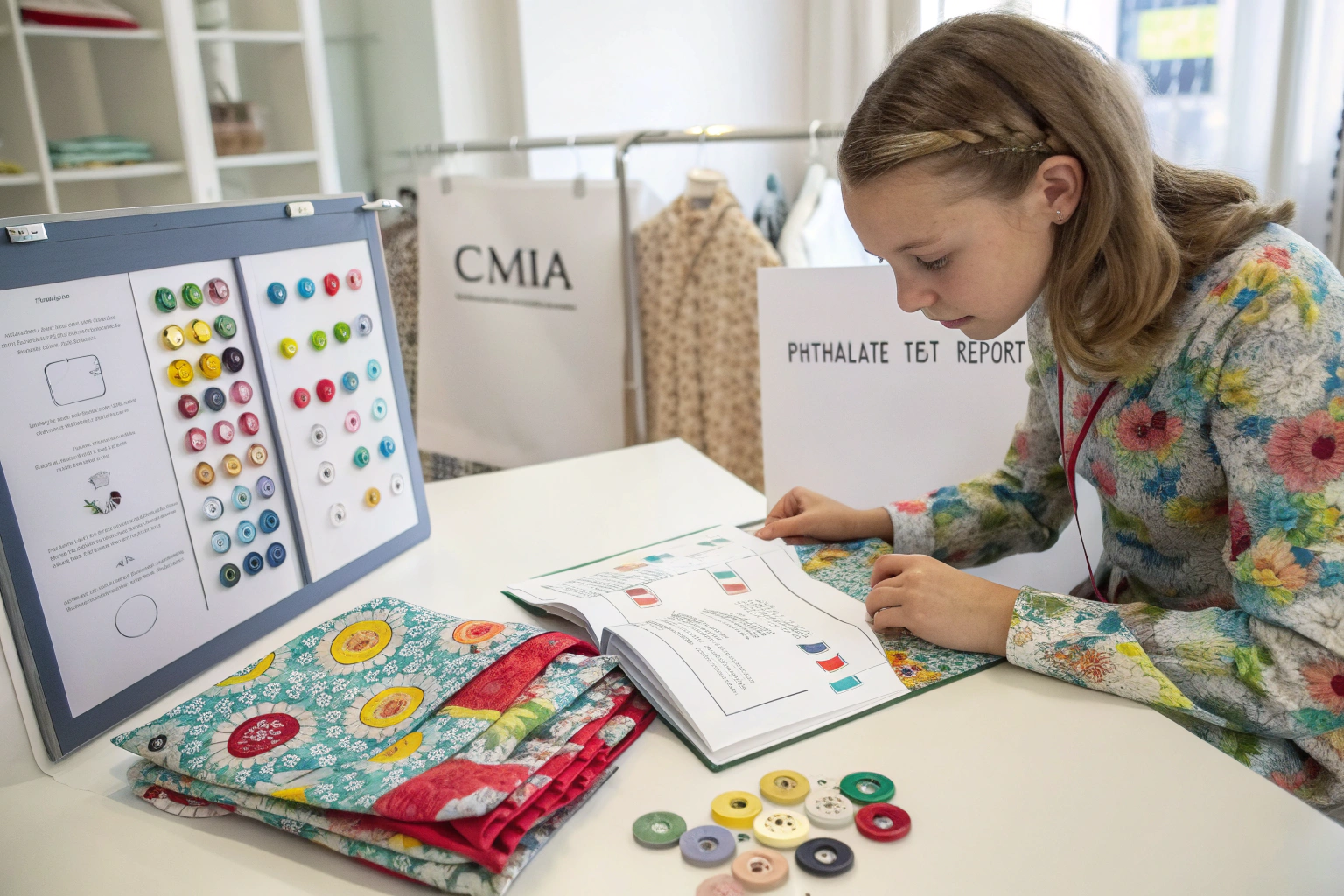
- Plastic Trims: Buttons, snaps, zipper pulls, sequins.
- Prints and Transfers: Plastisol prints, PVC-based transfers, glitter applications.
- Synthetic Leather/Patent Trims: Often used for accents on shoes or jackets.
- Coated Fabrics: Rainwear coatings, waterproof membranes.
- Screen Printing Inks: Especially those creating a rubbery or raised feel.
A common oversight is assuming all components come from the same certified source. We once audited a shipment where the main fabric was CMIA-certified, but the factory sourced cheap, uncertified plastic buttons locally. The entire batch was rejected. Now, we mandate that clients using our certified fabrics also source trims through our vetted network or provide their own component test reports—a holistic approach to managing accessory compliance in apparel manufacturing.
How to Implement "CMIA-Plus" in Your Supply Chain?
Step-by-Step Integration.
- Specify in Tech Packs: Clearly list CMIA and additional phthalate standards (by name and regulation number) as mandatory requirements.
- Pre-Production Sample Testing: Require the factory to submit pre-production samples of all components (fabric, trim, print swatches) for combined CMIA and phthalate testing. The cost is minimal compared to a recall.
- Batch-Specific Documentation: Insist that the final CMIA certificate and the phthalate test report are linked to the bulk production batch numbers. Generic reports are worthless.
- Third-Party Verification: Use your inspection agency to verify that the components in the bulk shipment match the tested samples. This closed-loop system eliminates substitution risk.
How Can You Verify Phthalate Compliance Beyond the CMIA Certificate?
Trust, but verify. A supplier’s promise of "CMIA-certified and phthalate-safe" is meaningless without concrete, verifiable proof. Your due diligence process must be designed to uncover the truth about what was actually tested.
First, go beyond the CMIA certificate. Demand the full test report from the accredited laboratory. Scrutinize the "Scope of Testing" or "Test Items" section. Does it explicitly list phthalates Which ones? Are the tested material descriptions specific (e.g., "blue plastic button," "red print paste") or vague (e.g., "fabric sample")? In our experience, a professional supplier like Shanghai Fumao will provide these detailed reports without hesitation. We recently provided a Scandinavian brand with a 15-page dossier including CMIA, separate phthalate reports for prints, and even migration tests for heavy metals to meet their home country’s toy-safety standards for apparel.
Second, conduct spot testing via a third-party lab of your choice. This is the ultimate verification. You can instruct your quality inspection agency (like SGS, Intertek, or TÜV) to randomly select finished garments from the production line and send components (buttons, prints) to their lab for phthalate analysis. While this incurs an added cost, it’s the most powerful deterrent against non-compliance and provides irrefutable evidence for your own records. Resources like the American Apparel & Footwear Association’s (AAFA) Restricted Substances List (RSL) can guide you on which phthalates to test for specific markets.

What Are the Red Flags in Supplier Documentation?
Spotting the Gaps Before They Cost You.
Be highly suspicious if:
- The supplier provides only a CMIA certificate and claims it "covers everything."
- The test report sample description is generic and doesn’t mention trims or prints.
- They refuse to provide lab contact information for verification.
- They suggest testing can be done "next time" or after shipment.
- The phthalate test report is dated significantly before your order date and isn’t batch-specific.
Any of these signs indicate a supplier who either doesn’t understand compliance or is actively cutting corners. In the children’s wear sector, this is an unacceptable risk.
How to Structure Your Contract for Maximum Protection?
Legal Language That Matters.
Your purchase agreement must have teeth. Include clauses such as: "Supplier warrants that all products, including all component parts and decorations, comply with CMIA standards and contain no phthalates restricted under EU Regulation No. 1907/2006 (REACH) Annex XVII at concentrations above 0.1% by weight. Supplier shall provide valid, batch-specific test reports from a CNAS-accredited lab as a condition of payment. Violation constitutes a material breach entailing all recall costs, legal liabilities, and full indemnification." This transfers the financial and legal risk back to the supplier, aligning their incentives with your safety requirements.
What Are the Practical Steps for Sourcing Truly Safe Children’s Apparel?
Knowledge is only power when applied. To transform your understanding of CMIA and phthalates into a safer supply chain, you need a actionable, step-by-step sourcing protocol.
Step 1: Design with Safety in Mind. Choose materials and decorations known for low risk. Opt for silicone buttons over PVC, water-based prints over plastisol, and avoid unnecessary plastic trims. When you design with compliance in mind, testing becomes a confirmation, not a crisis.
Step 2: Select Partners with Proven Expertise. Choose factories and fabric suppliers who can discuss phthalate testing knowledgeably from the first conversation. Ask for case studies. At Shanghai Fumao, we maintain a "Compliant Component Library" of pre-tested buttons, prints, and elastics for children’s wear, which dramatically simplifies our clients’ sourcing.
Step 3: Mandate Pre-Production Testing. Never skip this. The cost of testing a set of components (typically $200-$500) is negligible against the value of a production run. Make approval of these test reports a formal milestone before cutting fabric.
Step 4: Maintain a Digital Compliance File. For each style, archive the CMIA certificate, all component test reports, and lab dip approvals. This creates an audit trail that is invaluable for retailer requests, regulatory inquiries, or due diligence during a sale of your business.

How Does This Approach Future-Proof Your Business?
Building Resilience Against Regulatory Shifts.
Global regulations on chemicals like phthalates are constantly evolving. By establishing a rigorous "CMIA-Plus" system today, you create a flexible framework. When a new phthalate is restricted, you simply add it to your tech pack’s required test list. Your suppliers are already accustomed to the process. This proactive stance turns regulatory compliance from a reactive scramble into a managed, predictable part of your workflow. It’s the hallmark of a mature, responsible brand in the modern eco-conscious children’s apparel market.
Where Can You Find Reliable Information and Support?
Leveraging Industry Resources.
Don’t navigate this alone. Utilize:
- Industry Associations: The AAFA RSL, OEKO-TEX standards, and the International Association for Textile Care Labelling (GINETEX) provide updated guidance.
- Testing Labs: Build relationships with the local offices of international testing companies. They often offer free seminars on regulatory updates.
- Specialized Suppliers: Partner with suppliers who invest in compliance infrastructure, like our CNAS-accredited lab at Shanghai Fumao, which acts as a first line of defense for our clients.
Conclusion
Does CMIA certification address phthalates in children’s apparel? Yes, but incompletely. It provides a critical, mandatory foundation for the Chinese market and regulates phthalates in obvious plastic components. However, for brands with global ambitions and uncompromising safety standards, CMIA is the starting block, not the finish line. The true path to safety—and peace of mind—lies in a deliberate "CMIA-Plus" strategy that layers targeted phthalate testing and rigorous component verification on top of the baseline certification.
This approach does more than prevent recalls; it builds a brand reputation for integrity and care that resonates deeply with modern parents. It transforms compliance from a cost center into a core brand value and competitive advantage. In the sensitive world of children’s products, there is no such thing as being too safe.
If you’re ready to move beyond basic certification and build a truly robust safety protocol for your children’s apparel line, you need a partner who lives and breathes this complexity. Let’s discuss how our integrated testing and sourcing system can deliver not just CMIA certificates, but comprehensive safety assurance.
To develop a "CMIA-Plus" compliance plan for your next collection, contact our Business Director Elaine at elaine@fumaoclothing.com. We’ll provide the clear documentation and proactive strategy you need to protect your youngest customers and your brand’s future.