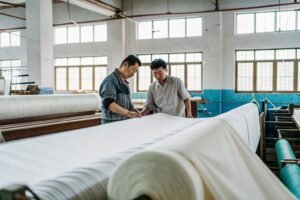
For high-end fashion brands, the difference isn’t just in the design—it’s in the fabric’s story. Your customers demand luxury that’s not only beautiful but also responsible and safe. They’re asking hard questions about sourcing, and they expect clear answers. If you can’t provide proof of your materials’ safety and sustainability, you risk damaging the premium reputation you’ve built. It’s a quiet crisis happening in boardrooms and design studios.
So, is the China Compulsory Certification (CMIA) for textiles essential? For brands targeting discerning global markets, the answer is increasingly a strategic ‘yes.’ While not a global mandate like some eco-labels, CMIA certification acts as a critical passport for your fabrics within China and a powerful trust signal for your brand story. It’s your demonstrable commitment to meeting rigorous, government-backed safety standards on formaldehyde, pH, colorfastness, and harmful substances. Think of it as a foundational layer of credibility in a market where claims are many, but proof is precious. At Shanghai Fumao, navigating these certifications is part of our daily fabric development process, ensuring our partners’ materials are as compliant as they are exquisite.
This article will unravel the CMIA puzzle. We’ll explore its practical impact on your supply chain, weigh it against other global standards, and provide a clear roadmap for deciding if and how it fits into your high-end strategy. Let’s weave through the compliance landscape together.
What Exactly is CMIA Certification and What Does It Test?
You might see “CMIA” on a spec sheet and wonder if it’s just another bureaucratic hurdle. It’s not. It’s China’s mandatory gatekeeper for textile safety, and understanding its mechanics is your first step to leveraging it. For a high-end brand, this isn’t about mere compliance; it’s about understanding the baseline of material integrity for your products entering or sourced from the world’s largest textile ecosystem.
In essence, the China Compulsory Certification (CMIA) is a government-imposed system that requires specific products, including many textile categories, to pass stringent safety tests before they can be sold, imported, or distributed in the Chinese market. The scope covers items from infant wear to adult clothing and home textiles. The core of CMIA is its testing protocol, which rigorously examines four critical safety parameters that directly impact consumer health and product longevity. Ignoring these can lead to costly recalls and brand damage, something no premium label can afford.

How Do CMIA Tests Protect Your Brand from Quality Failures?
The CMIA testing suite is designed to catch failures that erode consumer trust. Let’s break down the key tests:
- Formaldehyde Content: This is a major red flag. High formaldehyde, often used in anti-wrinkle finishes, can cause skin irritation and respiratory issues. CMIA sets strict limits, especially for infant wear. We had a client in 2023, a Swedish children’s wear brand, who sourced jersey fabric from an uncertified mill. Their own post-production testing detected borderline formaldehyde levels. They had to hold the entire production run, incurring massive delays. When they switched to using our CMIA-pre-tested organic cotton jersey from Shanghai Fumao, their clearance process became seamless.
- pH Value: Fabric that is too acidic or alkaline can disrupt the skin’s natural balance, causing irritation. CMIA ensures the fabric is in a skin-friendly neutral range after all dyeing and finishing processes. This is non-negotiable for luxury loungewear and high-touch apparel.
- Colorfastness: This tests how well dye resists fading or bleeding due to washing, perspiration, and rubbing. For a high-end brand, a $500 cashmere blend sweater that dyes a customer’s skin or other clothes is a disaster. CMIA’s colorfastness standards help prevent this. (Here’s a tip from our QC floor: achieving excellent colorfastness on deep shades like burgundy often requires specific dyeing cycles and premium fixatives—it’s not just about the dye itself.)
- Presence of Harmful Substances: This includes banned aromatic amines from certain azo dyes, which can be carcinogenic. CMIA screening is a vital barrier against these.
Think of CMIA as your factory’s essential pre-shipment inspection for fabric safety. While you may still conduct your own audits, CMIA provides a government-recognized first line of defense.
Can CMIA Certification Streamline Your China Sourcing Logistics?
Absolutely. Beyond safety, CMIA has a direct, practical impact on your supply chain fluidity. Consider it a logistical facilitator.
First, if your finished goods are destined for retail in China—a growing market for many international luxury brands—CMIA certification is not optional; it’s the law. Customs will require it for clearance. Without it, your shipment can be held, rejected, or even destroyed.
Second, even if your final market is the US or EU, sourcing CMIA-certified fabrics from your Chinese supplier acts as a powerful risk mitigation tool. It means the raw material has already passed a tough, standardized check. This reduces the chance of late-stage failures in your own compliance tests. I recall a case from late 2022 with a Los Angeles-based contemporary brand. They were sourcing a complex performance woven fabric with moisture-wicking properties. Their previous supplier’s fabric failed a heavy metal content test during their third-party inspection, stalling production for weeks. We provided the same fabric with pre-existing CMIA and OEKO-TEX reports. Their comment was simple: "It just moved faster." The takeaway? Certification simplifies the complex process of managing international textile compliance.
How Does CMIA Compare to OEKO-TEX and GOTS?
Navigating the alphabet soup of textile certifications can be dizzying. CMIA, OEKO-TEX, GOTS—they all signal safety, but they play different roles in your brand’s story. Choosing the right one depends on your customer’s priorities and your brand’s promise. Getting this wrong means either overpaying for unnecessary credentials or missing a key trust signal for your market.
CMIA is the legal baseline for China. Its primary focus is consumer safety, pure and simple. OEKO-TEX Standard 100, particularly the more demanding product classes (like Class I for infants), is a globally recognized, voluntary safety standard that often has even stricter limits on substances than CMIA. It’s a badge of honor for brands selling worldwide. GOTS (Global Organic Textile Standard) is a holistic sustainability standard. It starts with organic fiber sourcing and covers the entire environmental and social process, including safety criteria. For a brand built on an organic story, GOTS is core.
Here’s a quick comparison to clarify:
| Feature | CMIA (China Compulsory) | OEKO-TEX Standard 100 (Voluntary) | GOTS (Voluntary) |
|---|---|---|---|
| Primary Focus | Consumer Safety & Legal Market Access | Consumer Safety & Harmful Substances | Organic Origin & Full Process Sustainability |
| Geographic Scope | Mandatory for China market access | Global recognition & trust signal | Global recognition for organic claims |
| Testing Emphasis | Formaldehyde, pH, Colorfastness, Azo Dyes | Extensive list of 100+ harmful substances (varies by class) | Includes safety, plus environmental & social criteria |
| Best For | Brands selling in China or using Chinese mills | Brands wanting a strong, global safety credential for marketing | Brands committed to organic fibers and ethical production |

Is OEKO-TEX a Stronger Marketing Tool Than CMIA?
For a high-end brand selling in Milan, New York, or Tokyo, the answer is usually yes. OEKO-TEX carries immense consumer recognition in Western markets. It’s a label your customers may actively look for. CMIA, while rigorous, lacks that direct marketing cachet outside of China. However, the smart play isn’t to choose one. The most robust approach is to use CMIA as your supply chain assurance tool and OEKO-TEX as your consumer-facing marketing tool. They work in tandem.
For instance, we develop many of our Tencel™ blends and high-end linens to pass both standards simultaneously. This dual compliance gives our partners, like a prominent Australian resort wear brand we work with, the internal confidence in material safety (via CMIA) and the powerful label they can stitch into their garments (via OEKO-TEX). It’s about covering all bases. If you’re unsure how to start, resources like the comprehensive guide to understanding OEKO-TEX certification classes on platforms like Textile Exchange can be very helpful before speaking with your supplier.
When Should a High-End Brand Prioritize GOTS Over CMIA?
This decision comes down to your brand’s core values. If your label is built on a foundation of environmental stewardship, organic farming, and full supply chain transparency, then GOTS is non-negotiable and far more comprehensive than CMIA’s safety-only scope. CMIA would be just a tiny, almost automatic, box to tick within the GOTS framework.
Prioritize GOTS if your collections are centered on organic cotton, recycled materials, or bamboo silk (BAMSILK) and you market this story aggressively. The GOTS logo on your hangtag is a direct conversation with your eco-conscious consumer. CMIA would be an underlying requirement for any production happening in China, but it wouldn’t be your lead message. Remember, GOTS certification also audits social criteria like fair wages and working conditions, which aligns with the broader values of many luxury houses. For a deep dive into implementing these standards, exploring forums dedicated to sustainable fashion sourcing and ethical manufacturing practices can provide real-world insights from other brands.
What Are the Real Costs and Timeline for CMIA Certification?
Let’s talk brass tacks. “Essential” also needs to be “feasible.” The cost and time for CMIA certification are practical concerns that directly affect your margins and calendar. The good news? For a prepared supplier, it’s a streamlined process. The bad news? If your factory treats it as an afterthought, it can derail your timeline.
The certification is applied to a specific product type or style, not a blanket for the whole factory. Costs are influenced by the number of fabric components (e.g., shell, lining, trim), colors, and the complexity of the tests. As a ballpark, certification for a standard woven fabric in one colorway might range from a few hundred to over a thousand dollars. This investment, however, is often offset by the avoidance of far greater costs: shipment rejections at customs or, worse, a product recall.
The timeline typically takes 4-6 weeks from sample submission to certificate issuance. This includes laboratory testing and administrative review. This is why planning is crucial. At Shanghai Fumao, we integrate this into our development schedule. For example, when a UK-based athleisure brand approached us in Q1 2024 for a new antibacterial and moisture-wicking polyester fabric, we factored the CMIA and functional testing timeline into our 48-hour sampling promise. We presented them with a certified prototype and a clear bulk production schedule, locking in their order ahead of their competitors.

How Can You Avoid Delays in the CMIA Certification Process?
Delays usually stem from failure and resubmission. The key is front-loading the work. Here’s our proven method:
- Pre-Test with Your Supplier: Before submitting for the official certification, work with your supplier to conduct identical tests in their internal or partner lab. Our CNAS-accredited lab does this routinely. We won’t send a fabric for formal CMIA testing until it clears our own pre-screening. This step alone saves 3-4 weeks of back-and-forth.
- Standardize Your Inputs: Variations in dye batches or finishing chemicals can cause results to fluctuate. Use standardized, certified-safe dyes and auxiliaries. We maintain a list of approved chemicals for our dyeing partners to ensure consistency.
- Understand Fabric-Specific Risks: Some fabrics are trickier. Dark, rich colors (navy, black, red) are more prone to colorfastness issues. Fabrics with special finishes (water-repellent, wrinkle-free) need careful chemical selection to keep formaldehyde in check. Knowing these pain points allows for proactive adjustment.
Managing these steps effectively is part of building a resilient textile supply chain for fashion brands. It turns certification from a hurdle into a routine checkpoint.
Is CMIA Certification Cost-Effective for Small-Batch Luxury Production?
This is a common concern. For a small batch of 500 meters, the fixed cost of certification can seem high per meter. However, for high-end production, this cost is often a negligible percentage of the total garment’s selling price and is justified by risk mitigation.
Consider the alternative: producing 500 units of a $800 dress, only to have the entire batch flagged at port or, worse, cause a skin reaction in a high-profile client. The financial and reputational loss is catastrophic. For small batches, the certification cost is an insurance premium.
The strategic approach is to certify the fabric prototype before bulk production. Once the fabric composition, dye, and process are locked in and certified, you can produce multiple small batches under that same certificate, amortizing the cost. We guide our boutique and startup clients through this model all the time, making top-tier compliance accessible even for limited runs.
How to Verify and Work with a CMIA-Certified Supplier?
Finding a supplier who claims to have CMIA capability is easy. Verifying that they have a systematic, reliable process is where the real work begins. Your due diligence here protects your entire investment. A certificate is a piece of paper; a certified process is what delivers peace of mind.
Start by asking for more than just a certificate. Request to see test reports for similar fabrics they have produced. Look for the official seal and the unique certificate number issued by a Chinese certification body (CQC is a major one). Then, go a step further: ask about their internal quality control protocol for ensuring CMIA compliance. Do they pre-test? Do they audit their dyeing and finishing houses? Their answers will separate the true experts from the box-tickers.
A telling sign is a supplier’s familiarity with other standards. A partner who understands the nuances between CMIA, OEKO-TEX, and REACH compliance for exporting textiles to the European Union is likely managing a sophisticated compliance program. This was evident when we partnered with a German functional wear brand. Their audit didn’t just ask for our certificates; they interviewed our lab manager and reviewed our chemical inventory management system. They weren’t buying fabric; they were buying a system.

What Red Flags Should You Look For During Supplier Audits?
Watch out for these warning signs during your evaluation:
- Vagueness: If they can’t immediately explain which of their fabrics are typically certified or what the process entails, be cautious.
- The "One-Size-Fits-All" Certificate: A certificate is product-specific. If a supplier shows you a generic factory certificate or a certificate for a completely different fabric type (e.g., showing a cotton poplin cert for a polyester blend), it’s a major red flag.
- No Internal Lab or Partnership: Reliance solely on third-party testing for every batch, with no internal QC, indicates a reactive, not proactive, approach. It leads to longer lead times and higher risk of batch failure.
- Unrealistically Low Price: High-quality, safe dyes and responsible chemical management cost money. A quote that seems too good to be true often means corners are being cut in the dyeing and finishing process, which is where CMIA compliance is won or lost.
How to Integrate CMIA Compliance into Your Tech Pack and Orders?
Make certification a formal, non-negotiable part of your sourcing documents. Don’t leave it as a verbal agreement.
- In Your Tech Pack: Include a dedicated section for "Compliance & Certification." Clearly state: "Fabric must comply with and be certified for China Compulsory Certification (CMIA) GB standards. A valid certificate and test report must be provided prior to fabric shipment for bulk production."
- In Your Purchase Order (PO): List CMIA certification as a condition of sale. Specify that the certificate and full test report are required delivery documents, alongside the commercial invoice and packing list.
- Schedule a Pre-Production Test: Plan and pay for a pre-production sample to be officially tested. Confirm compliance before the bulk dye lot is made. This is standard practice for our partners at Shanghai Fumao, and it’s the single most effective way to ensure a smooth production run. For more on structuring these critical documents, industry resources like the Fashion Incubator’s guide to creating bulletproof tech packs offer excellent foundational advice.
Conclusion
Navigating the world of textile certifications is a definitive part of modern high-end fashion sourcing. While CMIA may not be a glamorous marketing term like "organic" or "OEKO-TEX," its role is fundamentally strategic. For brands producing in or selling to China, it is an essential legal requirement. For all brands using Chinese textile expertise, it serves as a critical pillar of supply chain risk management—a verified assurance of material safety that protects your brand from the inside out.
The journey isn’t about chasing every certificate, but about intelligently layering the right ones to build an unshakeable foundation of quality and trust. CMIA provides the baseline safety assurance, OEKO-TEX amplifies your consumer-facing credibility, and GOTS champions your sustainability narrative. The most successful brands we see are those that understand this ecosystem and partner with suppliers who can navigate it seamlessly.
If you’re looking to streamline your fabric sourcing with a partner who treats compliance not as an obstacle but as an integral part of quality craftsmanship, let’s connect. At Shanghai Fumao, we build these safeguards into every meter of fabric, from our eco-friendly innovations to our high-performance textiles. To discuss how we can help you produce your next collection with confidence, reach out to our Business Director, Elaine. She can guide you through our capabilities and how we tailor our end-to-end fabric solutions to meet your brand’s specific needs. You can contact her directly at elaine@fumaoclothing.com to start the conversation.