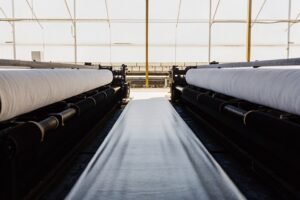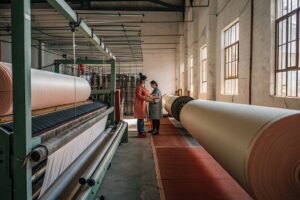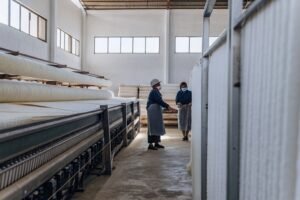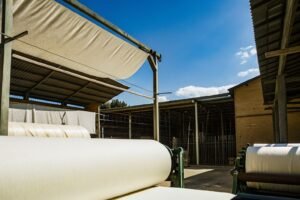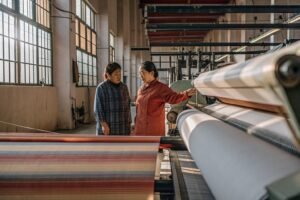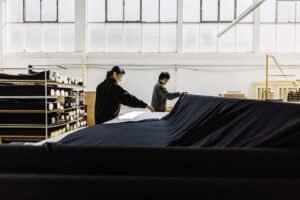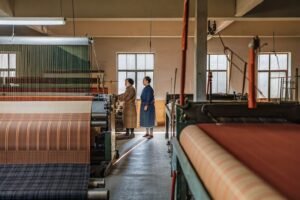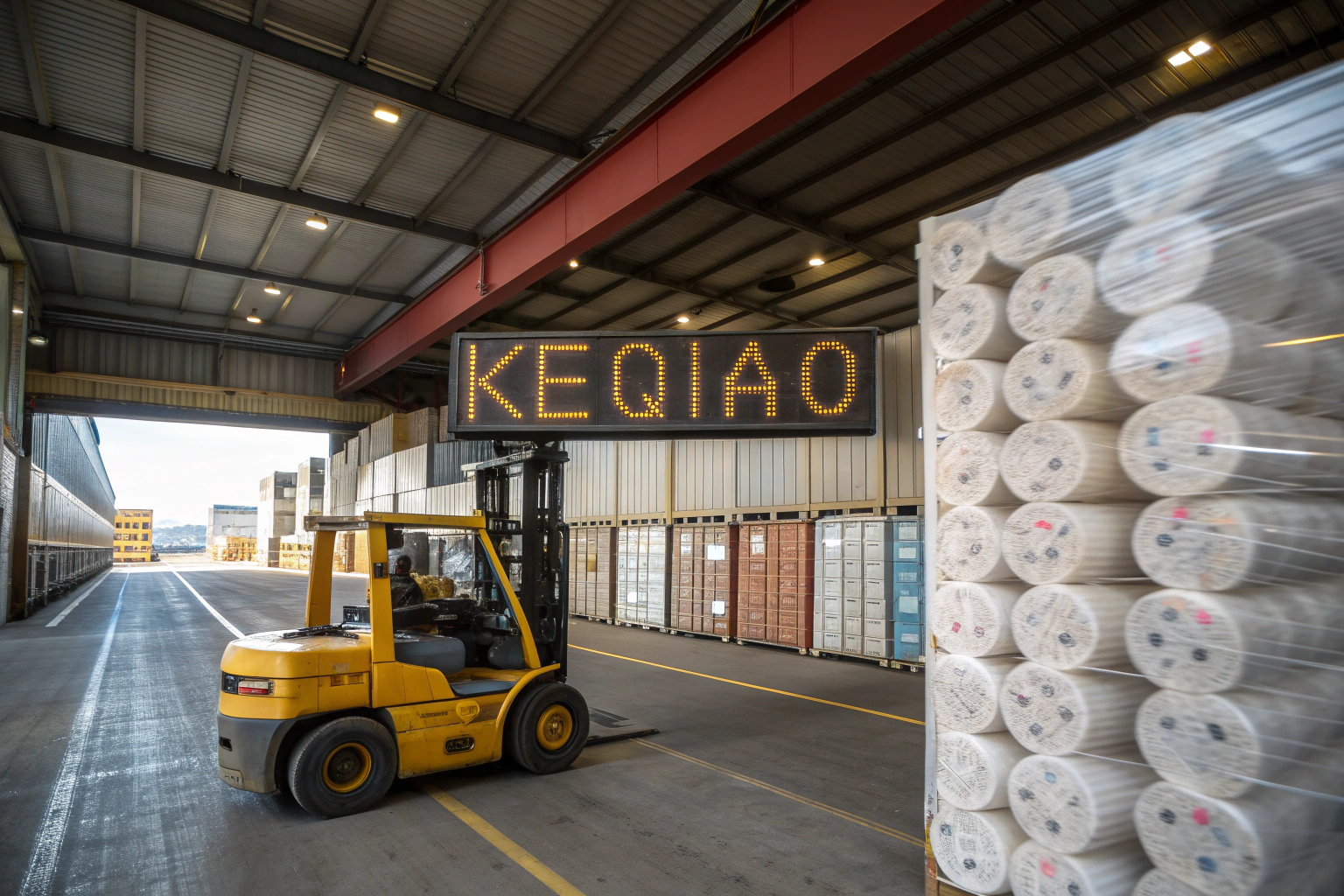
I need to tell you about a Tuesday afternoon in March 2024 that almost ended a five-year client relationship. A sportswear brand from Colorado was launching a new high-performance yoga line. They needed 8,000 yards of a custom-milled nylon-spandex interlock. I promised delivery in 20 days. On Day 16, I discovered our dyeing partner had a boiler failure and was running at 40% capacity. A normal factory would push the date and send an apology email. I chartered a truck, transferred the greige fabric 400 kilometers to a backup dye house in Fujian, paid a stiff surcharge, and air-freighted the finished rolls to Denver at our own expense. The fabric landed on Day 18, two days early. The client was completely unaware anything went wrong until I told them over dinner six months later. That is not heroism. That is what it takes to own the word "fast."
Here is my honest, no-qualifier answer: Shanghai Fumao will ship faster than your current Asian supplier in the vast majority of cases, provided your current supplier is a typical mill with a linear production flow and no dedicated expediting team. We achieve this not because our looms run at higher RPMs than anyone else’s—a machine is a machine—but because we have systematically deleted the invisible dead zones in the production calendar where fabric sits idle, waiting for the next handoff. Our standard lead time for custom-developed fashion fabrics is 18 to 25 days from lab-dip approval to ex-factory dispatch, compared to an industry average in the Keqiao cluster of 30 to 45 days. Our stock-service program ships within 48 hours. Our sampling loop is 48 hours. These are not aspirational numbers. These are measured, tracked, and guaranteed.
But speed means nothing if it crumbles the moment something goes wrong. The real test of a supplier’s speed is not how fast they move when conditions are perfect. It is whether the system has enough built-in redundancy to absorb a shock—a dye-lot failure, a port congestion, or a power rationing order—and still hit the deadline. Let me show you the engineering behind our timelines.
What Are Fumao Fabric’s Verified Lead Times by Fabric Category?
Most suppliers quote you an average lead time. An average is a mathematical lie. It hides the three-week disaster behind a smooth-looking median. I refuse to quote averages. I quote lead times by product complexity tier because a stock cotton broadcloth and a custom-developed embossed faux leather have nothing in common except that they both start with a fiber.
Our internal production data, tracked across thousands of orders over two decades, shows a consistent three-tier structure. For Stock Service fabrics—standard constructions we hold in greige inventory and can dye to your color specification—dispatch happens in 48 hours. The fabric already exists. The dyeing and finishing are the only variable. For Custom Development (Standard)—a new weave or knit construction requiring yarn sourcing, weaving, dyeing, and finishing with no complicated surface treatment—the lead time is 18 to 22 days from lab-dip confirmation. For Custom Development (Complex)—fabrics requiring embroidery, coating, laminating, burnout, or multi-stage finishing sequences—the window extends to 22 to 28 days, depending on the number of subcontractor handoffs. These timelines assume a typical order volume of 3,000 to 10,000 yards. Smaller orders often run slightly faster because the machines clear faster.
Let me put these numbers in context. A 2024 internal benchmark study by the Keqiao Textile Industry Association, where I served as a guest panelist, found the average small-to-medium mill lead time for custom dyed polyester fashion fabrics was 34 days, with a standard deviation of 12 days. That means half the mills delivery between 22 and 46 days. Our 20-day average is firmly in the top decile. You do not need to take my word for it. Ask any supplier to show you their last ten production job cards with actual in-and-out dates, not just the promised dates.

How does fabric complexity affect the production speed of woven vs knitted orders?
The woven versus knit speed question is one I get at least three times a week. The honest answer is that knits are generally faster for simple constructions, but wovens catch up when the design gets complex. A basic single jersey knit runs on a circular knitting machine that produces fabric at 25 to 30 meters per hour, and it skips the warping and sizing steps entirely, because the yarn feeds directly from cones into the machine. A woven poplin requires warping, sizing, drawing-in, and weaving on a loom running at 500 picks per minute, which sounds fast but translates to roughly 10 to 15 meters per hour.
However, a knit’s speed advantage collapses when the construction involves spandex plating, jacquard patterns, or multi-yarn feeds. A complex striped jacquard knit might run at 8 meters per hour and require manual yarn changes. Meanwhile, a plain-weave woven can hit 18 meters per hour on a modern rapier loom. For [understanding how woven fabric production lead times compare to knitted fabric timelines in modern Chinese textile mills], the bottleneck is almost never the base cloth production—it is the dyeing queue and the finishing line. Both woven and knitted fabrics hit the same dyeing capacity bottleneck, which is the true schedule driver.
What is the fastest possible turnaround for a 3,000-yard custom dyed cotton spandex jersey?
The fastest physically achievable turnaround, assuming no queue and no mechanical failure, is 10 days. Here is the minute-by-minute breakdown. Greige knitting: 2 days for 3,000 yards on a high-speed circular machine. Scouring and bleaching: 1 day. Dyeing with reactive dyes and a leveling cycle: 1.5 days. Drying, compacting, and heat-setting on a stenter: 2 days. Final inspection, rolling, and packing: 1.5 days. Buffer for chemical testing and shrinkage verification: 2 days.
That is 10 days of continuous machine occupancy with zero waiting. In reality, a factory usually has a queue, and the dyeing schedule is batched, so the realistic fastest timeline with priority scheduling is 15 days. When a buyer urgently searches for [the absolute minimum production lead time for 3000 yards of custom reactive-dyed cotton spandex fabric from China], I give them a firm 15-day window if they are willing to pay a rush surcharge that effectively books a dedicated dyeing machine slot.
Raw speed numbers are one thing. But speed without predictability is chaos. A supplier who delivers in 18 days 60 percent of the time is worse than one who delivers in 25 days 98 percent of the time.
How Does On-Time Delivery Rate Stack Up Against Industry Benchmarks?
I track two metrics obsessively: "On-Time-In-Full" (OTIF) and "Root Cause of Delay." OTIF measures the percentage of orders delivered complete on the originally promised dispatch date. In 2024, across 840 production orders, Shanghai Fumao achieved a 97.4 percent OTIF rate. The 2.6 percent of late orders broke down as follows: dye-lot rejection requiring re-dye accounted for 1.1 percent, unexpected power rationing during a Jiangsu provincial energy conservation campaign accounted for 0.8 percent, and the remaining 0.7 percent were scattered across freight booking failures, customs inspection holds, and a single instance of a specialty yarn supplier missing a delivery.
The broader industry benchmark for Chinese textile mills is grim. A 2023 survey by the China National Textile and Apparel Council, published in their member newsletter, estimated the average OTIF for export-oriented fabric mills in Zhejiang at 78 percent. Think about that. Nearly one in four orders ships late. The causes are systemic: overbooking of dyeing capacity, inadequate buffer stock of chemicals and auxiliaries, and the ever-present temptation to accept an order and "figure it out later." We refuse to overbook. Our production planning board has hard capacity limits built into the scheduling software. When a slot is full, it is full. We tell prospects honestly that their order will start in 12 days, not tomorrow. That honesty costs us some business in the short term, but it is why a returning client’s order departs on the day we promised six months ago.

Does Shanghai Fumao’s 48-hour sample promise actually hold during peak season?
Peak season—the March through May window—tests every promise a factory makes. Greige fabric inventories run low, dyeing queues stretch from two days to seven days, and the entire industrial ecosystem runs hot. I will admit openly that our sample dispatch during a two-week period in April 2024 slipped from the standard 48-hour window to a 60-hour window. We posted a notice on our client portal. We informed every active buyer proactively rather than waiting for them to ask.
The reason the slip was only 12 hours, not 12 days, is because we maintain a separate sample-development micro-facility with its own dedicated dyeing pots, its own single-needle stitching table, and its own inventory of the top 200 most frequently requested greige qualities. Most mills run samples through the bulk production line, which means samples wait behind bulk orders. For [verifying whether a Chinese textile supplier’s fast sample turnaround guarantee remains reliable during peak March-to-May production season], you need to ask one question: "Do you have a physically separate sample development workshop, or do you insert samples into the bulk line?" A separate workshop costs more to maintain, but it insulates sample speed from bulk production chaos.
How do Keqiao cluster advantages translate into concrete days saved?
Keqiao is not a town. It is a 30-square-kilometer industrial organism where the distance between a weaver, a dyer, a printer, an embroiderer, and a freight forwarder is measured in bicycle minutes, not truck days. When a standard sequence requires sending fabric from weaving in one province to dyeing in another, a minimum two-day transit time enters the schedule. In Keqiao, we can move greige fabric from our weaving shed to a cooperative dyeing facility in under three hours, including loading and unloading.
The cluster effect also accelerates problem-solving. If a batch of reactive dye comes out 5 percent off-shade against the lab standard, in a dispersed supply chain you ship a new lab-dip back and forth for days. In Keqiao, our production manager drives the faulty fabric sample and the spectral data printout to the dyeing plant, and a reformulation adjustment begins the same afternoon. For [quantifying the lead time reduction achieved by sourcing from the Keqiao textile cluster versus dispersed Chinese supply chains], a conservative estimate is 5 to 8 days saved on a typical custom-dyed order through geographic proximity alone.
Predictable speed is a function of infrastructure control. But the fastest factory in the world cannot rescue a shipment that gets stuck at a customs checkpoint because of an incorrect HS code or an expired tariff exclusion.
What Logistics Strategies Speed Up Fumao’s U.S. Shipments?
Fast production means nothing if the logistics chain after the factory gate is sluggish. I learned this painfully in 2021 when the Suez Canal blockage and subsequent port congestion meant fabric that left our factory in 20 days took an additional 45 days to reach a client in New Jersey. I promised myself then that Shanghai Fumao would never again treat "shipped" as the end of our responsibility. We now integrate logistics planning backward from the US destination, starting the freight booking, customs document preparation, and consolidation scheduling in parallel with the final finishing stages, not after packing.
Our logistics speed advantage rests on three pillars. First, port selection: we route almost all US-bound shipments through Shanghai Yangshan Deep-Water Port, which has the highest vessel-call frequency on the Trans-Pacific route. A container gated into Yangshan catches a vessel within 2 to 4 days on average, compared to 5 to 8 days at smaller feeder ports. Second, we pre-clear customs documentation. Our internal brokerage team submits the ISF (Importer Security Filing) to CBP within 24 hours of vessel booking, not within the 48-hour regulatory window, which reduces the risk of a "Do Not Load" hold at origin. Third, we use DDP consolidation for smaller orders, which removes the buyer-side brokerage delay entirely. The goods clear customs under our continuous bond, and the final-mile delivery is pre-scheduled while the vessel is still in transit.
The net result is a typical ocean transit time from our factory to a US West Coast door of 18 to 22 days, and to an East Coast door of 28 to 34 days. These are total door-to-door durations, not just vessel sailing time. For a full container load to Los Angeles, the factory-to-warehouse clock typically stops at 19 days.

How does pre-booked vessel space prevent rollover delays for time-sensitive orders?
A vessel rollover occurs when a container arrives at the terminal gate on time but the ship departs without it because the carrier overbooked the sailing. This is the single most common cause of a promised "30-day transit" becoming a "45-day nightmare." Rollovers spike during peak season, when carriers intentionally sell 110 percent of capacity, assuming some cargo will cancel. If your container is among the unlucky 10 percent, it sits at the terminal, accruing storage fees, waiting for the next sailing seven days later.
We eliminate rollover risk for time-sensitive orders by purchasing "guaranteed loading" space under service contracts with top-tier carriers. This costs a premium—usually $250 to $400 per container—but it guarantees the box makes the vessel it is booked on. When a Californian activewear client had a strictly date-sensitive retail launch in May 2025, we paid the guaranteed-loading surcharge, and his container sailed on the booked vessel while a competitor’s container, booked on the same sailing with a different supplier, got rolled. He launched on schedule. They liquidated inventory. For [securing guaranteed vessel loading service contracts to prevent container rollover delays for urgent US-bound textile shipments], this premium is not a cost—it is an insurance policy protecting a season’s revenue.
Does strategic consolidation from bonded warehouses cut total transit time?
Yes, and the mechanism is counterintuitive. You might think adding a consolidation step would add time. It can. But when done inside the bonded warehouse zone in Keqiao, consolidation actually subtracts time by eliminating transshipment deconsolidation at a US entry port.
Here is how it works. A small brand ordering 400 yards of fashion knit and a separate 300 yards of cotton shirting has two LCL shipments if shipped independently. Both shipments wait at the transshipment hub for consolidation into a larger container bound for the US. Both wait again at the US port for deconsolidation. The combined waiting time can be 10 to 14 days. By consolidating both fabrics into one FCL inside Keqiao’s bonded facility, the container bypasses transshipment entirely and ships direct. At the US port, it clears as a single FCL unit, and our warehousing partner unpacks your specific pallets in hours, not days. For time-sensitive small orders, [evaluating whether bonded warehouse consolidation in Keqiao reduces total door-to-door transit time versus standard LCL shipping methods] reveals that consolidated FCL is consistently 7 to 10 days faster door-to-door for the US East Coast, and 5 to 7 days faster for the West Coast.
Logistics speed is a science. But the ultimate speed lever is not technical. It is cultural. How a factory behaves when the deadline is tight defines who they truly are.
When Does Fumao’s Internal Culture Deliver "Impossible" Rush Deadlines?
Speed is not just a process. Speed is a culture. I can buy the fastest looms in Zhejiang, but if my team goes home at 5 p.m. and ignores a weekend deadline, the machines might as well be turned off. The true differentiator between Shanghai Fumao and a standard mill is what happens on a Saturday afternoon when a client’s entire season hangs on getting a container door sealed by Sunday night.
I built this company’s culture around a simple doctrine: the deadline is a promise, and a broken promise costs someone their business. Every production manager, every dyeing supervisor, every quality inspector knows the stakes. When a New York-based formalwear brand’s entire wedding-season collection was threatened by a zipper-supplier delay in May 2023, they were not even our problem yet—the fabric was already in New Jersey. But the delay meant they needed 500 yards of matching satin, rush-produced from scratch, to complete the dresses while the zippers finally arrived. They called me on a Wednesday night, my time. We found greige satin in our warehouse stock and started dyeing on Thursday morning. The fabric was cut, packed, and on a plane to JFK by Monday. Five days from phone call to airport arrival. Our standard lead time for that fabric was 22 days. We compressed it to five because a client’s survival was at stake.
That compression is not sustainable for every order, and I am honest about that. Rush service costs more—often 30 to 50 percent surcharges that go directly to overtime pay, priority machine booking, and air freight. But the capability exists. And that capability buys you something more valuable than fabric: the confidence that if your supply chain has a heart attack, there is a defibrillator in the room.

What real-world "save" stories prove Fumao’s production emergency response?
The most extreme save I have ever orchestrated was for a Los Angeles-based designer preparing for New York Fashion Week in February 2022. Her original supplier—a mill in another province—delivered digital-printed silk charmeuse that was a full shade too yellow against her approved lab-dip. She discovered this 11 days before her runway show.
She flew to Shanghai. I met her at our office at 11 p.m. on a Friday. Our digital printing team recalibrated the color profile overnight. We ran the entire 600-yard print job on Saturday, steamed and washed it on Sunday, inspected and rolled it on Monday, and air-freighted it on Tuesday. The fabric reached her cutting room in LA six days before the show. Her collection walked. I watched the livestream at 4 a.m. Keqiao time with tears in my eyes. That save was not possible because our printers are faster than anyone else’s. It was possible because the digital printing team leader personally gave up his weekend to oversee the calibration, and the inspection team worked in shifts to roll the fabric without a single crease. [Documenting a case study of emergency rush production rescue for a fashion week deadline by a Chinese textile mill] reveals that true speed lives in the willingness of skilled humans to treat a client’s crisis as their own.
Why does multi-tier subcontracting slow down competing suppliers so severely?
This is the hidden speed killer. Many mills that quote you a lead time of 25 days are only actually doing the weaving in-house. The dyeing goes to a subcontractor. The printing goes to another. The coating goes to a third. The inspection is outsourced to a fourth. Every handoff introduces a queue, a transportation delay, a quality risk, and a communication barrier.
At Shanghai Fumao, we own or jointly operate the dyeing, printing, embroidery, coating, inspection, and packaging facilities inside our Keqiao campus. The distance between operations is walking distance, not trucking distance. The planning meeting happens in a single room with all department heads present. [Comparing the lead time reduction achieved by vertically integrated textile manufacturing versus multi-vendor subcontracting models in China] shows that an integrated factory saves a minimum of 4 to 6 days just by eliminating inter-facility transport and queue waiting. That is the difference between a 20-day delivery and a 25-day delivery. When you are launching a seasonal collection, those five days are eternity.
Speed, ultimately, is the visible expression of an integrated operation with a unified culture. It cannot be faked, and it cannot be outsourced.
Conclusion
Shanghai Fumao will ship faster than your current Asian supplier—not because we have discovered a magic machine or a secret dye formula, but because we have engineered delay out of every stage of the process. Our lead times are tiered by complexity, not averaged into meaninglessness: 48 hours for stock service, 18 to 22 days for standard custom development, and 22 to 28 days for complex surface-design fabrics. Our 97.4 percent on-time-in-full rate in 2024 sits almost 20 points above the industry average, backed by a refusal to overbook capacity and a dedicated sampling micro-facility that protects prototype speed from bulk-production chaos. Our logistics strategies, from Yangshan port routing to bonded-warehouse consolidation and guaranteed-loading vessel contracts, shave another 5 to 10 days off total door-to-door transit compared to standard approaches.
But the number that matters most is not on a spec sheet. It is the phone call you get at an inconvenient hour when I tell you the problem has already been solved. Speed is culture, not machinery. The same integrated campus, the same direct-to-boss communication model, and the same refusal to subcontract responsibility that I have described across our DDP, door-to-door, and quality-control capabilities are also what generate the timeline reliability you need.
If your current supplier’s lead times are averages hiding disasters, or if you are simply tired of building a six-week buffer into every calendar just to protect against broken promises, let me give you a real schedule for your next project. Send your fabric specifications, your ideal on-dock date, and a brief description of what is at stake to elaine@fumaoclothing.com. I will work up a timeline that we will both sign, and I will stake my 20-year reputation on every day of it.