
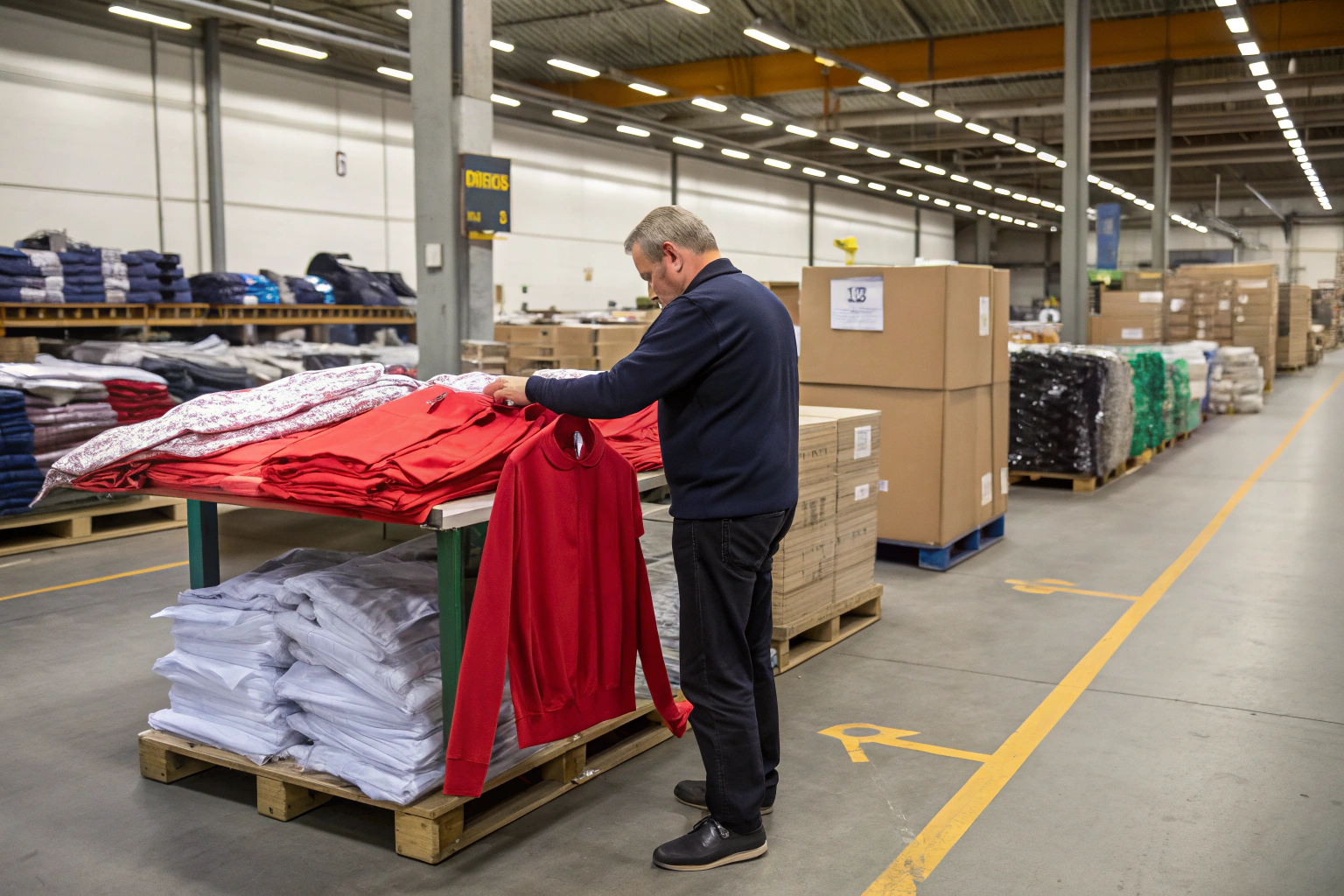
I was standing in a warehouse in Hamburg in 2019, looking at a pallet of returned jersey dresses. The distributor who had imported them, a sharp guy who moved about 200,000 garments a year, pulled one dress out of a polybag and laid it flat on the inspection table. The side seams, which were supposed to run straight down the sides of the body, had twisted. They started under the armpit where they belonged and spiraled around toward the front hem. The dress, when laid perfectly flat, looked like a corkscrew. "Every single dress in this batch does this," he said. "The retailer issued a blanket return. I am out €34,000. My supplier in Turkey says the fabric was fine when they cut it. My factory says they sewed it straight. Nobody will take responsibility. Tell me what went wrong."
I did not need to send the fabric to a lab to know what went wrong. I could see it in the way the yarns spiraled. "Spirality," I said. "Fabric torque. The yarn was twisted, the knit structure was unbalanced, and the fabric was not properly relaxed. It was a ticking time bomb the moment it left the knitting machine. Washing just triggered the explosion." He stared at me for a second and then said, "Why did no one teach me about this in fifteen years of this business?" That conversation is why I am writing this article. Fabric torque is one of the most destructive, least understood, and most preventable quality defects in knitted textiles, and distributors—the people who stand between the mill and the retailer, who own the inventory risk—are the ones who pay the price when it goes wrong.
Torque, also called spirality or skew, is the inherent tendency of a knitted fabric to twist out of its flat, orthogonal geometry and adopt a spiral distortion. It is caused by the twist liveliness of the yarn used to knit the fabric. When a yarn is spun, twist is inserted to bind the fibers together. That twist stores torsional energy. If the yarn is a single-ply yarn, that energy is unbalanced—the yarn wants to untwist itself. When thousands of these torque-laden yarns are formed into knit loops and the fabric is washed, the loops rotate to release the stored twist energy, and the entire fabric panel twists into a spiral. The result is a garment that looks like the side seams were sewn by someone who had lost a fight with a hurricane. For a distributor, spirality means chargebacks from retailers, return logistics costs, inventory write-offs, and the slow erosion of trust with the retail buyers who control access to the shelf. It is, in my experience, the single most common preventable defect that nobody talks about until it is too late.
What Exactly Is Knit Fabric Torque and How Is It Measured?
Fabric torque, in technical terms, is the residual torsional stress within a knitted structure that causes the fabric to skew or spiral when it is relaxed, washed, or allowed to rest in a tension-free state. It is quantified as the angle of spirality, measured in degrees, between the direction of the wales (the vertical columns of knit loops) and a line drawn perpendicular to the fabric’s cut edge. A perfectly balanced, torque-free fabric will have a spirality angle of 0 degrees—the wales run exactly at 90 degrees to the cut edge. A moderately skewed fabric might read 5 to 8 degrees. A severely skewed fabric, the kind that triggers a retailer rejection, will read 12 to 20 degrees, and the distortion is immediately visible to the naked eye.
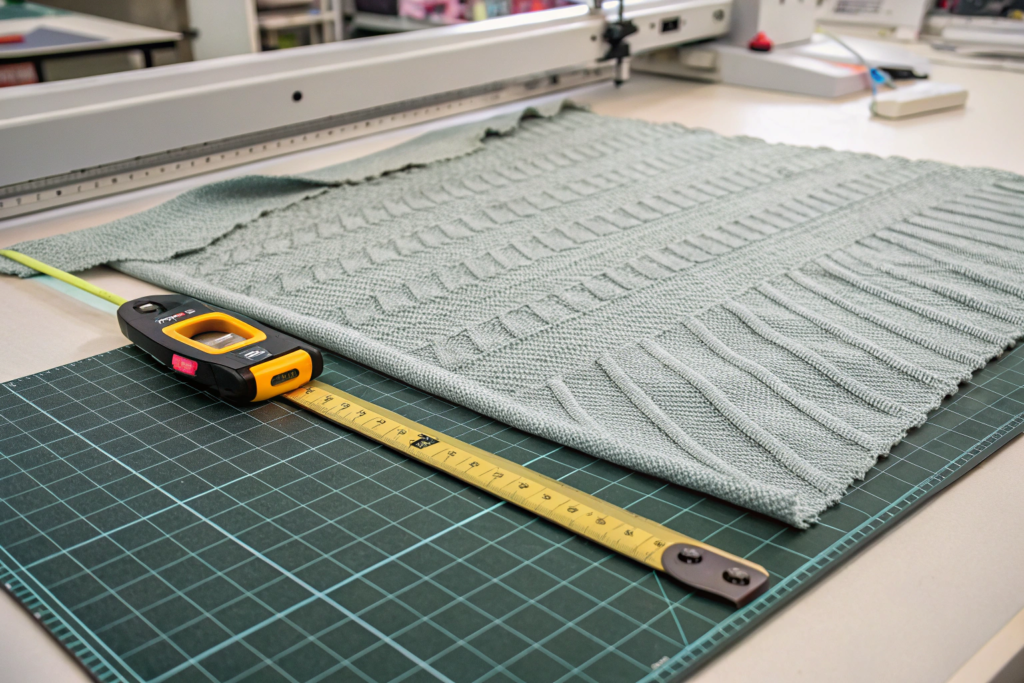
The measurement is standardized under ASTM D3882 or ISO 16322-2, both of which specify the procedure for determining fabric skew and bow in woven and knitted fabrics. The fabric specimen is conditioned in a relaxed state for a minimum of four hours at standard atmosphere, laid flat on a smooth grid-marked table, and the angle between the wale line and the perpendicular to the cut edge is measured using a protractor, a digital angle finder, or the grid marks cast onto the fabric surface. The measurement is taken at multiple points across the fabric width—left, center, and right—because torque can vary across the width if the knitting machine had uneven yarn tension from one feed to another. The average spirality angle is reported, along with the direction of the skew, designated as S-skew (wales tilt to the left, forming an S shape when viewed from the top) or Z-skew (wales tilt to the right, forming a Z shape). The direction correlates directly with the twist direction of the yarn used—an S-twist yarn produces Z-skew, and a Z-twist yarn produces S-skew, because the fabric skews in the opposite direction as it releases the twist energy.
How Does Yarn Twist Liveliness Create the Corkscrew Effect in Single Jersey?
Single jersey is the most common knit structure on the planet—t-shirts, dresses, underwear, bedsheets, all single jersey—and it is also the most vulnerable to torque. The vulnerability is structural. Single jersey is an unbalanced knit. The face of the fabric shows the smooth V-shaped knit loops, and the back shows the purl side. The yarn path through the knit loop is asymmetrical; the yarn enters the loop from one angle, forms the loop, and exits at a different angle. This asymmetrical loop geometry, combined with a torque-active, single-ply yarn, creates a perfect engine for spirality.
When a single-ply yarn is spun, twist is inserted in one direction—say, Z-twist, which is the most common direction for ring-spun cotton. The fibers are helically wound around the yarn axis, and they are held in that twisted state by inter-fiber friction. The twist is mechanically stable as long as the yarn is under tension. But when the yarn is knitted into a fabric, the tension is released, and the twist energy is only partially restrained by the interlocking of the knit loops. When the fabric is wetted—during dyeing, finishing, or the consumer’s first wash—the water acts as a lubricant, reducing the inter-fiber friction. The fibers slide against each other, the twist partially relaxes, and the yarn untwists slightly. This untwisting rotation is transmitted through every loop in the fabric, and because the single jersey structure is unbalanced, the rotational force is not opposed by an equal and opposite force. The loops rotate, the wales tilt, and the fabric spirals. The effect is most dramatic in single-ply, ring-spun yarns with high twist levels, and in fabrics with a low stitch density that provide less structural resistance to loop rotation.
What Is the Acceptable Spirality Angle Before a Garment Looks Defective?
The human eye is remarkably sensitive to geometric distortion in clothing. We expect side seams to run vertically, parallel to the body’s centerline. When a side seam deviates from vertical by more than a few degrees, the brain registers it as "wrong," even if the consumer cannot articulate why. The generally accepted industry threshold for visible spirality in a finished garment is 5 degrees of wale skew from the perpendicular. Below 3 degrees, even a trained inspector has difficulty detecting the skew. Between 3 and 5 degrees, a careful consumer might notice that something is slightly off, but the garment is usually still saleable. Above 5 degrees, the skew is clearly visible, and the garment will be perceived as defective by most consumers.
For distributors supplying quality-sensitive retailers—department stores, premium brands, uniform programs—the acceptable limit is tighter: 3 degrees maximum in the finished garment. For mass-market and promotional product where the price point is low and the consumer expectation is correspondingly lower, the limit can be stretched to 5 degrees. But I advise my clients to treat 5 degrees as a hard ceiling regardless of price point. The risk of returns and brand damage above 5 degrees is simply too high. I test spirality at the fabric stage, after wet relaxation but before cutting, and my internal rejection limit is 3 degrees for any fabric destined for a premium garment. If a fabric measures above 3 degrees at the post-dyeing inspection, it is either re-processed through a mechanical compacting line to physically realign the wales, or it is rejected and re-knitted with a balanced yarn.
Why Do Single-Ply Yarns and Compact Spinning Cause Hidden Torque Problems?
Single-ply yarns are the default choice for a huge volume of knitted apparel because they are cheaper to produce than two-ply yarns and they produce a softer, loftier fabric with better cover. The problem is that a single-ply yarn is fundamentally unbalanced in its torsional structure. When a single strand of fibers is twisted into a yarn, the twist runs in one direction only—either S or Z. The yarn, left to its own devices in a relaxed, un-tensioned state, will twist back on itself, forming snarls and kinks. This is why a single-ply yarn will snarl into a tangled mess if you pull a length from a cone and let it go slack. The yarn is alive with stored torsional energy. When that yarn is knitted into a fabric, the energy is still there, temporarily locked in the interlocking loop structure. Wet finishing releases it, and the fabric spirals.
Compact spinning, a modern spinning technology that produces a denser, less hairy yarn by condensing the fiber strand before twist insertion, introduces a secondary torque problem that is less well-known. Compact yarns have higher fiber-to-fiber friction because the fibers are more parallel and more densely packed. This higher friction means the twist is more effectively locked into the yarn structure and less likely to relax during spinning and winding. That sounds like an advantage, and for yarn strength and hairiness, it is. But for torque, it means the yarn retains more of its original twist liveliness and delivers it, intact, to the knitting machine. When the fabric is wetted, the lubricated fibers finally release that stored energy, and the torque manifests. A fabric knitted from compact-spun single-ply yarn can have a higher spirality potential than a fabric knitted from an equivalent ring-spun single-ply yarn, because the ring-spun yarn may have partially relaxed its twist through natural fiber migration and "dead" fiber segments, whereas the compact yarn has preserved its twist energy like a coiled spring.
Why Does a Cheaper Single-Ply Cotton Cause More Distribution Headaches Than Two-Ply?
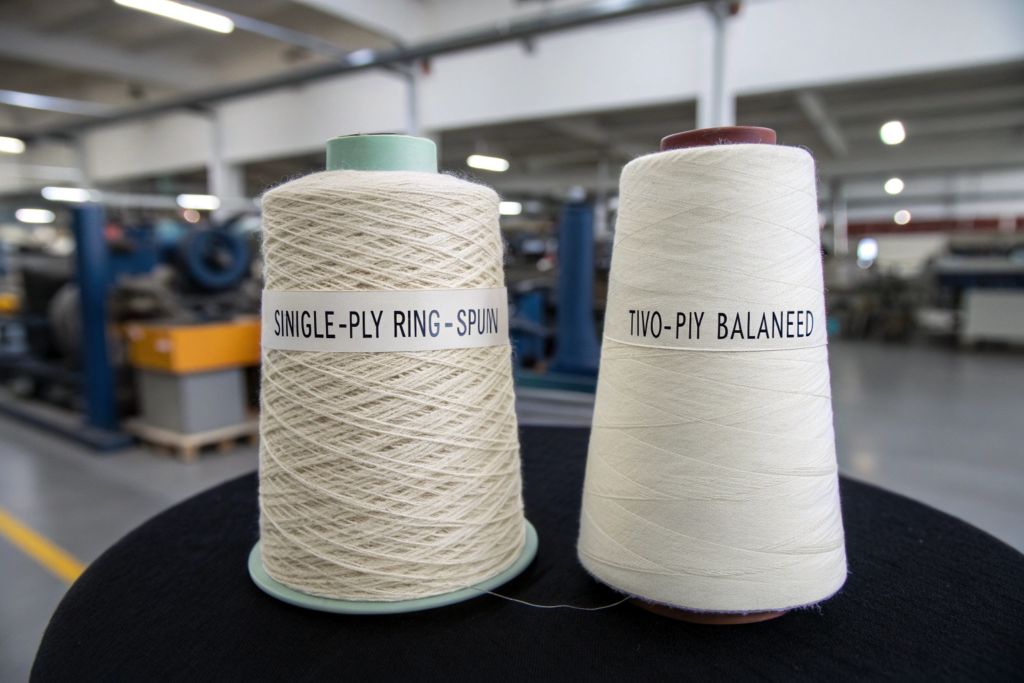
The answer is economics metastasizing into quality problems. Single-ply yarns are popular because they are simply cheaper to produce. To make a two-ply yarn, you spin two separate single strands, and then you ply them together by twisting them in the opposite direction of the original singles twist. This plying operation requires an extra production step, extra machine time, and extra energy. The result is a yarn that is inherently more expensive per kilogram—typically 20% to 30% more than an equivalent single-ply yarn. For a brand or a distributor operating on thin margins, that cost difference is difficult to absorb. So they spec single-ply.
The torque problem is not felt at the shipping stage. The fabric arrives at the garment factory, it is cut and sewn, and the finished garments are pressed flat and packed in polybags. Everything looks perfect. The distributor receives the container, opens a few cartons, sees flat, straight garments, and signs off. The problem detonates at the consumer level. The first wash releases the twist energy, and six months of returns begin to trickle back from retailers. The distributor is holding inventory that is now known to be defective, and the single-ply cost savings vanish in return freight, chargebacks, and lost reorders. Two-ply yarns solve the torque problem at the structural level because the plying operation balances the twist. The singles twist in one direction, the ply twist in the opposite direction, and the two torsional forces cancel each other out. The resulting yarn is torque-balanced. It does not kink when relaxed, and fabric knitted from it does not spiral. For any garment where spirality would be a catastrophic failure—dresses with prominent side seams, striped fabrics where the stripe distortion screams at the consumer, tight-fitting garments where the twist throws off the fit—I recommend two-ply yarn as the baseline specification.
How Do Residual Torque Issues Survive the Dyeing and Finishing Stages?
You would think that dyeing and finishing, with their multiple wet processing steps, heat, and tension, would relax away all the twist energy in a single-ply fabric. Often, they do not. In fact, some finishing processes can temporarily mask the torque, making it invisible at final inspection but still latent in the fabric structure, ready to emerge when the consumer washes the garment. This is a particularly dangerous scenario because it passes every pre-shipment check and fails only in the field.
The masking mechanism usually involves the stenter frame. After dyeing, the fabric is dried and heat-set on a stenter, which stretches the fabric to its finished width and applies heat to set the synthetic fibers or thermally relax the cotton. The stenter can physically pull the wale lines straight by applying differential tension across the width. The fabric comes off the stenter flat and straight, and the inspector measures a spirality angle near zero. But the twist energy has not been released; it has been mechanically overridden. The yarns inside the knit loops are still twisted and still storing energy, but they are held in their aligned position by the temporary set of the heat-setting process. When the consumer washes the garment, the water and heat break that temporary set, the twist energy releases, and the fabric spirals. This is why I do not rely on stenter straightening alone to eliminate torque. The real solution is to release the twist energy before the fabric reaches the stenter.
How Does Reliable Finishing Eliminate Spirality in Knits at the Production Stage?
The only way to permanently eliminate spirality in knitted fabric is to release the yarn’s stored torsional energy completely and then stabilize the fabric in its relaxed, torque-free state before it ever reaches the cutting table. This requires a combination of wet relaxation, mechanical compaction, and sometimes a chemical setting step, all done in sequence under controlled conditions. At Shanghai Fumao, even after knitting, the fabric typically passes through a multi-stage finishing process: scouring to remove knitting oils and waxes, dyeing, and then a critical sequence of relaxation drying followed by mechanical compacting.
Compacting is the essential process. A tubular knit compacting machine, also called a compactor or a felt compactor, feeds the wet, dyed fabric tube onto a spreading frame that opens it to the desired width. The fabric then passes between a heated cylinder and a thick felt blanket. The felt blanket is compressed as it enters the nip point, and as it exits, it expands back to its original thickness, physically pushing the fabric loops closer together in the length direction. This mechanical compression forces the knit loops to assume their most relaxed, lowest-energy geometry. The yarns inside the loops release their twist energy into the compacted loop shape, and the heat from the cylinder sets this relaxed configuration. The fabric emerges from the compactor fully relaxed, spirality-free, and dimensionally stable. It will not twist further when washed because there is no remaining twist energy to release.
The alternative approach, which I use for fabrics that will not fully relax through mechanical compaction alone, is a combination of wet over-relaxation and tumble drying before compacting. The dyed fabric is processed through a batch of hot water with mechanical agitation and zero tension, allowing the yarn twist to relax completely in a free, unrestricted state. The fabric is then tumble-dried in a relaxed condition, which further agitates and relaxes the structure. Only after this complete tension-free relaxation does the fabric go to the compactor to be set to the final width and length. This double-relaxation route is more time-consuming and more expensive, but for high-risk fabrics—lightweight single jersey in single-ply yarn, striped patterns where skew will be immediately visible, or orders destined for retailers with strict spirality limits—it is the only way to guarantee a torque-free final product.
What Are Open-Width Compacting and Relaxation Drying and Why Do They Matter?
Open-width processing is a critical distinction from tubular processing for torque control. Many knit fabrics are finished in tubular form—the fabric tube that comes off the circular knitting machine is slit open either before or after dyeing, and then processed as a flat, open-width fabric on a stenter. The problem with tubular processing is that the fabric is a double-layer tube; the inner layer and outer layer can experience different levels of friction, tension, and heat exposure during processing. This can introduce a differential torque effect, where the face and back of the fabric have slightly different relaxation histories, and the fabric twists in a more complex, less predictable way.
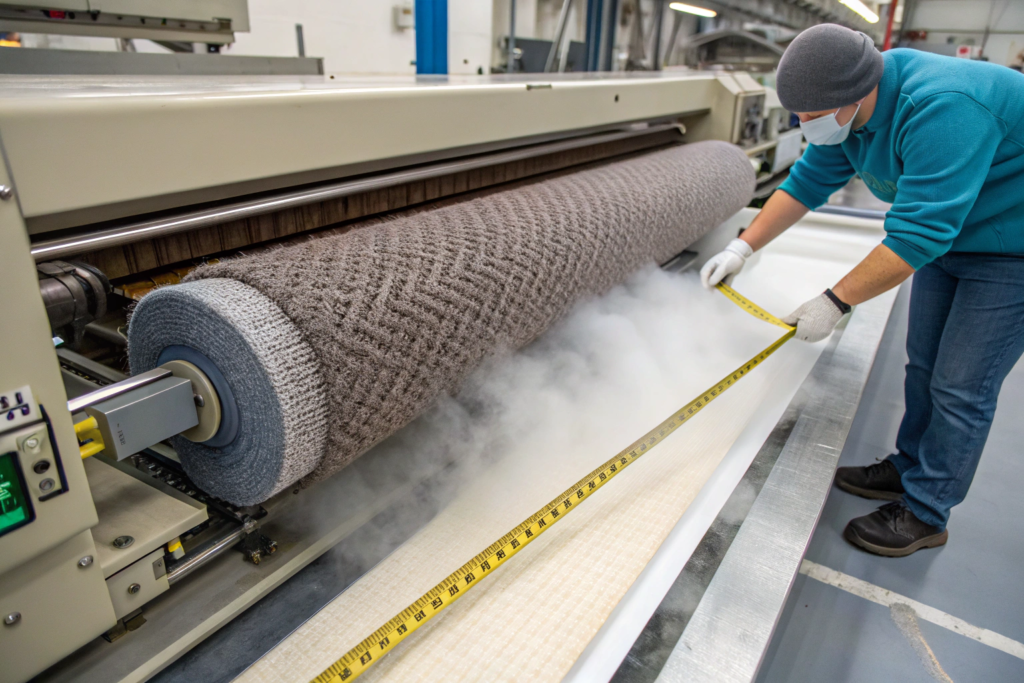
Open-width compacting processes the fabric as a single, flat layer from start to finish. The fabric is slit open immediately after knitting or after scouring, and it is processed through an open-width washing range, an open-width dyeing machine, and an open-width compactor. In the compactor, an open-width fabric passes between a heated steel cylinder and a rubber or felt blanket, and the compression is applied uniformly across the entire width. The fabric is then gently overfed onto a conveyor belt dryer or a perforated drum dryer, which dries the fabric in a completely relaxed, tension-free state. This open-width, overfeed, tension-free drying is what permanently sets the relaxed loop geometry. The fabric emerges with no residual width-wise or length-wise tension, and its spirality angle is essentially zero. Open-width processing is more capital-intensive and requires more floor space than tubular processing, which is why many low-cost mills avoid it. But for high-quality, torque-sensitive knit fabrics, it is the gold standard.
Can Steaming and Agitation During Finishing Permanently Relax Yarn Twist?
Yes, steaming and agitation are the primary mechanical tools for twist relaxation. Wet heat is the universal solvent for the hydrogen bonds that hold cotton fibers in their twisted configuration, and mechanical agitation provides the energy for the fibers to slide past each other into a lower-energy, less twisted arrangement. The combination of hot water and vigorous agitation in a jet dyeing machine or a rotary washer causes the yarn to swell, the interfiber friction to drop, and the twist energy to dissipate as the fibers rearrange themselves. Industrial steamers apply dry or saturated steam at high temperature directly to the fabric surface, rapidly heating the yarns and accelerating the relaxation process.
The key parameter is time and temperature, and better machinery provides greater control over both. A typical relaxation sequence involves passing the fabric through a steam box at 100 to 105°C with a dwell time of three to five minutes, followed by mechanical agitation in a drum washer or an open-width washing range, followed by overfeed drying. The steam swells and plasticizes the fibers; the agitation releases the twist. I have seen fabrics that measured 12 degrees of spirality straight off the knitting machine drop to below 1 degree after a single pass through this steam-and-agitation sequence. The relaxation is permanent because it is a physical rearrangement of the fibers within the yarn structure, not a chemical bonding. The twist energy is not "locked away"—it is surgically removed.
How Do You Audit a Fabric Supplier’s Spirality Control Before Committing to a Bulk Order?
The supplier audit for spirality control is a physical process verification, not a paper exercise. A supplier can produce a test report showing zero spirality on a pre-production sample, but if the bulk production does not include the same relaxation and compacting processes, the bulk fabric will spiral. Your audit must verify that the equipment exists, that it is operational, that it is included in the standard process flow for your fabric type, and that the quality control system measures spirality on every production batch.
When I am helping a client evaluate a potential knit fabric supplier, I ask them to walk the factory floor and physically see the compacting machine, the relaxation dryer, or the open-width finishing range. If the supplier claims to produce torque-free single jersey but does not own a compactor, they are either outsourcing the compacting—which introduces scheduling and quality risk—or they are not compacting the fabric at all and relying on stenter straightening, which is temporary. The equipment must be integrated into the standard process flow, not sitting unused in a corner. The supplier should be able to demonstrate the compacting process running live, show the fabric entering and exiting the compactor, and explain the specific overfeed percentage and temperature settings used for your fabric construction. A competent supplier will have a process specification sheet for each fabric type that lists the compaction parameters, and the machine operator will be following it.
The quality control system is the second verification layer. Ask to see the in-process spirality measurement records for a recent batch of fabric. The records should show spirality angle measurements taken at regular intervals during processing—every 30 minutes or every 500 meters is standard—with clear pass-fail limits. A measurement of 3 degrees should trigger an immediate process adjustment: increasing the compactor overfeed, adjusting the steam pressure, or slowing the line speed. If the supplier cannot produce these records, or if the records show every measurement at exactly 0.0 degrees with no variation, the system is not genuinely measuring spirality.
What Equipment Should a Reputable Knit Supplier Have to Control Torque?
A reputable knit supplier producing torque-sensitive fabrics should have, at a minimum, a mechanical compacting machine, either a tubular compactor or an open-width compactor depending on the fabric format. The compactor is the centerpiece of torque control because it physically releases the twist energy and stabilizes the fabric’s loop structure in a relaxed, dimensionally stable configuration. The machine should be well-maintained, with a visible maintenance log, and the felt blanket or rubber sleeve that provides the compression surface should be in good condition—a worn, glazed, or damaged compaction blanket cannot impart uniform compression, resulting in uneven torque release across the fabric width.
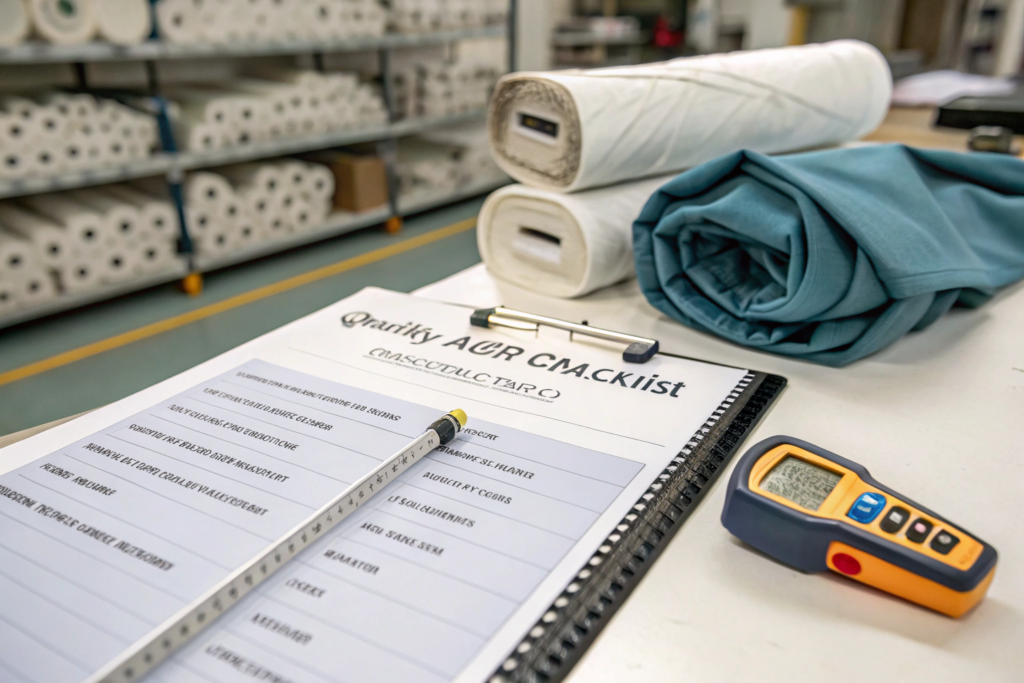
Beyond the compactor, the supplier should have a wet relaxation capability. This could be a dedicated relaxation dryer—a conveyor belt or suction drum dryer that dries the fabric in a completely tensionless, overfeed condition—or it could be a combination of a tumble dryer for rope-form relaxation and a stenter for final width setting, but the stenter must be operated with minimum tension and maximum overfeed. Vibration or shaking devices integrated into the feed section further release stitch tension by allowing the fabric to settle before final drying. Finally, the supplier should have a quality control workstation equipped with a flat, grid-marked inspection table, a calibrated angle measurement device—either a digital inclinometer, a rotary protractor, or a camera-based optical system—and a documented procedure for measuring spirality per ISO 16322-2 or ASTM D3882.
Should You Demand a Multi-Wash Spirality Test Report for Every Production Lot?
Yes, and I consider this a non-negotiable requirement for any distribution contract where torque failure would result in chargebacks. A single-point spirality measurement taken off the compactor at the end of finishing tells you the fabric is torque-free in its just-processed state. It does not tell you that the relaxation is permanent and that the fabric will not re-develop spirality after consumer washing. The only way to verify permanent torque release is a multi-wash relaxation test.
The protocol I recommend is a three-cycle wash-and-dry test per ISO 6330, with spirality measurements taken after the first, second, and third cycles. The fabric specimen is conditioned, marked, and measured for initial spirality. It is washed, tumble-dried, re-conditioned, and re-measured. A fabric that is truly torque-free will show a spirality angle below 3 degrees at all three measurement points, with no upward trend. A fabric that has been stentered straight but not properly compacted will show a low initial spirality that increases with each successive wash cycle, as the temporary stenter set is progressively broken. I have seen fabrics that measured 1 degree off the compactor climb to 8 degrees after three washes. That fabric is a warranty claim waiting to happen. The multi-wash report catches this before the fabric is cut and sewn. Ask your supplier to include the three-cycle spirality report with the pre-production approval sample, and make it a contractual requirement that bulk production lots will be spot-tested to the same protocol.
Conclusion
Fabric torque is the silent, latent defect that turns a beautiful garment into a corkscrew the moment it hits water. It originates in the spinning mill, with a twist-lively single-ply yarn, and it survives dyeing and finishing processes that mask it rather than release it. When it finally manifests in the consumer’s washing machine, the distributor is the one who pays. The returns, the chargebacks, the lost shelf space, the eroded buyer trust—all of these are the distributor’s costs, even though the technical failure originated upstream.
Eliminating torque is a process control challenge, not a material selection challenge. The solution is not to ban single-ply yarns—they have legitimate cost and hand-feel advantages that the market demands. The solution is to process those yarns through a finishing line that includes genuine wet relaxation, mechanical compaction, and tension-free drying, followed by a quality control system that measures spirality on every batch and validates permanence with a multi-wash test protocol. This costs more money and takes more time than a simple stent-and-ship process, but it costs far less than a container of twisted dresses coming back from a retailer.
At Shanghai Fumao, I have invested in the compacting and relaxation equipment, the calibrated measurement tools, and the multi-wash test protocols that ensure fabric torque is fully released and permanently stabilized before a single meter leaves our facility. If you are a distributor who has been burned by spirality, or if you are entering a high-stakes contract where torque failure is not an option, I can provide you with a pre-production torque verification package that includes the single-point and three-cycle spirality test data, the equipment list from our finishing line, and a retained torque reference sample from your approved lot. Contact our Business Director, Elaine, at elaine@fumaoclothing.com. Send her your fabric construction details, your target end-use, and your spirality tolerance limit. She will coordinate with our finishing team to produce a sample and the audit-quality documentation to prove it will stay straight through every wash cycle your customer puts it through. Let us make sure your next container of knitwear arrives as flat and straight as the day it left the factory floor.








