
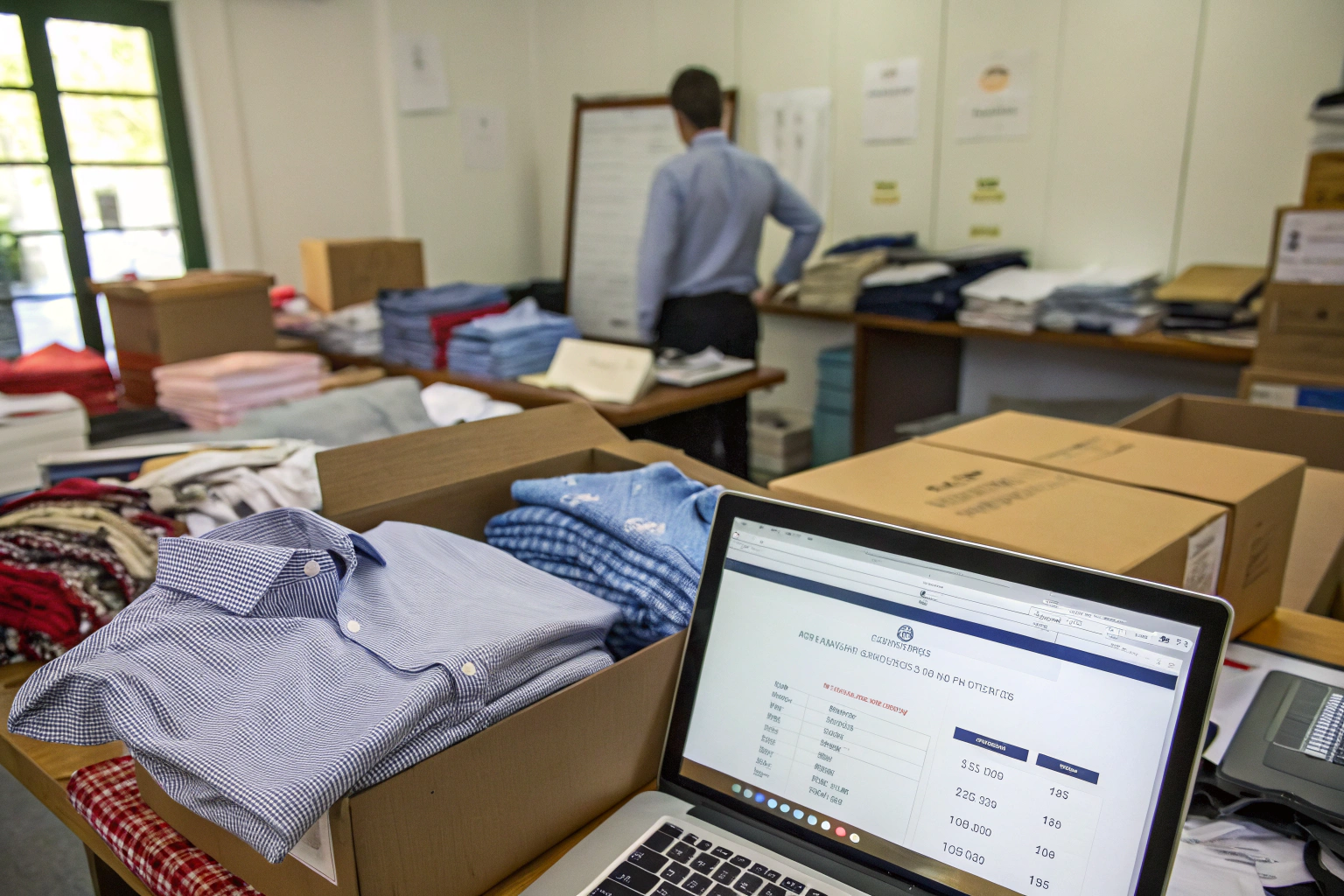
I had a call in 2021 that I will never forget. A small-but-respected menswear brand from Melbourne had just launched a premium line of linen-cotton blend shirts. The fabric we supplied was beautiful—soft, breathable, a gorgeous slub texture. But three weeks after the launch, their customer service inbox was on fire. Customers were sending photos of shirts that had shrunk a full size after a single cold wash. Sleeve cuffs that once sat perfectly at the wrist were now three centimeters too short. The brand had to process returns on nearly 12% of the entire production run, issue refunds, and worst of all, absorb a wave of one-star reviews that tanked the product’s search ranking. The total cost to their business, factoring in return shipping, restocking labor, lost margin on the damaged goods, and the long-term reputational damage to a small brand built on trust—was north of $18,000 on a single order. The root cause? The fabric was not properly pre-shrunk.
Pre-shrunk fabric is not a marketing phrase to stick on a hangtag. It is a mechanical insurance policy against one of the most common and most expensive failure modes in apparel: progressive shrinkage after the customer takes the garment home. When a fabric is pre-shrunk correctly, the residual shrinkage is driven out in a controlled factory environment before the fabric is ever cut and sewn. The customer washes the garment, and it stays the same size. When it is not pre-shrunk, or when the pre-shrinking is done poorly, the garment shrinks unpredictably on the customer’s body, and they return it. The math is brutal. The average apparel return rate sits around 20 to 30% for online purchases, and sizing or fit issues account for over 50% of those returns according to multiple industry surveys. A significant portion of those "fit" returns are actually shrinkage problems the customer cannot articulate—they just know the garment does not fit like it did when they tried it on.
Our entire quality system is built around dimensional stability. I am going to walk you through exactly what pre-shrinking means at the mechanical and chemical level, how it differs between fabric types, the specific testing standards you should demand from your supplier, and the real financial calculation that proves pre-shrunk fabric is not a cost—it is a return on investment that pays for itself many times over.
What Exactly Is Pre-Shrunk Fabric and How Is It Made?
Pre-shrunk fabric is fabric that has been mechanically or chemically treated to remove the latent shrinkage that would otherwise occur when the customer washes and dries the garment at home. The technical term for this is achieving "dimensional stability" or "low residual shrinkage." Almost every woven and knitted fabric has some degree of latent shrinkage right after it leaves the loom or knitting machine and goes through wet processing. During dyeing and finishing, the fabric is stretched under high tension on pin frames and hot rollers. That tension pulls the yarns into an elongated, unstable state. If you cut and sew that stretched fabric into a garment, the first time it hits water and heat in a domestic washing machine, the yarns relax back to their natural, un-stretched state, and the garment shrinks. The pre-shrinking process releases that latent tension and forces the fabric to do its shrinking in the factory, not in the customer’s laundry room.
The specific method depends on the fabric type. For woven cotton and cotton-blend fabrics, the gold standard is the sanforizing process, patented by Sanford Lockwood Cluett in the 1930s and still the most reliable mechanical compaction method today. The fabric is fed into a sanforizing machine—essentially a thick, heated rubber blanket that is stretched around a large roller. The fabric is pressed against this stretched rubber blanket with a heated steel cylinder. As the rubber blanket contracts back to its normal thickness after passing through the roller nip point, it physically compresses the fabric in the warp direction, forcing the individual yarns closer together. This mechanical compaction mimics the relaxation that would occur during washing. The fabric is then dried under low tension to set the compacted state. For knitted fabrics, which are structurally different and more prone to progressive shrinkage, the preferred method is typically a combination of open-width compacting or tumble-dry relaxation. The knit fabric is fed through a compactor machine that uses controlled overfeed and steam to mechanically relax the knit loops, followed by a tumble dryer that further relaxes the fabric in a tension-free environment. This dual approach is critical because knits have a three-dimensional loop structure that releases shrinkage more gradually than woven yarns do.

Is Sanforizing the Same as Generic Pre-Shrinking on a Spec Sheet?
No, and this distinction matters enormously when you are reading a supplier’s specification sheet. Sanforizing is a specific, licensed mechanical process that uses a particular type of machine—the sanforizer—and guarantees a specific residual shrinkage level, typically 1% or less in the warp direction. The term "Sanforized" is a registered certification mark owned by Cluett, Peabody & Co., and a fabric can only carry that label if it has been tested and certified by an authorized laboratory to meet the standard. Generic "pre-shrinking" on a spec sheet can mean almost anything. It could mean the fabric was washed once in a rotary drum machine and line-dried. It could mean the fabric was passed through a steamer and lightly relaxed. It could mean absolutely nothing—some suppliers write "pre-shrunk" on the spec sheet because they assume the buyer wants to see it, without actually performing any meaningful dimensional stabilization process.
I learned to verify this distinction the hard way. In 2019, a US-based home textile brand ordered 15,000 meters of a cotton-linen blend curtain fabric from us with a spec that simply said "pre-shrunk." Our finishing team ran the fabric through our standard sanforizing line, tested the residual shrinkage per AATCC 135 at 2% warp by 3% weft, and shipped it. The brand rejected the shipment because their quality manual defined "pre-shrunk" as a maximum 1% residual shrinkage in both directions. Our sales contract did not specify the test method or the numerical tolerance. After three weeks of back-and-forth and a costly re-processing run, we settled the claim and I rewrote our internal specification policy. From that day forward, every Shanghai Fumao technical data sheet specifies "Mechanically sanforized, residual shrinkage per ISO 6330-2021, max 1.5% warp x 2.0% weft" or the equivalent AATCC standard, with the specific test method and the numerical tolerance explicitly stated. Generic words on a spec sheet are a liability; standard numbers with test method references are a contract.
How Does Mechanical Compaction Physically Stabilize Woven Cotton at the Fiber Level?
The sanforizing machine operates on a principle of differential velocity and controlled compression. The machine has two key components: a thick, endless rubber blanket stretched over a large feed roller, and a heated steel cylinder. The rubber blanket is stretched under tension as it approaches the nip point, reducing its thickness and increasing its surface area. The cotton fabric is fed into the nip between the stretched rubber blanket and the hot steel cylinder. At the exact moment of contact, the rubber blanket passes around the roller and the tension is released. The blanket thickness rebounds, and the surface contracts. The fabric, which is pressed tightly against the rubber blanket, is physically forced by friction to contract along with it—the fabric is effectively scrunched up in the warp direction by the contracting rubber surface. The steel cylinder provides the heat and pressure to lock the individual cotton fibers into their new, compressed configuration.
At the fiber level, this is not permanent in an absolute chemical sense—cotton will always have some hygroscopic expansion and contraction with humidity changes—but it is mechanically and thermally "set" in a stable minimum-energy state. The hydrogen bonds between the cellulose chains re-form in the compressed configuration under the heat and pressure of the hot steel cylinder. When the fabric later enters a home washing machine, the water and agitation try to release the fiber’s internal stresses, but those stresses have already been largely exhausted during the sanforizing process. The fibers are already in their relaxed, compressed state, so the additional shrinkage is minimal—typically 0.5% to 1.5% residual, which is functionally unnoticeable to the consumer.
How Does Fabric Shrinkage Directly Cause E-Commerce Fit Complaints and Returns?
The most common return reason in e-commerce apparel is "doesn’t fit." But under that simple phrase lies a more specific and preventable reality: the garment did not fit because it changed size after the customer was washing it according to the care label. A customer tries on a new shirt. It fits well enough to keep. They cut off the tags and throw it in the wash. It comes out of the dryer one size smaller—sleeves too short, chest too tight, hem riding up. The fit problem was not a sizing error by the brand. It was a latent shrinkage problem that the fabric supplier failed to remove. But the customer does not blame the fabric mill; they blame the brand. They initiate a return, select "Too Small" from the dropdown menu, and the brand’s fit data is corrupted with false negatives. The design team then adjusts the next season’s sizing, adding extra length to compensate for a shrinkage problem the fabric should have prevented.
I have seen this cycle destroy a brand’s sizing integrity over multiple seasons. In 2022, I worked with a UK-based sustainable fashion label that was experiencing a 22% return rate on their linen-viscose blend dresses. Their customer feedback specifically mentioned the dresses "shrinking up" and becoming unwearably short. They sent us a returned garment, and we measured it against their original production spec. The garment had shrunk by 4.2% in length. Our testing of the original mill-finished fabric from the same dye lot showed a residual shrinkage potential of 5.1% under the ISO 6330 standard wash. The fabric had never been compacted or relaxed; the mill had simply shipped it straight from the stenter frame at full stretched width. The dresses were essentially "pre-shrinking" in the customer’s washing machine, and the customer was understandably returning them. The brand had to eat the cost of 480 returned dresses, re-order a properly compacted version of the fabric, and rebuild trust with their mailing list through a public apology and a discount code. The root cause was a missing process that in our factory is standard operating procedure.

Why Does Progressive Shrinkage in Knits Cause More Returns Than Initial Shrinkage?
Knitted fabrics, by their structural nature, have a more insidious shrinkage behavior than woven fabrics. A woven fabric typically releases its maximum shrinkage in the first or second wash cycle; once the warp and weft yarns have relaxed, the fabric stabilizes. A knitted fabric, especially one made from cotton or a cellulosic blend, can exhibit progressive shrinkage—each successive wash and dry cycle causes a small additional amount of shrinkage, accumulating over ten, twenty, or even thirty cycles. The garment fits fine after the first wash. It fits okay after the fifth wash—a little snug, but the customer is not sure. By the twentieth wash, the t-shirt has shrunk a full size and the customer finally concludes that "this brand runs small" and leaves a negative review.
Progressive shrinkage is caused by the continued relaxation of the knit loop structure under repeated cycles of water absorption, mechanical agitation, and heat drying. Every time the knit gets wet, the yarn swells, and the knit loop geometry compresses slightly. Every time it tumbles in a heated dryer, the fibers are agitated into a more compacted state. The process is gradual and cumulative. A knit fabric with an initial residual shrinkage of 2% might show 3.5% after five cycles, 5% after ten cycles, and 6.5% after twenty cycles if it was not properly compacted and tumble-relaxed during finishing.
I learned to take progressive shrinkage seriously in 2020 with a US basics brand that ordered a cotton-spandex jersey from us for a core t-shirt program. Our standard compacting process achieved a 3% residual shrinkage after one wash on the production line, which we documented and reported. The brand did not specify a multi-cycle test requirement. Six months later, they filed a claim because their own five-cycle wash test showed 6.5% cumulative shrinkage. The one-cycle test had missed the progressive component. We re-engineered the compacting route with a double tumble-relaxed process and a multi-cycle validation protocol, and since then, I have made the five-cycle wash test a mandatory part of every knit development. If you are sourcing knit fabric, ask your supplier for the five-cycle residual shrinkage value tested per ISO 6330 or AATCC 135, not just the single-cycle value. The gap between one cycle and five cycles is where the pain hides.
What Is the Real Cost of a Single Shrinkage-Related Garment Return?
I have built a bottoms-up cost model on this because you cannot make a convincing business case for pre-shrinking without hard numbers. Let’s use a mid-priced woven cotton shirt with a retail price of $65 and a gross margin of 60%, as a representative example. The direct costs are the visible ones: the outbound shipping, which the brand paid initially, and the shipping label cost is around $6 to $8. The return shipping label costs the brand another $6 to $8. The return processing labor at the warehouse—unpacking, inspecting, steaming, re-bagging—costs between $3 and $5 per unit, depending on volume. If the garment is classified as damaged, which a severely shrunken garment often is, it cannot be resold as first-quality, and the brand writes off $26 of product cost. If it is sold through a secondary liquidation channel, the brand might recover $5 to $8 per unit. The total direct loss per returned garment, depending on whether it is resellable or damaged, ranges from $15 to $40.
Now layer on the indirect costs. The return requires customer service labor, typically $3 to $5 per inquiry. The return skews the brand’s sizing analytics, potentially causing the design team to incorrectly adjust the fit block for the next season. The negative review left by a frustrated customer drags down the product’s conversion rate. Even a single one-star review on an e-commerce product page can reduce conversion by 10 to 15%, especially for a smaller brand with fewer total reviews. A product with a 3.8-star rating because of shrinkage complaints generates significantly less revenue than the same product with a 4.5-star rating. And the customer lifetime value impact is the quiet killer. A customer who experiences a shrinkage return is statistically less likely to purchase from that brand again. The cumulative lifetime cost of a single preventable shrinkage return can easily exceed $100 over multiple lost future orders. Pre-shrinking is a $0.10 to $0.25 per meter process; it pays for itself with the very first return it prevents.
Which Testing Standards Prove a Fabric Is Truly Pre-Shrunk?
The test standard is the verification that the pre-shrinking was done correctly. Without a specific, named test standard and a numerical residual shrinkage value on the supplier’s report, the phrase "pre-shrunk" is just a hope. The two dominant international standards for dimensional stability testing of fabrics are ISO 6330 and AATCC 135. These standards specify the exact washing machine type, the wash cycle, the water temperature, the detergent, the drying method, and the measurement protocol. ISO 6330 defines multiple washing procedures (1N, 2N, 3N, etc.) that simulate different domestic washing conditions, from a delicate cold wash to a vigorous hot wash, with line drying, flat drying, or tumble drying following. AATCC 135 is broadly equivalent and widely used by US-based brands. The critical point is that the test conditions must match the care label instructions the brand will sew into the garment.
I standardize my dimensional stability testing at Shanghai Fumao around ISO 6330 because the majority of our clients serve European and global markets where ISO standards are the common language. The procedure is rigidly defined. A 60 cm x 60 cm marked specimen is cut from the finished fabric after it has been conditioned for at least 4 hours at 21°C and 65% relative humidity. Three pairs of reference marks, typically 50 cm apart, are carefully drawn on the fabric in both the warp and weft directions. The specimen is washed in a specific Wascator front-loading machine with a defined load of make-weight fabric, a specified detergent, and a specified water temperature. After the wash cycle completes, the specimen is removed and dried according to the specified procedure—tumble dry, line dry, or flat dry. The specimen is then re-conditioned for at least 4 hours, and the distance between the reference marks is re-measured. The percentage change is calculated for each pair of marks, and the average is reported as the dimensional change percentage. If the average warp shrinkage exceeds 2.0%, I consider the pre-shrinking inadequate and the lot is re-processed or rejected.

What Is the Difference Between ISO 6330, AATCC 135, and a Basic Home Wash Test?
The home wash test is uncontrolled, unreproducible, and useless as a contractual quality metric. It involves throwing a fabric swatch into a random domestic washing machine, selecting a random cycle, using a random detergent, and measuring the result with a ruler from a stationery drawer. Two different home washing machines—even the same model from different production years—can produce meaningfully different mechanical agitation profiles, spin speeds, and water temperature accuracies. A home test might tell you roughly whether the fabric shrinks to the naked eye, but it cannot provide a legally defensible, repeatable number that a supplier and a buyer can agree on as a pass-fail criterion.
ISO 6330 and AATCC 135 are laboratory-grade standards that specify precise equipment, precise procedures, and precise reporting formats. The washing machine itself is a standardized instrument—a Wascator FOM71 CLS or equivalent, calibrated regularly for water temperature, water level, drum speed, and cycle timing. The detergent is a specified reference detergent, not whatever supermarket brand was on sale that week. The make-weight ballast fabric is a specific type, typically 100% polyester knitted pieces, to ensure the mechanical agitation is consistent across test runs. The drying procedure is standardized—line drying on a specific type of line, flat drying on a specific mesh rack, or tumble drying in a calibrated tumble dryer at a specified exhaust temperature. The measurement is done with a calibrated metal ruler or a digital fabric measuring table. The result is a number with a known measurement uncertainty, typically ±0.3%. In a dispute between a buyer and a seller over whether a fabric was adequately pre-shrunk, the ISO or AATCC test result is the evidence that stands up in a commercial claim. The home wash test is worth exactly nothing.
How Many Wash Cycles Should a Reliable Pre-Shrunk Certificate Actually Cover?
At a minimum, three cycles. A single-cycle test is a snapshot that proves the fabric has received some dimensional stabilization, but it does not prove that the stabilization is durable or complete. For woven fabrics, three cycles usually reveals the vast majority of the releaseable shrinkage. If the fabric is properly sanforized, the shrinkage after three cycles is only marginally higher than after one cycle—maybe an additional 0.2% to 0.5%. For knitted fabrics, as I discussed earlier, I strongly recommend a five-cycle test as the standard. The progressive shrinkage behavior of knits requires a longer wash history to characterize accurately.
For a truly reliable pre-shrunk certificate for high-specification contracts, such as school uniforms, workwear, or premium hospitality textiles, I recommend a five-cycle test per ISO 6330-1N or 2N with tumble drying, reporting both the single-cycle result and the cumulative five-cycle result. The spec might read: "Single-cycle residual shrinkage ≤ 2.0% warp x 2.0% weft; Cumulative five-cycle shrinkage ≤ 3.0% warp x 3.0% weft." This dual-threshold specification captures both the immediate stability and the long-term stability, and it forces the mill to optimize the pre-shrinking process for durability, not just for passing a one-off test. At Shanghai Fumao, I include a five-cycle test in the standard quality package for all knit fabric developments, and I offer it as an optional upgrade for woven developments. The additional cost is about $80 per test, and for a batch that will become 30,000 meters of t-shirt fabric, that $80 is the best insurance money can buy.
How Does Pre-Shrinking Add Value Beyond Just Stopping Returns?
Pre-shrinking is not just a defensive play against customer returns. It actively improves the entire production and product quality chain. When a fabric has been properly pre-shrunk, the cutting room can rely on the fabric’s dimensional stability to produce accurate cut panels that do not shift and shrink after assembly. This improves the "size-to-size" consistency of the garment—a Medium truly stays a Medium through the wash—and reduces the need for the design team to build excessive "ease" into the pattern to guess how much the fabric might shrink later.
The downstream benefits multiply. A stable fabric reduces the internal stress in sewn seams, because the fabric components are not fighting each other by shrinking at different rates after washing. The garment lies flatter after pressing, looks better on the hanger, and photographs better for e-commerce product pages. A customer who washes a pre-shrunk garment and finds it still fits is a customer who keeps the garment, wears it repeatedly, and places reorders. For brands that sell through wholesale channels to department stores, pre-shrunk fabric reduces chargebacks. Large retailers like Nordstrom, Macy’s, and John Lewis have strict vendor compliance manuals that specify maximum acceptable shrinkage levels, typically 2% or less. A brand that ships garments made from non-pre-shrunk fabric risks chargebacks, deductions, and ultimately losing shelf space to a competitor whose product survives the retailer’s random wash testing. (This is something I have walked several newer brands through—their first large department store order is usually when they discover what "vendor compliance" actually means.)

Does Pre-Shrunk Fabric Improve Pattern Cutting Accuracy and Garment Consistency?
Yes, and the mechanism is a reduction in what is called "fabric relaxation variability." When a non-pre-shrunk fabric arrives in the cutting room, it carries latent tensions from the finishing process that are unevenly distributed across the roll width and length. The center of the fabric, which was more tightly stretched on the stenter pins, may shrink more than the selvedge edges. The beginning of the roll, which was processed first on the finishing line, may have a different relaxation profile than the end of the roll. When this variable fabric is cut into garment panels, the panels are all cut to the same dimensions, but they relax to different final dimensions after sewing and washing. The result is garments that come off the same cutting table and measure inconsistently—one Medium shirt has a 104 cm chest, the next Medium has a 101 cm chest. The pattern cutter’s skill is neutralized by the fabric’s variability.
A properly pre-shrunk fabric has been uniformly relaxed across its entire width and length through the sanforizing or compacting process. The residual tension is minimal and uniform. The batch-to-roll variability in relaxation shrinkage is far lower. The cut panels are dimensionally stable, and the sewn garments measure consistently against the pattern specification. This reduces the need for the QC department to pull and re-measure garments for size compliance. It also allows the brand to confidently publish a size chart online, knowing that the garment the customer receives will match the chart. In e-commerce, where size chart accuracy directly drives conversion rate and return rate, a stable fabric is a direct sales enabler.
Can Sanforized Cotton Reduce Seam Puckering After Home Washing?
Seam puckering is that annoying, wavy, gathered appearance along the seam line that appears after washing. It makes a well-constructed garment look cheap. The primary cause of post-wash seam puckering is differential shrinkage between the sewing thread and the fabric. If the fabric shrinks 4% but the polyester core-spun sewing thread shrinks only 0.5%, the longer fabric is forced to accommodate the shorter thread, and it buckles into puckers. Pre-shrinking the fabric reduces the shrinkage differential. If the fabric is sanforized to a residual shrinkage of 1%, the mismatch with the thread is much smaller, and the seam puckering is dramatically reduced.
There is also a secondary mechanism related to the sewing needle damage I discussed in a previous article. When a needle penetrates a tightly stretched, non-pre-shrunk fabric, it breaks some of the stretched fibers. When the fabric is later washed and the tension released, those broken fibers retract and create micro-distortions around the needle hole. A pre-shrunk fabric is in a more relaxed state during sewing, so the needle damage is less severe and the post-wash relaxation distortion is minimal. The combination of reduced fiber-level damage and reduced thread-fabric shrinkage mismatch produces a seam that lies flat through repeated washing, preserving the garment’s premium appearance. (Here I have to mention that our technical director demonstrated this exact phenomenon at a trade show by boiling two identical shirts side by side—the sanforized one stayed flat, the non-sanforized one puckered instantly.)
Conclusion
Pre-shrunk fabric is a financial instrument disguised as a textile process. Every cent you spend on proper mechanical compaction—whether it is cotton sanforizing, knit compacting, or multi-cycle tumble relaxation—is a cent you do not spend on return shipping labels, customer service labor, damaged inventory write-offs, negative review mitigation, and lost customer lifetime value. The pre-shrinking process stabilizes the fabric’s internal structure, releases the latent tensions introduced during dyeing and finishing, and forces the shrinkage to happen in the factory where it is controlled and harmless rather than in the customer’s washing machine where it is destructive and expensive.
I have built my quality system at Shanghai Fumao around dimensional stability because I learned early that a fabric’s shrinkage performance is the single biggest predictor of a brand’s long-term satisfaction with a supplier. Color issues can be negotiated and sometimes accepted by the market. Hand-feel issues can be softened with finishing adjustments. But a shrinkage problem is binary: the garment fits, or it does not. When it does not, it gets returned, and the cost cascades through the brand’s entire operation.
If you are currently dealing with a return rate that seems too high, and you suspect fabric shrinkage might be the hidden driver, I can help you diagnose the problem and fix it at the source. At Shanghai Fumao, I can provide a full ISO 6330 dimensional stability report—single-cycle and five-cycle—for any fabric we develop for you, with guaranteed maximum residual shrinkage values written into the purchase contract. Contact our Business Director, Elaine, at elaine@fumaoclothing.com. Send her your current fabric specification and your target shrinkage tolerance, and she will work with our finishing team to deliver a pre-production sample and a verified test report. Let us make sure your fabric does its shrinking before it leaves our factory, not after your customer takes it home.








