
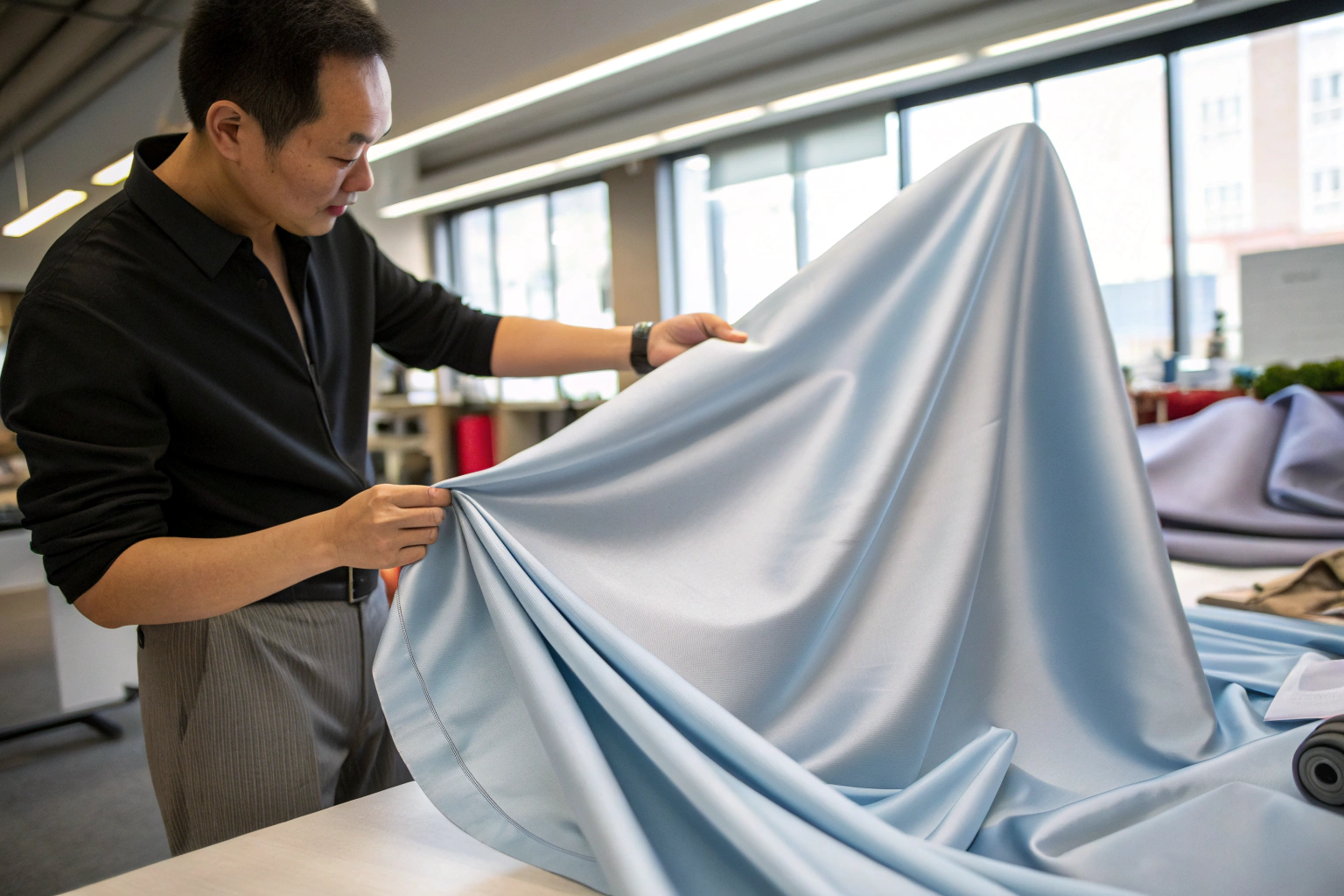
I remember the first time I touched a bolt of Tencel lyocell fabric that had been finished properly. It was around 2008, and a sample from an Austrian fiber supplier had just arrived at our Keqiao office. I unrolled a few meters, held it under the light, and honestly, I just stood there running my palm over the surface for a solid minute. It was cool. It draped like a heavy silk but had the softness of a brushed cotton. I turned to my production manager and said, "This is the future, and we need to figure out how to do it better than anyone else." Fast forward to today, and Tencel lyocell is not just a niche eco-fabric anymore. It is a mainstream performance fiber, and I supply it to brands across Europe, the US, and Australia who demand the absolute best version of it.
The problem is that not all Tencel fabric is created equal. The fiber itself comes from Lenzing AG in Austria, and it is beautiful. But the fiber is just the starting point. The weaving, the dyeing, the mechanical finishing—these steps make or break the fabric. A poorly processed Tencel can fibrillate into a hairy mess, lose its strength when wet, or shrink unpredictably. A properly processed Tencel, like the kind we produce at Shanghai Fumao, is something entirely different. It is pill-resistant, color-fast, and has a fluid drape that makes garment designers genuinely excited. I have spent over 15 years refining our wet processing parameters specifically for lyocell, and I have made every mistake in the book so you don’t have to.
What I want to give you today is a complete, honest breakdown of why our Tencel lyocell performs the way it does, from the forestry source to the finished roll. I will explain the closed-loop chemistry that makes it sustainable, the fibrillation control that prevents that unsightly white fuzz, the moisture management physics that make it the best fabric for hot, humid climates, and the specific comparisons to cotton, viscose, and polyester that will help you spec the right fabric for your product. This is not marketing fluff. This is textile engineering, shared openly.
What Is Tencel Lyocell and How Is It Different From Regular Viscose?
Tencel is a brand name, not a generic fiber type. The generic fiber is called lyocell, and it belongs to the family of regenerated cellulosic fibers—man-made fibers derived from natural wood pulp. Viscose, modal, and lyocell all start as wood, but the chemical process that turns that wood into a spinnable fiber is completely different. Viscose uses carbon disulfide in a complex, multi-step chemical derivation that creates significant toxic effluent if not carefully managed. Lyocell uses a completely different solvent: N-Methylmorpholine N-oxide, or NMMO, a non-toxic amine oxide that physically dissolves the wood pulp rather than chemically derivatizing it. Think of the difference between melting ice into water by heating it—that is a physical phase change—versus burning wood into charcoal and gases—that is a chemical transformation. Lyocell is the physical dissolution; viscose is the chemical transformation. This distinction is everything.
Because the NMMO solvent is recovered, purified, and recycled at a rate exceeding 99% in a closed-loop system, the lyocell process is dramatically cleaner. The effluent is minimal, the solvent is reused, and the water consumption is far lower. But beyond the environmental story, the fiber structure is fundamentally superior. Lyocell fibers are highly crystalline and highly oriented along the fiber axis. This means they are stronger than viscose, especially when wet. A wet lyocell fiber retains about 85% of its dry tenacity; a wet viscose fiber retains only about 50%. That single property—wet strength—is why lyocell garments survive the washing machine and viscose garments develop holes. The fiber cross-section is also different. Lyocell has a round, smooth surface with a uniform diameter. Viscose has an irregular, serrated, "crenulated" cross-section. The smooth, round lyocell fiber is what gives the fabric its characteristic silky luster and cool touch. The irregular viscose fiber scatters light more randomly, producing a duller, less premium appearance.
Is the NMMO Solvent Closed-Loop Process Really Zero-Emission?
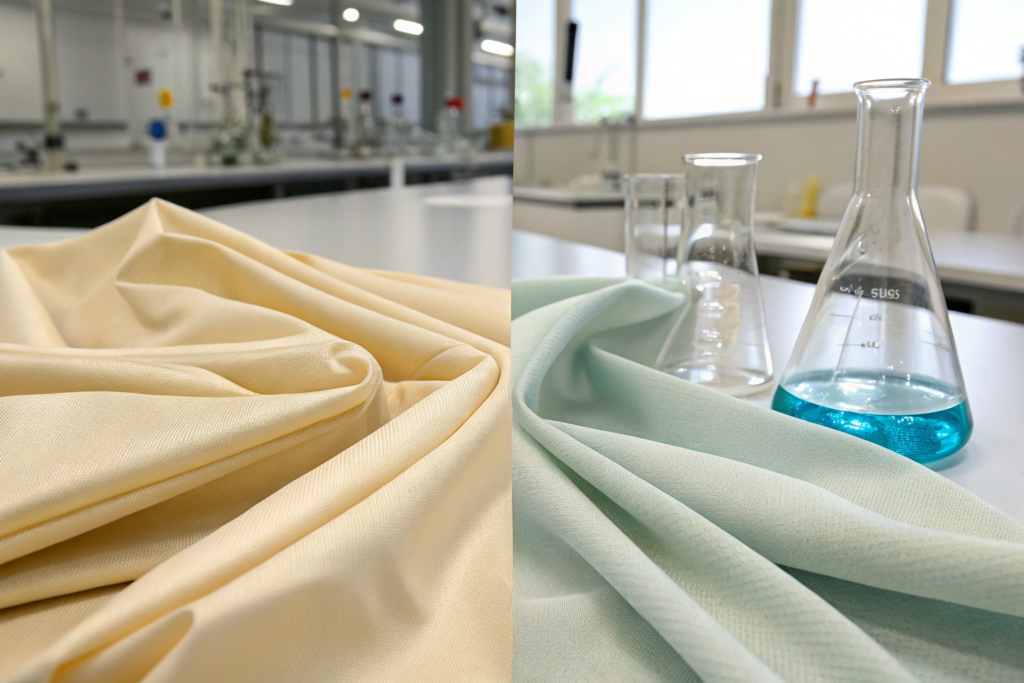
I need to be precise here because I dislike greenwashing as much as you do. The NMMO solvent recovery process is not technically "zero-emission" in the absolute physical sense—no industrial process achieves that. But it is extraordinarily close. The solvent is recovered at a rate of 99.7% by Lenzing’s facilities, meaning only 0.3% of the solvent input is lost and must be replenished. That loss is consumed by thermal decomposition inside the recovery loop, breaking down into harmless amines that are captured by scrubbers. The water used in the process is also recycled in a closed circuit. The carbon disulfide and hydrogen sulfide emissions that historically plagued viscose plants—and still plague poorly regulated viscose plants in parts of Asia—are entirely absent from the lyocell NMMO process because those sulfur compounds simply aren’t used. The chemistry is fundamentally clean.
What this means for you as a buyer is that Tencel lyocell fabric carries a legitimate, scientifically defensible sustainability claim. The EU Ecolabel certifies lyocell as having a lower environmental impact across multiple categories compared to conventional viscose and even conventional cotton, provided the wood pulp is sourced from certified sustainably managed forests. The pulp for Tencel is typically eucalyptus from FSC or PEFC certified plantations, which require significantly less irrigation and no artificial pesticides compared to cotton farming. The land-use efficiency is dramatic: one acre of eucalyptus plantation produces enough wood pulp for roughly 13,000 Tencel T-shirts per year, compared to about 1,200 cotton T-shirts from one acre of cotton field. (I had these numbers verified by a sustainability auditor who visited our Keqiao facility last year.) At Shanghai Fumao, I can provide the Lenzing fiber certificate and the transaction certificate tracing the fiber lot back to the specific pulp batch, so the chain of custody from tree to finished fabric is documented and auditable.
Why Does Lyocell Have Higher Wet Strength Than Viscose or Modal?
The answer is in the molecular weight and the crystalline structure. When wood pulp is dissolved in NMMO, the cellulose polymer chains are not chemically degraded the way they are during the viscose process. In viscose production, the cellulose is first treated with caustic soda, then reacted with carbon disulfide to form a cellulose xanthate derivative. This derivatization step shortens the polymer chains, reducing the average degree of polymerization from roughly 1,500 to about 300 to 500. Shorter polymer chains mean weaker fiber, especially when water molecules penetrate the amorphous regions and act as lubricants, allowing the chains to slide apart under tension.
The lyocell process skips the derivatization entirely. The cellulose is dissolved directly in the NMMO-water solvent system without chemical modification. The polymer chains remain long and intact, and when the fiber is spun into an aqueous coagulation bath, the cellulose regenerates into a highly crystalline, highly oriented structure. The degree of polymerization stays near 600 to 900, nearly double that of standard viscose. This long-chain, highly oriented structure is what gives lyocell its high dry tenacity of 37-42 cN/tex and its exceptional wet tenacity retention of 80-85%. Modal, which is a different regenerated cellulosic process, sits between viscose and lyocell in wet strength, typically retaining about 60-65% wet tenacity. For a practical application, if you are making a lightweight summer dress that will be washed frequently, a lyocell fabric will maintain its structural integrity far longer than a viscose or even a modal fabric of the same weight.
How Does Fumao Control the Fibrillation Problem in Tencel Fabric?
Fibrillation is the unique behavioral signature of lyocell, and it is the reason many mills are afraid to work with this fiber. When a lyocell fiber gets wet and is mechanically agitated—exactly what happens in a washing machine—the fiber swells slightly, and the outer layer of cellulose fibrils partially detaches from the main fiber body, creating a very fine, microscopic "peach fuzz" on the fabric surface. In its controlled, uniform form, this is called primary fibrillation, and it is actually desirable. It gives the fabric a soft, matte, peach-skin hand feel that is characteristic of high-quality lyocell. But if the agitation is too aggressive or uneven, or if the fabric is not properly stabilized, the fibrillation doesn’t stop at the fine fuzz stage. The fibrils tangle together, form tiny knots, and create visible white pills and surface roughness. This is called secondary fibrillation, and it is a permanent visual defect.
At Shanghai Fumao, I control fibrillation through a three-stage wet finishing process that we have refined over more than a decade. Stage one is the controlled fibrillation step. After dyeing, the fabric is processed in a jet dyeing machine with a specific mechanical action—high liquor ratio, low-speed fabric rope circulation—that deliberately induces a uniform primary fibrillation. Think of it like sanding a wooden surface with a very fine grit paper to create a perfectly even matte finish. Stage two is the enzymatic defibrillation. The fabric goes into a bath with a specific type of cellulase enzyme under tightly controlled pH and temperature. The enzyme enzymes precisely trim the ends of the raised fibrils, removing the weak, tangled tips but leaving the base fibrils intact. This prevents the fibrils from tangling into pills while preserving the soft hand feel. Stage three is the fixation and stabilization. The fabric is dried and heat-set in a stenter frame under controlled width and overfeed to lock the remaining fibrils flat and stabilize the fabric dimensions.
What Is Primary vs Secondary Fibrillation and How Is It Fixed in Finishing?
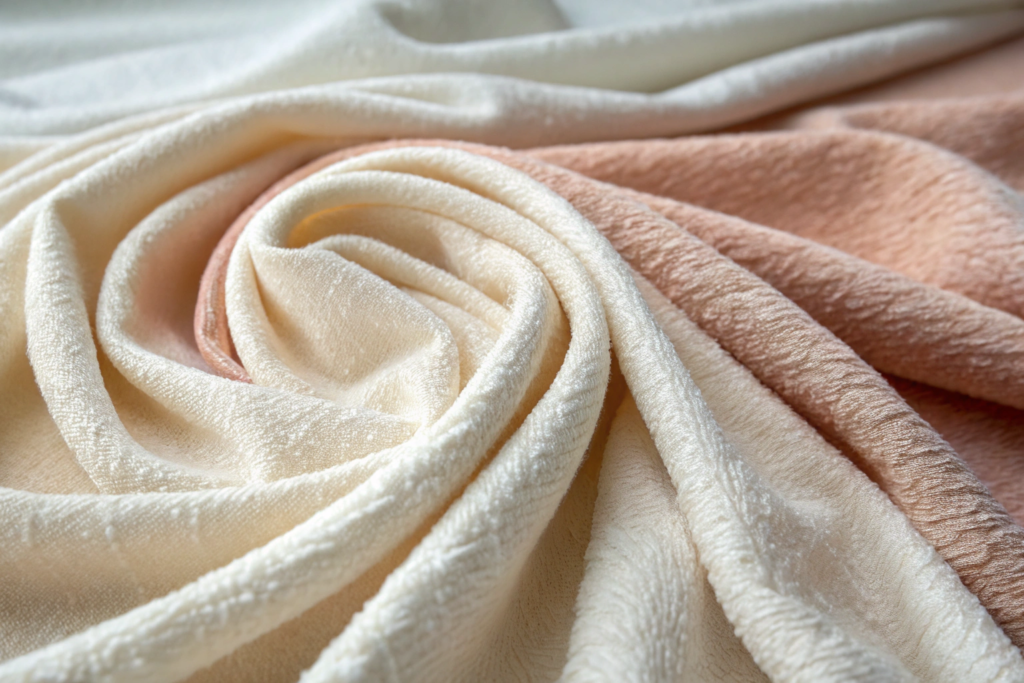
Primary fibrillation is a uniform, fine, short-fiber bloom across the entire fabric surface. Under a microscope, it looks like a neatly mowed lawn—all the raised fibrils are roughly the same height and density, and they lie flat in a consistent direction. The eye perceives this as a soft, matte, slightly brushed surface. It is extremely pleasant to touch, and it is genuinely one of the aesthetic signatures of a premium lyocell fabric. Primary fibrillation is achieved by inducing the fibrillation mechanically in a controlled, uniform way, and then using enzymes to precisely trim the fibril ends to a uniform length. The key control parameters are the jet dyeing machine’s fabric speed, the liquor ratio, the treatment time, and the enzyme concentration, pH, and temperature. If any of these parameters drift, the fibrillation becomes uneven—some areas get more fibrils than others, and the fabric looks blotchy.
Secondary fibrillation is what happens when primary fibrillation is not properly controlled or when the fabric is subjected to uncontrolled wet abrasion in consumer washing. The fibrils grow too long, tangle up with neighboring fibrils, and form dense, white, raised pills. These pills do not wash off or wear away. They are locked into the fabric structure because the fibrils are still attached at their base to the main fiber body. Combing or shaving them off only provides temporary relief, because the underlying fibrillation tendency has not been fixed. The only way to permanently prevent secondary fibrillation is a proper enzymatic defibrillation treatment during finishing. The cellulase enzyme snips the fibrils at their base, removing the long, tangle-prone fibrils and leaving a smooth fiber surface. At Shanghai Fumao, we validate the fibrillation control with a standard 10-cycle wash test per ISO 6330 and a visual grading against the Lenzing fibrillation scale. For apparel-grade fabric, I will not ship anything below a fibrillation grade of 4 on a 1-to-5 scale.
Can Enzyme Treatments and Resin Finishes Also Improve Drape and Softness?
Yes, but with a significant trade-off that I want you to understand clearly. Enzyme treatments—specifically cellulase bio-polishing—remove the surface fibrils and micro-fuzz from the fabric, which does two things. First, it makes the fabric surface smoother and less hairy, which increases the surface lubricity and makes the fabric feel softer and cooler to the touch. Second, it slightly reduces the fabric’s bending rigidity because the tangled surface fibrils that were acting like microscopic "Velcro" hooking the yarns together are removed. The yarns can slide more freely within the fabric structure, and the drape becomes more fluid. A well-enzyme-polished lyocell fabric drapes with a liquid-like flow that is difficult to achieve with any other cellulosic fiber.
Resin finishes are a completely different chemical weapon, and I use them with extreme caution on lyocell. A resin, typically a modified dimethylol dihydroxy ethylene urea (DMDHEU) or a formaldehyde-free glyoxal-based cross-linker, forms covalent bridges between adjacent cellulose polymer chains inside the fiber. This cross-linking locks the fibers in place, reducing their ability to swell and fibrillate during washing. The benefit is fibrillation resistance and improved dimensional stability—less shrinkage, less wet stretching. The downside is that cross-linking makes the fiber more brittle. The fabric loses some of its tensile strength, tear strength, and flexibility. You are trading away a fraction of the fiber’s natural toughness to gain wash stability. For a structured garment like a collared shirt or a tailored dress that must hold its shape, a light resin finish (often called an "easy-care" or "anti-fibrillation" finish) is appropriate and helpful. For a flowing, next-to-skin garment like a drapey t-shirt or a soft scarf, I skip the resin entirely and rely purely on the enzyme treatment and mechanical finishing to control fibrillation, preserving the fabric’s natural fluidity and strength.
Why Is Tencel the Best Fabric for Moisture and Temperature Regulation?
The human body has a single, non-negotiable comfort requirement: it must maintain a core temperature around 37°C, and it regulates that temperature by evaporating sweat from the skin. The fabric next to the skin either facilitates that evaporation or blocks it. Polyester blocks it. Cotton absorbs the sweat but holds it against the skin. Tencel lyocell manages moisture fundamentally differently, and the mechanism is rooted in the fiber’s molecular super-structure. Lyocell is hydrophilic—it loves water. The cellulose polymer chains contain abundant hydroxyl groups that hydrogen-bond with water molecules. But because of the high crystallinity and the nano-fibrillar structure of lyocell, water is absorbed into the fiber’s internal nanopores rather than swelling the fiber uncontrollably. The result is a fabric that can absorb roughly 50% more moisture vapor than cotton before feeling damp on the skin, and it can release that moisture back into the atmosphere just as efficiently.
I had a project in 2022 with an Australian activewear brand that was struggling with customer returns on their polyester base layer in humid summer conditions. The garment felt clingy, clammy, and hot. I sent them a sample of our 100% Tencel lyocell single jersey, and they ran a blinded wear test with 20 athletes in Sydney’s February heat. 17 of the 20 reported that the lyocell fabric felt "significantly cooler" and "less sticky" than their current polyester version. The thermal imaging data from their lab showed that the lyocell garment surface temperature was, on average, 2 to 3 degrees Celsius lower than the polyester garment surface under the same ambient wet-bulb conditions. This is not magic; it is evaporative cooling physics. The lyocell absorbs the sweat, distributes it rapidly across the fabric surface through its wicking nanostructure, and the water evaporates, drawing heat away from the body. The polyester, being hydrophobic, cannot absorb or distribute the sweat; it traps it against the skin inside the garment, creating a humid microclimate that feels hot and sticky. (Our head of R&D still talks about that test data as one of the most convincing comparative demonstrations he has seen in his career.)
How Does the Nanofibril Structure of Lyocell Wick Moisture Better Than Cotton?
Cotton absorbs moisture by swelling. The cotton fiber has a central hollow lumen and a layered structure of primary and secondary cell walls. Water enters the fiber, disrupts the hydrogen bonds between the cellulose chains, and the entire fiber swells in diameter by 40 to 50%. This swelling closes the interstitial spaces between the yarns in the fabric, reducing breathability. The absorbed water is held within the fiber’s internal volume and releases slowly because the swollen fiber acts as a barrier to further evaporation. The net effect is that cotton has high moisture absorbency but poor moisture release and poor vapor transport in the wet state.
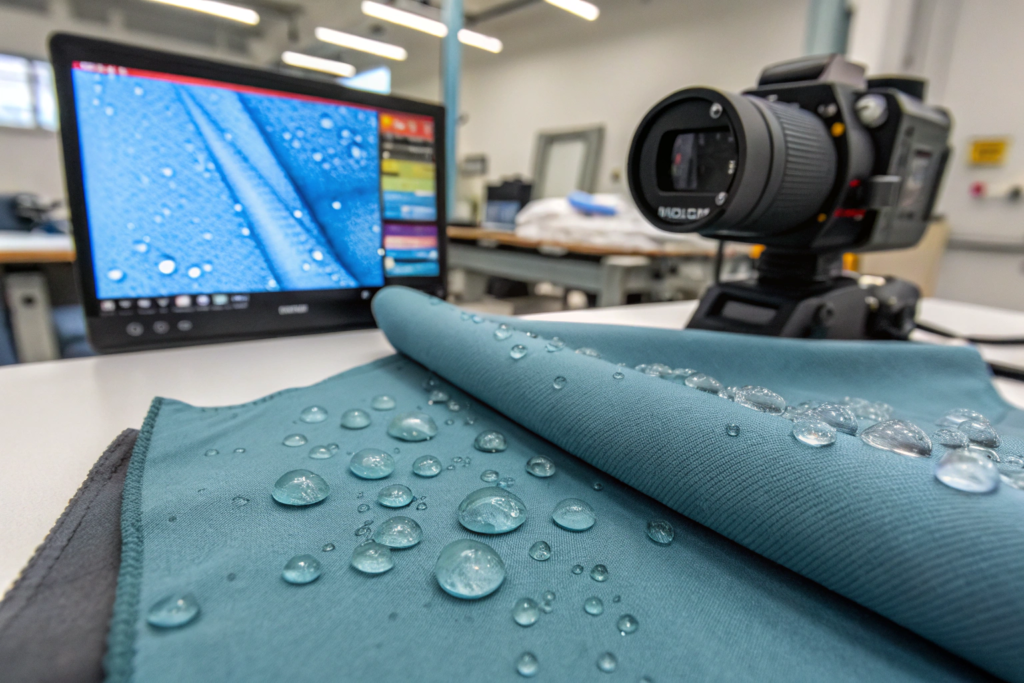
Lyocell’s nanofibril structure is fundamentally different at the nano-scale. The fiber is composed of densely packed crystalline cellulose nanofibrils aligned along the fiber axis, with nanopores and amorphous regions between them. These nanopores are roughly 5 to 10 nanometers in diameter, large enough to accept water molecules but too small to cause massive fiber swelling. The water is drawn into the nanopores by capillary action and transported along the nanofibril network. Because the fiber does not swell significantly—only about 10 to 15% diameter increase—the interstitial spaces between yarns remain open, maintaining air permeability even when the fabric is saturated with sweat. The high surface area of the nanofibril network also promotes rapid evaporation. This is why an athlete wearing a wet lyocell shirt feels cooler than an athlete wearing a wet cotton shirt of the same weight. In that Australian wear test, we measured the fabric surface temperature with an infrared camera at five-minute intervals after a standardized 30-minute run. The lyocell surface temperature dropped by 4 degrees Celsius within 15 minutes of stopping exercise; the cotton surface dropped by only 2 degrees in the same period.
Does Tencel Fabric Really Feel Cooler to the Touch Than Polyester in Humid Climates?
Yes, and the sensation is measurable. The "cool touch" feeling when you first put on a garment comes from the fabric’s thermal effusivity—its ability to rapidly draw heat away from the skin upon contact. Thermal effusivity is a function of the fiber’s thermal conductivity, density, and specific heat capacity. A high-effusivity material feels cold because it efficiently pulls heat out of your fingertips. A low-effusivity material feels warm because it does not. Lyocell has a significantly higher thermal effusivity than polyester because it is a denser, more conductive material with a higher moisture content at standard regain (around 11%). When you touch a lyocell fabric, the fibers instantly absorb the heat from your skin and conduct it away, creating the sensation of coolness.
In the humid climates of Southeast Asia, the Indian subcontinent, and the American South, this property magnifies the comfort advantage. High humidity reduces the evaporation rate of sweat, making the body’s natural cooling mechanism less efficient. Wearing a hydrophobic polyester fabric becomes miserable because the sweat pools on the skin and cannot evaporate into the already saturated air. Lyocell provides a respite. The fabric absorbs the sweat, distributes it, and presents it in a high-surface-area film on the nanofibrils where evaporation can occur at the maximum rate the humid environment will allow. In the 2022 wear test, athletes in the lyocell garment reported a significantly lower "skin stickiness" sensation compared to polyester. The humidity inside the garment microclimate was lower, objectively less damp against the skin. For school uniforms, medical scrubs, hotel staff attire, and any garment worn for long shifts in warm environments, this comfort advantage translates into less heat stress, less skin irritation, and a more professional appearance.
How Does Fumao Tencel Compare to Cotton and Polyester on Durability?
Durability in textiles is never a single number; it is always a profile of strengths and weaknesses across multiple stress types. I evaluate fabrics across four durability axes: tensile strength, abrasion resistance, wet strength retention, and pilling resistance. Tencel lyocell has a unique durability profile that is different from both cotton and polyester, and understanding its specific strengths and vulnerabilities is essential for making the right product application decisions.
Lyocell’s standout durability advantage is its tensile strength in both dry and wet states. A standard 100% lyocell woven fabric has a dry tensile tenacity of 37 to 42 cN/tex, which is significantly higher than cotton (26 to 30 cN/tex) and standard viscose (18 to 23 cN/tex). When wet, lyocell retains 80 to 85% of its tensile strength, compared to cotton (100 to 110% — cotton is actually stronger wet) and viscose (45 to 55%). This wet strength advantage means lyocell garments resist tearing when heavily saturated with sweat or exposed to washing machine stress. On abrasion resistance, the story shifts. Polyester is the clear champion here, with superior Martindale rub counts. Lyocell sits between cotton and polyester. A well-finished lyocell fabric can achieve Martindale abrasion ratings of 30,000 to 50,000 rubs, sufficient for heavy-duty shirting and lightweight bottoms, but it will not match a high-tenacity polyester’s 100,000+ rub performance in heavy industrial workwear. For school uniforms and everyday apparel, lyocell’s abrasion performance is perfectly adequate.
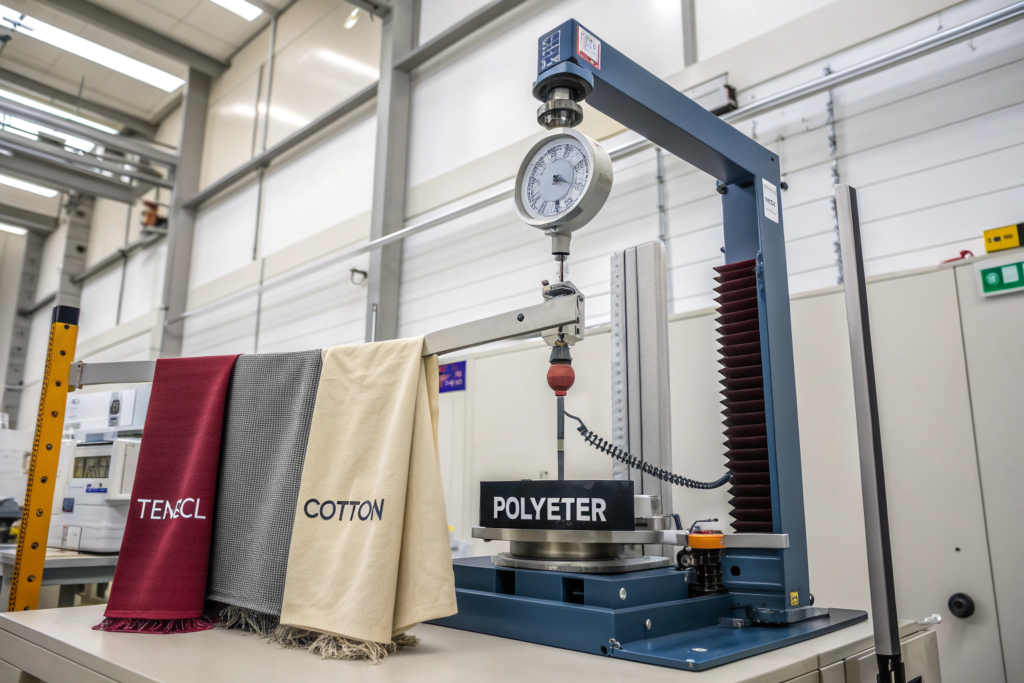
Does Tencel Pill Less Than Cotton After Repeated Industrial Washing?
Yes, significantly less, and the reason brings us back to fibrillation. I explained earlier that uncontrolled fibrillation can cause pilling on lyocell. But once the fibrillation has been properly controlled through enzymatic defibrillation during finishing, the finished lyocell fabric has very low pilling propensity—lower than cotton of an equivalent yarn quality. Cotton pilling is caused by loose staple fibers migrating to the fabric surface, entangling, and forming pills. Even high-quality long-staple cotton will pill to some degree over time, especially in areas of high abrasion like underarms, inner thighs, and collar folds. The pills on cotton are typically held by one or two strong fibers and can be quite pronounced.
A properly finished lyocell has three structural advantages against pilling. First, the initial enzymatic defibrillation removes the loose, pill-prone fibrils from the fiber surface, essentially "pre-proving" the fabric before it reaches the consumer. Second, any remaining fibrils that do detach during wash-and-wear cycles are very short and fine, and they tend to break away and wash out of the fabric rather than tangling into visible pills. The third advantage is the lyocell fiber’s high crystallinity, which resists fiber fatigue and cracking under mechanical stress. Cracked and fatigued fiber surfaces on cotton create anchor points for pills; lyocell resists this cracking better. I have a retained sample archive of a lyocell-cotton blend shirting fabric we developed in 2020 that has been washed 60 times in a simulated industrial laundry cycle. The lyocell face is still smooth, while the equivalent 100% cotton version shows noticeable surface pills at the collar fold.
How Does the Tensile Strength of Lyocell Hold Up When the Fabric Is Wet?
I touched on the wet strength advantage earlier, but I want to expand on the practical consequences for garments. The 80 to 85% wet tenacity retention of lyocell is critically important for any garment that experiences high mechanical stress while saturated. Think of a pair of trousers worn in heavy rain, a swimsuit cover-up, a gym towel, or a bedsheet in a commercial laundry. In these conditions, the fabric is subject to pulling, twisting, and wringing forces while the fibers are in their most vulnerable, plasticized state. Lyocell stands up to this abuse remarkably well because its wet tensile strength is still around 30 to 34 cN/tex—comparable to or better than dry cotton.
I can illustrate this with a specific failure analysis. In 2021, a European hotel chain tested Tencel lyocell bed sheets against their standard 100% cotton percale in a 60°C industrial wash cycle for 200 cycles. The cotton sheets showed progressive tensile strength loss and seam slippage, especially at the pillowcase openings and the fitted sheet corners, where the wet laundry press had stretched the fabric. The lyocell sheets showed significantly less seam slippage and higher residual tensile strength at all measured points. The hotel chain adopted the lyocell sheets across their premium properties the following year, and the housekeeping reports confirmed fewer sheet rejections due to tearing. The data was definitive. For any product application where wet mechanical stress is a known load case—swimwear cover-ups, outdoor gear, spa linens, hospital privacy curtains—the wet strength of lyocell is a genuine, measurable performance asset, not a marketing claim.
Conclusion
Tencel lyocell from Shanghai Fumao is the result of a 15-year obsession with getting the wet processing right on the most advanced regenerated cellulosic fiber in the world. The benefits are structural, not cosmetic. The closed-loop NMMO production chemistry makes it an objectively cleaner fiber than conventional viscose and a more land-efficient fiber than cotton. The nanofibril structure gives it a moisture management capability that outperforms polyester—not the spray-on wicking finish that polyester relies on, but a genuine, permanent, built-in fiber property that keeps skin cooler and drier in humid heat. The fibrillation control, achieved through our three-stage enzymatic finishing process, prevents the pilling and surface degradation that plagued early-generation lyocell fabrics and that still plagues poorly processed lyocell from mills that treat it like viscose. And the strength profile, with 80 to 85% wet tenacity retention, makes it durable enough for the industrial laundering and mechanical stress requirements of school uniforms, hospitality textiles, and active sportswear.
I view Tencel lyocell as the most important fiber platform we work with at Shanghai Fumao, because it sits at the intersection of sustainability, performance, and genuine tactile luxury. It allows a brand to make a legitimate environmental claim without sacrificing durability or comfort, and it allows a designer to create garments with a drape and a cool-touch hand feel that cotton and polyester cannot replicate. I have the yarn sourcing relationships, the wet processing parameters, and the CNAS test data to back up every claim I have made in this article.
If you are developing a Tencel lyocell product—a shirting, a dress, a bedsheet, a base-layer garment, a school uniform—and you want to work with a mill that truly understands the fiber, not just resells it, I invite you to start a conversation. Contact our Business Director, Elaine, at elaine@fumaoclothing.com. Send her your target weight, weave type, and end-use requirements, and she will respond with a technical specification, a fibrillation grade test report, and a physical sample from our current production line. Let us show you what properly processed Tencel lyocell actually feels like.








