
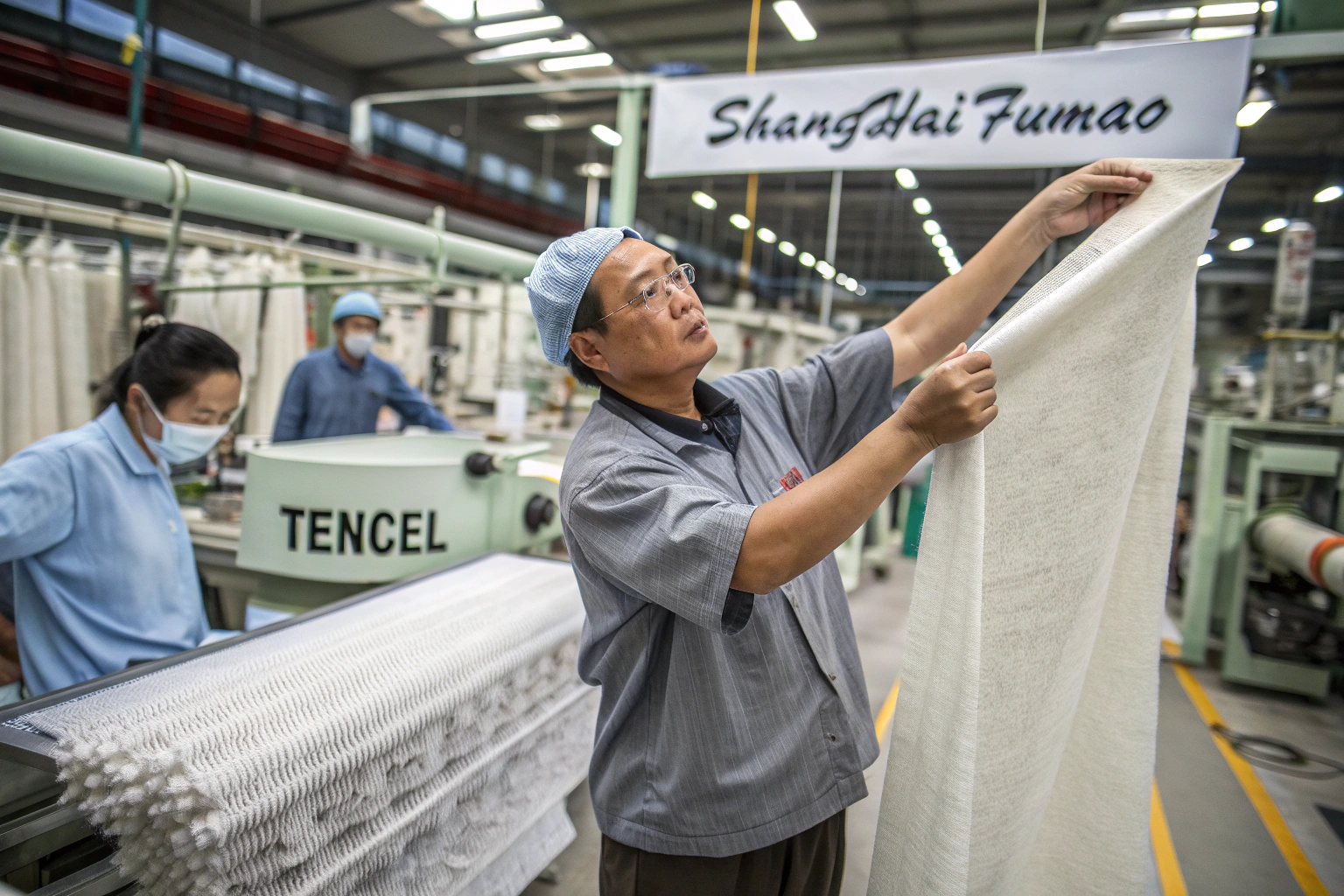
You are costing out a new capsule collection. The fabric supplier sends you two options: a standard viscose twill at $3.20 per meter and a Tencel-branded lyocell twill at $5.10 per meter. That is a 59% premium for what looks, on the surface, like the same fiber category. Both are made from wood pulp. Both are soft, drapey, and breathable. Both are labeled "regenerated cellulose." You stare at the two prices and wonder if Tencel is just a fancy trademark with a sustainability story attached, or if there is a genuine, material difference that your customer will perceive and pay for.
Tencel is more expensive than generic viscose in 2026 because it is manufactured through a fundamentally different chemical process with higher capital costs, higher energy costs, and a closed-loop solvent recovery system that generic viscose plants do not have. The fiber properties that result from this process—higher wet strength, better fibrillation control, and a smoother hand feel—are real and measurable. But the price gap has widened in recent years due to tightening EU environmental regulations, rising carbon costs, and a surge in demand for verified sustainable fibers that has outpaced lyocell production capacity expansion. At Shanghai Fumao, I buy both viscose and Tencel for different product tiers and different brand requirements. I am going to explain the manufacturing chemistry behind the price gap, the physical differences you can actually feel in a finished fabric, and the regulatory pressures that are making viscose more expensive and Tencel more demanded simultaneously.
What Chemical Process Difference Makes Tencel Production Costlier?
Viscose and Tencel both start with wood pulp. The difference is how that pulp is transformed into a spinnable fiber. Viscose uses a chemical-heavy, multi-step process that has been largely unchanged for over a century. Tencel, which is the branded form of lyocell produced by Lenzing AG, uses a modern closed-loop solvent process based on N-methylmorpholine N-oxide (NMMO). The viscose process is cheaper per kilo of installed capacity because the chemical inputs—caustic soda, carbon disulfide, sulfuric acid—are commodity industrial chemicals with low prices. The lyocell process is more expensive because the NMMO solvent is expensive, the recovery system is capital-intensive, and the entire process must be hermetically sealed to prevent solvent loss.

Why Does the "NMMO Solvent Recovery" System Add So Much Capital Cost?
The NMMO solvent is the heart of the lyocell process. It dissolves cellulose directly, without the need to chemically derivatize the pulp into an intermediate compound. The solvent is not consumed in the reaction. It is used, recovered, purified, and reused in a closed loop. The recovery rate in a modern Lenzing lyocell plant exceeds 99.5%. Less than 0.5% of the solvent is lost per production cycle.
But that 99.5% recovery rate is not cheap. The recovery system involves multiple stages of filtration, evaporation, and purification. The solvent must be separated from the water used in the spinning bath, reconcentrated to the exact specification, and returned to the dissolution step without contamination. The equipment required—thin-film evaporators, membrane filtration units, precision pumps—is specialized and expensive. A lyocell plant costs roughly 30% to 50% more to build than a viscose plant of equivalent capacity. That capital cost is amortized over every kilo of fiber produced for the 20-year life of the plant. It is baked into the Tencel price permanently.
What Is the "Carbon Disulfide" Problem That Makes Viscose Cheaper but Dirtier?
Viscose manufacturing converts cellulose into a soluble derivative called cellulose xanthate by reacting it with carbon disulfide (CS2). Carbon disulfide is cheap, effective, and toxic. It is a neurotoxin that poses serious occupational health risks to workers and releases sulfur compounds into the air and water if not captured. Modern viscose plants in Europe and North America have expensive scrubber systems that capture most of the CS2 emissions. But many older viscose plants in Asia, where the majority of the world’s viscose is produced, have minimal emission controls.
The cost of running those scrubbers—the energy, the maintenance, the chemical replacement—adds to the viscose production cost. But the cost of not running them is even lower, which is how budget viscose achieves its rock-bottom price. The environmental and human health costs are externalized onto the surrounding community, not captured in the per-kilo fiber price. When you buy cheap generic viscose, a portion of the price gap versus Tencel is explained by this externalization. Tencel cannot externalize its costs because the closed-loop process physically cannot operate without the solvent recovery system running. The environmental performance is engineered into the process, not bolted on as an optional scrubber.
How Do the Physical Properties of Tencel Justify Its Price Premium?
The price difference between Tencel and viscose is not just a sustainability premium. It is also a performance premium. Tencel fibers are stronger, especially when wet. They fibrillate in a controlled, predictable way that can be used to create beautiful peach-skin finishes. Generic viscose fibers are weaker, especially when wet, and their fibrillation is chaotic and often leads to unattractive surface fuzzing and pilling. The consumer experiences these differences as a garment that washes better, pills less, and feels smoother against the skin for longer.

Why Does Tencel Retain 85% of Its Dry Strength When Wet?
Standard viscose loses approximately 40% to 50% of its tensile strength when saturated with water. This is because the viscose process produces a fiber with relatively short polymer chains and a less crystalline internal structure. Water molecules penetrate the amorphous regions of the fiber, break the hydrogen bonds between cellulose chains, and the fiber weakens dramatically. A wet viscose garment is fragile. It tears easily, abrades easily, and must be handled with care during laundering.
Tencel lyocell retains approximately 85% of its dry strength when wet. The lyocell process produces a fiber with longer cellulose polymer chains and a higher degree of crystallinity. The crystalline regions are resistant to water penetration. The hydrogen bonds that hold the cellulose chains together survive the wet state. A wet Tencel garment is still strong. It can be machine washed and tumble dried without the catastrophic strength loss that plagues viscose. This wet strength difference is the single most important technical justification for the Tencel price premium. It translates directly into garment durability and consumer satisfaction. I have tested Tencel and viscose fabrics side by side in our lab at Shanghai Fumao, and the wet tear strength difference is not subtle. Tencel wet tears at roughly double the force of an equivalent-weight viscose.
What Is "Fibrillation" and Why Does Tencel Do It Better?
Fibrillation is the tendency of wet cellulose fibers to develop micro-fine hair-like splits on their surface when subjected to mechanical abrasion. Under a microscope, a fibrillated fiber looks like it has sprouted thousands of tiny tendrils along its length. Uncontrolled fibrillation produces a hairy, fuzzy, unattractive surface. Controlled fibrillation, followed by an enzyme treatment that removes the fibrils, produces an extraordinarily smooth, soft, peach-skin surface called a "bio-polished" finish.
Tencel fibrillates more readily than viscose, which sounds like a disadvantage until you understand the control. Because Tencel’s fibrillation is predictable and uniform, a skilled finisher can use it deliberately to create premium surface effects. The fabric is tumbled in a wet state to raise the fibrils, then treated with a cellulase enzyme that shears them off at the root. The result is a surface smoothness that no other cellulose fiber can match. Generic viscose fibrillates unpredictably, often in patches, and the fibrils are more likely to tangle into pills than to shear off cleanly. The Tencel fibrillation control is why premium Tencel bedding and apparel have that signature silky, cool touch.
How Are EU Regulations Making Viscose More Expensive and Tencel More Demanded?
The price relationship between viscose and Tencel is not static. It is being actively reshaped by regulatory pressure, particularly from the European Union. The EU is the world’s largest consumer market for sustainable apparel, and its regulations are forcing viscose producers to either clean up their processes or lose market access. Cleaning up costs money, which shrinks the price gap with Tencel. Simultaneously, EU regulations and brand commitments are driving demand for verified sustainable fibers, which Tencel supplies and generic viscose often cannot.

How Does the "EU Taxonomy" Push Lyocell Over Viscose?
The EU Taxonomy for Sustainable Activities is a classification system that defines which economic activities are environmentally sustainable. It is not a ban on viscose. But it is a powerful market signal. The Taxonomy favors closed-loop lyocell production over open-loop viscose production. Financial institutions use the Taxonomy to guide green lending and sustainable investment funds. Apparel brands use it to guide their material sourcing strategies and their sustainability reporting.
A brand that has committed to an EU Taxonomy-aligned supply chain will preferentially buy Tencel over generic viscose, even at a higher price, because the Tencel purchase counts toward their sustainability targets and their ESG reporting. The generic viscose purchase might not. This demand-side pressure increases Tencel’s order book, which supports its price premium. Simultaneously, viscose producers that want to retain EU market access are investing in emission control upgrades that raise their production costs. Both sides of the market are moving toward a higher equilibrium price for regenerated cellulose, with Tencel commanding a consistent premium for its verified closed-loop performance.
What Is the "Carbon Border Tax" Impact on Imported Viscose?
The EU Carbon Border Adjustment Mechanism (CBAM), which began its phased implementation in 2023 and will be fully in effect by 2026, imposes a carbon price on imported goods equivalent to the carbon price paid by EU domestic producers under the Emissions Trading System. If a viscose plant in a non-EU country operates with a high carbon footprint and no carbon pricing, the EU importer must purchase CBAM certificates to cover the embedded emissions.
Viscose production, with its multi-step chemical processing and energy-intensive spinning, has a significant carbon footprint. Lyocell production, with its closed-loop solvent recovery, has a lower carbon footprint but still faces energy-related emissions. The CBAM effectively adds a tariff to imported viscose based on its carbon intensity. This shrinks the price advantage of budget viscose imported from regions with lax environmental standards. A $3.20 viscose fabric might see a $0.15 to $0.30 per meter CBAM-related cost increase by 2026. A $5.10 Tencel fabric, produced in a Lenzing plant in Austria with a lower carbon intensity, sees a smaller CBAM impact. The regulatory playing field is tilting toward cleaner production methods.
How to Decide Whether the Tencel Premium Is Worth It for Your Product?
The Tencel premium is not always worth paying. For some products, the performance differences are invisible to the consumer or irrelevant to the end-use. For others, the wet strength, the fibrillation control, and the sustainability story directly translate into higher sell-through and fewer returns. The decision is a function of the garment’s price point, the consumer’s expectations, and the mechanical demands of the end-use.

When Is Tencel the Clear Winner for Loungewear and Activewear?
Loungewear and activewear are the ideal categories for Tencel because they combine skin contact, moisture exposure, and mechanical stress. A Tencel loungewear set will feel cooler and smoother against the skin than a viscose set, and it will survive repeated machine washing without losing its silky hand feel. The consumer washes their favorite loungewear set dozens of times. Viscose will progressively roughen and lose strength. Tencel will maintain its character.
Activewear exposes the fabric to sweat—a wet state—and to repetitive stretching. Tencel’s high wet strength means the fabric does not weaken when the wearer perspires. Viscose’s low wet strength means a viscose-rich activewear garment is at risk of tearing at the seams during a workout. I recommend Tencel or a Tencel-rich blend for any garment that will be worn against the skin and washed frequently, especially if the retail price point is above $50. The consumer at that price tier expects durability, and Tencel delivers it.
When Is Generic Viscose Still the Smarter Commercial Choice?
Generic viscose is the smarter choice for fashion-forward pieces that will be worn a few times, on special occasions, and washed infrequently. A viscose challis dress with a beautiful print, retailed at a fast-fashion price point, does not need the durability of Tencel. The consumer buys it for the look and the drape, wears it to a party, and washes it gently. Viscose delivers the required performance at the required price.
Viscose is also the smarter choice for internal linings that are not directly exposed to wear and washing. A viscose lining inside a tailored jacket provides the same smooth, breathable comfort as a Tencel lining, at a significantly lower cost, and the lining is protected from abrasion by the jacket’s outer shell. I use viscose linings in mid-tier tailored garments and Tencel linings only in premium and luxury tiers where the sustainability story adds marketing value. At Shanghai Fumao, I guide my clients toward the right cellulose fiber choice based on their product category, their retail price point, and their customer’s laundering habits, not on a blanket preference.
Conclusion
Tencel costs more than viscose in 2026 because it is manufactured through a fundamentally different, cleaner, and more capital-intensive closed-loop solvent process. The N-methylmorpholine N-oxide solvent recovery system adds 30% to 50% to plant capital costs, and the solvent itself is an expensive specialty chemical that must be recovered at over 99.5% efficiency. The resulting fiber has measurably superior properties: 85% wet strength retention versus 50% for viscose, and controllable fibrillation that enables premium surface finishes. The price gap is being reinforced by EU regulations, including the Taxonomy and the Carbon Border Adjustment Mechanism, which are raising the cost of high-emission viscose production while increasing demand for verified closed-loop lyocell.
At Shanghai Fumao, I stock both generic viscose and Tencel-branded lyocell across a range of fabric weights and constructions. I help my clients choose between them based on the product’s end-use, the target price point, and the brand’s sustainability commitments. If you are evaluating cellulose fabric options and want to understand the cost-performance trade-off for your specific product, please contact our Business Director, Elaine. She can send you a swatch pack with viscose and Tencel versions of the same weave and weight, so you can test the wet strength and hand feel yourself. Email her at elaine@fumaoclothing.com. Let us match the fiber to the performance your brand promises.








