
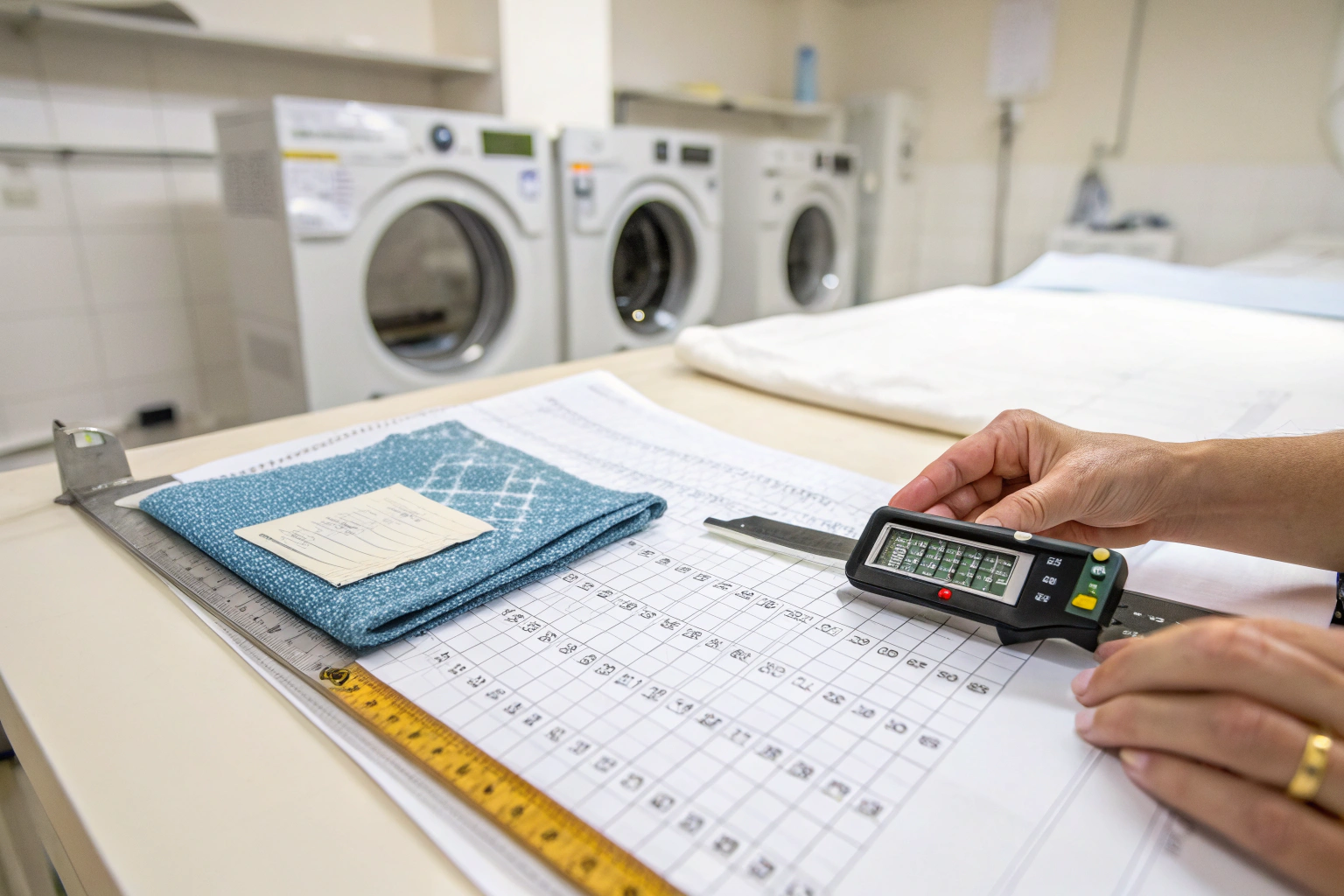
You get the PDF from your supplier. The subject line says "Shrinkage Test Report." You open it, expecting a simple "Pass" or "Fail." Instead, you see a table full of numbers: -2.3% length, -1.8% width, AATCC 135, 3 cycles, tumble dry. You are not sure if the minus sign is good or bad. You are not sure if a 2.3% shrinkage is acceptable or a disaster waiting for customer returns. You forward it to your pattern maker with a note: "Can we use this?" They reply: "I need to know the differential shrinkage before I can adjust the marker." Now you have a new word you do not understand, and a decision deadline in two hours.
A fabric shrinkage test report is not a Pass/Fail certificate. It is a diagnostic snapshot of your fabric’s dimensional stability under specific washing and drying conditions. The numbers tell you exactly how much a garment will change shape after your customer launders it, and whether that change will be uniform (annoying but manageable) or differential (a garment-ruining disaster). At Shanghai Fumao, I generate these reports for every bulk lot and I train my buyers how to interpret them, because a misinterpreted shrinkage report has killed more brand launches than bad zippers. I am going to walk you through the test methods, the math, the pass-fail thresholds, and the specific numbers that matter for different garment types.
What Do AATCC 135 and ISO 6330 Actually Measure?
AATCC 135 and ISO 6330 are the two global standard test methods for dimensional stability of woven and knit fabrics during home laundering. They are similar in principle but differ in critical details—water temperature, detergent type, washing machine design, and drying method. If you compare a shrinkage report tested to AATCC 135 against a different fabric tested to ISO 6330, you are comparing apples to slightly different apples. The test method matters because the same fabric can produce different shrinkage numbers under different standards. A North American buyer expects AATCC 135. A European buyer expects ISO 6330. You must know which standard your report uses and what the standard actually simulates.

How Does the AATCC 135 Washing Cycle Simulate Real Home Laundry?
AATCC 135 uses a specific top-loading washing machine model with a defined agitation speed, a specific water volume, and a standardized detergent. The test replicates what happens when your customer throws the garment into a typical American home washing machine. The fabric swatch is marked with a precise measurement grid, usually 50cm by 50cm, using an indelible pen or stitched benchmarks. It is placed in the machine with a ballast load—additional fabric pieces that simulate a full laundry load—and washed at a specified temperature: cold (27°C), warm (41°C), or hot (60°C).
After the wash cycle, the sample is dried according to the specified procedure. Tumble dry, line dry, drip dry, or flat dry are all options, and the choice dramatically affects the result. Tumble drying causes the most mechanical stress and typically produces the highest shrinkage figures. A report that says "AATCC 135, 3 cycles, 41°C wash, tumble dry medium" is telling you the fabric was put through three aggressive wash-and-dry cycles. The 3-cycle requirement is key because cumulative shrinkage over multiple washes is what your customer experiences. A fabric that shrinks 2% in the first wash might shrink another 1.5% in the second, and another 0.5% in the third, stabilizing at about 4% total. A single-cycle test is almost useless for predicting long-term performance.
What Is the Difference Between "Relaxation Shrinkage" and "Progressive Shrinkage"?
Relaxation shrinkage is the dimensional change that occurs when the fabric gets wet for the first time. During knitting or weaving, the yarns are under tension. When the fabric hits water, the yarns relax, and the fabric contracts. This is a one-time event. A well-finished fabric should have minimal relaxation shrinkage because the finisher has already wet-processed and relaxed the fabric through compaction or sanforization.
Progressive shrinkage is the dimensional change that continues with each subsequent wash. This is the dangerous one. Progressive shrinkage indicates that the fabric was not properly stabilized during finishing. The fibers continue to felt, or the yarns continue to contract, wash after wash. A fabric with 2% relaxation shrinkage and zero progressive shrinkage is stable and predictable. A fabric with 1% relaxation shrinkage and 1% progressive shrinkage per cycle for five cycles will shrink 6% total, and the customer will be furious by the third wash. A multi-cycle test report reveals which type of shrinkage you are dealing with. Always ask for a minimum 3-cycle test. A single-cycle report hides progressive shrinkage.
How to Interpret the Plus and Minus Signs on Your Report?
The plus and minus signs on a shrinkage report are not math errors. They tell you whether the fabric got smaller or larger. A minus sign means the dimension decreased—the fabric shrank. A plus sign means the dimension increased—the fabric grew. Both can be problems depending on the magnitude and the garment type. A fabric that shrinks in length and grows in width will change its aspect ratio, distorting the garment silhouette. A fabric that shrinks in both directions is simply smaller. Understanding the direction and the magnitude is the first step to deciding whether the numbers are acceptable for your specific product.

Why Does a Minus Sign Mean Shrinkage and a Plus Sign Mean Growth?
The formula for dimensional change is: (Final Dimension minus Original Dimension) divided by Original Dimension, multiplied by 100. If a 50cm marked length becomes 48.5cm after washing, the calculation is (48.5 – 50) / 50 x 100 = -3.0%. The negative sign is the mathematical result of the dimension getting smaller.
If a 50cm marked width becomes 51cm after washing, the calculation is (51 – 50) / 50 x 100 = +2.0%. The positive sign means the fabric expanded. Expansion happens when the yarns relax in one direction and push outward in the other. A knit fabric that shrinks heavily in length may actually grow in width because the loops are redistributing themselves. This is why you must read both length and width shrinkage together. A fabric with -5% length and +3% width has changed its dimensions by a total of 8%, even though the area change is smaller. Your pattern maker needs both numbers to adjust the marker correctly.
How to Calculate "Differential Shrinkage" Between Length and Width?
Differential shrinkage is the absolute difference between the length shrinkage percentage and the width shrinkage percentage. If your fabric has -3% length and -2% width, the differential is 1%. That is low and acceptable. If your fabric has -5% length and -1% width, the differential is 4%. That is high and problematic.
A high differential shrinkage causes garment distortion. A tee shirt cut on the grain will shrink more in one direction than the other. The side seams will twist. The hem will skew. The neckline will distort. This is not fixable by simply making the pattern larger because the distortion is not uniform. A fabric with low differential shrinkage can be compensated with a shrinkage-adjusted marker. A fabric with high differential shrinkage is fundamentally unstable and should not be cut until the finishing process is corrected. At Shanghai Fumao, I flag any differential above 3% for review before the fabric is released. The QC team re-checks the stenter frame settings and the compaction process to bring the width and length shrinkage back into balance.
What Are the Pass/Fail Shrinkage Limits for Different Garment Types?
There is no single universal shrinkage limit. A woven dress shirt, a pair of rigid denim jeans, and a stretch activewear legging have completely different acceptable shrinkage ranges. The limit depends on how the garment is worn, how it is fitted, and whether the consumer expects any shrinkage. A buyer who applies a woven shirt standard to a knit hoodie will reject perfectly good fabric. A buyer who does not know the standard for their category cannot enforce a specification.

Why Do Knits Tolerate More Shrinkage Than Wovens?
Knits stretch. A knit tee shirt that shrinks 3% in length can still be worn comfortably because the fabric stretches to fit the body. The consumer may not notice a 3% length reduction on a stretchy cotton jersey. A woven dress shirt that shrinks 3% in the sleeve length is a return. The customer buttons the cuff, the sleeve pulls up their forearm, and they cannot wear it. Wovens have no forgiving stretch.
The industry standard for woven apparel fabrics is typically +/- 2% maximum for length and width. For knit apparel fabrics, the standard is often -3% to -5% length, and -2% to -3% width. Some knit categories, like open-weave sweaters, can tolerate even more because the loose structure is designed to compress and stretch. The test report must be read against the correct category standard. I provide a shrinkage tolerance table in my fabric specifications at Shanghai Fumao, and I match the tolerance to the buyer’s end-use. A buyer who specifies +/- 1% for a knit hoodie is asking for a level of stability that the knit structure cannot physically deliver, and they will reject every lot.
What Is the "Consumer Warning" Threshold for Denim and Raw Fabrics?
Raw denim, unsanforized canvas, and other rigid, un-treated fabrics are designed to shrink. The consumer buys them oversized, soaks them in a bathtub, and wears them to achieve a custom fit. This is a feature, not a defect. But the shrinkage must be predictable and communicated. A raw denim that shrinks 8% in length and 5% in width is normal, provided the brand warns the customer: "This jean will shrink up to two sizes. Size up."
If the brand does not provide the warning, the returns will flood in. The test report quantifies the shrinkage, and the brand’s marketing and labeling must communicate it. I produce unsanforized selvedge denim for a heritage menswear brand. The shrinkage report shows -8% length, -5% width. The brand prints this exact information on the hangtag. The customer knows what to expect. There are no surprises. The test report is not just a QC tool. It is the source data for honest consumer communication.
How to Enforce Shrinkage Standards with Your Mill?
A shrinkage standard that exists only in your mind is not enforceable. You must write the standard into the purchase agreement with a specific test method, a specific cycle count, a specific drying method, and a specific maximum acceptable percentage for both length and width. You must also specify the remedy if the bulk lot fails. Without these four elements, you have no basis to reject a shipment that shrinks 6% when you expected 2%.

How to Write a Shrinkage Specification That Leaves No Ambiguity?
A proper shrinkage specification line in a purchase order looks like this: "Dimensional Stability: AATCC 135, 3 cycles, 41°C wash, tumble dry medium. Maximum acceptable change: -3.0% length, -2.5% width. Differential between length and width not to exceed 2.0%." Every parameter is defined. The test lab can read this line and execute the test with no interpretation required. The supplier knows exactly what standard they must meet. The buyer knows exactly what standard they can enforce.
The specification must also state the sampling protocol. "One sample per dye lot, taken from the left, center, and right of the fabric roll." A single sample from the center does not capture edge-to-edge variation. I include the sampling protocol in my internal QC standards at Shanghai Fumao, and I provide the full test results for every roll position to the buyer upon request.
What Is a Fair Remedy for Bulk Fabric That Exceeds Shrinkage Limits?
A fair remedy ladder has three rungs. Rung one: if the shrinkage is within 1% of the specified limit, the buyer accepts the fabric but receives a price discount, typically 5% to 8%, to compensate for the pattern adjustment and potential consumer complaints. Rung two: if the shrinkage exceeds the limit by more than 1% but the fabric is still usable with a re-cut pattern, the supplier pays for the pattern adjustment and provides a credit for the fabric loss. Rung three: if the shrinkage exceeds the limit by more than 3% or the differential exceeds 5%, the fabric is rejected, and the supplier must replace the lot at their own cost, including all freight.
This ladder is fair because it acknowledges that small deviations are manageable and large deviations are catastrophic. I include this remedy ladder in my supply agreements with buyers. It protects the buyer from a worst-case scenario and protects the mill from a buyer who weaponizes a 0.5% deviation to demand a free container.
Conclusion
A fabric shrinkage test report is a predictive tool, not a judgment. The numbers tell you exactly how your garment will behave in your customer’s washing machine, provided you read the test method, the cycle count, the plus and minus signs, and the differential between length and width correctly. AATCC 135 with 3 cycles and tumble dry is the most aggressive and predictive standard for the North American market. A minus sign means the fabric shrank; a plus sign means it grew. A differential above 3% is a garment distortion risk. Knits tolerate more shrinkage than wovens, and raw denim expects it. The standard is not universal, but it must be written, specific, and paired with a remedy ladder that both parties signed before the order was cut.
At Shanghai Fumao, I generate multi-cycle shrinkage reports for every bulk lot and I provide the full left-center-right data, not just an average. I want my buyers to see exactly what they are getting before the container leaves the port. If you are reviewing a shrinkage report and need a second opinion, or if you want to build a shrinkage specification into your next purchase agreement, please contact our Business Director, Elaine. She can send you a sample of our standard QC report and walk you through the numbers on your current supplier’s test. Email her at elaine@fumaoclothing.com. Let us make sure your fabric fits your customer as perfectly on the tenth wash as it does on the first.








