You paid a premium. You built your brand around it. Your website says "100% GOTS-Certified Organic Cotton" in bold, confident letters right above the "Add to Cart" button. Your customer trusts you. They care about what touches their skin and what touches the planet. One day, a customer with a curious mind and a lighter flicks a flame onto a loose thread. Instead of turning to ash, it melts into a hard, black, plastic bead. They post the video on TikTok. By morning, your brand is viral for the wrong reason. You are not a fraud. You are a victim. But your customer does not care about the distinction.
Fabric fraud is the dirtiest secret in the textile supply chain. Virgin polyester pellets cost significantly less per kilo than organic cotton lint, and the chemical difference is invisible to the naked eye once the yarn is spun and the fabric is finished. A soft, brushed "cotton" fleece can be 40% polyester, and you will not feel it in your hand. At Shanghai Fumao, I have caught blended fabric passed off as pure organic cotton more times than I can count, and I have built a simple set of verification protocols that any brand, no matter how small, can execute. I am going to teach you the burn test, the bleach test, and the paperwork test. By the end of this, you will be able to spot a polyester impersonator in under sixty seconds.
What Does the "Burn Test" Reveal About Fiber Content Instantly?
The burn test is the great equalizer. It does not care about your supplier’s reputation. It does not care about the certificate on the wall. It cares about polymer chemistry. A cellulose fiber—cotton, linen, hemp, viscose—burns like paper. A synthetic fiber—polyester, nylon, acrylic—burns like plastic. The difference is unmistakable once you have seen both. You do not need a lab coat. You need a pair of tweezers, a lighter, a ceramic plate, and a small tuft of yarn pulled from the fabric in question. I train every new QC inspector at Shanghai Fumao on the burn test in their first week, because it catches the most egregious frauds before they ever reach a customer.

How Does a Cotton Flame Smell and Ash Differently from Polyester?
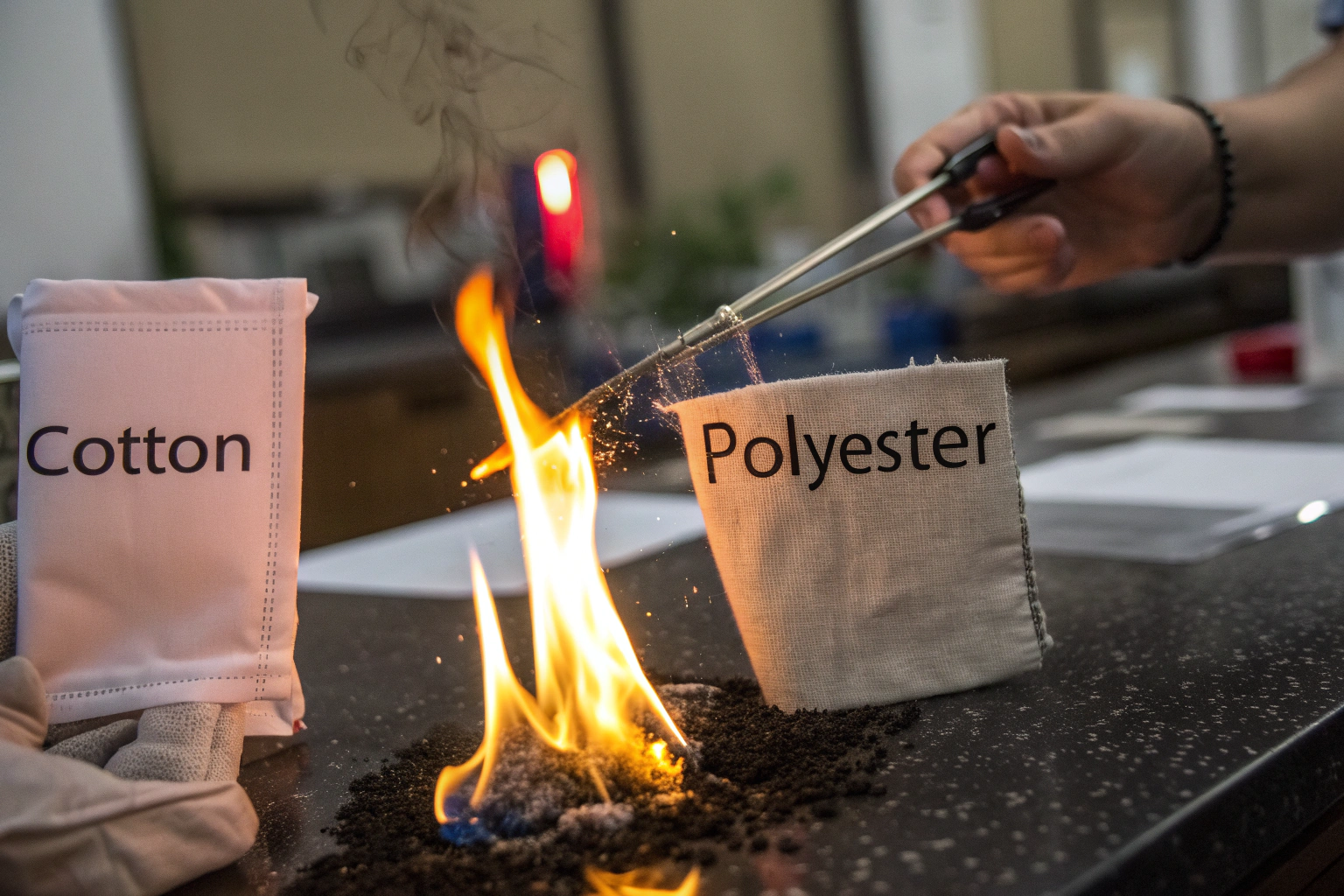
Pull a small tuft of yarn from the fabric, about the size of a cotton ball. Grip it with metal tweezers. Hold it over a ceramic plate—not a plastic surface, because polyester drips will melt onto plastic. Bring the flame close. Watch and smell.
Cotton ignites quickly. The flame is steady and yellow. The smoke is white and smells exactly like burning paper or burning leaves. When the flame goes out, the ash is fine, soft, and grey. You can crush it to powder between your thumb and forefinger. There are zero hard lumps.
Polyester shrinks away from the flame before it ignites, like a vampire from sunlight. When it catches, it burns with a sputtering, black-smoke flame. The smell is acrid, chemical, and unmistakably like burning plastic. When the flame goes out—and it often self-extinguishes—the residue is a hard, shiny, black or dark brown bead. You cannot crush it. It is solid plastic. If your "100% organic cotton" fabric leaves a hard bead after a burn test, it contains synthetic fiber. There is no ambiguity. The bead is proof of polyester, nylon, or acrylic contamination. For a deeper understanding, learning how to interpret fiber burn test results for common blends will help you estimate blend ratios, not just detect the presence of synthetics.
Can the Burn Test Detect a Polyester Core Spun in Cotton?
Yes, but you have to look harder. A core-spun yarn wraps a cotton sheath around a continuous polyester filament core. The outer cotton burns like cotton. The inner polyester melts. The burn test of the whole yarn will produce some ash and some hard bead residue. You might see a small, hard pellet hidden inside a pile of grey ash. That pellet is the polyester core.
To reveal it, twist the yarn before you burn it. Untwist the individual plies under a bright light. If the yarn is core-spun, you will see a very fine, slightly shiny filament running down the center of the cotton wrapping. If you see it, pull it out with tweezers and burn it separately. It will melt. The outer cotton wrapping will burn clean. A pure cotton yarn will have no hidden filament. The twist test plus the burn test is the poor man’s spectrometer, and it will catch core-spun frauds that a standard burn test of the whole yarn might miss.
How Can a "Bleach Test" Expose Hidden Synthetics in White Fabrics?
White fabrics pose a special problem. You cannot easily see the difference between white cotton and white polyester because there is no dye to hide behind. The burn test still works, but there is an even simpler test for whites: bleach. Household chlorine bleach dissolves cellulose fibers. It does not dissolve polyester. Drop a swatch of your "100% organic cotton" into a glass of bleach, wait thirty minutes, and see what is left. If there is sludge at the bottom and clear liquid above, it was cotton. If there are intact threads floating, those threads are synthetic.

Why Does Cotton Dissolve in Chlorine While Polyester Floats?
Cellulose is a natural polymer built from glucose units linked by beta-1,4-glycosidic bonds. Chlorine bleach, sodium hypochlorite, is a powerful oxidizing agent. It attacks those glycosidic bonds and breaks the long cellulose chains into small, water-soluble fragments. The fabric literally disintegrates. Polyester, polyethylene terephthalate, is a synthetic polymer built from ester linkages. The aromatic ring in the PET chain makes it resistant to oxidation by hypochlorite. The bleach cannot break the polymer backbone. The polyester thread remains structurally intact.
The test is brutally simple. Cut a 5cm by 5cm swatch. Drop it into a glass beaker of undiluted household bleach. Stir gently. Wait 30 minutes. If the swatch has vanished into a cloudy sludge, the fiber was cellulose. If solid threads remain floating in the beaker, those threads are synthetic. I have used this test to catch a "100% organic cotton" interlining that was actually a 60/40 cotton-poly blend. The cotton dissolved. The polyester mesh remained, perfectly intact, a ghost of the hidden synthetic structure.
What Is the "Microscope Slide Test" for Blended Yarn Identification?
The bleach test tells you synthetics are present. The microscope tells you exactly what they are and in what proportion. A longitudinal view of a cotton fiber under a microscope shows a flat, twisted ribbon shape with convolutions. A polyester fiber is a smooth, straight, featureless cylinder. They look as different as a twisted rope and a glass rod.
You can buy a pocket microscope for twenty dollars. Place a single yarn on a slide, tease out the individual fibers with a needle, add a drop of water, and view at 100x magnification. If every fiber is a twisted ribbon, you have pure cotton. If you see smooth, straight rods mixed among the twisted ribbons, you have a blend. Counting the fibers is tedious, but even a visual estimate will tell you if the blend is 5% poly or 50% poly. I keep a pocket microscope in my briefcase when I visit yarn spinners. It has saved me from more than one "pure organic" claim that turned out to be contaminated with cheap acrylic.
What Documentation Must a Genuine Organic Cotton Supplier Provide?
Paper does not make cotton organic. But proper, verifiable paper trails make fraud detectable and punishable. A genuine organic cotton supplier operates under a certification body that audits their facility annually, traces their raw material purchases, and issues transaction certificates for every sale. A fake supplier prints a GOTS logo they found on Google Images and calls it a day. You need to know how to tell the difference between a certificate that has legal weight and a piece of marketing decoration.

How to Verify a GOTS Certificate Number Online in Real Time?
A genuine GOTS certificate has a license number, a scope of certification, and an expiration date. The license number is your key to verification. Go to the GOTS public database online, type in the license number, and check three things. First, does the company name on the database exactly match the company name on your supplier’s invoice? Second, does the scope cover the specific product category you are buying—yarn, fabric, or finished garment? Third, is the certificate status "Valid" and not "Expired" or "Suspended"?
I have seen trading companies photoshop their name onto a manufacturer’s GOTS certificate and hope the buyer does not check the database. The database check takes two minutes. It is free. It is the single most effective fraud prevention tool in organic textile sourcing. If you are sourcing organic fabric and want to understand the full verification process, learning how to authenticate a GOTS certificate through the official database is an essential step.
What Is a "Transaction Certificate" and Why Does It Trace Your Exact Roll?
A scope certificate says the factory is certified to produce organic fabric. A transaction certificate says this specific shipment of fabric was produced using certified organic raw materials. The TC is issued for a specific quantity, a specific lot number, and a specific buyer. It traces the organic fiber from the gin, through the spinner, through the knitter or weaver, through the dye house, and to the final seller.
If your supplier cannot provide a TC that matches your purchase order quantity and lot number, the fabric is not certified organic, even if the factory has a valid scope certificate. The TC is the proof that organic fiber actually flowed through the supply chain to your specific fabric. I provide a TC with every organic cotton lot I ship from Shanghai Fumao. The TC number is linked to our internal batch records, and the buyer can trace the bale origin directly from the TC document. No TC means no organic claim.
How to Commission a Third-Party Fiber Content Analysis for Peace of Mind?
Your burn test suggests the fabric is pure. Your bleach test came up clean. The GOTS certificate checked out. You are 95% confident. But if your brand’s entire reputation rests on a fiber content claim, you may want 100% confidence with a legal-grade test report to back it up. A third-party fiber analysis from an ISO 17025-accredited laboratory costs between $75 and $150 and takes about a week. The report will list every fiber present in the sample by percentage, down to a fraction of a percent. This report is admissible evidence if a customer or a regulator ever challenges your label claim.

What Is an AATCC 20 Quantitative Fiber Analysis and How Reliable Is It?
AATCC 20 is the standard test method for fiber analysis in textiles. The lab technician separates the fabric into its component fibers using chemical dissolution. They treat the sample with a solvent that dissolves one fiber type but not the other. For a cotton-polyester blend, they dissolve the cotton in sulfuric acid, and the remaining polyester is weighed. The weight loss is the cotton percentage. The residual is the polyester percentage.
The method is accurate to within plus or minus 2% to 3%. It will catch a 5% synthetic contamination. It will quantify a 60/40 blend exactly. The lab report will state the percentages and the test method used. If your supplier’s claim is "100% organic cotton" and the AATCC 20 report says "98% cotton, 2% polyester," that 2% might be contamination from the spinning mill’s machinery, not intentional fraud, but you now have the data to have an honest conversation with your supplier and decide whether the claim is defensible.
How to Use a "Spot Check" Program for Ongoing Quality Assurance?
A one-time lab test proves the sample you sent was clean. It does not prove the bulk lot you receive six months later is clean. Fiber content fraud can creep in when the supplier faces a cost squeeze and decides to "adjust" the blend without telling you. An ongoing spot-check program is your insurance policy against this drift.
I recommend to my brand clients that they pull one random roll from every third bulk shipment and send a cutting to their lab for a fiber content re-test. It costs $150 per test, and it keeps the supplier honest. If the supplier knows the buyer is testing randomly, the incentive to cheat evaporates. I welcome these spot checks at Shanghai Fumao. I tell my clients to test my fabric against my claims any time they want. The cost of the test is nothing compared to the cost of a recall or a reputation collapse.
Conclusion
Your organic cotton claim is only as strong as your ability to prove it. A polyester impersonator looks soft, feels brushed, and hangs beautifully on the rack. It will fool your hand. It will not fool a flame, a beaker of bleach, or an accredited lab’s sulfuric acid dissolution test. The burn test takes thirty seconds and costs nothing. The bleach test dissolves cellulose and leaves synthetics floating intact. The GOTS database verification takes two minutes online and exposes fake certificates instantly. The AATCC 20 quantitative analysis from an independent lab gives you a legally defensible fiber composition report.
At Shanghai Fumao, I stake my company on the integrity of our fiber claims. We maintain current GOTS and OCS certifications. We provide transaction certificates for every organic lot. We welcome random third-party testing of our bulk shipments. If you are sourcing organic cotton fabric and want a supplier whose documentation and physical product pass every test you can throw at them, please contact our Business Director, Elaine. She can send you our certification package, a sample cutting for your own burn test, and the contact details of the ISO lab we use for independent verification. Email her at elaine@fumaoclothing.com. Let us make sure your "100% organic cotton" claim is backed by chemistry, not just trust.