
You negotiated the fabric price down to $3.50 per meter. You feel good. The supplier confirmed the order, production is underway, and you mentally calculate your gross margin at a healthy 65%. Then the invoices start rolling in. The freight forwarder’s bill is $800 higher than estimated. Customs charges a duty rate you did not expect. The trucking company tacks on a fuel surcharge. Your cutting table discovers two meters of unusable fabric on every roll due to selvage damage. You sit down with your calculator, re-run the numbers, and realize your actual cost is $5.20 per meter. That 65% margin just shrunk to 42%, and you have already priced the garments. The profit is gone before the first piece is cut.
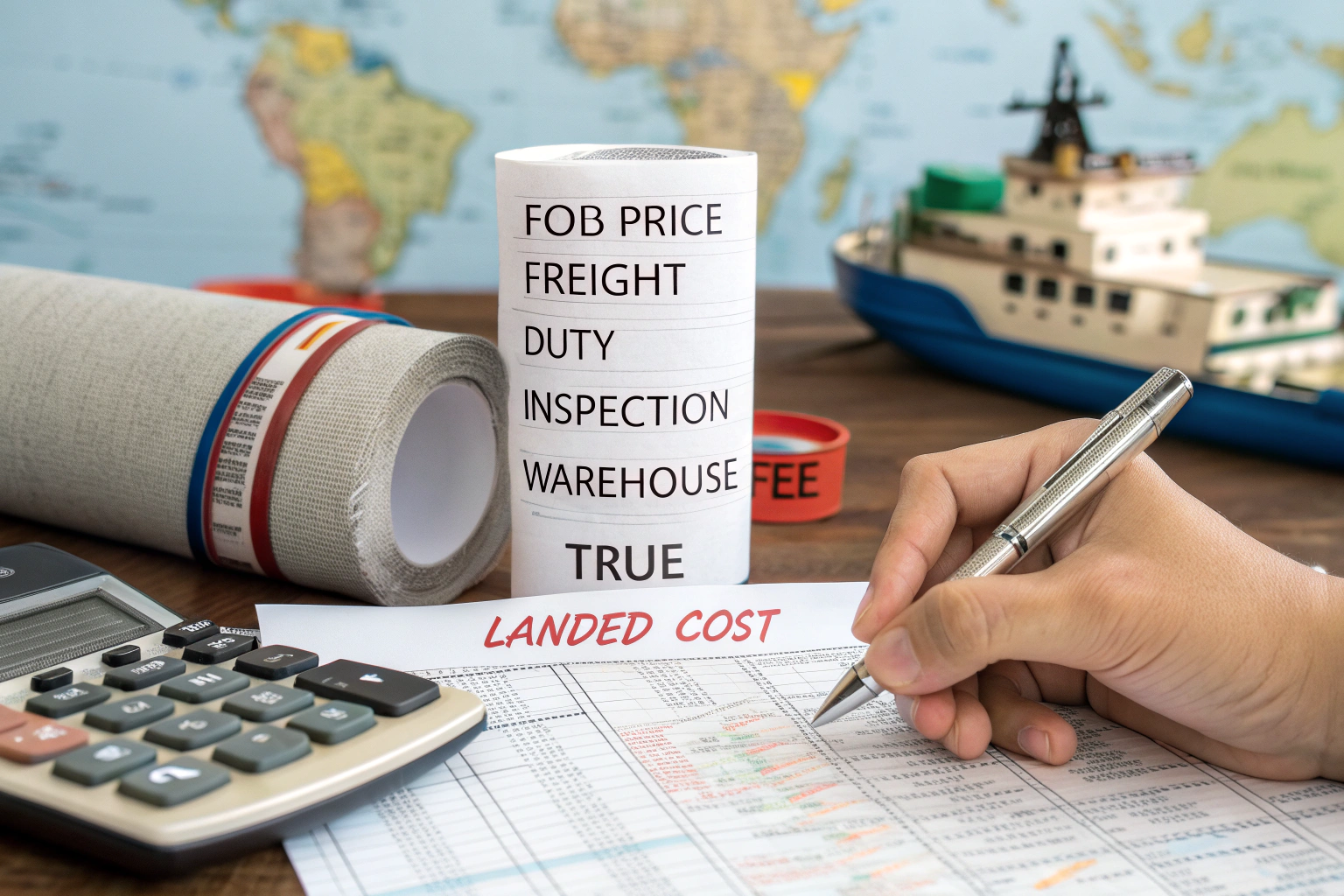
Most fabric buyers price their garments on the FOB cost—the price the factory charges to put the fabric on a ship. FOB stands for Free On Board, and it is a lie. It is not the cost of the fabric sitting in your warehouse, ready to cut. The true landed cost includes freight, duty, insurance, inspection, bank fees, currency conversion loss, port handling, and a hidden waste factor that nearly every first-time importer ignores. At Shanghai Fumao, I have watched thousands of buyers make this mistake, and I have built my export documentation to help them avoid it. I am going to walk you through the complete cost stack, including the ugly line items that nobody tells you about until the invoice arrives.
What Hidden Freight Charges Inflate the FOB Price?
The FOB price you negotiated with your supplier covers the fabric, the export packaging, and the trucking to the port. It stops at the ship’s rail. Everything that happens after the container crosses that rail—and some things that happen before it even gets there—is on you. The shipping line, the terminal, and the freight forwarder each have their own menu of surcharges that they rarely quote upfront unless you ask. These charges are not optional. They are not negotiable at the moment of shipment. They are the cost of doing business in a congested global shipping system.

Why Does "BAF" and "CAF" Appear on Your Freight Invoice?
BAF stands for Bunker Adjustment Factor. It is a fuel surcharge. Container ships burn heavy fuel oil, and the price of that fuel fluctuates with global crude oil markets. When oil spikes, the shipping line tacks a BAF onto your freight bill to recover the extra fuel cost without renegotiating the base freight rate. BAF is calculated as a percentage of the base freight or as a flat fee per container. In a volatile oil market, BAF can swing from $200 to $600 per 40-foot container within a quarter.
CAF stands for Currency Adjustment Factor. The shipping line’s costs are in a mix of currencies—fuel in US dollars, crew wages in Euros or local currency, port fees in the local currency of each call. When the US dollar weakens against these currencies, the line’s costs go up in dollar terms. The CAF is a surcharge that passes this currency risk to you. It is usually a small percentage, 1% to 5%, but on a $4,000 freight bill, that is an extra $40 to $200 you did not plan for. I always tell my clients to ask their forwarder for an "all-in" rate that includes BAF, CAF, terminal handling, and documentation fees. If the forwarder quotes a base rate only, double it mentally for your true cost estimate. For a more detailed breakdown, learning the difference between base freight and all-inclusive shipping rates is essential.
How Do "Port Congestion" and "Peak Season" Surcharges Work?
A port congestion surcharge is the shipping line’s penalty to you for the fact that the destination port is slow. If the Port of Los Angeles has a queue of 30 ships waiting to berth, the line’s vessel is burning fuel sitting idle at anchor. The congestion surcharge compensates the line for that waiting time. It can be $200 to $500 per container, announced with little warning, and applied to shipments already on the water.
The Peak Season Surcharge is a predictable annual event. From August to November, as retailers rush to stock for the holiday season, container demand spikes. The lines impose a PSS of $300 to $600 per container. You can avoid this by shipping earlier in the year, or you can negotiate a peak season waiver into your annual freight contract. I ship a lot of holiday collection fabric in June and July specifically to beat the PSS. The fabric sits in the client’s warehouse for an extra month, but the warehousing cost is less than the peak season surcharge. Math wins.
How to Accurately Estimate Customs Duty for Your Fabric Category?
Customs duty is not a flat percentage. It is a specific rate assigned to a specific 10-digit Harmonized Tariff Schedule code, and that code depends on the fiber content, the weave structure, the weight, and sometimes the intended end-use of your fabric. A 100% cotton woven poplin has a different duty rate than a 50/50 cotton-polyester blend poplin. A knitted fleece has a different rate than a woven velvet. Guessing the code or letting your supplier guess it is a financial gamble with retroactive penalties.

Why Does "Fiber Composition" Change Your Duty Rate by Double Digits?
The US tariff schedule discriminates sharply between natural and synthetic fibers, and between different blend ratios. A 100% cotton woven fabric might enter under Chapter 5208 or 5209, with a duty rate typically around 7% to 8%. A 100% polyester woven fabric enters under Chapter 5407 or 5512, with a duty rate that can range from 12% to 14.9%. That is a 5% to 7% difference on the entire invoice value, purely based on what the fiber is.
Blends are even trickier. A fabric that is 55% cotton and 45% polyester is classified under the cotton chapter because cotton predominates by weight. The duty rate follows the cotton rate. Flip the ratio to 55% polyester and 45% cotton, and the fabric moves to the polyester chapter, and the duty rate jumps. I have seen buyers misclassify a poly-cotton blend because they eyeballed the blend as "mostly cotton" and got hit with a Customs audit and a back-duty bill for two years of shipments. The only safe method is a lab test from a certified facility, with the composition printed on the mill test report, and the HS code verified by a licensed customs broker who specializes in textiles.
What is the "De Minimis" Threshold and When Does It Apply?
De Minimis is the Section 321 entry rule that allows shipments valued at $800 or less to enter the US duty-free and with minimal paperwork. For a small brand ordering samples or a tiny production run, De Minimis is a beautiful gift. Your 50-meter sample order, valued at $200 FOB, enters with zero duty and zero formal customs fees. You pay the freight and nothing else.
But De Minimis does not scale. If you split a $5,000 order into seven separate $700 shipments to dodge duty, that is called "structured importation," and CBP considers it customs fraud. The penalty is the forfeiture of the goods and a fine. I have seen small brands try this trick, and I always warn them off it. Use De Minimis honestly for genuine small-value shipments. For anything over $800, file the proper entry, pay the correct duty, and build that duty into your landed cost calculation as a fixed percentage. The risk of a fraud finding is not worth the duty savings.
What Are the "Soft Costs" of Importing That Most Calculators Miss?
The hard costs—freight, duty, insurance—are visible on invoices. The soft costs are the ones that do not arrive as a bill but drain your bank account and your time just the same. They include the wire transfer fee your bank charges to send money overseas, the currency exchange spread that silently skims 2% to 3% off your payment, the cost of the hours you spend managing logistics instead of designing, and the cost of the fabric you pay for but cannot use. These soft costs often add 5% to 8% to your landed cost, and they are completely invisible in a standard FOB-plus-freight calculation.

How Does "Currency Exchange Spread" Silently Steal Margin?
When you wire $10,000 to a Chinese supplier, your bank does not convert your dollars to yuan at the mid-market rate you see on Google. Google shows the interbank rate, which is the rate banks trade at. Your bank gives you the retail rate, which includes a spread of 2% to 5% built into the exchange rate itself. They do not list this as a separate fee. They just give you a worse rate and pocket the difference.
On a $10,000 fabric order, a 3% spread is $300. That is real money. You can reduce this by using a specialist international transfer service that offers rates closer to the interbank mid-rate, or by negotiating a better spread with your bank if you transfer regularly. I tell my clients to compare the rate their bank offers against the XE.com mid-market rate at the exact moment of transfer. The difference is their spread. A 0.5% spread is excellent. A 3% spread is a silent margin killer.
What is "Fabric Yield Loss" and How Do You Budget for It?
Fabric yield loss is the difference between the meters you paid for and the meters you actually cut into garments. Every roll has some waste: the first meter might be shopworn from being unrolled for inspection, the selvage might be unusably tight or damaged, the end of the roll might have a splice or a defect that must be cut around. A well-run cutting room with first-quality fabric typically loses 2% to 4% to yield loss. A poorly-run cutting room with lower-grade deadstock can lose 8% to 12%.
A 5% yield loss on a 2,000-meter order is 100 meters you paid for but cannot sew. If your fabric cost is $4 per meter, that is a $400 hidden cost. I always build a 5% yield loss factor into my own landed cost calculations, and I recommend my clients do the same. Order 5% more fabric than your cutting ticket requires. The small overage is far cheaper than an emergency reorder with air freight when you run short on a sold-out style. For more information on minimizing cutting waste, looking into practical fabric yield optimization strategies for small apparel brands can save real money.
How to Build a Landed Cost Calculator That Actually Works?
You do not need expensive supply chain software. You need a spreadsheet with every cost line item, a formula that sums them, and the discipline to fill it out for every single order before you negotiate with a supplier. I have built a simple landed cost calculator template that I share with my buyers at Shanghai Fumao. It forces them to list every cost, including the soft costs, and it produces a single number: the true cost per meter sitting in their warehouse, ready to cut. That number, not the FOB price, is the basis for garment pricing.

What Line Items Must Your Spreadsheet Include for Full Accuracy?
A complete landed cost spreadsheet includes at minimum these line items, each as a separate row with a cost per meter calculated by dividing the total cost by the usable meters:
- FOB Fabric Cost: The price per meter paid to the supplier.
- Inspection Fee: Third-party inspection cost per meter, if used.
- Freight (Ocean or Air): The all-in freight cost including all surcharges.
- Insurance: Marine cargo insurance, typically 0.3% to 0.5% of the invoice value.
- Customs Duty: The correct percentage applied to the FOB value.
- Customs Bond and Broker Fee: Per-shipment fees divided by total meters.
- Port and Terminal Handling: Destination port charges.
- Trucking to Warehouse: Delivery from port to your door.
- Bank Transfer Fee: Wire fee divided by total meters.
- Currency Exchange Spread: The percentage loss on the exchange rate.
- Yield Loss Provision: 3% to 5% added to the per-meter cost.
Add the FOB cost, the per-meter freight, the duty percentage on FOB, and all the fees. Then multiply by the yield loss factor. The formula is not complicated: true cost per usable meter equals the sum of all costs divided by the usable meters after waste. The hard part is the discipline of collecting all the numbers before you price your garments.
How to Use "Scenario Planning" to Stress-Test Your Costs?
Freight rates change. Duty rates can be revised by trade policy shifts. Your landed cost is not a single number; it is a range. A smart buyer runs three scenarios before committing to a large order. A "Best Case" scenario with the current freight rate and no surcharges. A "Likely Case" with a 10% freight buffer and the standard yield loss. And a "Worst Case" scenario with a 25% freight spike, a port congestion surcharge, and a higher yield loss from an unfamiliar factory.
If your garment pricing is still profitable in the Worst Case, you have a resilient supply chain. If the Worst Case wipes out your margin, you know exactly where your risk lives—freight volatility, duty uncertainty, or quality inconsistency—and you can take steps to mitigate it. I run these scenarios with my clients during the quoting phase. A transparent supplier will help you model the range. A supplier who only tells you the FOB price and says "shipping is cheap, don’t worry" is setting you up for a margin surprise.
Conclusion
The true landed cost of a fabric roll is not a single number on a proforma invoice. It is a carefully constructed stack of hard costs, soft costs, and waste factors that accumulate from the moment the yarn is spun to the moment the roll hits your cutting table. The FOB price is just the foundation. On top of it sits freight with its BAF, CAF, peak season, and congestion surcharges. Then customs duty, calculated on a specific HS code that depends on the exact fiber blend. Then the invisible margin killers: the currency exchange spread, the bank wire fee, and the 3% to 5% of fabric that never becomes a garment because of yield loss. If you price your product on FOB alone, you are pricing it on a fantasy.
At Shanghai Fumao, I want my buyers to have the full cost picture before they place the order. I provide the FOB price, the estimated freight range, the correct HS code for their fabric category, and the roll-by-roll inspection data that allows them to predict yield loss accurately. If you are preparing a new collection and need a supplier who helps you calculate the true landed cost, not just the factory price, please reach out to our Business Director, Elaine. She can send you our landed cost calculator template and walk you through the specific freight and duty estimates for your fabric type and destination port. Email her at elaine@fumaoclothing.com. Let us make sure your margin survives the journey from Keqiao to your cutting room.








