You are standing in your flagship store, the one you spent six months designing, with the perfect warm-track lighting that makes every customer look like they are glowing. You walk over to the new collection rack, and your stomach drops. Your "Midnight Navy" linen blazer looks black. Not dark blue. Black. You lean in, squint, and tilt the hanger. Under the focused beam of the 3000K LED spotlight, there is no blue to be found. You pull out your phone, turn on the flashlight, and hold it directly against the sleeve. There it is. Navy. You are not crazy. Your fabric did not change color during shipping. Your lighting did.
This phenomenon is called metamerism, and it is the most frustrating, least understood color problem in the textile industry. Two fabrics that match perfectly under one light source can look completely different under another. A navy that reads as a rich, deep blue in your D65 daylight office can read as dead black under the warm, low-color-temperature lights that dominate retail boutiques. At Shanghai Fumao, I have debugged metameric failures for brands ranging from luxury suiting to fast fashion, and the root cause is almost never the dye alone. It is the spectral reflectance curve of the dye-fiber combination interacting with the spectral power distribution of the store’s light source. I am going to explain metamerism in plain English, show you how to specify a light source for color approval, and give you a simple test you can do in your own studio before you commit to a bulk dye lot.
What Is Metamerism and How Does It Trick the Human Eye?
Metamerism is a color-matching illusion. Two objects with completely different spectral reflectance curves—the chemical fingerprints of how they absorb and reflect light across the visible spectrum—can appear identical under one light source and dramatically different under another. This happens because color is not a physical property of the object. Color is a perception created by your brain based on the wavelengths of light that enter your eye. Change the light source, change the wavelengths, change the color. The fabric did not change. The physics of the light reaching your retina did.

Why Do Two Navy Dyes Look Identical in Daylight but Split Under LEDs?
A standard navy fabric can be dyed with dozens of different dye recipes. One recipe might use a pure navy reactive dye. Another might use a mixture of red, blue, and yellow dyes to build a navy shade. To the naked eye under natural daylight, both recipes produce the same navy color. But the spectral reflectance curves are completely different. The pure navy dye reflects a narrow band of wavelengths around the blue region. The mixed recipe reflects a broader spectrum with peaks in the red, blue, and yellow regions that, when combined by your eye, produce the sensation of navy.
Under daylight, which has a full, continuous spectrum of wavelengths, both recipes stimulate your eye’s cone cells in the same way. The match works. Under a narrow-spectrum LED light, which has spikes at specific wavelengths, the recipes diverge. The LED might lack the red wavelengths that the mixed recipe needs, suppressing its red reflectance and making the fabric look more blue or more purple than intended. Or it might lack the blue wavelengths the pure navy needs, suppressing its blue reflectance and making it look black. The match that was perfect under daylight collapses under LED. This is why I ask every buyer what light source their store uses before I approve a dye recipe. The recipe must be evaluated under the actual light source where the garment will be sold.
What Is "Illuminant Metamerism" vs. "Observer Metamerism"?
Illuminant metamerism is the most common type. It is the color mismatch caused by changing the light source. Daylight to LED, LED to fluorescent, fluorescent to halogen. Each light source has a different spectral power distribution, and each interacts differently with the fabric’s spectral reflectance curve. This is what you experienced in your store.
Observer metamerism is less common but equally real. It is the color mismatch caused by differences between individual human observers. Your color perception depends on the exact distribution of cone cells in your retina, which varies from person to person, and on the age-related yellowing of your eye’s lens. A 25-year-old QC technician and a 65-year-old brand owner can look at the same fabric under the same light and disagree on the color match. The younger eyes have clearer lenses and see more blue. The older eyes have yellowed lenses and see less blue, shifting navy perception toward black. You cannot argue someone out of observer metamerism. You can only use a spectrophotometer, which has no age, no bias, and no retinal variation. The spectrophotometer reads the spectral reflectance curve mathematically. That reading, expressed as a Delta E value under a specified illuminant, is the objective standard that overrides human disagreement.
How to Test Your Fabric Under Multiple Light Sources Before Approval?
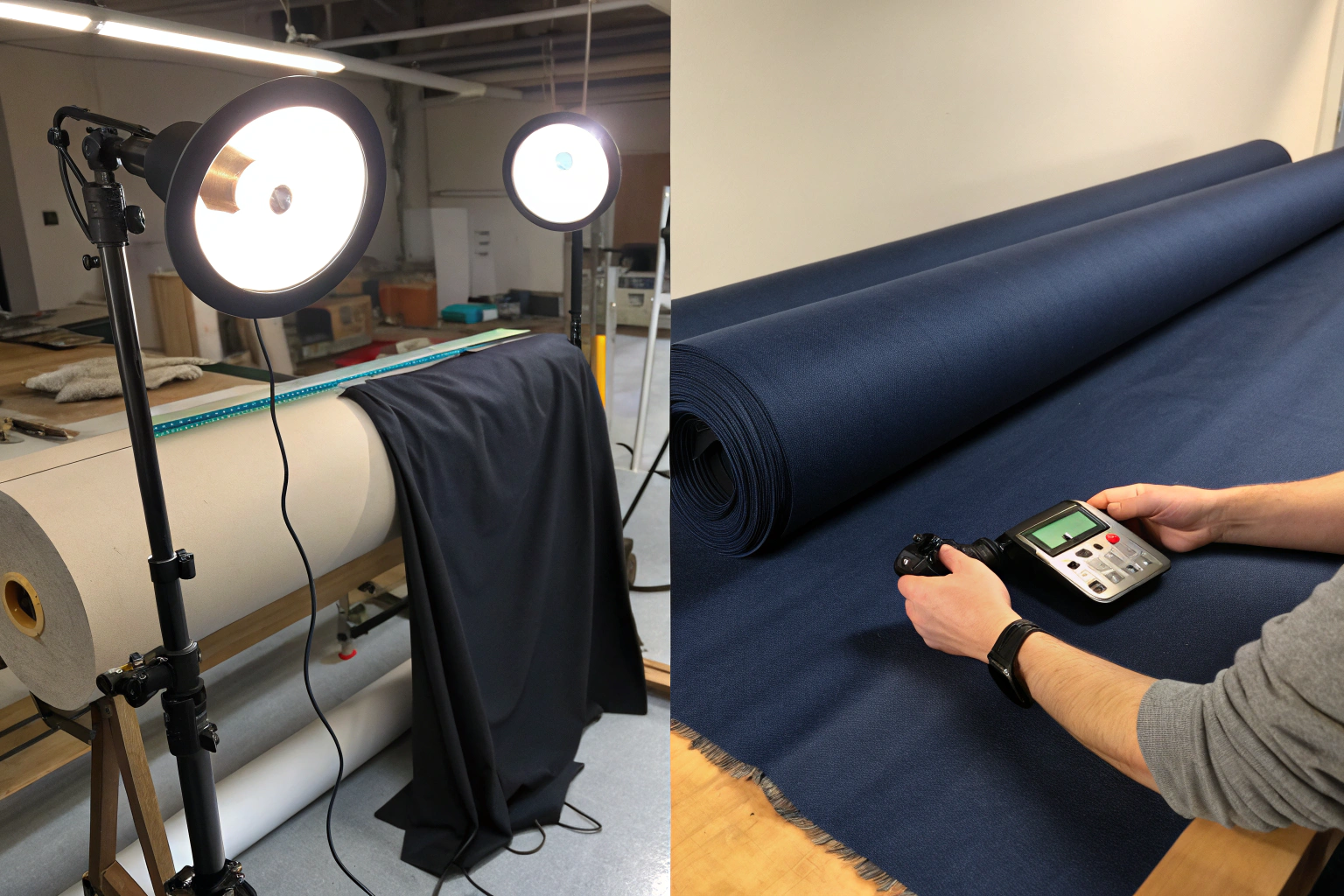
You do not need to ship fabric to your store to discover a metamerism problem. You can catch it at the lab dip stage, before a single meter is dyed. The tool is a light booth, sometimes called a color-matching cabinet, which contains multiple standardized light sources. The standard set includes D65 (simulated daylight), TL84 or CWF (cool white fluorescent, common in office and retail environments), and A or F (incandescent or warm LED, common in boutique and home settings). You evaluate the lab dip under each light source, comparing it to your reference standard, and you look for any shift in hue, saturation, or lightness.

What Is a "Light Booth" and How Do You Use One for Color Approval?
A light booth is a box lined with neutral grey walls and equipped with switchable lamps that simulate different standard illuminants. The grey walls are critical because a colored wall would contaminate the visual perception. The booth eliminates ambient room light so that the only light reaching the fabric is the standardized source.
Place your reference standard—the Pantone chip or the sealed fabric swatch you approved—side by side with the lab dip. Do not overlap them. Leave a small gap so you can see both edges clearly. Switch on D65 first. Evaluate the match. Look for differences in hue (is the navy redder or greener?), saturation (is the navy duller or more vivid?), and lightness (is the navy darker or lighter?). Then switch to TL84. Evaluate again. Then switch to A. If the match holds under all three illuminants, the dye recipe is metamerism-free for those light sources. If the match collapses under one of them, you have found a metameric pair, and the dye recipe must be reformulated. I run this test for every new dye recipe at Shanghai Fumao, and I send a video of the light booth evaluation to the buyer so they can see the match under each illuminant with their own eyes.
How to Use Your Smartphone to Detect Metamerism in the Field?
You do not need a $5,000 light booth to do a basic metamerism check. Your smartphone has a camera that is sensitive to spectral differences that your eye might miss in the moment. The phone camera’s sensor records the actual spectral response of the fabric under the ambient light. When you review the photos later on a calibrated screen, color shifts that were subtle in person can become obvious.
Take a photo of the fabric next to your reference standard under at least three different lighting conditions: natural daylight near a window, your office fluorescent or LED ceiling lights, and the warmest light source you can find. Do not use flash. Hold the fabric flat, avoid shadows, and keep the reference standard in the same frame. Review the photos on a computer screen, not a phone screen, because phone screens apply auto-color correction. If the fabric looks identical to the reference in the daylight photo but different in the office light photo, you have metamerism. The photos are not a substitute for a formal light booth evaluation, but they are a fast, free screening tool that can catch a catastrophic metamerism failure before you approve the lab dip.
How to Specify a Light Source for Color Approval in Your PO?
The phrase "color must match approved sample" is legally meaningless. Under what light? Evaluated by whom? Using what measurement method? A proper color specification names the primary illuminant, the secondary illuminant, the acceptable Delta E tolerance under each, and the observer angle. This level of detail transforms a subjective aesthetic judgment into an objective, measurable quality parameter that a third-party lab can verify. At Shanghai Fumao, I encourage my buyers to include this specification in every purchase order because it protects both of us from a color dispute at the pre-shipment inspection stage.

What Are the Standard Illuminant Codes You Must Know?
The International Commission on Illumination (CIE) has standardized a set of illuminants that represent common real-world light sources. The four most important for textile color approval are:
- D65: Simulated average daylight with a color temperature of 6500K. This is the primary illuminant for most apparel brands because it represents natural outdoor light.
- TL84 (or CWF): Cool white fluorescent with a color temperature of 4100K. This is the standard illuminant for retail store lighting in many chain stores.
- A (or F): Incandescent or warm white with a color temperature of 2856K. This represents the warm lighting of boutiques, restaurants, and home interiors.
- UV: Ultraviolet light, included separately to check for optical brighteners that fluoresce. A fabric that glows under UV contains brighteners that can shift the color under daylight.
I recommend specifying D65 as the primary illuminant and TL84 as the secondary. If the match holds under both, the risk of a store-level metamerism failure is very low. The buyer who knows their store uses a specific LED color temperature can request a custom LED illuminant evaluation as well.
What Is "Delta E" and How Does It Quantify "Close Enough"?
Delta E is a single number that represents the mathematical distance between two colors in a three-dimensional color space. A Delta E of zero means the colors are identical. A Delta E of 1.0 is perceptible to a trained observer under ideal conditions. A Delta E of 2.0 is perceptible to an untrained observer. A Delta E of 3.0 or higher is a visible, unacceptable mismatch for apparel.
Your color specification should state the maximum acceptable Delta E under each illuminant. For a premium navy fabric, I recommend: "Delta E CMC(2:1) ≤ 1.0 under D65, and ≤ 1.5 under TL84." The CMC(2:1) formula weights lightness and chroma differently to match human visual perception better than the older CIELAB formula. If the spectrophotometer reads a Delta E of 0.8 under D65 and 1.2 under TL84, the color passes. If it reads 0.9 under D65 and 2.3 under TL84, the color fails on metamerism even though it passes under daylight. The two-illuminant specification with a numeric tolerance is enforceable, objective, and unambiguous. It replaces "looks good to me" with "the machine says it passes."
How Can a Dye Recipe Be Adjusted to Reduce Metamerism Risk?
A metameric dye recipe is not a dead end. It is a starting point for reformulation. The dye lab can adjust the recipe by swapping one component for a different dye with a different reflectance curve, or by adding a small amount of a shading dye to fill a gap in the spectral reflectance. The goal is to create a recipe whose reflectance curve matches the reference standard’s curve across the entire visible spectrum, not just under one light source. This is called a "spectral match," and it is the gold standard of color reproduction.

What Is a "Spectral Match" vs. a "Colorimetric Match"?
A colorimetric match is a recipe that produces the same perceived color as the reference under a single specified light source. The Delta E is below 1.0 under D65, and the job is done. The problem is that two colorimetric matches to the same reference can have different spectral reflectance curves, and those differences reveal themselves under a different light source. A colorimetric match is a single-illuminant solution.
A spectral match is a recipe whose entire spectral reflectance curve closely tracks the reference curve across all visible wavelengths, typically 400 to 700 nanometers. A spectral match will be metamerism-free under any light source because the underlying physics of light absorption and reflection is the same. Achieving a spectral match is harder and more expensive than a colorimetric match. It requires a dye library with precisely characterized reflectance data for every dye, and a computerized matching system that can search for combinations that minimize the spectral difference, not just the colorimetric difference. I invest in spectral matching capability at Shanghai Fumao for critical colors like navy and black, where the retail lighting risk is highest. The extra lab time pays for itself in zero returns.
Why Does Adding a "Shading Dye" Sometimes Fix the Metamerism?
A navy that looks black under warm light is often missing red reflectance. The warm light source has a lot of energy in the red-orange region of the spectrum, but the navy dye absorbs all of it. There is no red light reflected back to your eye, and without any red component, the navy reads as a neutral dark—black. Adding a small amount of a red shading dye introduces a controlled reflectance peak in the red region. Under warm light, this red reflectance activates, and the fabric reads as navy instead of black. Under daylight, the red component is barely perceptible but keeps the overall color within the acceptable Delta E.
This is a delicate adjustment. Too much red and the navy turns eggplant or burgundy. Too little and the metamerism remains. The dyer iterates in small increments, measuring the spectral curve after each addition, until the curve under the problematic light source reads correctly without destroying the daylight match. I have watched my dye masters perform this adjustment in real time, adding microliter quantities of shading dye, and it is a combination of chemistry, physics, and intuition that no computer can fully replicate.
Conclusion
Your navy fabric did not turn black by accident. It turned black because the spectral reflectance curve of the dye recipe does not produce enough reflected energy in the wavelength regions where your store’s warm LED lights emit their light. This is metamerism, and it is a predictable, testable, and preventable problem. You catch it at the lab dip stage by evaluating the color under at least two standardized light sources—D65 for daylight and TL84 or A for retail conditions—and you write a dual-illuminant Delta E specification into your purchase order. If the recipe fails, a skilled dye lab can reformulate toward a spectral match, adjusting the reflectance curve so the navy reads as navy under every light your garment will ever encounter.
At Shanghai Fumao, I treat metamerism prevention as a standard part of the color development process, not an optional extra. We evaluate every lab dip under D65, TL84, and A before submission. We provide the spectral reflectance data and Delta E values under all three illuminants in the color approval report. If you have had a metamerism disaster in a past collection, or if you are developing a critical dark color for a new line, please contact our Business Director, Elaine. She can send you our color approval protocol document and set up a light booth evaluation video call so you can see your lab dip under every light before you approve it. Email her at elaine@fumaoclothing.com. Let us make sure your navy stays navy, no matter what light your customer stands under.