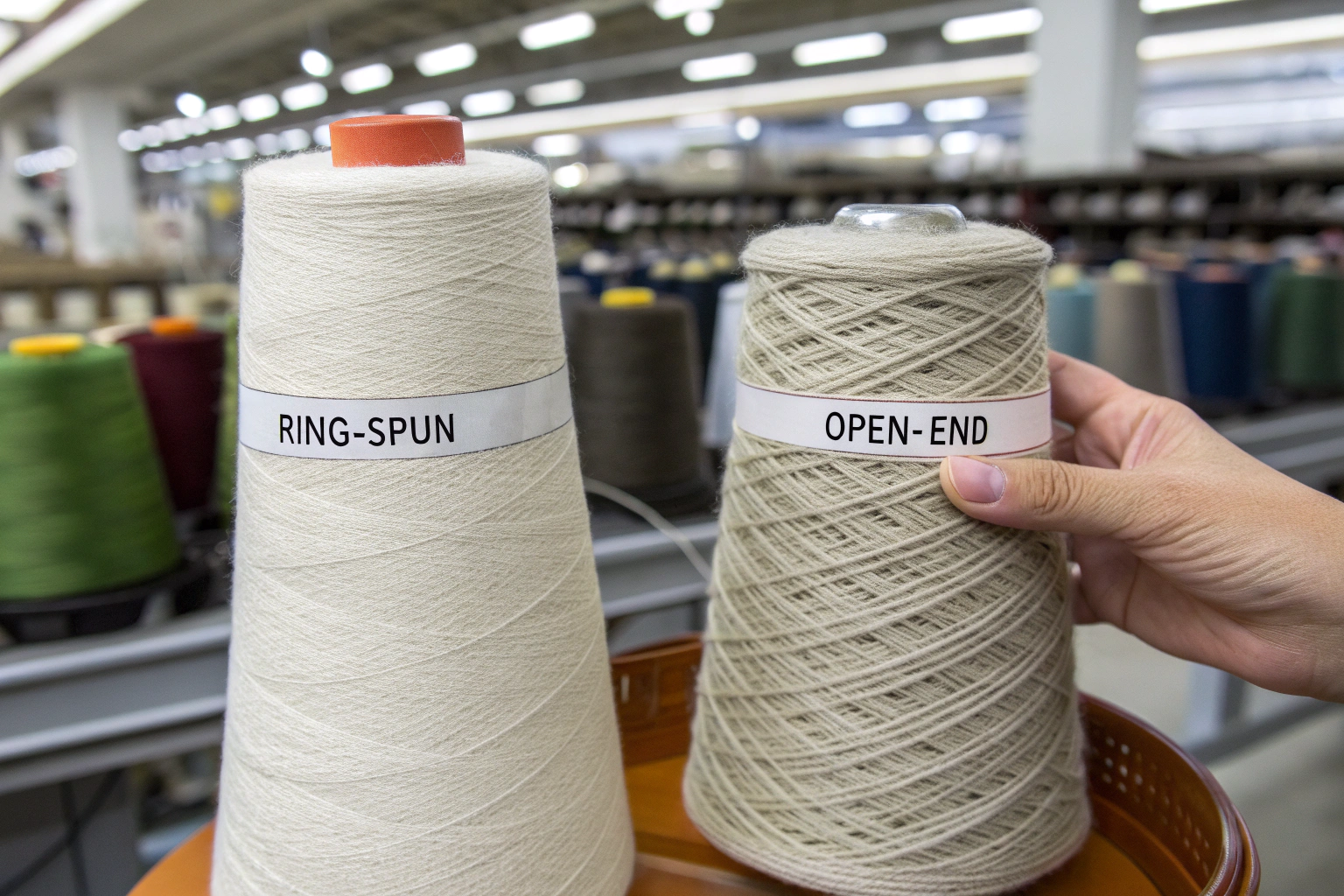
You are reviewing a fabric quotation from a new supplier. The spec says "30s cotton jersey, open-end yarn, $2.80 per meter." The alternative is "30s cotton jersey, ring-spun yarn, $3.60 per meter." That is a 28% price gap on the same fiber, the same weight, the same weave. Your margin spreadsheet screams for the cheaper option. But you remember the customer review that complained your tee shirt felt "scratchy" after five washes, while a competitor’s version at the same price point felt "silky" a year later. You are not sure if that difference was the yarn, the finishing, or something else entirely. You need to know if ring-spun is a marketing upsell or a real quality upgrade that your customer will actually feel.
Ring-spun and open-end yarns are not two grades of the same thing. They are produced by fundamentally different spinning technologies that create yarns with different structures, different strength profiles, different surface characteristics, and different costs. The choice between them determines the hand feel of your fabric, the durability of your garment, the price point you can hit, and the pilling performance over time. At Shanghai Fumao, I run both ring-spun and open-end yarns into different products for different markets, and I switch between them based on the end-use, the price point, and the consumer expectation. I want to explain what actually happens inside each spinning machine, how to see the difference with a pick glass, and exactly when each yarn type is the right business decision.
What Physically Happens to Cotton Fibers During Ring Spinning?
Ring spinning is a 200-year-old technology refined to near-perfection. It is slow, expensive, and produces the highest-quality yarn that cotton can yield. The process starts with a roving—a thick, loosely twisted strand of carded or combed fibers. The roving is fed through a drafting system: three sets of rollers running at progressively faster speeds that attenuate the thick strand into a thin ribbon of parallel fibers. The final strand exits the front rollers and enters the twisting zone. A small metal traveler, shaped like a tiny paperclip, slides freely around a ring at high speed—up to 25,000 revolutions per minute. The traveler inserts twist into the yarn, and the twisted yarn is wound onto a rotating spindle. The twist binds the fibers together into a strong, cohesive structure.

How Does the "Traveler" Mechanism Create a Smooth, Strong Yarn?
The traveler is the heart of the ring-spinning system. It rotates around the ring slightly slower than the spindle, creating a difference in speed called the "winding-on" differential. This differential is what simultaneously inserts twist and winds the yarn onto the bobbin. Because the traveler slides on a thin film of lubrication, the twist insertion is smooth and uniform. Every inch of yarn receives the same number of twists.
This uniform twist, combined with the parallel fiber alignment achieved in the drafting zone, produces a yarn with a smooth surface and high tensile strength. The fibers are tightly bound. The short fiber ends are trapped inside the yarn body. The yarn surface has minimal hairiness. The result is a fabric that feels smooth and soft against the skin, resists pilling, and holds its strength through repeated washing. A ring-spun 30s cotton jersey has a clean, almost lustrous surface that reflects light evenly. This is the yarn behind the "$50 premium tee shirt" hand feel. The cost is speed: a ring-spinning frame produces yarn at roughly 15 to 25 meters per minute. An open-end frame produces at 100 to 200 meters per minute. The speed gap is the price gap.
Why Does Ring-Spun Yarn Command a 20-30% Price Premium?
The price premium is not marketing. It is machine productivity, labor cost, and energy consumption. Ring spinning is slower, and slower machines mean more machines to produce the same output, more floor space, more electricity per kilo of yarn, and more operators per ton of production. The traveler wears out and must be replaced regularly. The drafting rollers need precise maintenance to keep the fiber alignment consistent.
Additionally, ring-spun yarn typically uses longer-staple cotton. The drafting system works best with fibers that are long enough to be gripped by multiple roller pairs simultaneously. Short fibers—below about 12 millimeters—are not well-controlled in the drafting zone and create unevenness and weak spots in the yarn. So ring-spun yarn is often made from better cotton to begin with, which adds raw material cost on top of the spinning cost. When a buyer asks me why the ring-spun version is 28% more expensive, I break down the cost: roughly half is the slower spinning productivity, and half is the longer-staple cotton required to spin efficiently.
How Does Open-End Rotor Spinning Work Differently?
Open-end spinning, also called rotor spinning, is a 20th-century technology that completely rewrites the yarn formation process. There is no roving. There is no traveler. There is no spindle rotating at 25,000 RPM. Instead, a carded sliver is fed directly into the machine, where a combing roller tears it apart into individual fibers. An airstream carries these fibers into a small metal rotor spinning at up to 150,000 RPM—six times faster than a ring spindle. The fibers are thrown by centrifugal force against the rotor wall, where they collect in a V-shaped groove. The yarn is formed by pulling the fiber bundle out of the groove through a central tube, and the twist is inserted by the rotor rotation itself, not by a separate traveler. The yarn is wound onto a large package at the top of the machine.

What Is the "Rotor Groove" and How Does It Trap Fibers Differently?
The rotor groove is the critical engineering feature of open-end spinning. It is a precisely machined V-shaped channel around the interior circumference of the rotor. As the rotor spins, the individual fibers are forced outward by centrifugal force and settle into this groove, layering on top of each other in a random, crisscross arrangement. The fibers are not parallel. They are not aligned. They are deposited chaotically.
When the yarn is pulled out of the groove, the twist binds this randomly arranged fiber bundle. The result is a yarn with a fundamentally different structure from ring-spun. The core of the yarn is dense and tightly twisted, giving it good strength despite the poor fiber alignment. But the surface of the yarn has a characteristic "wrapper fiber" appearance—loose, crisscrossing fibers that wrap around the yarn body at irregular intervals. These wrapper fibers give open-end yarn its rougher, fuzzier hand feel and its matte surface appearance. They also contribute to the yarn’s lower tensile strength compared to ring-spun of the same count. The open-end yarn is about 15% to 20% weaker than an equivalent ring-spun yarn. For many applications, this strength difference is irrelevant. For others, it is critical.
Why Does Open-End Yarn Produce a "Fuzzier" Hand Feel?
The fuzziness is a direct result of the fiber arrangement and the twist mechanics. In ring-spun yarn, the drafting system aligns the fibers parallel, and the traveler applies a smooth, uniform twist that traps the fiber ends inside the yarn body. The surface hairiness is low. In open-end yarn, the fibers are deposited randomly in the rotor groove. Some fibers land at odd angles. Some are bent. Some are only partially trapped by the twist and stick out of the yarn surface.
These protruding fiber ends create the characteristic fuzzy, slightly rough hand feel of open-end yarn fabric. The fuzz scatters light, giving the fabric a matte, non-reflective surface. This is not inherently bad. For a workwear jacket, a canvas tote bag, or a pair of work pants, the matte, slightly toothy texture feels appropriate—rustic, honest, hard-wearing. For a luxury tee shirt meant to feel cool and smooth against the skin, the fuzz is a liability. I produce open-end cotton fabrics for brands that specifically want the "natural, unrefined" aesthetic. The fuzz is the feature, not the defect.
How to Visually Tell Ring-Spun and Open-End Fabrics Apart?
You should not need a lab report to distinguish ring-spun from open-end fabric. The visual and tactile differences are distinct and consistent, once you know what to look for. Ring-spun fabric has a clean surface with subtle luster. Open-end fabric has a fuzzy, matte surface with a slightly rougher, drier hand feel. The difference is most visible on solid-colored fabrics where the surface texture is not hidden by prints or heavy brushing. With a simple pick glass magnifier, you can see the characteristic wrapper fibers on an open-end yarn surface that confirm the spinning method.

What Does a "Pick Glass" Reveal About the Yarn Structure?
A pick glass, also called a linen tester, is a small folding magnifier with a 1-inch square opening and a built-in scale. It costs about $15 and is the single most useful tool in a fabric buyer’s kit. Place the pick glass on the fabric surface and look at the individual yarns. On a ring-spun fabric, the yarns are uniform in diameter, smooth along their length, and show very few loose fiber ends protruding. The twist is even, and the yarn surface reflects light cleanly.
On an open-end fabric, the yarns show characteristic "wrapper fibers"—loose fibers that spiral around the yarn body at irregular intervals, crisscrossing the main twist direction. The yarn diameter is slightly less uniform, with occasional thin and thick spots. The surface is hairy with protruding short fiber ends. These wrapper fibers are the definitive visual signature of open-end spinning. They cannot be eliminated by finishing because they are structurally embedded in the yarn. Brushing can amplify them. Singeing can reduce them, but at the cost of adding another process, which narrows the cost advantage. If you see wrapper fibers under the pick glass, the yarn is open-end. No wrapper fibers, and a smooth surface, means ring-spun.
How Does the "Hand Feel" Compare for Lightweight vs. Heavyweight Fabrics?
The hand feel difference between ring-spun and open-end is more pronounced in lightweight fabrics. A lightweight 30s or 40s single jersey in ring-spun cotton feels silky, cool, and smooth against the skin. The same weight in open-end cotton feels dry, slightly papery, and noticeably less smooth. The consumer can feel this difference on a tee shirt, and they will associate the ring-spun version with higher quality.
In heavyweight fabrics—a 400 GSM french terry or a 12-ounce canvas—the hand feel difference is less pronounced. The sheer mass of the fabric dominates the tactile experience. The weight and structure communicate quality more than the surface smoothness. An open-end heavyweight sweatshirt can feel substantial, cozy, and perfectly premium, especially if it has been brushed or enzyme-washed. The consumer’s hand is feeling the loft and the weight, not the individual yarn surfaces. This is why I often recommend open-end for heavyweight knits and ring-spun for lightweight knits. The price gap is real, but the perceived quality gap shrinks as the fabric gets heavier.
When Should You Choose Open-End Over Ring-Spun for Your Product?
Open-end yarn is not the "cheap" option. It is the cost-optimized option for specific applications where the ring-spun premium does not translate into a consumer-perceptible benefit. Choosing open-end is a strategic decision to allocate your fabric budget where the consumer actually feels it—and to save money where they do not. I have guided luxury brands to open-end for their internal linings, and I have guided fast-fashion brands to ring-spun for their hero jersey program. The right choice is about the product, not the price.

When Is Open-End the Better Choice for Lining, Pocketing, and Workwear?
Internal linings, pocketing fabrics, and industrial workwear are the sweet spot for open-end yarn. The lining inside a jacket never touches the consumer’s skin directly. The pocketing inside a pair of trousers is felt only briefly. The consumer evaluates the garment on the face fabric, the fit, and the visible details. A ring-spun lining adds cost that the consumer cannot perceive and will not pay for.
Workwear—heavy canvas chore coats, denim work pants, utility vests—actually benefits from the slightly rougher, toothier hand feel of open-end yarn. The matte surface and the sturdy, slightly irregular texture read as "authentic" and "hard-wearing." A ring-spun canvas can look almost too refined, too polished, for the workwear aesthetic. I produce a 10-ounce open-end cotton canvas for a heritage workwear brand. They have tested ring-spun versions twice, and both times the customer panel preferred the open-end for its "vintage, broken-in character." The open-end was not a compromise. It was the correct aesthetic choice.
How Does Open-End Perform in Heavily Brushed or Enzyme-Washed Finishes?
Brushing and enzyme washing are the great equalizers. A heavy brushing process—where the fabric surface is mechanically raised to create a fuzzy, soft nap—largely erases the hand feel difference between ring-spun and open-end yarns. The brushing creates its own surface texture that dominates the tactile experience. An open-end fleece that has been heavily brushed can feel just as soft and cozy as a ring-spun brushed fleece, at a significantly lower cost.
Enzyme washing—a wet finishing process that uses cellulase enzymes to eat away surface fuzz and create a smooth, clean finish—can actually improve open-end fabric more than it improves ring-spun. The enzyme preferentially attacks the loose wrapper fibers and short protruding ends, selectively cleaning up the exact features that make open-end feel rougher. The result is an open-end fabric with a hand feel that approaches ring-spun, at a processing cost of $0.15 to $0.25 per meter. The combination of open-end yarn and enzyme wash can deliver 90% of the ring-spun hand feel at 80% of the total cost. This is a powerful value-engineering strategy that I deploy for mid-tier brands.
Conclusion
The choice between ring-spun and open-end yarn is not a simple "good versus cheap" decision. It is an engineering choice that determines the hand feel, the surface appearance, the durability, the pilling resistance, and the cost of your fabric. Ring spinning aligns fibers parallel, inserts uniform twist with a traveler mechanism, and produces a smooth, strong, low-hairiness yarn that commands a 20% to 30% premium. Open-end rotor spinning assembles fibers randomly in a high-speed rotor groove, producing a bulkier, fuzzier yarn with characteristic wrapper fibers and a matte surface, at a fraction of the production cost. Ring-spun is the correct choice for lightweight knits, luxury tees, and any fabric where the consumer’s skin directly feels the surface. Open-end is the correct choice for heavyweights, brushed finishes, workwear aesthetics, and internal components where the consumer cannot perceive the difference.
At Shanghai Fumao, I run both spinning technologies and I stock yarns in both categories across a range of counts. I guide my clients toward the right choice based on their product, their price point, and their brand’s tactile promise. If you are developing a new fabric and want to feel the difference between ring-spun and open-end in your specific weight and finish, please reach out to our Business Director, Elaine. She can send you a paired swatch pack with ring-spun and open-end versions of the same fabric, so you can make the decision with your own hands. Email her at elaine@fumaoclothing.com. Let us match the spinning technology to the product quality your brand stands for.