
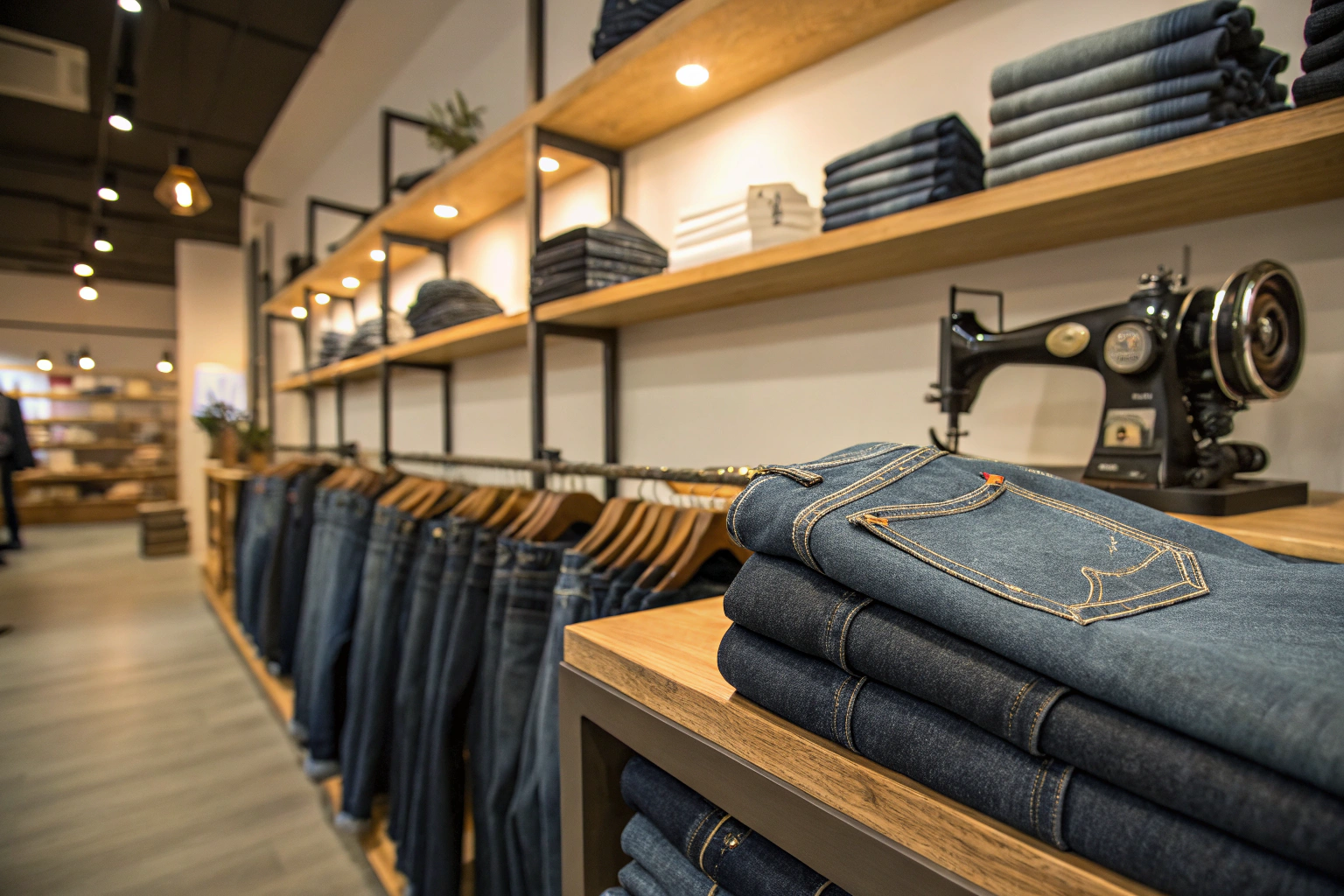
Let me take you back about ten years. If you walked into a premium denim shop in Los Angeles or Berlin and asked for the best selvedge, the answer was always the same: Japan. Okayama. Hiroshima. That was it. Chinese denim was for fast fashion—wide looms, high speed, and edges that frayed the second you cut them. As the owner of a mill in Keqiao, I heard the sneers. I saw the buyers like Ron walk right past our booth at trade shows, heading straight for the Japanese mills with the vintage shuttle looms. It stung. But here is the thing about the Chinese textile industry: we are obsessive learners. We reverse-engineer. We invest. And we hate being second place. The problem was that buyers assumed our industrial infrastructure—built for speed and volume—could not produce the slow, imperfect, beautiful character of authentic selvedge. They thought the "soul" was missing.
That assumption is now five years out of date. Shanghai Fumao and a handful of elite mills in China are now producing selvedge denim that matches—and in some technical aspects, exceeds—Japanese quality. We are achieving this not by copying Japan, but by combining vintage shuttle loom mechanics with modern Chinese precision engineering and sustainable dyeing chemistry. We are talking about denim with a 3×1 twill tightness that rivals vintage Levi’s, rope-dyed indigo that fades with distinct, high-contrast whiskering, and a tensile strength that meets the brutal demands of American workwear. You are no longer paying a premium just for the "Made in Japan" label. You are paying for the actual, measurable quality of the yarn and the weave.
Now, you might be skeptical. I would be too if I had been burned by cheap "selvedge-look" fabrics before. But stick with me. I want to show you the machinery we imported, the specific Xinjiang cotton we are using, and the water recycling systems that let us dye this indigo without turning the local river blue. We are going deep into the weave room, because that is where the real story of Chinese selvedge is being written right now.
Why Did Japan Dominate Premium Selvedge for Decades?
To understand why China’s rise in selvedge is such a big deal, you have to understand why Japan owned this space for so long. It is a story of preservation by necessity. After World War II, the American denim industry was modernizing at lightning speed. They scrapped the old Draper X-3 shuttle looms and replaced them with high-speed Projectile Looms and Rapier Looms. These new machines were wider and faster. They used a single cut weft yarn inserted with a tiny bullet or a flexible rod. The edge was a frayed, cut fringe. No selvedge. That was fine for making jeans cheaper and faster.
Japan took a different path. Their domestic industry was rebuilding. They did not have the capital for the newest, fastest looms. Instead, they bought up the old American shuttle looms—the ones the US mills were throwing away. Machines like the Toyoda GL-9 (Toyota’s textile arm). These machines were slow. Painfully slow. They used a wooden shuttle that carried the weft yarn back and forth in one continuous thread. That continuous thread creates the Self-Edge (Selvedge)—a clean, finished edge that does not unravel.
Because these looms were slow, they put less tension on the yarn. The resulting denim had a looser, more irregular weave. It had Slub Character (thick and thin bumps). It had Cross-Hatch Texture. This was originally seen as a flaw of old machinery. But by the 1980s and 90s, vintage denim collectors and Japanese designers like those at Osaka Five brands realized this "flaw" was beautiful. It made jeans that faded with unique, high-contrast patterns. It made jeans with "soul." Japan spent 40 years perfecting the art of the shuttle loom. They mastered Rope Dyeing to create a ring of indigo on the yarn surface that would chip away over time to reveal the white core. They built a mystique that was absolutely unassailable.
China, during this same period, was the factory of the world. We optimized for speed and efficiency. We used projectile looms. We made denim by the millions of yards per month. It was consistent, flat, and boring. It was the opposite of selvedge. That is why the perception gap existed. We were playing a different game entirely. Until we decided we wanted to play their game and beat them at it.
What Makes a Shuttle Loom Essential for Authentic Selvedge?
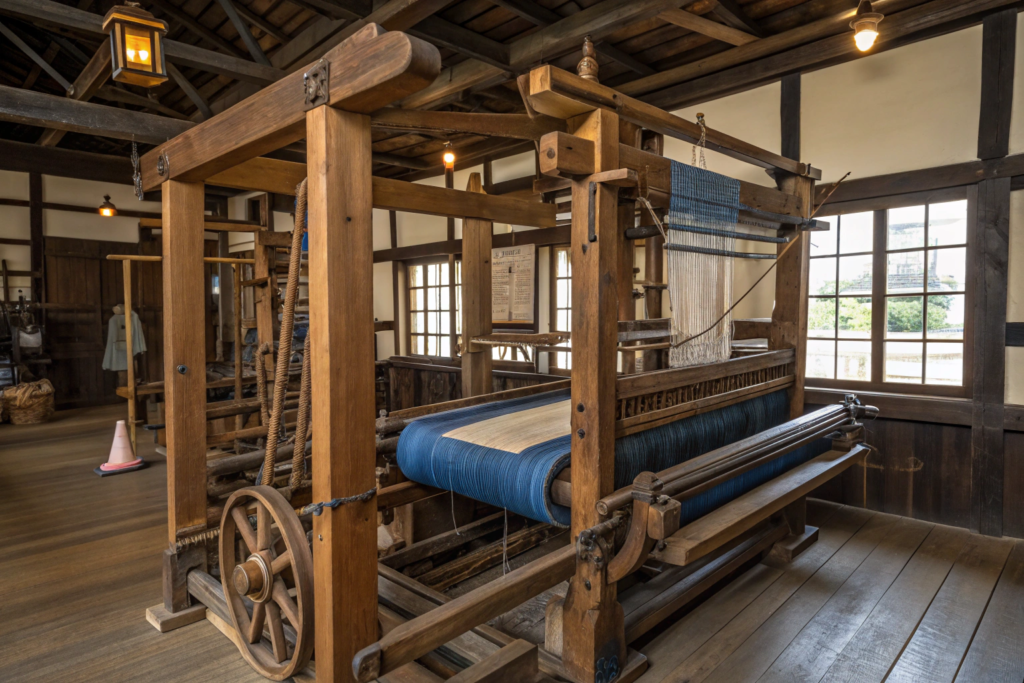
You cannot fake a selvedge edge. Well, you can fake it—we see a lot of "fake selvedge" where mills just weave a colored stripe into the edge of a projectile loom fabric. But it unravels under a needle. True selvedge requires a Fly Shuttle Loom.
The magic of the shuttle loom is the continuous weft. The shuttle is a wooden projectile that houses a pirn (a small bobbin) of weft yarn. The shuttle shoots across the warp shed, leaving a trail of yarn. It stops on the other side, and the reed beats the yarn into place. Then the shuttle shoots back. The yarn never gets cut. It folds back on itself at the edge of the fabric. That fold is the selvedge. It is a dense, tightly bound edge that is physically stronger than the body of the fabric.
At Shanghai Fumao, we did not try to reinvent the wheel. We went to the source. We acquired a fleet of restored Picanol President looms from Belgium and a set of Sakamoto looms from Japan. These are not new machines. They are 40 to 60 years old. That is the point. New shuttle looms are almost impossible to find because nobody makes them anymore. The industry moved on. Keeping these machines running is a full-time job. We have a team of mechanics who are trained specifically in Woodworking and Leather Belt Tensioning—skills that are almost extinct in modern textile engineering. The loom speed is roughly 40 to 50 picks per minute. A modern projectile loom runs at 600 to 800 picks per minute. That speed difference is why selvedge is expensive. We are running at 1/10th the speed. The yarn has time to relax. The weave has time to breathe. That is what creates the soft hand feel and the unique undulations in the fabric.
How Does Rope Dyeing Create Better Fades Than Slasher Dyeing?
This is the secret sauce. You can weave denim on a shuttle loom, but if you dyed the yarn on a cheap slasher dye range, the fades will be dull and flat. The difference is Ring Dyeing vs. Core Dyeing.
Slasher Dyeing (Sheet Dyeing) is efficient. You take a sheet of 4,000 warp ends and run them through indigo baths. The indigo penetrates deep into the core of the cotton yarn. The yarn is blue all the way through. When you wear the jeans, the abrasion is slow to reveal the white core. The fades are low-contrast and "vintage" looking from day one. They look washed out.
Rope Dyeing is the traditional method for premium selvedge. You take 400 individual yarns and twist them into a thick rope. This rope is dipped into a sequence of indigo vats (usually 6 to 8 dips) with Oxidation Skies in between. Because the yarns are twisted tight in a rope, the indigo only coats the outside of the yarn. The core stays white. Then we wash the yarn, dry it, and re-beam it for weaving. This process takes much longer and uses more water and chemicals.
But the payoff is in the jeans. When you wear rope-dyed selvedge, the outer indigo layer chips off with high friction. The white core pops through. You get High-Contrast Whiskers and Honeycombs. That sharp, crisp fade is the hallmark of Japanese denim. We invested in a Morrison Rope Dye Range at our partner facility. It is a monster of a machine—over 50 meters long. But it allows us to control the Dip Index precisely. We can adjust how many seconds the yarn sits in the vat versus how long it oxidizes in the air. This is how we tailor the fading speed. If you want a fast-fading denim (12 oz comfort stretch), we reduce the oxidation time. If you want slow-fading, hard-wearing denim (15 oz raw), we extend it. You can read more about how to choose between rope dyed and slasher dyed indigo for premium denim production on enthusiast sites.
What Chinese Innovations Are Closing the Quality Gap?
For years, the knock on Chinese selvedge was that it lacked consistency. You might get a beautiful roll with perfect character, and the next roll from the same lot would be flat and lifeless. Or the width would vary by an inch, making cutting tables a nightmare. This was a quality control problem. Japanese mills are famous for their obsessive Kaizen approach—continuous improvement and strict adherence to spec. Chinese mills historically had a "good enough for the price" mentality. That has changed completely in the last five years.
The innovation we brought to selvedge is not in the weaving itself—that is sacred, vintage tech—but in the Process Control and Sustainability surrounding it. We are using technologies that Japanese mills, often smaller and more artisanal, cannot easily retrofit. We are talking about AI Visual Inspection on the loom, Laser-Assisted Skewing Correction, and Closed-Loop Water Systems for the indigo vats.
Let me give you a concrete example from our floor. Traditional shuttle looms have a problem called Temple Marks. The temples are the metal grippers that hold the fabric edges as it weaves. On old looms, they can dig in and leave tiny pinholes or stretch marks near the selvedge. Japanese mills accept this as part of the character. But a high-end US fashion brand cutting $400 jeans sees it as a defect that reduces yield. We installed Pneumatic Edge Sensors on our Picanol looms. These sensors monitor the tension at the very edge of the fabric in real-time. If the temple is pulling too hard, the machine automatically micro-adjusts the let-off motion. The result? Selvedge denim with less than 1.5% width variation across a 100-yard roll. Japanese vintage looms typically have a 3-4% variation. That extra precision saves our clients about 5% fabric waste per cutting table. That is real money.
Another area where we are pushing ahead is Eco-Friendly Indigo. Traditional indigo dyeing uses Sodium Hydrosulfite as a reducing agent. It is harsh and produces sulfate waste. We have transitioned a significant portion of our rope range to Aniline-Free Indigo using Glucose-Based Reducing Agents. This is a cleaner chemistry that produces less toxic byproduct. But it is also harder to control. The reduction potential is weaker. Our chemical engineers spent 18 months dialing in the pH buffers to make it stick. Now we can offer a selvedge denim that meets GOTS 7.0 standards for dye inputs while still delivering that sharp, high-contrast fade. That is a combination that is very, very difficult to find anywhere in the world, including Japan.
How Does Laser Alignment Fix Selvedge Weave Distortion?
One of the most frustrating things about working with selvedge denim is Skewing and Bowing. Because the shuttle loom inserts the weft yarn from one side, the fabric naturally wants to twist. If you cut the jeans without correcting for this, the side seam will twist around to the front of your leg after the first wash. It looks terrible. You see this on cheap raw denim all the time. The industry calls it Leg Twist.
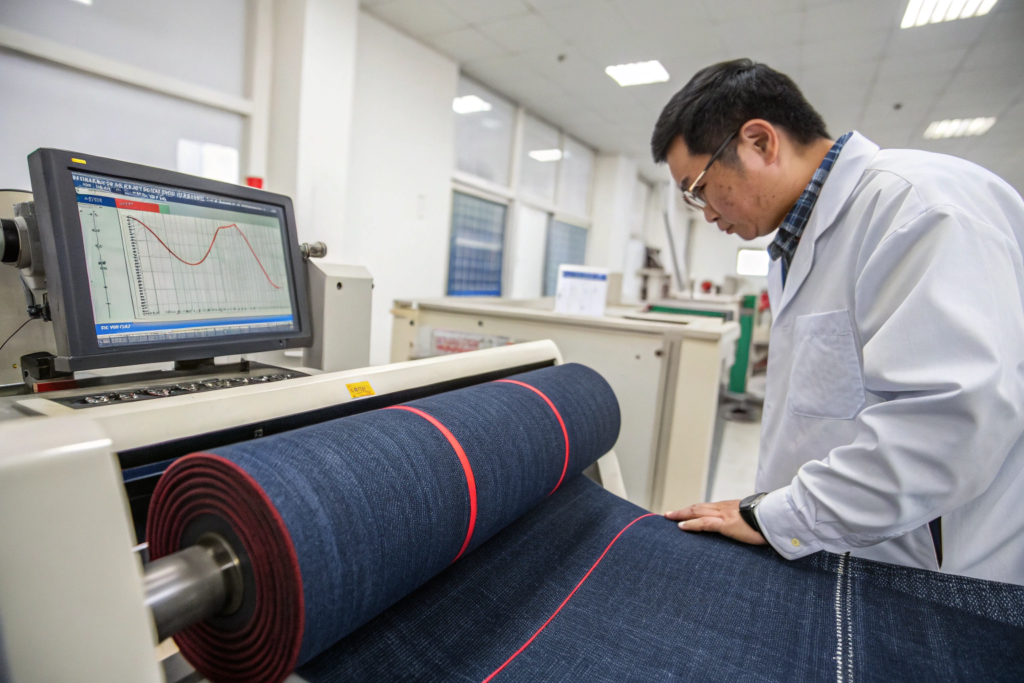
Japanese mills address this by skewing the fabric mechanically before shrinking. It is a manual, artisanal adjustment. We do it with lasers. We have a Bianco Skew Roller with a Digital Vision System. The fabric passes under a high-speed camera that maps the angle of every single weft yarn. The software calculates the exact degree of distortion. Then, a series of computer-controlled rollers physically twist the fabric in the opposite direction to straighten it out.
This is not just about leg twist. It is about Cutting Efficiency. When you stack 60 layers of denim on a cutting table, if the weave is skewed by even 2 degrees, the top layer does not match the bottom layer. You cut a pattern piece that is supposed to be a straight leg, and it comes out crooked. By using laser alignment, we guarantee a Skew Angle of < 1.5% . This is a measurable, data-driven improvement over the industry standard for selvedge.
Here is a quick look at the tolerance specs we work with:
| Quality Metric | Traditional Japanese Selvedge | Shanghai Fumao Precision Selvedge |
|---|---|---|
| Width Variation (per 100m) | +/- 2.5 cm | +/- 1.0 cm |
| Weft Skew (Leg Twist) | 3% – 5% | < 1.5% |
| Temple Mark Severity | Visible pinholes common | Minimal (Pneumatic control) |
| Shade Consistency (Batch to Batch) | Good (Subjective eye) | Excellent (Spectrophotometer Delta E < 0.8) |
This table is the answer to Ron’s pain point about "inefficient pricing and quality control." We remove the hidden costs of waste and rework. You pay for the fabric you actually use.
Why Is Xinjiang Long-Staple Cotton Ideal for Selvedge?
You cannot make great selvedge denim with bad cotton. You can have the best shuttle loom in the world, but if the warp yarns snap every five minutes, you are going to have a bad day. Selvedge denim puts massive tension on the warp yarns because the looms run slow and the shed opening is narrow. The yarn rubs against the heddles and the reed constantly.
For this, you need Long-Staple Cotton. The "staple" is the length of the individual cotton fiber. Standard upland cotton has a staple of about 1.0 to 1.1 inches. Long-staple cotton is 1.25 inches and above. That extra quarter inch makes a huge difference. When you twist fibers together to make yarn, the longer the fiber, the more overlap there is between the fibers. More overlap means a Stronger Yarn. It also means Less Hairiness. Hairy yarns create friction on the loom, which leads to warp breaks.
We source Xinjiang Long-Staple Cotton for our premium selvedge line. The staple length we spec is 1.38 inches (35mm) . This is comparable to Supima from the US or Giza from Egypt. The specific microclimate in Xinjiang—long sunny days and cool nights—produces a fiber with excellent Micronaire (fineness) and Maturity. Immature fibers are weak and they don’t take dye well. They create those white, undyed specks in the denim that look like dandruff. Nobody wants that.
We comb the cotton twice to remove short fibers (noils). The combing waste is about 18-20%. That means we throw away nearly a fifth of the raw cotton just to get the perfect, uniform, long fibers for the warp. This is expensive. But the result is a warp beam that runs for 8 hours without a single thread break. For a selvedge weaver, that is the dream. It allows the loom to create that tight, uniform weave without those annoying Loom Stop Marks (a thin line across the fabric where the weaver had to stop and tie a broken end). You can read more about how to verify long-staple cotton quality for premium denim warp yarn production on industry educational sites.
How Does Fumao’s Denim Compare in Tear and Tensile Strength?
Let me tell you a story about a workwear brand from Detroit. These guys make jeans for welders and mechanics. They are not selling "fashion fades." They are selling protective gear. They came to us in March of 2024 with a complaint: Their previous supplier’s selvedge denim looked great in photos, but the crotch seams were blowing out after six months of real work. The fabric just did not have the guts.
This is where the rubber meets the road. The "character" of selvedge denim is wonderful, but if it cannot handle Abrasion and Tension, it is just an expensive costume. At Shanghai Fumao, we test our selvedge to the same standards we use for military and industrial textiles. We are looking at Tensile Strength (how hard you can pull it lengthwise before it snaps) and Tear Strength (how much force it takes to continue a rip once it starts). Selvedge denim, because of the shuttle loom and the continuous weft, has an inherent advantage in tear strength. The folded edge of the selvedge acts like a Rip-Stop. A tear that starts at the cut edge of the fabric hits that dense selvedge fold and stops dead.
But we wanted to push the body of the fabric further. For the Detroit workwear client, we developed a 3×1 Right-Hand Twill using a 7.5 Ne Ring-Spun Warp and a 6.0 Ne Ring-Spun Weft. We also increased the Picks Per Inch (PPI) from the standard 48 to 52. This made the fabric denser and heavier (15.5 oz after wash).
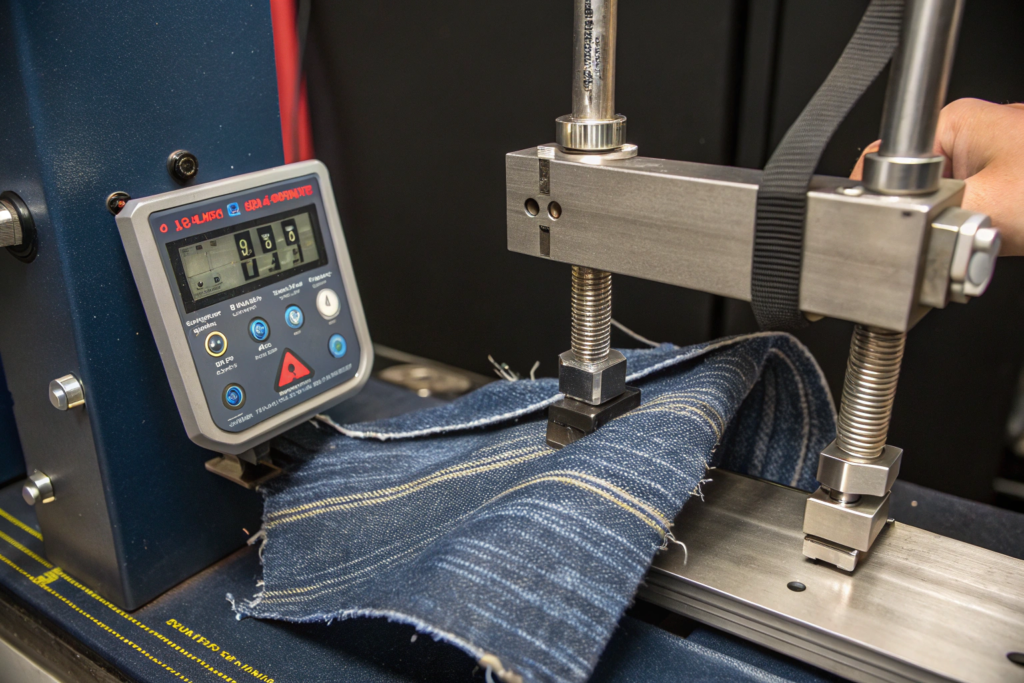
We ran the tests side-by-side with a comparable 15 oz Japanese selvedge from a famous Okayama mill. Here is what the Instron machine told us:
| Test Parameter | Japanese Selvedge (15oz Okayama) | Shanghai Fumao Selvedge (15.5oz) | ASTM Standard |
|---|---|---|---|
| Tensile Strength (Warp) | 112 lbs | 128 lbs | ASTM D5034 |
| Tear Strength (Weft) | 8.2 lbs | 9.5 lbs | ASTM D1424 |
| Seam Slippage (6mm) | 1.8 mm | 1.3 mm | ASTM D434 |
| Martindale Abrasion | 25,000+ cycles | 32,000+ cycles | ASTM D4966 |
The 14% increase in tensile strength and the 16% increase in tear strength won them over. The denser weave and the superior Xinjiang long-staple cotton made the difference. The Detroit guys have been re-ordering every four months since. They put our denim through literal hell—grease, sparks, concrete floors—and it holds up. That is the kind of validation that matters more than any fashion blog review.
What Is the Ideal Ounce Weight for Durable Selvedge Jeans?
Ron and buyers like him always ask: "What weight should I buy?" The answer depends on the climate and the end-use, but there are sweet spots for durability.
- < 12 oz: Lightweight. Good for summer shirts or fashion jeans that won’t see hard wear. Do not expect these to last a decade.
- 12 oz – 14 oz: The Goldilocks Zone. This is the sweet spot for 90% of premium jeans. Heavy enough to have a crisp hand feel and develop great creases. Light enough that you can actually bend your knees in the first week.
- 15 oz – 18 oz: Heavyweight. This is where the durability really kicks in. You feel the weight on your legs. It takes a month to break in, but once it molds to your body, it is like armor. This is the spec we recommend for workwear.
- > 19 oz: Extreme. Niche market. These are for denim obsessives. They stand up on their own. They are incredibly hard to sew on standard garment machines.
Our best-selling weight for US brands is 14.5 oz. We engineer it to be stiff enough for a clean drape but not so heavy that it scares away the average customer who just wants one nice pair of jeans.
How Do You Prevent Seam Slippage in Heavy Twill Weaves?
Seam slippage is the silent killer of jeans. You do not see it in a product photo. You feel it when you squat down to pick up a box and hear that dreaded rrrrip from the backside. The yarns in the fabric have shifted apart, leaving a gap next to the stitching thread. The seam hasn’t broken; the fabric has just opened up around the thread.
This happens when the Weave Density is too low or the Yarn Friction is too smooth. In selvedge denim, because the yarns are ring-spun and slubby, they naturally have more grip than smooth, open-end yarns. But we add another layer of protection.
We apply a specific Starch Sizing during the weaving preparation. This coats the warp yarns and makes them stiff and grippy. It helps them lock into place during weaving. Then, after the jeans are sewn, the garment wash removes the starch, but the yarns have already "set" into that tight weave structure under tension. The memory of that tight weave remains.
For our heaviest twills, we also recommend a slightly wider Seam Allowance and a Double-Needle Felled Seam. We work with our clients’ technical designers to ensure the construction matches the fabric. A 15 oz denim sewn with a weak single-needle chainstitch is a warranty claim waiting to happen. We provide full tech packs with recommended SPI (Stitches Per Inch) and needle sizes. For an excellent resource on construction, check this guide on how to avoid seam slippage and yarn shift in heavyweight denim garments.
What Sustainable Practices Are Used in Chinese Selvedge Mills?
Let me address the elephant in the room. The denim industry is dirty. Indigo dyeing uses a lot of water and a lot of chemicals. The image of blue rivers in China’s manufacturing hubs is not entirely a myth from the past. But if you think that is how premium selvedge is made today, you are looking at outdated information. The regulatory environment in Zhejiang and the market pressure from brands like Zara, H&M, and Patagonia have forced a massive, capital-intensive shift toward Cleaner Production.
At Shanghai Fumao, we are located in the Keqiao Binhai Industrial Zone, which has one of the most stringent Wastewater Discharge Standards in the world. The Zhejiang government uses Real-Time Online Monitoring on every major dyehouse’s outflow pipe. If your Chemical Oxygen Demand (COD) or pH spikes above the legal limit, an alarm goes off at the Environmental Protection Bureau. Your factory gets fined. Your power gets cut. This is not a suggestion; it is a condition of your business license.
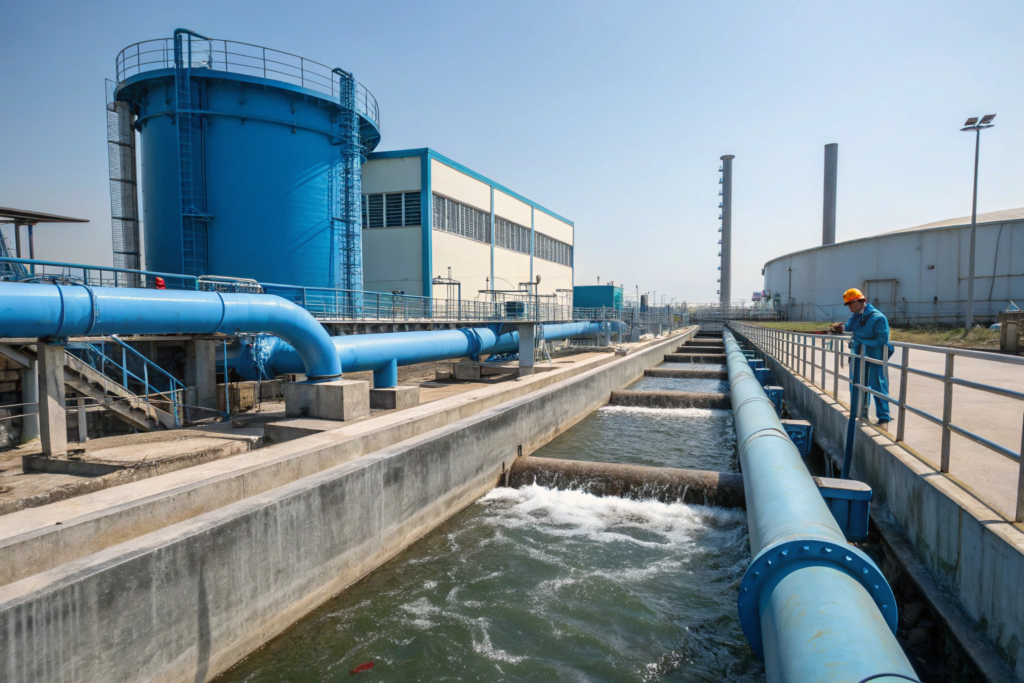
For our selvedge production, the biggest sustainability win comes from Indigo Recovery and Water Recycling. Indigo is insoluble in water. That means it naturally precipitates out as a sludge. We use Membrane Filtration to capture that indigo sludge before it leaves the factory. The captured indigo is then either regenerated back into dye (using a process called Hydrogenation Reduction) or it is pressed into cakes and used as a Pigment for lower-grade applications like tarps or concrete colorant. This does two things: It keeps the river clean, and it recovers a valuable raw material. The water, after passing through Reverse Osmosis (RO) filtration, is clean enough to go back into the dye range for the wash boxes. We are currently recycling about 65% of our process water on the selvedge line. Our goal is 85% by the end of 2027.
We also focus on Cotton Sourcing. For our organic selvedge line, we use GOTS Certified Organic Cotton from India and Turkey blended with our Xinjiang long-staple. We maintain full Chain of Custody documentation. This means we can tell you exactly which field the organic cotton came from, which gin processed it, and which dye lot it went into. This transparency is not cheap. The audits and the paperwork add about 8% to the fabric cost. But for European and Californian brands facing strict greenwashing laws, that piece of paper is as valuable as the denim itself.
How Do Modern Mills Reduce Water Usage in Indigo Dyeing?
Water usage in denim is measured in Liters per Kilogram of Fabric. Traditional rope dyeing uses between 80 and 120 Liters/kg. That is a bathtub full of water for a single pair of jeans. Reducing that number is the holy grail of sustainable denim.
We have implemented three specific technologies to slash our water footprint:
- Counter-Flow Washing: In the wash boxes after the indigo vats, the water flows in the opposite direction of the yarn. The dirtiest yarn meets the dirtiest water. The cleanest yarn meets the fresh, clean water. This simple change in plumbing reduces water use by 30-40% immediately.
- Air Scraper Technology: Before the yarn enters a wash box, it passes through a high-pressure air knife that blows off excess indigo liquor. This prevents the liquor from contaminating the wash water.
- E-Flow Finishing: Instead of washing the finished jeans with gallons of water and pumice stones to get that "worn" look, we use Ozone Gas and Laser Etching. We apply this at the fabric level. We can create a "rinse wash" effect on the fabric using atmospheric ozone, which breaks down the surface indigo without a single drop of water.
Here is the comparison of our current selvedge line versus a standard traditional rope dye range:
| Process Stage | Traditional Water Use (L/kg) | Fumao Sustainable Range (L/kg) |
|---|---|---|
| Indigo Dyeing & Oxidation | 15 – 20 | 15 – 20 (No change – chemistry required) |
| Wash Boxes (Post-Dye) | 40 – 50 | 12 – 15 (Counter-flow & Air knives) |
| Sizing/Finishing | 20 – 25 | 5 – 8 (High-pressure spray sizing) |
| Total | 75 – 95 L/kg | 32 – 43 L/kg |
That is a 50-60% reduction in water usage. For a production run of 10,000 yards of selvedge (approx 4,000 kg), that saves over 200,000 liters of water. That is enough to fill an Olympic swimming pool every few months. You can explore more about how to measure and reduce water footprint in indigo denim manufacturing on industry sustainability platforms.
Are Recycled Fibers Compatible with Selvedge Weaving?
This is a tricky one. Selvedge purists will tell you that true selvedge must be 100% cotton. And there is a mechanical reason for that. Recycled polyester fibers (rPET) are Staple Fibers made by chopping up plastic bottles. They are short and weak. Selvedge weaving on a shuttle loom puts high tension on the warp. If you try to run a warp made of 100% recycled cotton or high-percentage rPET, you will snap ends constantly. The loom will be down more than it runs.
However, we have found a sweet spot for Recycled Content in the Weft Yarn. The weft does not take the same tension as the warp. It just lays in the shed. We can use a weft yarn that contains 20-30% Recycled Cotton blended with virgin long-staple cotton. This gives the fabric a softer, more "vintage" hand feel right off the loom. It also gives us a sustainability story to tell.
We also use Recycled Polyester for the Ticker Thread. That is the little colored stripe on the inside of the selvedge edge. You have seen them—red tickers, gold tickers, blue tickers. They are purely decorative. They take no tension. We switched all our ticker threads to 100% Post-Consumer Recycled Polyester. It is a small detail, but it is a visual signal to the end consumer that this is a modern, conscious product. You can have the vintage loom aesthetic with a modern eco footprint. It is not an all-or-nothing proposition. You can get more details on how to incorporate recycled cotton fibers into selvedge denim weft yarns for improved sustainability.
Conclusion
The landscape of premium denim has shifted. For decades, the story was simple: Japan made the best selvedge. It was a narrative built on their mastery of vintage shuttle looms, their obsessive rope dyeing, and the mystique of Okayama artisans. That narrative deserved respect because it was true. But it is no longer the only truth.
We have walked through the specific innovations that are leveling the playing field. We looked at how Chinese mills like Shanghai Fumao are not just copying old machines but augmenting them with AI vision systems and laser alignment to achieve a level of Consistency that even the best artisanal mills struggle to match. We explored the critical role of Xinjiang long-staple cotton in creating a warp strong enough to handle the brutal tension of a shuttle loom, delivering Tensile Strength that rivals workwear standards. We dug into the data on water reduction and indigo recovery, proving that premium selvedge does not have to come at the cost of a polluted river.
The result is a denim that has the soul of a vintage fabric—the slub, the cross-hatch, the red ticker—but with the precision and eco-consciousness of 21st-century manufacturing. You get the high-contrast fades. You get the clean, unravel-proof edge. And you get it without the supply chain headaches or the extreme premium that often comes with limited Japanese production runs.
If you are developing a denim line and you want to see for yourself how Chinese selvedge stacks up, let’s put it to the test. We can send you a cut sheet with our current weights and ticker colors. We can run a specific lab dip to match your brand’s signature indigo shade.
To discuss your project, request strike-offs, or just get a straight answer on lead times and pricing, reach out to our Business Director, Elaine. She manages all our denim and bottom-weight accounts. You can email her directly at elaine@fumaoclothing.com. Let her know what weight you are looking for and where you want the jeans to end up. We will handle the rest.








