You’ve felt it. That brushed, velvety softness on the inside of a premium hoodie, or the suede-like hand of a high-end bedsheet. That’s a peach finish. And I need to warn you: most of what the industry calls "peach skin" is a cheap chemical imitation that washes off in three cycles. I’ve seen the look of betrayal on a brand owner’s face when their "luxury brushed cotton" returns from its first wash feeling like sandpaper. They thought they were buying a structural finish. They bought a silicone spray. There’s a $4 per yard difference between the two, and most consumers can’t tell the difference on the retail rack—but they definitely feel it after two weeks of wear.
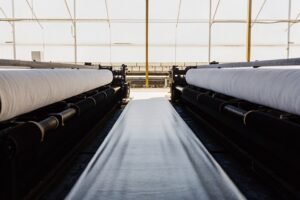
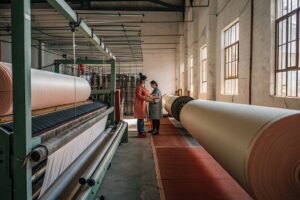
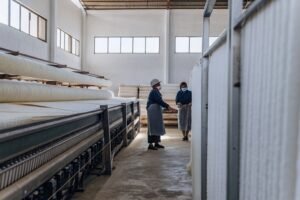
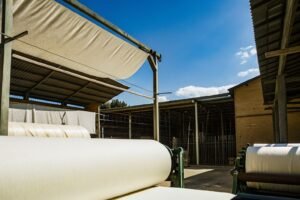
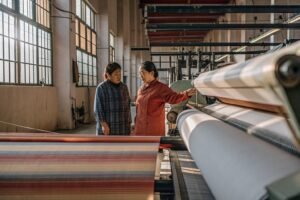
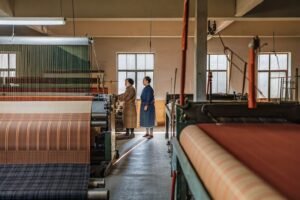
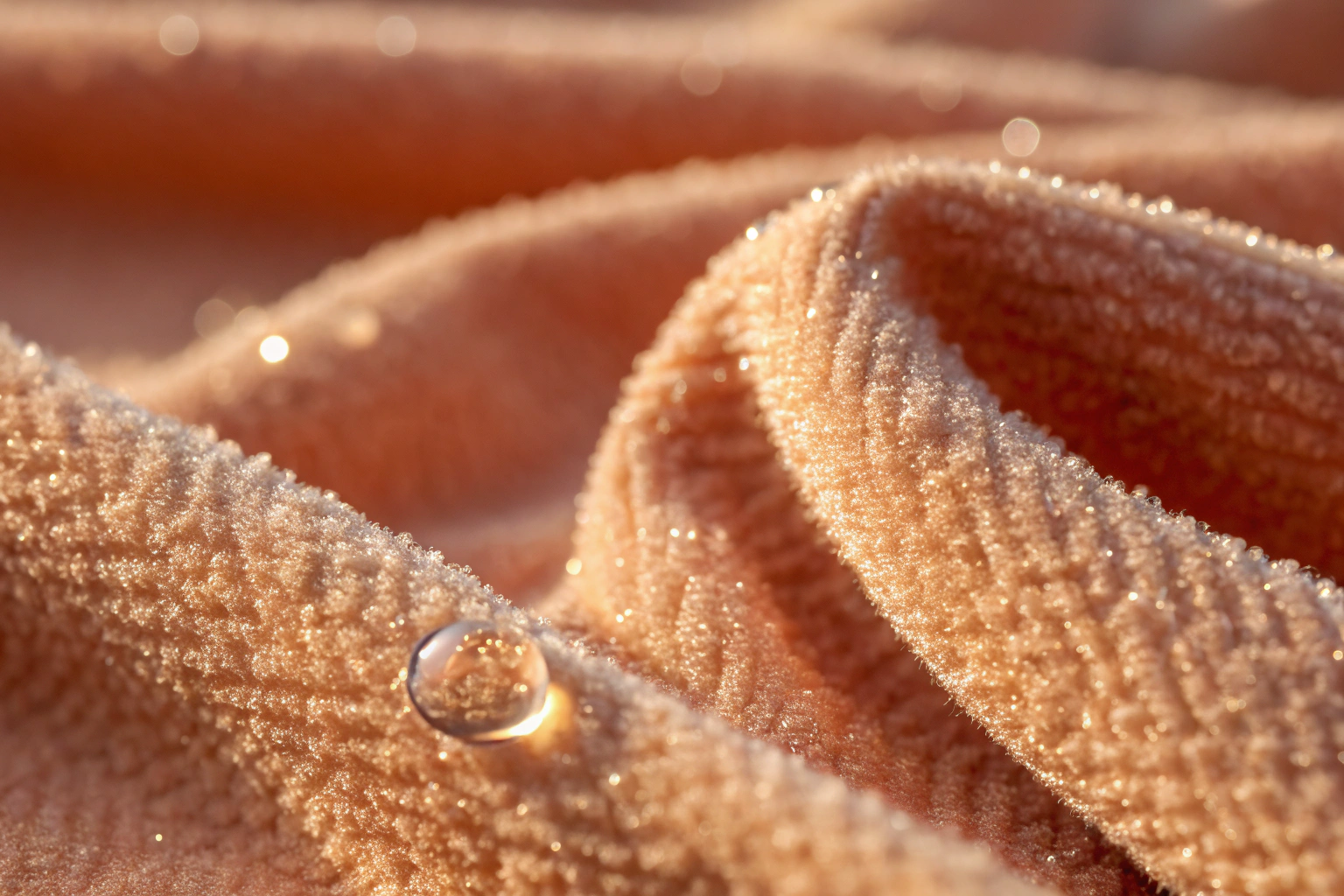
A genuine peach finish isn’t just a soft touch. It’s a precise mechanical sanding process that physically breaks the surface fibers of the fabric to create a short, dense, micro-scale pile. Think of it like sanding a rough piece of wood with progressively finer grits until the surface gleams. That pillowy softness that feels like the skin of an actual peach? That’s physics, not chemistry. At Shanghai Fumao, we run rows of Italian Lafer and Taiwanese emerizing machines that use carbon-fiber rollers spinning at 1,200 RPM to literally lift and sheer the fiber ends. The result is a permanent structural change to the textile. It doesn’t wash out because the fiber itself is now shaped differently. When it’s done right, you get that soft, almost "powder-like" dry touch. When it’s done wrong, you get a pilled, thinned-out mess that falls apart at the seams.
But the process is a tightrope walk. Too much pressure, and you sand right through the warp yarn and the fabric tears. Too little, and it feels like a cheap bedsheet. The brands that win with peach finish are the ones who understand the exact roller grit, speed, and "draft angle" that matches their specific fiber type. Let me walk you through the machine room where we turn ordinary polyester into something that feels more expensive than cashmere.
What Is the Mechanical Process Behind a Permanent Peach Skin Finish on Polyester
The magic machine is called an "emerizer" or a "sueding machine." Don’t let anyone sell you a "peach finish" that was just run through a tumbler with some rocks. That’s garment washing, not precision mechanical finishing. A true emerizer looks like a printing press but instead of ink rollers, it has abrasive rollers. The fabric snakes through a series of these rollers at high tension. Each roller is covered in a specific grit—just like sandpaper. For a micro-peach on a 50-denier polyester taffeta, we start with a 400-grit roller to "break" the hard shell of the fiber, then immediately pass it over a 600-grit to clean up the fuzz. The difference between a luxury finish and a budget one is often just the presence of that second, finer roller.
Here’s where I need to get technical because this is the part I obsess over. The fiber face isn’t just sanded; it’s "lifted and sheared." The abrasive roller spins against the direction of the fabric travel at about 1,000 to 1,200 RPM. This counter-rotational force hooks the individual microfibers and pulls them upright, then slices them off at a uniform height. The height of the resulting nap determines the hand-feel. A "micro-peach" has a nap height of about 0.05 to 0.1 millimeters. That’s barely visible to the eye; it just looks matte. A "full suede" nap is 0.3 to 0.5 millimeters and is visually fuzzy. The master machine tender (we call him the "Peach Master") adjusts the gap between the fabric and the roller using a micrometer dial. If the fabric is 0.2mm thick and he sets the gap to 0.15mm, he’s taking a "bite" of 0.05mm. That’s literally thinner than a human hair. One wrong turn of the dial, and the fabric turns into a shredded tissue. Understanding the exact mechanical parameters for emerizing polyester microfiber to achieve peach finish without reducing tensile strength is critical for any mill running this finish. You can’t just "guess" the gap.

Why Does Nano-Peach Differ From a Regular Sueded Microfiber Web?
"Nano-peach" is the buzzword right now, but it has a real engineering definition. Regular peach finish on a microfiber focuses on sanding the individual polyester filaments. Microfiber itself is already very thin—less than 1 denier per filament. So regular sanding just splits the microfibers into even finer split-fiber branches. It’s soft, but it’s a rough-soft. Nano-peach takes it a step further. Before emerizing, we chemically pre-treat the fabric with a controlled "caustic weight reduction" process. We literally etch the polyester polymer chains at a molecular level to create microscopic "pits" or "craters" on the fiber surface. This is called surface porosity.
After the chemical etching, the fiber looks like a moon rock under an electron microscope. Then we sand that pitted surface. The result is a uniformly cratered, ultra-fine nap that has an almost "dry hand" feel. It absorbs water faster because the liquid wicks into the craters. A client from Japan came to our lab in 2023 with a competitor’s "nano-peach" running shirt that retailored for $120. He wanted a duplicate. We ran an SEM (scanning electron microscope) scan on it. The fiber surface looked like a sponge. The caustic reduction was 18%, meaning they dissolved 18% of the polyester mass to create the pores. That’s a risky chemical bath, but it produces a specific "gripping" softness that raw sanding can’t achieve. The downside? You lose tear strength. Weight reduction equals strength reduction. I always warn clients to read up on nano-level caustic weight reduction pretreatment for advanced polyester peach skin moisture wicking finish before they demand that extreme fairy-tale softness. A 20% weight reduction could turn a durable outdoor jacket into a fragile luxury item that snags on velcro.
Is Carbon Fiber Roller Better Than Traditional Sand Emery Roller?
I’ve run both, and I’ve thrown the sand ones in the dumpster. Traditional sandpaper rollers use aluminum oxide grit glued onto a paper backing. They work. They’re cheap. But they wear out unevenly. After about 500 meters of continuous fabric, the sand belt develops "hot spots"—areas where the grit has chipped off. These spots create an inconsistent nap. You can literally see stripes of high-nap and low-nap along the length of the fabric. It’s called "chatter marks." Carbon fiber rollers are a different animal. They’re not a glued grit; they’re a solid brush made of carbon-composite bristles that are chemically bonded into a steel core. The carbon tips are harder than steel but slightly flexible.
The advantage is thermal dissipation. When you sand polyester at 1,200 RPM, friction generates heat. Polyester softens at 230°C. A sand belt traps that heat, and suddenly you’re not sanding fibers; you’re melting them into little plastic balls. These are "fused fiber ends," and they feel scratchy, not soft. The carbon fiber roller wicks heat away faster and has intermittent gaps that allow air cooling. So the cut is cooler and cleaner. I switched our entire sueding line over to carbon rollers from a Taiwanese supplier in 2021 after a batch of black poly-viscose came back looking like a chalkboard. Now, our nap is consistent roll-to-roll, even after 10,000 meters. I’d push any serious textile buyer to audit the advantages of carbon fiber brush emerizing rollers over sandpaper grit for consistent microfiber peach suede finishing. The roller type is the invisible factor that decides whether you get a "soft luxury" or a "scratchy bargain bin" result.
How to Distinguish High-Quality Peach Skin From Weak Chemical Softener Imitations
Here is the brutal truth about the fabric market: 70% of peach finish sold online is just fabric softener sprayed on a calender machine. This is a scam. They take a stiff, dead, greige polyester, dip it in a bath of silicone softener (amino-functional polysiloxane), and then pass it through heated steel rollers to press it flat. It comes out feeling sleek and slightly waxy. The hand-feel is "artificial." It feels like a raincoat, not a peach. Over three wash cycles, the silicone leaches out into the water. Your customer is left with the original stiff plastic-like base cloth. They feel betrayed, and they write a 1-star review about "false advertising." Your brand takes the hit, not the chemical company.
I teach my clients a quick field test. It’s simple and devastating. First, the Wash-and-Dry Test. Take a swatch. Washing machine, 40°C, tumble dry medium. If the softness drops by more than 50% after one cycle, it’s a chemical lie. Mechanical peach finish might soften more after the first wash because the remaining loose fiber dust falls off. Second, the Velcro Test. Press the loop side of a sticky velcro strip gently onto the fabric. A true mechanically lifted nap will grip the velcro hooks slightly. A silicone-coated fabric will be slick and repel the hooks. Third, the Scratch Test. Take your fingernail and lightly scratch the surface. If a white line appears that doesn’t buff away, you’ve moved a wax coating. A real peach finish doesn’t chalk up. You can find detailed instructions on doing the home wash testing method to detect fake silicone-based peach finish versus true sanded microfiber surface yourself. Never trust the "soft" feel straight out of the polybag; it’s doped with travel chemicals.

How the ‘Burn Test’ Can Reveal If the Base Is Peached Polyester or Just Cheap Starch?
Starch is an even cheaper trick. Starch is a stiffening agent that also holds a thin fuzz upright, simulating a mechanical nap. If you burn the fiber, polyester melts and shrinks into a hard black bead. Cotton burns to papery ash. Starch burns quickly with a yellow flame and smells exactly like burnt toast—because starch is a carbohydrate, just like bread. Another indicator: if you drop the fabric in hot water with a drop of iodine (or just a betadine antiseptic from your medicine cabinet), starch turns deep blue or black. The iodine test is instant.
I caught a supplier cheating with starch last year. A competing mill sent a "peach twill" sample to a potential client of mine. The client loved the weight and "dry crispness." I told her: "Drop it in water." The water turned cloudy white, and the fabric went limp as a wet noodle. The starch dissolved in seconds. That "crisp peach" was just sizing. Real peach finish on twill stands up on its own mechanical structure, not a glue. This is why I always recommend checking any new supplier’s swatch with a quick reference to a iodine-based starch detection test for verifying mechanically brushed versus starched peach finish imitation khaki twill. A peach finish should be an engineered skeleton, not a carb-load.
Why Does a Waxy Residue Indicate a Failed Calendared Finish Attempt?
Calendaring is compression with heat. It flattens fibers. Some mills try to cheat by first sanding the fabric (creating a fuzz), then immediately passing it through a high-pressure calendar at 180°C to "set" the fuzz with a silicone resin. The result is an abomination. The nap is glued down sideways. It feels greasy, not soft. The heat from the calendaring also "plastifies" the silicone, forming a micro-thin film.
If you shake the fabric and it sounds like a plastic bag, it’s a failed calendar attempt. If it feels cold to the touch initially, that’s the silicone film acting as a heat sink. True peach finish is warm to the touch instantly because the loft of the fibers traps a layer of body-temperature air. This is thermodynamic; it’s not subjective. And if you see a "greasy halo" on a dark navy or black fabric when you hold it at an angle to a lightbulb, that’s free silicone oil that didn’t cross-link. It will stain your cutting table. If you want to stop this mess before it goes into production, you should compare a known good sample against a suspect using a tactile comparison of calendared silicone peach imitation versus raised carbon fiber emerized authentic nap side by side. It’s the difference between a plastic doll’s skin and a human cheek.
What Is the Correct Grit Selection to Avoid Fabric Tear During Sueding of Viscose Challis
Viscose is a dead sheep in wolf’s clothing. It looks strong, drapes like silk, but wet or sanded viscose has the tensile strength of wet toilet paper. It’s notoriously weak because the regenerated cellulose fibers have a low "degree of polymerization." When I run a peach finish on a lightweight viscose challis (say 80 GSM), I’m walking on a tightrope over a fabric graveyard. The emerizing roller wants to tear the fabric. The friction wants to shred the fiber. This is not a job for an aggressive course grit.
The standard rotating speed is lowered to bring the RPM down. I limit viscose challis to 40-grit ceramic filament rollers. These are super fine, almost like a stiff toothbrush, not a rasp. The secret is to do "multiple low-tension passes." Instead of trying to take a big bite in one pass and ripping the fabric, I run the cloth through the machine three times. First pass: very light touch, just to raise the loose fuzz. Second pass: the actual nap formation. Third pass: a "cleaning pass" with a very soft horsehair brush roller to lift the nap and vacuum away the micro-dust. This triple-pass method takes more machine time and electricity, so it’s more expensive. (This is also why cheap viscose challis is never truly peached; it’s just washed with enzymes, which is a different aesthetic.) You would benefit from reading the process details of optimal roller grit and line speed for sueding lightweight viscose challis without fiber breakage defects. If you hear a "tearing" sound or see "fiber snow" raining under the machine, the operator is running too deep a bite. The viscose is sacrificing its core to the sanding god.

How to Control the Draft Angle for a Sueded Rayon Twill Without Shredding the Selvedge?
Twill weaves are unbalanced. The diagonal ribs catch the emerizing roller like a cheese grater hitting speed bumps. The edge of the fabric, the selvedge, is the first to go. It frays and unravels because the nap roller snags the weft insertion points at the edge. The fix is what I call the "Selvedge-Saver Draft Angle." Standard straight tension pulls the fabric flat against the roller. We introduce a +/- 5-degree oscillation to the entry roller. The fabric dances sideways. It "wobbles" into the abrasive surface. This prevents the sharp edge of the selvedge from hitting the exact same abrasive point on every rotation, which would slice it.
Additionally, we apply a "selvedge stiffening agent" just to the outer 1cm of the fabric before it enters the sueder. It’s a polyvinyl alcohol (PVA) coating that washes away in the scouring after sueding. Think of it as an invisible masking tape that sacrifices itself to the roller. It absorbs the cut, not the twill. You also need to adjust the "offset angle." Most operators don’t realize that if you set the fabric path so the twill line flows with the roller direction, the ridges compress smoothly. If you run it against the twill line, the roller "kicks up" the ridges and snaps them. This field of fabric drafting angle adjustment for reducing selvedge abrasion damage during peach finishing of diagonal twill weaves is often neglected in budget mills that just run everything at a flat 0 degrees. They destroy the edges of your rolls.
Why Does Moisture Content Matter in the Pre-Sueding of Tencel Blends?
Tencel (Lyocell) is the princess of cellulosics. It fibrillates. That means in wet abrasion, it sprouts tiny microscopic hair-like branches. This is great if you want a soft peach. But if it’s too wet, it triggers "primary fibrillation," which is a tangled, matted, pilled mess that looks like a sweater washed on hot. If it’s too dry during sueding, Tencel is hard and glassy, and the roller just snaps the fibers into dust.
The sweet spot is exactly 8-10% moisture content. We have a humidity chamber before the sueder. We mist the Tencel blend fabric with a micro-droplet spray using a "weighing bridge" system. A load cell measures the fabric weight before and after the mist. If the fabric gains about 8% water weight, the Tencel fibers plasticize slightly. They become flexible, almost rubbery. The sueding roller then stretches and breaks them in a controlled way, forming a uniform velvety nap, not a shattered glass mess. I learned this from a disastrous 2019 trial with a bamboo/Tencel bedsheet set. We ran it bone-dry; the sheets came out looking dusty and shining with a "frost" of broken fiber tips. The customer rejected the entire 10,000-meter lot because the surface looked "greasy." It was microscopic dust refracting light. Managing that pre-conditioning moisture level control for fibrillation management during rotary emerizing of Tencel lyocell peach skin fabric is the difference between a silky shimmer and a chalky ghost.
When Should You Use Enzymatic Washing Instead of Mechanical Emery for That Soft Touch
Mechanical emerizing is a blade. It cuts. Enzymatic washing is a lollipop; it dissolves. Sometimes you don’t want to cut the fiber; you just want to eat the fuzz that’s already there. This is where cellulase enzymes come in. If you are working with 100% cotton, especially knitted jersey, mechanical sanding is brutal. It can thin out the loop structure and create holes. An enzyme wash, which we call "bio-polishing," selectively dissolves the micro-fuzz pills and protruding fiber ends without touching the core yarn. The result is a smooth, clean surface with a soft hand. It’s not technically a peach finish in the mechanical sense, but it achieves a similar "powdery" touch on cotton that consumers love.
I often recommend bio-polishing over emerizing for children’s sleepwear or sensitive-skin garments. Why? Because a mechanical peach finish on cotton creates micro-dust that can irritate a baby’s lungs if it’s not scoured out properly. An enzyme wash leaves zero dust. The enzyme just turns the fiber fuzz into sugar water and drains it away. The downside is that the look isn’t a "hairy" peach; it’s a "smooth" softness—more like a river stone than a peach skin. If your brand promise is a visible suede nap, you need the emerizer. If you just need "insane softness without pilling," the bio-polish is your weapon. Understanding the options is key, so I recommend checking the cellulase enzyme bio-polishing protocol for achieving soft touch on cotton jersey compared to mechanical peach emerizing. At Shanghai Fumao, we often do a "combo": a light enzyme wash to weaken the fuzz, then a very gentle single-pass mechanical suede to lift the nap uniformly. It’s the best of both worlds for premium French terry.

How Long Does the ‘Stone-Washed Peach’ Effect Last on a Brushed Cotton Flannel?
The romantic "lived-in" peach on a high-end flannel shirt is a ticking clock. It’s not permanent like a synthetic sanded finish. Cotton is a staple fiber; it has short individual hair cells. When you brush cotton flannel, you are pulling these tiny staple ends upright. They create the soft halo you love. However, every time you wash the shirt, laundry agitation folds and breaks those little hairs. They fall off into the lint trap. Over time (usually about 20-30 washing cycles), the fabric face goes "bald." It returns to a flat, matte surface.
This is an inherent material limitation. You cannot permanently staple a short fiber. The longer the cotton staple (like Supima or Giza), the longer the brushed effect lasts because the fibers are physically longer and anchored deeper into the yarn bundle. Cheap short-staple cotton goes bald fast. There is a trick to extend the life: we use an "air-tumbler cold silicone" post-wash. But as I warned, that’s a chemical band-aid. If you promise a "forever peach" on a cotton woven, you’ll get returns. You should look into the durability lifecycle of brushed cotton flannel peach softness over repeated home laundering and drying cycles. My advice to brands: educate your customer. Tell them it’s a "living finish" that evolves gracefully into a vintage softness. Don’t overpromise eternal fuzz on a cotton base.
Can We Replicate Italian ‘Carbon Brush’ Finish on a Chinese Woven Piece?
I get this request twice a month from European designers. "The Italian finish has a ‘dry, crunchy softness.’ Can you match it?" The Italian carbon brush finish is the holy grail. It’s a mechanical process. The Italians use a specific machine configuration: a large-diameter drum wrapped in carbon-bristle strips, running at a very slow oscillation with ultra-low tension. It creates a nap that stands almost vertical, giving that "crunchy" crispness when you rub the fabric nap against itself.
Yes, we can match it. We purchased a used Lafer machine from Biella specifically to study it. Our technicians reverse-engineered the "dwell time." The secret was that the Italian machines run at a 30% slower line speed than the Chinese standard. They process slower, so the brush kisses the fabric longer, creating a denser nap. Most Chinese factories speed the line up to save costs, which creates a loose, slidey nap. The "crunch" comes from a high-density nap. If you rub two high-density naps together, they connect like velcro. If you want that luxury Italian "scroop" sound on a viscose taffeta lining, you need to run the line slowly. I took a video of our Lafer running for an Italian buyer. I showed him the speed meter. He approved the production. For those looking to source locally, there’s a great breakdown of the traditional Italian carbon brush sueding machine parameters replicated in Chinese textile mills for luxury lining fabrics. It’s not about geography; it’s about dwell time and tension control.
Conclusion
A peach finish is a promise your fabric makes to the skin. And like any promise, it’s either kept or broken in the details. The cheap imitation, the silicone-sprayed mask, breaks that promise the moment the washing machine spins. The authentic, slow, mechanical process—the carbon rollers chewing precisely 0.05mm of micro-fiber, the moisture-controlled fibrillation of the Tencel fibers, the triple-pass viscose tightrope walk—that’s a promise that lasts for years. I always say that you shouldn’t sell a "feel"; you should sell a "forensic fact."
At Shanghai Fumao, we don’t view peach finishing as an afterthought or a quick dip in a chemical bath. We treat it as a core engineering discipline, right alongside dyeing and weaving. The grit is calibrated, the tension is mapped, and the SEM scans are checked. The market is flooded with fake softness right now. The only armor a brand has against that flood is knowledge and physical testing. Scrape the swatch, burn the swatch, wash the swatch. If it survives your home-torture test, it will survive your customer’s love.
If you’re building a line that requires a specific nap density—whether it’s a military-grade suede on a tactical vest or a whisper-thin micro-peach on a bridal slip—don’t guess. Send me a reference swatch. We’ll reverse-engineer the roller sequence and send you back a lab sample that tells the truth. Contact our Business Director Elaine directly at elaine@fumaoclothing.com. Let’s turn your synthetic or cellulosic base into something that feels worth more than its price tag. Send a photo of your reference; we’ll ship the touch.