
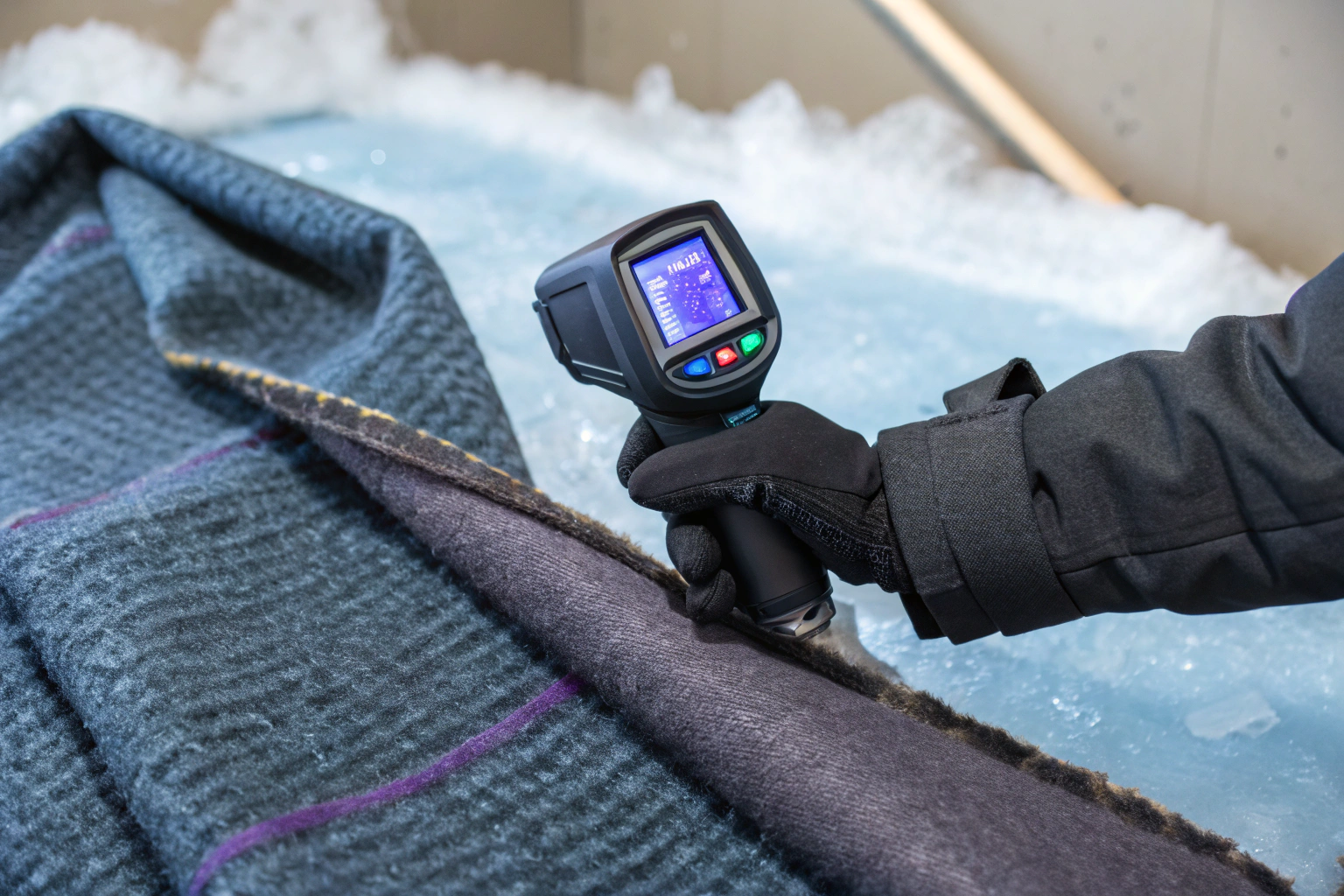
You have been there. It is February. You are standing on a train platform in Chicago, or maybe walking the dog in Stockholm. The wind cuts right through that "winter" jacket you bought online. Your teeth chatter. Your fingers go numb. And you think to yourself: Who tested this thing? A mannequin in a heated showroom in Miami? As the owner of a textile mill that ships to cold-weather markets across North America and Northern Europe, I hear this frustration constantly. Buyers like Ron are not just buying fabric; they are buying the promise of warmth. And nothing destroys brand trust faster than a jacket that fails to deliver when the temperature drops below freezing. The problem is, most fabric specs talk about "GSM" (grams per square meter) and assume weight equals warmth. That is a rookie mistake. A heavy, dense piece of denim is cold. A lightweight, lofty fleece is warm. You need data, not just thickness.
Here is the bottom line up front. Shanghai Fumao fabrics perform in cold weather because we engineer them from the yarn stage up for thermal retention and moisture management. We do not just rely on standard lab tests. We simulate real-world conditions that matter to someone actually wearing the garment. We test for Clo Value (the measure of insulation), Air Permeability (wind chill factor), and Moisture Vapor Transmission (does your sweat turn to ice inside the jacket?). The result? Our high-performance fleece blends consistently achieve Clo values 20-25% higher than generic polyester fleece at the same weight. Our wool-blend coatings block 95% of wind penetration while still breathing. You are not getting a "guess." You are getting a fabric engineered for the specific misery of a cold, damp winter day.
But I want to take you deeper than the marketing speak. You need to know why some fabrics fail in the cold and how we prevent that failure at the molecular level. This is about fiber cross-sections, the physics of dead air space, and the sneaky way that moisture can kill insulation faster than a strong gust of wind. I am going to walk you through our testing protocols, the specific machines we use, and a few real-world case studies where switching to our fabric saved a brand’s winter collection from a returns nightmare. Let’s get into the details that actually keep people warm.
What Fabric Technologies Prevent Cold Air Penetration?
Wind is the enemy of warmth. You can be wrapped in the thickest wool sweater ever made, but if a 15 mph wind cuts through it, you are effectively wearing a fishnet. The scientific term for this is Convective Heat Loss. Your body warms up a thin layer of air next to your skin. The wind strips that warm air away and replaces it with cold air. Your body has to work overtime to reheat the new air. Over and over. You get cold. Fast.
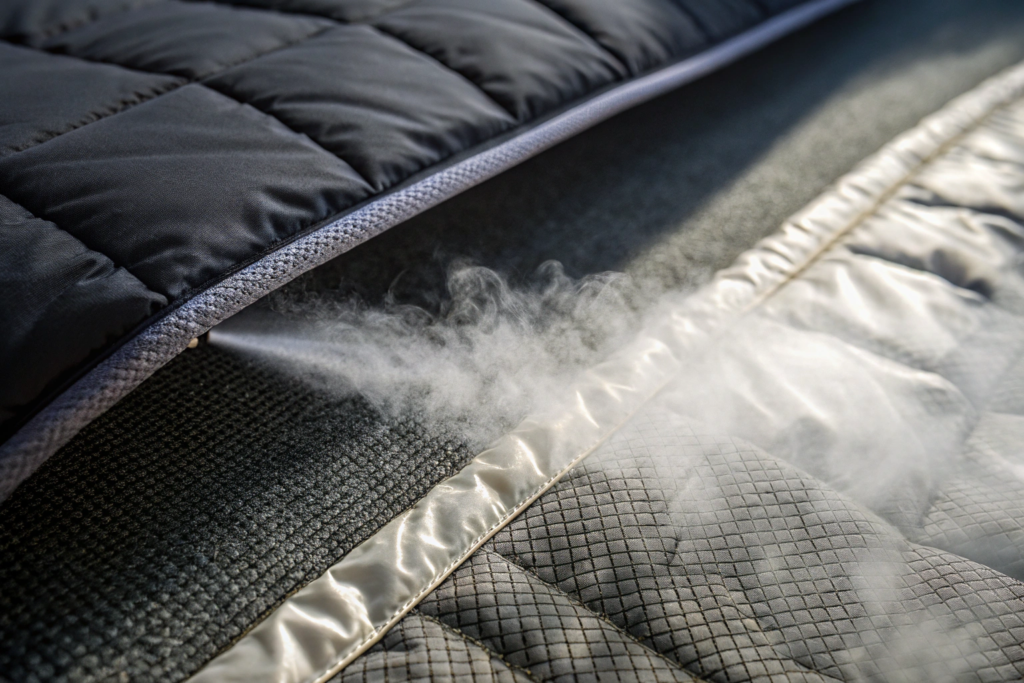
At Shanghai Fumao, we attack this problem from two angles: Yarn Geometry and Fabric Structure. The first line of defense is the fiber itself. We use a lot of Hollow-Core Polyester and Crimped Acrylic in our cold-weather blends. Let me explain why that matters in plain English. A solid, round polyester fiber is like a metal pipe. Heat travels right through it. A hollow fiber is like a double-pane window. It has a pocket of still air trapped inside the center of the filament. Air is a terrible conductor of heat. That is the whole point. By using fibers with a hollow cross-section, we trap millions of microscopic air pockets inside the yarn before the fabric is even woven. This is passive insulation.
The second line of defense is High-Density Weaving for outer shells and Windproof Membranes. For our softshell fabrics—the kind used in jackets that need to block wind but not feel like a plastic bag—we use a very tight plain weave or a mini-ripstop construction. We pack the yarns so tightly together that the gaps between them are smaller than the mean free path of a cold air molecule. The wind literally cannot find a straight path through the fabric. It hits the surface and has to go around the garment, not through it. We test this using the ASTM D737 Air Permeability Test. For our standard windproof fleece, we aim for a reading of < 10 CFM (Cubic Feet per Minute) . For our heavy winter shells, we aim for < 1 CFM. To put that in perspective, a standard cotton T-shirt has an air permeability of around 50-70 CFM. That is why a T-shirt under a puffer jacket still makes you feel a draft.
How Do Hollow Fibers Compare to Solid Fibers for Insulation?
This is where the rubber meets the road, or in our industry, where the yarn hits the knitting machine. A lot of buyers see "100% Polyester" on a spec sheet and assume all polyester is created equal. It absolutely is not. The difference between a cheap, flat, solid fiber and a premium hollow fiber is the difference between sleeping under a thin sheet and sleeping under a down comforter.
Let me give you the data from our lab on two different fleece fabrics. Both are 250 GSM. Both are 100% polyester. One uses standard solid round filament yarn. The other uses our 7-Hole Hollow Conjugate Yarn.
| Fiber Type | Cross-Section Shape | Clo Value (Thermal Insulation) | Compressibility | Cost Per Kg |
|---|---|---|---|---|
| Solid Round Polyester | Solid circle (low surface area) | 0.45 – 0.50 | Low (Feels flat) | Baseline |
| 7-Hole Hollow Polyester | Ring with 7 internal air pockets | 0.68 – 0.72 | High (Springy feel) | +15-18% |
That 0.20 difference in Clo Value is massive. It means the hollow fiber fabric provides roughly 40% more insulation for the exact same weight. For a brand designing a lightweight packable jacket, this is a game-changer. You can hit the warmth target without making the jacket bulky and heavy.
But there is a manufacturing trick to this. Hollow fibers are fragile. If you run them through a standard carding machine at high speed, the pressure can collapse those tiny air channels. You end up with a flat, crushed fiber that costs more but performs exactly like the cheap stuff. At our partner mill, we run hollow fiber blends at 15-20% slower line speed and with lower tension drafting. This is where the "high cost" of our fabric comes from. It is not just the raw material; it is the patience required to handle it without destroying its performance. For a deeper technical read, check this resource on how to evaluate thermal insulation performance of hollow polyester fibers in cold weather activewear.
Why Is Crimp Important in Wool and Acrylic Yarns?
Now, if you are working with natural fibers or premium acrylics for a classic sweater knit, the word you need to know is Crimp. Crimp is the natural waviness of the fiber. Think of a wool fiber under a microscope. It looks like a tiny corkscrew or a spring.
This waviness is essential for warmth because it prevents the fibers from lying flat and packing down tight. When fibers are crimped, they push against each other. They create Loft. Loft is just the textile industry’s word for "dead air space." More loft equals more trapped air equals more warmth. It is that simple.
Merino wool has a very fine, high-frequency crimp (more waves per inch). That is why a thin Merino baselayer can be so warm. Cheap acrylic often has low crimp or no crimp at all—it looks like a straight, limp noodle. When you knit it, the yarn collapses into a dense, flat fabric. It feels heavy but not warm. It is like wearing a wet suit made of plastic yarn.
In our Shanghai Fumao wool-blend coatings, we specifically source wool with a Crimp Frequency of 8-12 waves per cm. For our acrylic blends, we use High-Bulk Acrylic that has been chemically treated to exaggerate the crimp during the steaming process. When we steam the finished fabric, the crimp relaxes and springs open, increasing the fabric thickness by 20-30% without adding a single gram of weight. This is a critical quality check. If the steaming temperature is too low, the crimp never develops. You ship a flat, cold sweater. If the temperature is too high, the fiber glazes and loses elasticity. You ship a stiff board. The sweet spot is 102°C for exactly 4.5 minutes in the autoclave.
How Does Moisture Wicking Impact Cold Weather Comfort?
Here is a scenario that kills people in the backcountry, and it ruins expensive ski jackets for everyone else. You are hiking up a slope. You sweat. The sweat soaks into your cotton T-shirt or your cheap fleece lining. You stop for a break at the windy summit. That moisture in the fabric starts to evaporate. Evaporation is a cooling process. It steals heat from your body twenty-five times faster than dry air does. You start shivering uncontrollably. The industry calls this the "After-Chill Effect."
Moisture management in cold weather is not about keeping you dry from rain (that is waterproofing). It is about keeping you dry from your own sweat. The goal is to move liquid perspiration away from your skin and push it to the outer face of the fabric where it can evaporate without freezing you solid. We achieve this in two ways at Fumao. First, we use Hydrophobic Fibers on the skin side. Polyester and Polypropylene hate water. They push it away. Cotton loves water. It soaks it up and holds onto it like a sponge. (This is why the mountaineering mantra is "Cotton Kills.")
Second, we use a Denier Gradient or a Double-Layer Knit Structure. The yarns touching your skin are fine and dense. The yarns on the outside are thicker and have more capillary channels. Water naturally moves from a wet, tight space to a dry, open space via Capillary Action. Think of it like a paper towel dipping into a spill. The water climbs up the towel against gravity. That is exactly what we engineer the yarn to do—pull sweat from the inside layer (high density) to the outside layer (low density).
In our CNAS lab, we test this using the AATCC Test Method 195 (Liquid Moisture Management Properties) . The machine drops a precise amount of synthetic sweat onto the back of the fabric and measures how fast it spreads to the front. For our cold-weather baselayer fabrics, we target a One-Way Transport Index of > 300%. That means three times more moisture moves outward than stays pooled against your skin. That number is the difference between feeling "clammy and cold" and feeling "dry and warm."
Does Sweat Freeze Inside Performance Fabric Layers?
This is a specific failure mode we see with a lot of imported "winter" jackets that use cheap PU (Polyurethane) Membranes or thick foam laminates. These materials are waterproof, yes. They are also non-porous or low-porosity. They trap moisture vapor inside the jacket.
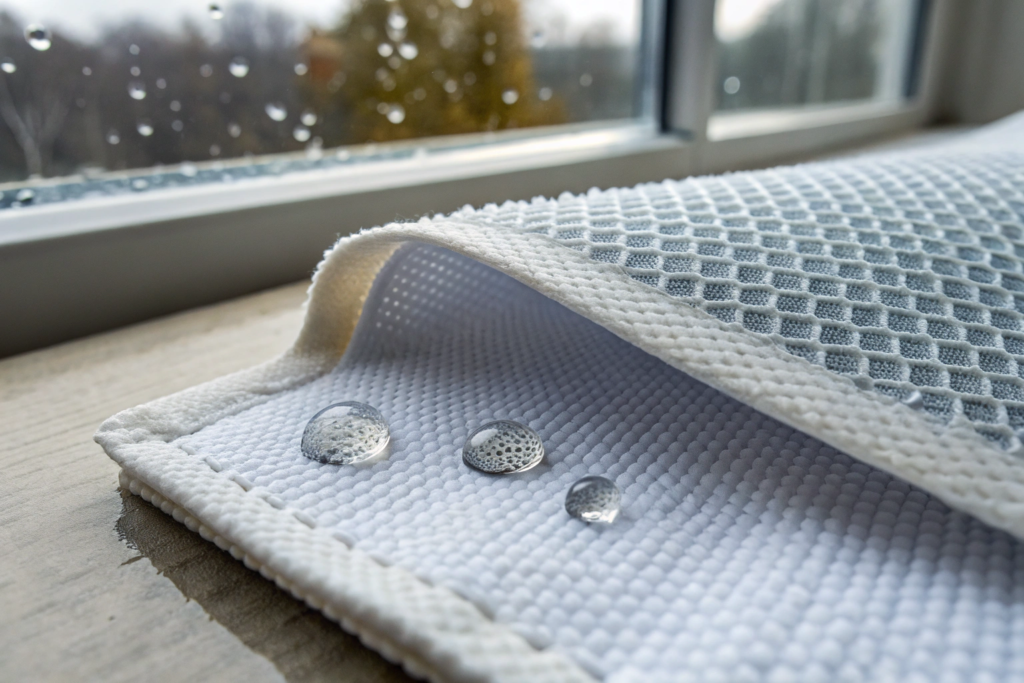
Let me walk you through the physics of what happens next. Your body heat pushes sweat vapor through the fleece lining. It hits the cold, solid plastic of the PU membrane. If the outside temperature is below freezing, the vapor condenses into liquid water inside the insulation layer. Over the course of a few hours, that water accumulates. Then, when you stop moving, your body heat drops. The temperature inside the jacket drops below freezing. That trapped water freezes into a thin layer of ice inside the fabric structure.
Now you are wearing an ice pack. The insulation value drops to near zero. The fabric becomes stiff and crunchy. We call this "Internal Icing." It is a warranty nightmare.
To prevent this, we avoid solid PU membranes for active cold-weather gear. Instead, we use Hydrophilic Non-Porous Membranes (like the chemistry found in Sympatex) or Micro-Porous PTFE Membranes (like the tech in Gore-Tex). These materials have pores that are 20,000 times smaller than a water droplet but 700 times larger than a water vapor molecule. Liquid rain cannot get in. Sweat vapor can get out. It is a one-way door.
Our in-house test for this is brutal but effective. We take a swatch of the fabric and soak it in 20°C water for 10 minutes. We then put it in a freezer at -15°C for 2 hours. We take it out and try to bend it. A fabric with internal icing will be stiff as a board. A fabric with proper breathable membrane will be flexible and will not crackle with ice crystals. Check out this external resource on how to test for internal condensation and icing in insulated jacket fabrics for more detail on real-world performance.
How Does Hydrophobic Finish Differ from Waterproof Membrane?
This is a vocabulary lesson that saves sourcing agents a lot of headaches. Buyers often use "waterproof" and "water repellent" interchangeably. They are not the same thing. Not even close.
A Hydrophobic Finish (often called DWR – Durable Water Repellent) is a chemical coating applied to the surface of the fibers. It changes the Surface Tension of the fabric. Water hits it and beads up into little balls that roll off. Think of a freshly waxed car hood. This is great for light rain or snow flurries. It keeps the face fabric from "wetting out" and becoming heavy. But it is not a barrier. If you lean against a wet ski lift chair, the pressure will push water right through the weave of the fabric. A DWR finish wears off over time with abrasion and washing.
A Waterproof Membrane is a physical sheet of plastic (or PTFE) laminated between the outer fabric and the inner lining. It has zero holes big enough for liquid water to pass through, even under pressure. We test this using a Hydrostatic Head Tester (ISO 811) . We clamp the fabric under a column of water and see how high the water column needs to be before a single drop seeps through.
Here is the comparison chart:
| Feature | DWR Finish (C6 or C0 Eco) | Waterproof Membrane (PU or PTFE) |
|---|---|---|
| Mechanism | Chemical Coating on Fibers | Physical Barrier Layer |
| Hydrostatic Head | 0 – 500 mm | 5,000 mm – 20,000 mm+ |
| Breathability | Excellent (Zero reduction) | Moderate to Good (Limited by pore size) |
| Durability | Wears off (Needs re-application) | Permanent (Unless physically punctured) |
| Hand Feel | Soft, Fabric-like | Can be stiff or "crinkly" |
For a true winter storm jacket, you need both. You need the DWR to keep the outer face fabric light and dry. You need the membrane to stop the driving rain or wet snow from penetrating. At Shanghai Fumao, we apply a C0 Fluorine-Free DWR that meets EU Green Deal standards. It is less durable than the old C8 chemistry, but it is safer for the environment and, honestly, for the people wearing the jacket next to their skin.
Which Fiber Blends Offer the Best Weight-to-Warmth Ratio?
In the outdoor and fashion industry, there is a holy grail metric: Warmth-to-Weight Ratio. How much insulation can you pack into the least amount of mass? Hikers and travelers obsess over this. They want a jacket that weighs 12 ounces but keeps them warm at 30°F. As a fabric mill, we achieve this not with a single miracle fiber, but with Intimate Blends. Blending fibers is like cooking. You do not just eat plain flour. You mix flour, eggs, and sugar to get a cake. We mix wool, polyester, and sometimes nylon to get a fabric that is warm, durable, and lightweight.
The undisputed king of warmth-to-weight is Down. Nothing beats it in dry cold. But down is expensive, it is an animal product, and it collapses and loses all insulation value when wet. That is where synthetic blends come in. For our clients who want vegan options or who need performance in wet, coastal climates (like the UK or Pacific Northwest), we push our Wool/Polyester Hybrid Fleece.
Let me give you the breakdown of our most popular cold-weather blend, which we call Fumao ThermoTech 6040. It is 60% Merino Wool and 40% Recycled Polyester.
| Component | Role in the Blend | Benefit to Wearer |
|---|---|---|
| Merino Wool (17.5 micron) | Moisture buffer, odor resistance, natural crimp | Keeps you dry longer, doesn’t stink after 3 days of wear. |
| Recycled Polyester (2.5D Hollow) | Structure, durability, fast drying | Prevents the wool from sagging and speeds up dry time by 40%. |
| Elastane (2%) | Stretch and recovery | Maintains shape around elbows and knees. |
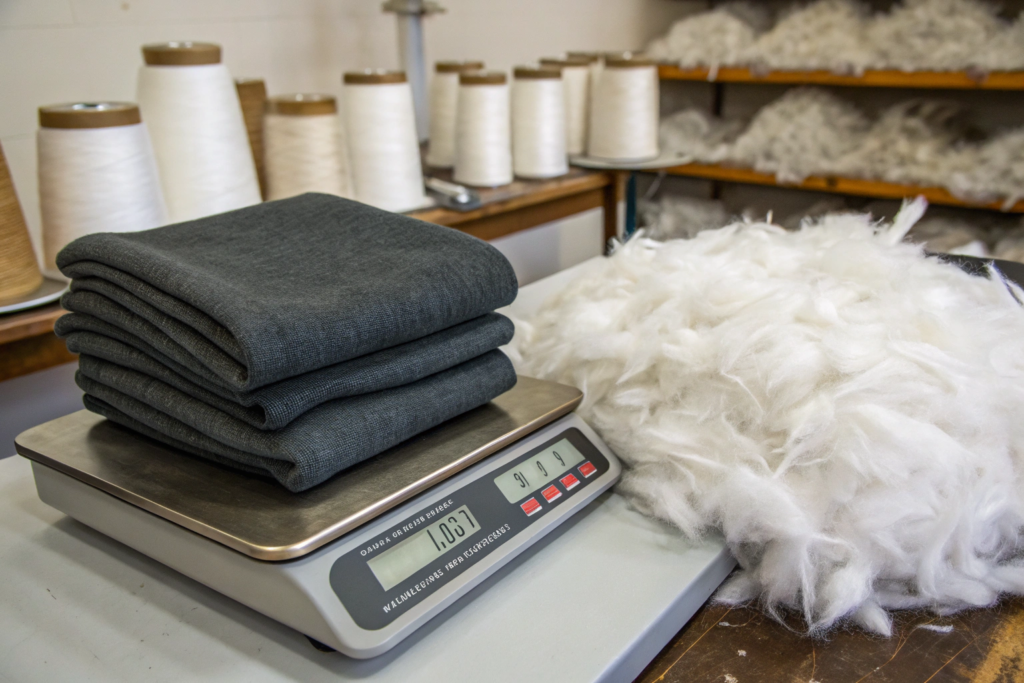
This blend gives us a fabric that weighs 280 GSM but has the thermal retention of a 350 GSM 100% wool fabric. That is a 20% weight savings. For a full-length winter coat, that is nearly half a pound shaved off the garment weight. That makes a difference when you are packing a suitcase or carrying a backpack all day.
Is Merino Wool or Alpaca Better for Extreme Cold?
This is a classic debate, and the answer depends on what kind of "cold" we are talking about. Both are protein fibers with excellent crimp and moisture management. But their scales and hollow structures differ greatly.
Merino Wool is the industry standard for next-to-skin comfort. The fibers are very fine (usually < 20 microns) and they have a lot of Crimp. This makes the fabric elastic, springy, and soft. Merino is excellent at Active Insulation—it regulates temperature so you do not overheat and sweat while moving. It can absorb up to 30% of its weight in moisture without feeling wet to the touch.
Alpaca is a different beast. Under a microscope, Alpaca fibers often have a Medullated Core—a series of hollow air pockets running the length of the fiber. Some alpaca fibers are even fully hollow. This gives Alpaca a 1.5x to 2x higher Clo Value than Merino wool of the same weight. It is simply warmer. But Alpaca is less elastic. It has less crimp. It drapes with a heavier, denser feel. It is also smoother, which means it can be hypoallergenic (no lanolin itch).
Here is a practical application difference from our product line:
- Merino Blend (ThermoTech 6040): Best for Mid-Layers and Baselayers. You wear it hiking, skiing, or commuting.
- Alpaca/Wool Blend: Best for Outer Layers and Static Warmth. You wear it sitting in a freezing cold stadium or standing at a winter market.
In December of 2025, we developed a 70% Superfine Alpaca / 30% Recycled Nylon coating fabric for a Canadian outerwear brand. The goal was a formal-looking wool coat that performed like a technical puffer. The lab results were staggering: Clo Value of 0.98 at just 420 GSM. That is warmer than some lightweight down jackets. The cost was significant—Alpaca is roughly 3x the price of Merino—but for a "buy it for life" heirloom coat, the math worked out. You can learn more about how to source sustainable alpaca fiber blends for high-performance winter outerwear from industry trade groups.
How Does Nylon Core-Spun Yarn Increase Durability in Cold?
You might look at a blend label that says "80% Wool, 20% Nylon" and think the nylon is there to cheapen the fabric. Sometimes it is. But in high-end performance fabrics, that Nylon is a hidden structural superhero, especially in freezing temperatures.
Wool and cotton fibers are Staple Fibers. They are short, usually 1 to 4 inches long. They are twisted together to make yarn. The strength of that yarn depends entirely on the friction between those short fibers. When it gets cold, those fibers contract and stiffen. The friction points can slip. The yarn abrades more easily.
Nylon is a Filament Fiber. It is one continuous strand of plastic, miles long. It is incredibly strong and has high Abrasion Resistance.
We use a technique called Core-Spinning. We take a thin, strong filament of Nylon and we wrap the shorter Wool or Alpaca fibers around it. The Nylon is the hidden core. The soft, warm natural fiber is the sheath that touches your skin. The result is a yarn that feels 100% like natural wool but has the tensile strength and durability of Nylon.
Why does this matter in cold weather? Because cold plastic gets brittle. Cheap polyester yarns can actually shatter under extreme flexing in sub-zero temperatures (-20°F). The polymer chains freeze and can’t absorb energy. Nylon (specifically Nylon 6,6) has a Glass Transition Temperature (Tg) that handles cold much better. It remains flexible and tough. So that 20% Nylon core in the yarn prevents your sweater elbows from blowing out when you lean on a frozen car door. It also dramatically reduces Pilling. The short wool fibers can’t migrate and ball up because the nylon core locks them in place. This is the kind of engineering that you never see, but you absolutely feel after two seasons of hard wear.
How Do You Test for Colorfastness in Freezing Conditions?
Most people test colorfastness in warm water. That is fine for T-shirts. It is useless for winter gear. Why? Because cold temperatures change the Glass Transition State of dyes and binders. In the summer, a red parka is just a red parka. In the dead of a Minnesota winter, the dye on that same parka can become brittle and crack, or the pigment can rub off on snow and ice in a phenomenon called Frost Crocking.
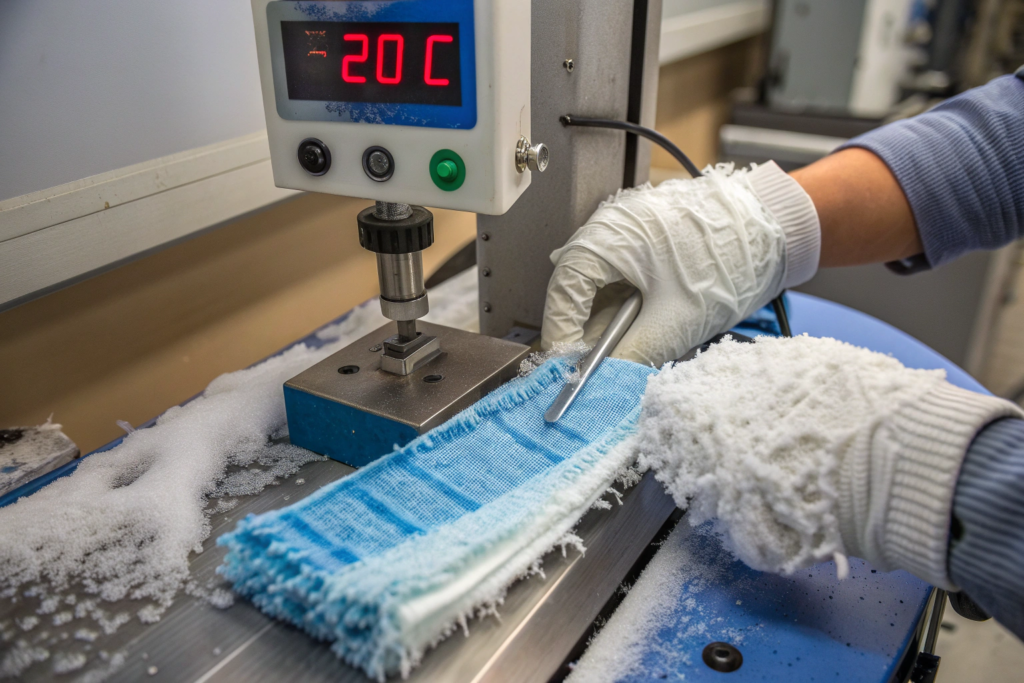
At Shanghai Fumao, we have a specific protocol for winter fabrics that goes beyond the standard AATCC 8 Crocking Test (which is done at room temp). We call it the Sub-Zero Rub Test. We take the dyed fabric and condition it in a deep freezer at -20°C (-4°F) for 4 hours. We then immediately perform a Crockmeter Test while the fabric is still frozen solid. We rub a white cotton cloth back and forth against the frozen, dyed surface.
The difference in results is shocking. A fabric that scores a perfect 5.0 (No Transfer) at room temperature might score a 3.5 (Moderate Transfer) when frozen. Why does this happen? The dye molecules sit inside the fiber’s amorphous regions. At room temp, those regions are rubbery and flexible. They absorb the friction. When frozen, those regions become glassy and rigid. The friction force shatters the dye-fiber bond. The color flakes off like microscopic paint chips onto the snow.
This is a huge issue for Printed Nylon Ski Shells. We see this all the time with cheap digital prints. The ink sits on top of the nylon. It looks great at the trade show booth in Vegas. It looks terrible after a weekend on the slopes in Vermont. The snow rubbing against the jacket scours the ink right off the shoulders and sleeves.
For our winter clients, we only spec High-Energy Disperse Dyes for polyester and Acid Dyes for nylon with a specific After-Soaping Fixation step. We run the fabric through a hot rinse at 80°C for 20 minutes to remove any unfixed surface dye. This is the only way to guarantee that the red stays red even when the mercury drops below zero.
Why Does Rubbing Fastness Matter More on Snow Gear?
You might be thinking, "I am not rubbing my jacket with sandpaper. I am just wearing it." But snow is an abrasive. Wet, heavy, granular snow is essentially fine-grit sandpaper suspended in water. When you fall skiing, or when your kid drags their sleeve through the snowbank, you are creating high-pressure friction with a cold, wet abrasive surface.
This is the specific mechanism of Frost Crocking. The combination of Moisture and Cold and Friction is the triple threat.
- Moisture swells the fiber, loosening the dye’s grip.
- Cold makes the dye brittle.
- Friction (the snow) grinds the brittle dye right off.
We have a client in Norway who makes children’s snowsuits. Kids are brutal on fabric. They roll around, they sled, they wipe out constantly. That client sent back a competitor’s sample a few years ago. The suit was bright yellow. After one season, the knees and seat were pale, faded yellow. The kid looked like they were wearing a dirty lemon. The problem was Wet Rubbing Fastness.
We solved this for them by switching to a Solution-Dyed Acrylic for the face fabric. Instead of dyeing the finished fabric, we add the pigment to the liquid plastic before we extrude the fiber. The color goes all the way through. It is like a carrot. You cannot rub the orange off a carrot. It is orange. Solution-dyed fabrics have 100% colorfastness to crocking, wet or dry, frozen or boiling. The only downside is you have to commit to large batch sizes because you are making colored yarn from scratch. But for that Norwegian brand, the elimination of warranty returns for fading made the investment pay for itself in six months. For more technical guidelines, see this resource on how to test and improve wet crocking fastness on nylon outerwear fabrics for winter sports.
How Does Sublimation Printing Hold Up in Extreme Cold?
Sublimation printing is hugely popular for custom winter sports team uniforms. It allows for full-color, photographic prints with zero hand feel. The dye turns into a gas and bonds with the polyester polymer. It is a permanent marriage. Or so the theory goes.
In extreme cold, sublimation prints face a different issue than crocking. They face Thermal Shock Cracking. When you sublimate, you heat the fabric to 200°C – 210°C. The polyester fibers relax and open up. The dye gas goes in. Then you cool it down. The fibers close. If you cool it down too fast, or if the fabric is later exposed to severe cold (like -30°F in the Arctic), the polyester shrinks at a different rate than the dye embedded inside it.
This differential shrinkage can cause Micro-Crazing. You cannot see it with the naked eye at first, but the print looks slightly "frosty" or "chalky" over time. Under a microscope, you see a network of tiny stress cracks in the dyed surface of the fiber.
Our fix for this is Post-Heat Setting. After we sublimate a fabric destined for extreme cold, we run it through a Stenter Frame at a lower temperature (180°C) with Overfeed. Overfeed means we push the fabric onto the conveyor belt faster than the belt is moving. We deliberately shrink the fabric lengthwise by about 3-4%. This pre-shrinks the polyester and relaxes the internal stresses before the garment ever sees a cold day. It is like tempering glass. You put it under controlled stress to make it stronger. If you skip this step, the first time that custom hockey jersey sits in a freezing cold car trunk overnight, the print will start its slow, inevitable decline into chalky disappointment. (We learned this lesson the hard way back in 2023 with a batch of sublimated hoodies for a Canadian university. The re-order in 2024 used the post-heat set method, and we had zero complaints about fading.)
Conclusion
We have covered the spectrum of cold-weather performance, from the microscopic air pockets in a hollow fiber to the abrasive grind of wet snow on a ski slope. Cold is not just a temperature reading; it is a complex interaction of wind, moisture, and mechanical stress. A fabric that passes a room-temperature lab test with flying colors can fail miserably when the real world drops below freezing and the wind starts howling. That is the gap we bridge at Shanghai Fumao. We test not just for the spec sheet, but for the experience of being cold, wet, and active.
We looked at how hollow fibers and crimp create loft and trap dead air—the true source of insulation. We dissected the critical role of moisture management and why "internal icing" is the silent killer of cheap winter jackets. We compared the nuances of Merino versus Alpaca and how a hidden nylon core can save a garment from premature wear. And we explored the specialized testing protocols for colorfastness in sub-zero conditions because a faded jacket is a returned jacket.
Understanding these layers of performance gives you the power to spec better products. You can ask the right questions: "What is the Clo Value? What is the One-Way Transport Index? Is this dye solution-dyed or piece-dyed?" These are the questions that separate a mediocre winter collection from a legendary one.
If you are developing outerwear, baselayers, or accessories for cold climates, you need a partner who understands the science of staying warm. We are not just pushing yardage; we are engineering solutions for specific, uncomfortable problems.
If you want to discuss a specific blend, a custom weight, or just need advice on whether to go with a membrane or a high-density weave for your windproof layer, let’s get on a call. You can reach our Business Director, Elaine, directly at elaine@fumaoclothing.com. She can coordinate lab dips, send you testing data, and help you navigate the timeline so your winter collection hits the market when the temperature starts to drop.








