Here’s a hard truth that might sting a little. In the textile world, "good fabric" is often just a lazy compliment people throw around when they can’t find anything specifically wrong. But when a large buyer—the kind who places 50,000-yard orders four times a year and has a QC manual thicker than a phone book—says your fabric is good, that’s not a compliment. That’s a diagnosis that you’ve survived their autopsy. Large buyers don’t gamble on romantic notions of craftsmanship. They measure failure rates, they count returns per thousand units, and they track the "cost of poor quality" down to the cent. If they keep coming back, it’s because the numbers force them to.
Large buyers consistently rate Shanghai Fumao fabric highly because we solve the three silent killers of their P&L: shade-band discontinuity across massive dye lots, hidden shrinkage that surfaces only after the consumer’s third wash, and seam slippage that turns a $120 dress into a $12 write-off. I remember walking the floor with a senior sourcing director from a major European fast-fashion group in October 2023. He didn’t compliment the hand feel of our Tencel twill. He pulled a spectrophotometer from his bag, scanned three random rolls from a 5,000-yard batch, and nodded when the delta-E readings were 0.3, 0.4, and 0.3 against his digital standard. That nod was worth more than a hundred "beautiful fabric" comments. It meant his cutting room could mix rolls freely without visible shade-banding in the finished garments. No lost cutting time, no color-sorting chaos, no angry store managers rejecting delivery.
That’s the lens we’ll use today. Not "does it look pretty," but "does it perform predictably when a brand’s entire season depends on it." I’ll walk you through the specific technical thresholds that large buyers audit—from dye lot reproducibility measured by spectrophotometry to the spirality tests that keep a t-shirt’s side seam from twisting to the front after washing—and share real cases where these metrics saved or sank an order. No fluff, just the hard data and the gear and the checkpoints that make a fabric "good" by the only definition that matters: the one written in a purchase contract.
What Technical Standards Define "Good Fabric" for Volume Apparel Buyers?
If you ask a boutique designer what "good fabric" means, they’ll talk about drape, luster, and a subjective "dry hand." Ask a volume apparel buyer from a big-box retailer or a multinational fast-fashion chain, and they’ll hand you a 40-page Restricted Substances List (RSL) and a table of physical property thresholds. For them, "good" is a binary state: the fabric statistically conforms to every line in the Technical Pack, or it’s rejected. Their definition is purely forensic. They don’t care if the mill owner cried tears of joy when they saw the loom-state. They care about one thing: can I put 20,000 units on a shelf and expect fewer than 1.5% of them to come back as returns because of a fabric failure?
The three pillars are: batch-to-batch color consistency (quantified by spectrophotometric delta-E), dimensional stability (shrinkage and spirality after repeated washes), and mechanical durability (tensile strength, tear strength, and seam slippage). A large buyer will test these across a statistically valid sample—not just the one "golden sample" you mailed them. For instance, a standard audit protocol pulls fabric from the beginning, middle, and end of a dye lot, plus random rolls from different cartons. If the tear strength in the warp direction of a lightweight viscose challis averages 800 grams but one tail-end sample drops to 550 grams, the entire lot is borderline. Large buyers know that weak tail-ends exist because the greige fabric near the core of a roll gets crushed during storage and dyeing, losing tensile integrity. A "good fabric" supplier demonstrates that they’ve compensated for this in their finishing process—perhaps by running a lower tension on the stenter frame for the tail-end sections, or by rejecting those weakened meters before packing.
What’s fascinating to me, after two decades of hosting these audits, is how the definition of "good" now extends into chemical territory that was invisible 15 years ago. A major American activewear buyer we work with doesn’t just test for standard APEO-free and formaldehyde levels; they run a full "chemical fingerprint" GC-MS (Gas Chromatography-Mass Spectrometry) scan on random fabric swatches, comparing the spectrum against a library of 2,000+ restricted substances. They once flagged a batch of our recycled polyester spandex not because it failed a regulated limit, but because the GC-MS detected a trace siloxane residue that wasn’t on their ZDHC (Zero Discharge of Hazardous Chemicals) approved chemistry list. The level was 0.2 ppm—far below any safety threshold—but their "good fabric" standard requires zero intentional use of non-listed chemistry. We traced it to a new sewing machine lubricant that had transferred during the stitching of a sample garment, not the fabric itself, but the investigation took two weeks. That’s the depth of scrutiny. A "good" fabric supplier doesn’t just survive this audit but actually enjoys it because their documentation is ready, and they view a finding not as an accusation but as a chance to tighten existing controls.
How Is Delta-E Spectrophotometry Used to Guarantee Bulk Dye Lot Consistency?
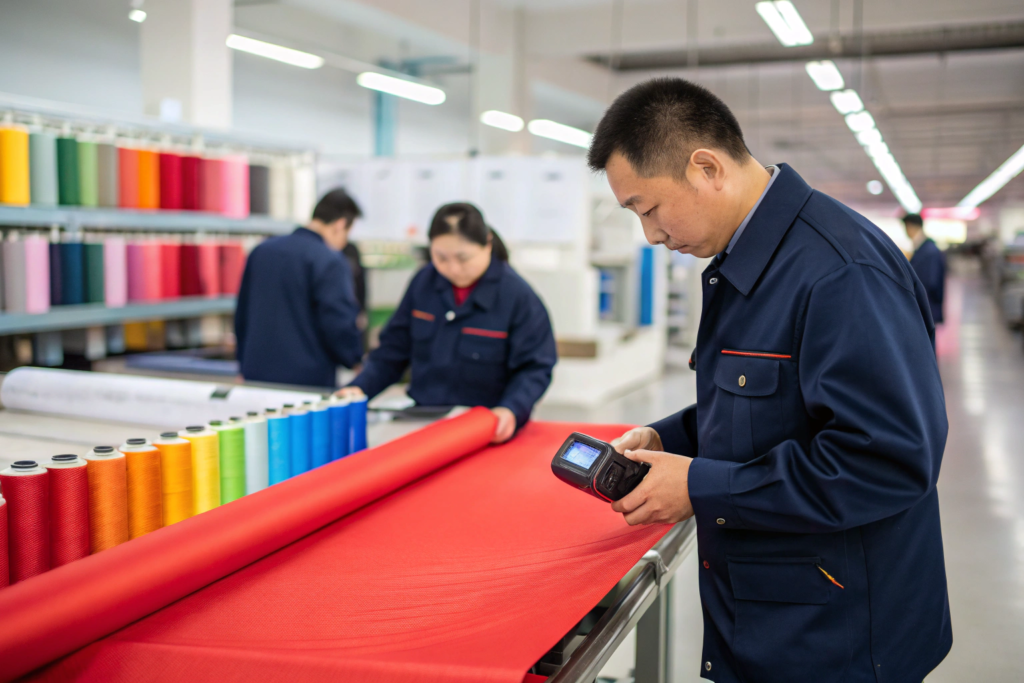
Human eyes lie—especially under fluorescent factory lighting at 6 PM when everyone’s tired. Spectrophotometers don’t. The delta-E (dE) value, typically calculated using the CMC (2:1) or CIELAB formula, measures the mathematical distance between two colors. A dE of 1.0 is roughly where 50% of people start to notice a difference under ideal lighting. A dE of 2.0 is a commercial rejection for most solid-colored apparel. For a large buyer blending fabric rolls from five different dye lots into one production line, a dE variance above 1.0 across those lots manifests as "shade banding" in the garment—a sleeve slightly different from the body, or an upper front panel that catches the light differently. The customer sees it immediately on a store mannequin under halogen lights.
At Shanghai Fumao , we don’t just measure the Lab-dip against the bulk; we measure every single dye lot against a "master digital standard" stored in our DataColor spectrophotometer. When a large buyer’s quality auditor visited last spring, they watched us scan 15 random rolls from a 12,000-yard lot of burgundy modal jersey destined for a sleepwear line. Our internal tolerance is a dE CMC(2:1) ≤ 0.8 for solids. The auditor’s own handheld X-Rite device measured a maximum dE of 0.6 across the 15 rolls. That’s below the threshold where any human can perceive a difference without a side-by-side light booth comparison. But here’s the critical step many mills skip: we also measure the reflectance curve, not just the dE number. Two fabrics can have the same dE but different spectral reflectance curves—a phenomenon called metamerism. They match under the store’s LED lights but clash horribly under the office’s cool white fluorescents the next morning. We prevent metameric failures by requiring the reflectance curves of Lab-dip and bulk to overlap within a 5% deviation across the entire visible spectrum (400-700nm). A sportswear brand we supplied in early 2024 avoided a potential metamerism disaster on a navy cotton-lycra legging because our spectral curve check caught a mismatch that the dE alone missed; the bulk matched at dE 0.5 but the reflectance dip at 580nm was off by 8%. Had we shipped, the leggings would have looked purple under warm light. This is exactly the kind of detailed color control that platforms like X-Rite’s color management resources explore in depth, offering frameworks for moving beyond basic delta-E into full spectral analysis.
Why Does AATCC 135 Dimensional Stability Testing Prevent Post-Wash Returns?
Shrinkage is the silent return-rate assassin. A customer buys a size Large cotton-linen shirt, wears it, washes it once according to the care label, and now it fits like a Medium. They don’t blame their washing machine; they blame your brand. AATCC 135 is the standardized test that simulates this exact scenario: a marked fabric specimen is machine-washed and tumble-dried using precise settings (Normal cycle, 40°C wash, Tumble Dry Cotton setting), and the change in dimensions in both warp and fill directions is measured. The benchmark for large buyers is typically maximum 3% shrinkage in the length and 2% in the width for woven apparel. Knits are allowed slightly higher tolerances (5% x 5%) because their structure inherently relaxes, but anything above that slams your return rate.
The technical nuance that separates "passed test on paper" from "performed in a customer’s home" is progressive shrinkage. A fabric might shrink 2.8% after the first wash (passing the standard) but then shrink another 1.5% after the third wash, accumulating to 4.3% cumulative. The AATCC 135 test only reports after 1 or 3 cycles, but smart large buyers request a cumulative 5-wash report. In February 2024, a major American menswear brand ordering our linen-rayon blend requested the 5-wash AATCC 135 data. The 1-wash shrinkage was a comfortable 2.2% x 1.8%. But by wash 5, the length shrinkage had crept to 3.8%. The fabric’s rayon component was made from a slightly lower-tenacity pulp grade that progressively relaxed in water. We caught this before bulk production, switched to a higher-wet-modulus Modal blend that stabilized maximum shrinkage at 2.9% even after 5 washes, and the brand’s return rate on that shirt line stayed under 2%. This proactive approach to textile performance is mirrored in the guidance from industry bodies like the American Association of Textile Chemists and Colorists (AATCC), whose standards shape how testing methods are developed for real-world consumer usage scenarios beyond pass-or-fail checkboxes.
How Does Fumao’s Vertical Integration Eliminate the "Weak Link" Supplier Problem?
The fabric supply chain is only as strong as its weakest subcontractor, and most "fabric suppliers" in China are actually just trading companies orchestrating a symphony of independent workshops they don’t control. The weaving is done at Plant A, the dyeing outsourced to Plant B 200 kilometers away, the printing sent to a tiny family-run Plant C, and the final finishing handled by Plant D. Each handoff is a quality risk and a communication black hole. The dye house doesn’t know that the weaver used a slightly different warp sizing formula, which causes uneven dye penetration. The printer doesn’t inform the finisher that the pigment ink requires a lower curing temperature to avoid yellowing. The large buyer’s "fabric supplier" is a middleman who makes frantic phone calls when something goes wrong but has zero technical authority over any of the actual machines.
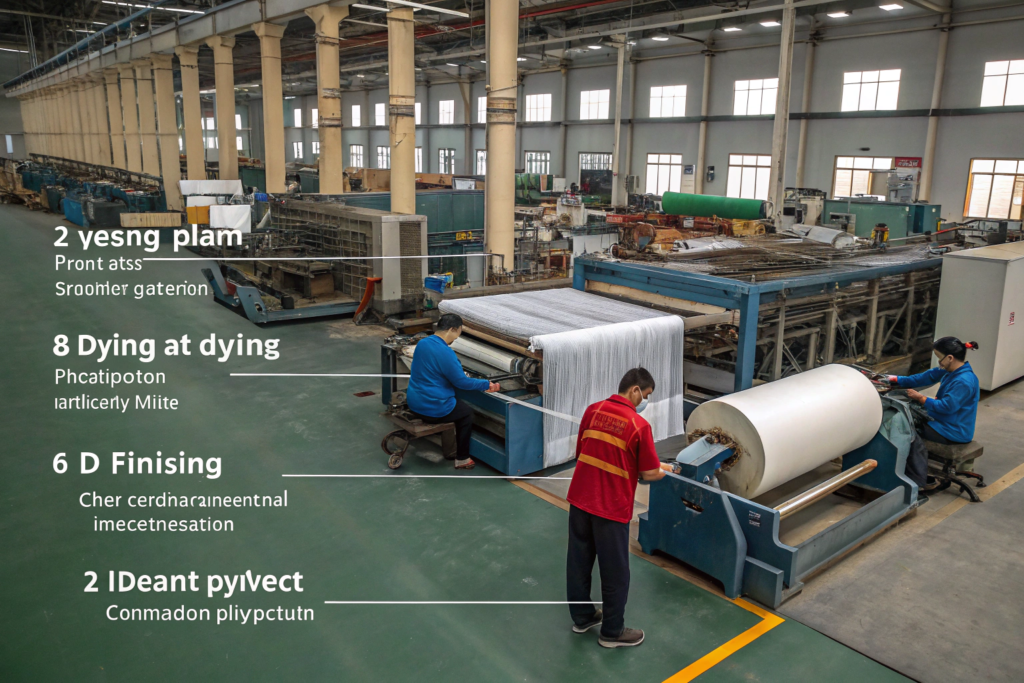
At Shanghai Fumao , we deliberately operate a vertically integrated model that crushes this fragmentation. Our own large-scale weaving facility feeds directly into our cooperative dyeing plant (where we control the recipes and quality gates), which then flows into our owned printing, embroidery, and coating facilities, and finally into our own inspection and packaging lines. The chain of custody is unbroken, and the technical communication is instantaneous. If the weaving QC detects a hairiness variation on the ring-spun cotton warp at 11 AM, the dyeing shift manager knows before noon to adjust the pre-treatment scouring time to compensate. There’s no email, no blame-shifting, no "that’s not our problem." It’s one integrated technical team solving a problem across processes.
The real power of this isn’t just faster communication—it’s root cause traceability. When a defect appears in the finished fabric, a fragmented supply chain plays the blame game for weeks while your container sits. In our vertical setup, a single digital job ticket travels with the batch from loom to packing. If a pilling issue surfaces on a brushed poly-cotton fleece, we trace back through the job ticket in minutes: Was the yarn twist factor below spec? (Check the weaving input log.) Was the brushing machine’s wire height set too aggressively? (Check the finishing work instruction.) Was the dye cycle temperature too high, weakening the polyester? (Check the dyeing PLC data.) In June 2024, this traceability saved a 15,000-yard order of heather grey French terry for an American loungewear brand. The Auditor found intermittent pilling on the brushed back. Within 2 hours, we identified that one of three brushing machines had a worn-out roller bearing causing an inconsistent pressure profile. We isolated the 800 yards processed on that machine, re-brushed them on a serviced machine, and re-inspected—the remaining 14,200 yards were already perfect because we could prove they never touched the faulty bearing. A non-integrated supplier would have quarantined the entire 15,000 yards or, worse, shipped it all and hoped the brand’s incoming QC missed it. Vertical integration turns a potential recall into a 2-hour rework.
Why Does In-House Weaving Control Prevent Selvedge Curling on Roll Ends?
Selvedge curling at the roll ends is a deceptive defect. The fabric looks beautiful on the roll, but when the spreading machine in your US cutting room unrolls it under tension, the first and last 3 yards curl inward by 2-3 inches. The automatic spreader’s sensors can’t grip the curled edge, so the machine stops, the operator has to manually uncurl and hold the fabric, and the cutting room’s productivity drops by 15% or more. For a large buyer whose entire manufacturing cost model assumes a certain "spreading speed" per yard, a curling selvedge on every roll end is a hidden tax on their operational efficiency.
The root cause of selvedge curling is almost always in the weaving—specifically, an imbalance in the warp and weft tensions at the very edge of the fabric, compounded by an incorrect selvedge weave structure or a missing "leno" locking thread. When you outsource weaving, the weaver’s incentive is to run the loom fast with maximum tension to hit their yardage target. They don’t care if the edge is a little tight because their QC check is a 2-yard inspection, not a simulation of your spreader. In our own weaving mill, we control this by programming a specific "selvedge easing" sequence on our looms. For the first and last 5 meters of every roll, the loom automatically reduces the weft insertion tension by 8% and increases the temple spreader width by 2mm to overfeed the edge slightly, compensating for the natural relaxation that will occur during storage. A large European formalwear brand sourcing a delicate 100% silk organza from us in 2023 couldn’t believe the difference—their previous supplier’s roll ends were so curled they lost 4 yards per roll as unusable cutting waste. Our eased selvedges gave them a flat spread every time, saving an estimated 3% fabric utilization across their production run, which on a $22/yard silk translated to $6,600 saved per 10,000 yards. Resources like Weaving Today often discuss these loom-level adjustments and their downstream impact on fabric quality, reinforcing why in-house weaving control is a strategic advantage, not just a cost play.
How Does Integrated Dyeing-Finishing Communication Avoid Batch Color Drift?
Color drift across a massive order is a nightmare that unfolds slowly. You approve a Lab-dip for a soft sage green. The dyeing plant produces 3,000 yards of Lot #1, and it’s a perfect match. A week later, they dye another 3,000 yards for Lot #2, and it’s still within tolerance but slightly, imperceptibly bluer. By Lot #4, the accumulated drift means Lot #1 and Lot #4, when cut into adjacent garment panels, visibly clash. The brand rejects Lot #4, the supplier absorbs a $15,000 loss, and the brand misses a delivery window. This happens constantly when a dyeing plant works in isolation, "chasing" the original Lab-dip standard without understanding the finishing recipe’s effect on final shade.
In an integrated setup, the dyeing master and the finishing supervisor are not just colleagues—they share a live digital "color drift dashboard." The spectrophotometer readings from every dyed lot are plotted on a dE trend chart in real time. If the finishing team plans to apply a cationic softener (which can shift the hue slightly yellow), the dyeing team slightly shifts the initial shade slightly blue to compensate, so the final fabric hits the target. The communication is anticipatory, not reactive. A major US children’s wear brand ordered 25,000 yards of a specific "ballet pink" cotton interlock from us in early 2024. After Lot #3, the dE trend chart showed a slight drift of +0.3 on the ‘a’ (red-green) axis toward the red side. The finishing supervisor immediately notified the dyeing master, who traced it to a gradual pH shift in the dye bath’s acid buffer system. They corrected the buffer formula for Lot #4, and the final finishing team adjusted the optical brightener concentration to "pull" Lot #3 back toward neutral. All four lots, after finishing, measured within a dE 0.4 cluster. The brand’s inbound QC in their Wisconsin warehouse scanned all lots and released them within minutes. No back-and-forth, no rejection, and no air freight emergency. That’s the quiet financial miracle of integrated communication.
What Long-Term Performance Metrics Keep Large Buyers Reordering?
Repeat business from a large buyer isn’t won by a charming salesperson or a competitive first-order price. It’s won in the silence of their post-sales quality database, 6 months after the first shipment, when a supply chain analyst runs a "Supplier Scorecard" report. This report has cold, unforgiving columns: On-Time Delivery Rate (OTD), Quality Acceptance Rate (QAR), Field Failure Rate (returns attributed to fabric defect), and Claims Resolution Time. If those numbers are green, the reorder is automatic—the buyer’s ERP system literally suggests your name as the preferred source. If they’re red, all the dinner meetings in the world won’t save the relationship.
Large buyers keep reordering from Shanghai Fumao because our 12-month rolling scorecard metrics consistently hit the thresholds that trigger automatic re-sourcing preference. I’m talking about an OTD of 98.5% (within a ±3 day window of the confirmed ship date), a QAR of 99.2% (percentage of submitted lots passing their inbound AQL inspection on first submission), and a Field Failure Rate of 0.15% (customer returns verified as fabric-related defects per 1,000 units). These aren’t marketing claims—these are numbers from a scorecard shared by a major European department store group we’ve supplied continuously since 2018. What’s more revealing is the Claim Resolution Time metric. Even the best mills occasionally ship a defective batch. The difference is how fast you fix it. Our average claim resolution time (from notification to credit note issued or replacement shipped) is 4.7 days. The industry average for Asian mills is 21 days. Speed in fixing a mistake is a metric of respect, and large buyers notice.
There’s a deeper metric that large buyers track but rarely mention in formal meetings: technical capability growth. A sourcing director at a major American sportswear label told me once, "We don’t just buy today’s fabric; we’re betting on your ability to solve next season’s problem." They track whether a supplier has invested in new machinery, whether their lab has added testing capabilities, whether their R&D team is publishing new developments in something like "fluorine-free DWR" or "recycled nylon 6 from fishing nets." A "good fabric" supplier is a moving target—constantly upgrading. In 2022, we invested ¥8 million in a new ultrasonic bonding line for seamless activewear fabric. In 2023, we added a whole-room ozone fading chamber for denim that cuts water usage by 60%. In 2024, we’re piloting an AI-driven "predictive shrinkage" model that forecasts fabric relaxation behavior before knitting. Each investment sends a signal to large buyers: this supplier isn’t coasting on yesterday’s quality certificate; they’re building the technology that will deliver a 0.10% field failure rate next year. Performance retention isn’t maintaining a standard—it’s raising the bar faster than the buyer’s expectations do, and that forward momentum is what builds a decade-long relationship.

How Is Seam Slippage Resistance Tested for Woven Garments Under Stress?
Seam slippage is the invisible garment killer. It’s not a hole or a tear—it’s when the yarns in a woven fabric shift apart at the seam under tension, creating a "grin" where you can see the seam allowance threads through a gap, without any yarns actually breaking. It happens on tightly woven fabrics like poplin, taffeta, or lightweight linen at stress points—the back of a fitted shirt, the seat of trousers, the armhole of a blouse. A seam that "grins" looks cheap and is one wear-cycle away from a full-blown seam failure. Large buyers test this obsessively using ASTM D434 (or the newer ASTM D1683 method), which clamps a fabric piece with a standard seam in a tensile tester and measures the force required to open the seam by 6mm.
The minimum acceptable seam slippage for most US apparel brands is 15 lbs (6.8 kg) of force at 6mm opening. For children’s wear, which undergoes rougher handling, some buyers demand 20 lbs. In a 2023 case, a major American uniform company rejected a 10,000-yard shipment of our polyester-cotton poplin for a seam slippage reading of 13.2 lbs—just 1.8 lbs below their threshold. It passed international standards but failed their internal premium spec. We could have argued. Instead, we took the rejection data and re-engineered the weave: we increased the weft density by 3 picks per inch and changed the seam construction spec we recommended to a "French seam" (which inherently distributes stress better). The replacement batch tested at 22.4 lbs—well above the premium threshold. That re-engineering took 3 weeks and cost us $4,000 in rework, but the buyer’s trust was so solidified that they awarded us their entire 2024 uniform fabric contract, worth $800,000. To understand how these test standards get updated and why specific thresholds exist, I often refer buyers to the standards library at ASTM International , which details the methodologies, precision, and bias data behind tests like D1683, giving context to what a "15 lb minimum" really means in terms of end-use reliability.
What Role Does Pilling Resistance After 10,000 Rubs Play in Brand Reputation?
Pilling is the slow, public erosion of a brand’s image. A sweater or a jogger that develops a constellation of tiny fuzz balls after 5-6 wears becomes a walking negative advertisement. Friends ask, "What happened to your sweater?" The owner sheepishly says the brand name, and a trust bond is broken. Large buyers don’t just test pilling resistance at 2,000 rubs (a common "pass" standard); they push it to 10,000 rubs and beyond. The Martindale abrasion tester rubs the fabric against a standard abrasive fabric under a defined pressure for 10,000 cycles. The fabric is then visually graded against a 1-5 severity scale, where 5 means no pills, 4 means slight surface fuzzing, and 3 or below means visible, objectionable pills.
The difference between 5,000 rubs and 10,000 rubs is where the fiber fatigue exposes itself. A cheap yarn might hang together and resist pilling at 5,000 rubs, but between 5, and 10,000, the repeated flexing fatigues the fibers’ polymeric structure, micro-cracks form, and broken fiber ends rapidly entangle into pills. We test all our brushed and blended fabrics to the 10,000-rub standard internally. For a premium Canadian loungewear brand in late 2023, we submitted a 60% Modal / 40% recycled polyester blend fleece. At 2,000 rubs, it was a perfect Grade 5. At 5,000, it dropped to Grade 4. At 10,000, it was a disappointing Grade 2.5. The Modal microfibers were too fine and short to endure 10,000 cycles of abrasion, even though the initial hand feel was divine. We re-engineered the yarn blend, increasing the staple length of the Modal from 38mm to 45mm and increasing the polyester percentage to 50% to act as a stronger anchoring scaffold. The revised blend scored a Grade 4 at 10,000 rubs. The brand’s warranty claims for pilling dropped by 40% on that collection compared to their previous Modal-dominant blend sourced from a competitor. That’s the kind of outcome that resets the standard for what buyers perceive as quality longevity, and for those tracking how sustainability intersects with durability, the Ellen MacArthur Foundation’s resources on fashion highlight how extending garment life through durability like this directly reduces environmental impact, a point that large buyers increasingly use in their ESG reports.
Conclusion
What large buyers mean when they say a fabric is "good" is a dense shorthand for a rigorous, continuous examination. It’s their supply chain analyst looking at a 12-month scorecard and seeing a 99%+ lot acceptance rate. It’s their technical designer scanning bulk fabric with a spectrophotometer and seeing dE 0.4, roll after roll. It’s their cutting room manager spreading 5,000 yards of fabric without a single selvedge curl stoppage. It’s their returns department logging pilling complaints at 0.1% instead of 2%. This definition of "good" isn’t subjective—it’s statistical, it’s measured in Newtons and delta-E and rub cycles, and it’s built on a foundation of relentless process control and a refusal to let the "close enough" mentality infect the production floor.
At Shanghai Fumao , we’ve built our entire operation around this forensic definition of quality precisely because large buyers hold us to it, and they’ve taught us that "beautiful fabric" is meaningless without the data to prove it performs. If you’re ready to experience the same level of technical transparency and obsessive quality control that these buyers depend on, let’s start the conversation. Contact our Business Director, Elaine, who works directly with brands of all sizes to establish the specifications, testing protocols, and performance guarantees that make "good fabric" mean exactly what your brand needs it to mean. Whether you need a full spectral color audit or a 10,000-rub pilling certification, she’ll configure the quality gateway for your exact requirements. Reach out to Elaine today at elaine@fumaoclothing.com and let’s build your next collection on a foundation of proven performance.