I’m going to address the elephant in the room right now. You’ve heard the whispers—maybe you’ve even said them yourself. "Chinese factories cut corners." "The quality always drops after the first order." "You can’t get premium fabric from China; that’s Italy’s game." These doubts aren’t born from ignorance; they’re born from experience. Someone, somewhere, burned you. A supplier sent you a perfect sample and then shipped bulk that felt like sandpaper. Or the stitching on that "premium" twill started unraveling after two washes. The skepticism is earned, and I respect it. But here’s the thing: a blanket assumption about an entire country’s manufacturing capability is a tax you’re paying on missed opportunity.
Yes, a China factory like Shanghai Fumao can deliver top quality fabric—but only when that factory has built its entire operational DNA around three specific things: a vertically integrated production chain that refuses to outsource critical processes, a CNAS-accredited laboratory that tests beyond the pass/fail checkbox, and a workforce of technical specialists who’ve spent 15+ years mastering a single machine type. This isn’t national pride talking; it’s machine data and audit results. I’ve been in this industry since the early 2000s, and I’ve watched the Keqiao textile cluster transform from a low-cost commodity producer into a legitimate high-precision manufacturing hub. The factories that survived and thrived did so by adopting the exact same equipment, testing standards, and quality management systems as the best mills in Italy, Japan, and Germany. The difference isn’t geography; it’s investment and discipline.
Let me prove this to you without marketing fluff. I’m going to walk you through the specific machinery we use—the same models you’d find in a premium European mill—the daily quality rituals that catch 98% of defects before they leave our floor, the environmental compliance framework that satisfies the strictest EU and US buyers, and a real case from March 2024 where we caught a microscopic yarn irregularity that would have ruined a $120,000 order for a San Francisco luxury brand. No generalizations, no stereotypes. Just the hardware, the data, and the processes that demonstrate what "top quality" actually looks like inside a serious Chinese textile factory.
What Advanced Machinery Does a High-End Chinese Textile Mill Actually Use?
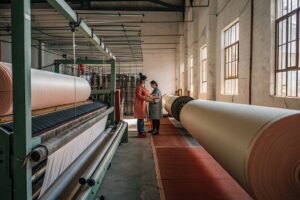
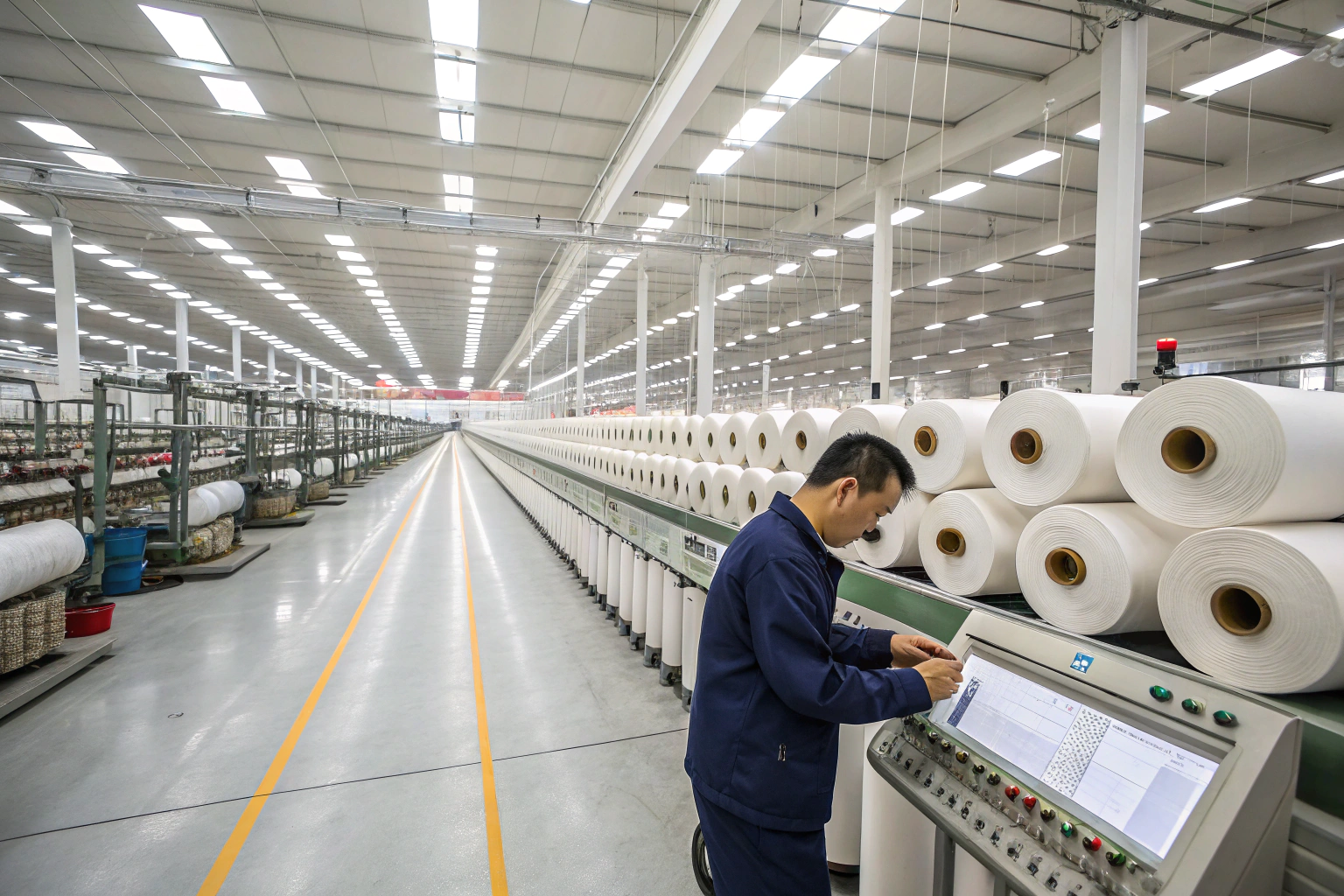
Let’s kill a myth right now. The image of a Chinese textile factory as a dimly lit shed full of rusty shuttle looms from the 1980s? That’s about 25 years out of date. The reality is that high-end mills here operate the same machinery as premium European and Japanese manufacturers—often newer and better maintained, because we invested later and could buy the latest generation. A serious mill’s machinery list isn’t a secret; it’s a badge of honor. If a supplier won’t tell you the exact brand and model of their looms, knitting machines, and dyeing equipment, they’re hiding something.
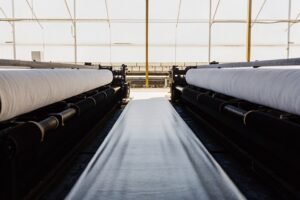
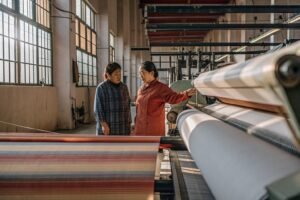
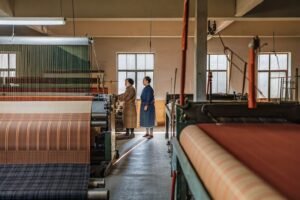
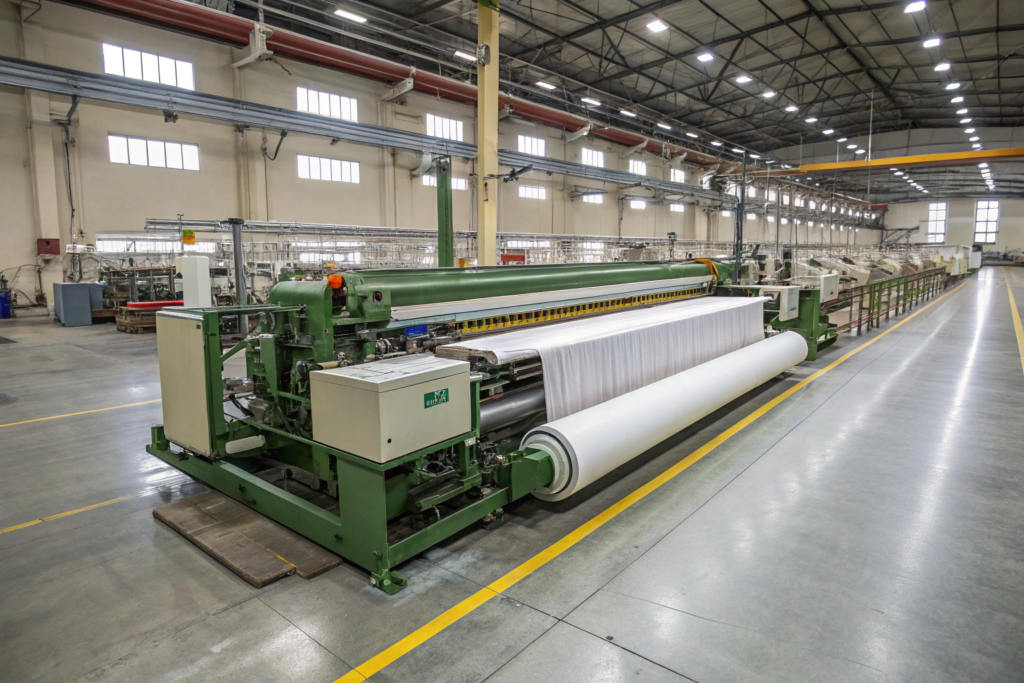
The backbone of a premium woven fabric operation is a fleet of electronically controlled rapier or air-jet looms. At our weaving facility, we run Picanol OptiMax-i rapier looms (Belgium) and Toyota JAT810 air-jet looms (Japan). These aren’t commodity machines; they represent about a $120,000 investment per unit. The key capability they bring is "individual servo motor control" on every weft insertion, tension, and beat-up motion. This means the machine adjusts its own parameters 1,000 times per second to maintain perfect fabric density even as the warp beam diameter shrinks. On the knitting side, a premium circular knit mill runs Mayer & Cie (Germany) or Santoni (Italy) machines with seamless gauge control. Our Mayer & Cie Relanit 3.2 HS machines hold a stitch length tolerance of ±0.05mm across all feeders—a consistency impossible to achieve on generic domestic machines. The result is that every loop in your jersey or interlock fabric is identical, which means no "barre" marks and perfect dye uptake. (Here I need to jump in—when you run a $120K loom, you treat it like a Ferrari, not a tractor. The maintenance budget alone would make some small mills faint.)
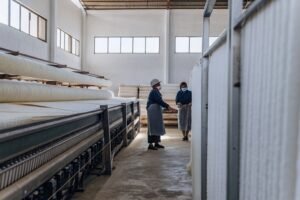
But advanced machinery is only as good as the hands that maintain it. A Picanol loom in a factory that skips daily oiling and calibration will produce worse fabric than a well-maintained 10-year-old machine. This is where the discipline of the maintenance team matters more than the brand logo on the iron. We operate a "zero-unscheduled-downtime" program: every machine has a digital maintenance log tracking running hours, and at 2,000-hour intervals, it’s taken offline for a full "valet service"—belts inspected, bearings lubricated, heald frames realigned, sensors recalibrated. The cost of this proactive downtime is about 3% of our monthly production capacity, but it prevents the 8-12% defect spike that would otherwise occur from worn components slowly drifting out of tolerance. A premium outdoor brand that toured our facility in November 2023 specifically commented on how clean the loom floor was—no oil drips on the concrete, no lint tumbleweeds floating around. That cleanliness is a visual proxy for maintenance discipline, and their technical director told me it was the single biggest factor that convinced him we could handle their strict waterproof ripstop nylon spec, which requires absolutely zero contamination from airborne lint particles embedding in the coating.
Why Do Picanol Rapier Looms Deliver Superior Selvedge Control for Premium Fabrics?
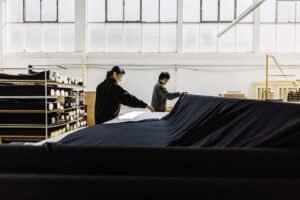
Selvedge control is one of those invisible quality markers that separates premium fabric from commodity fabric. A poorly controlled selvedge is tight, wavy, or curling—and when your cutting room in Los Angeles tries to spread that fabric on an automatic table, those defective edges cause stops, misalignments, and wasted material. Premium fabrics demand a selvedge that lays perfectly flat, has identical tension to the body of the fabric, and doesn’t require the cutter to trim 2 inches off every edge as waste. The Picanol OptiMax-i rapier loom achieves this through a combination of a guided positive rapier transfer system and independent selvedge frame control.
Here’s the engineering reality: on a rapier loom, the weft yarn is carried across the warp shed by a flexible rapier tape. On cheaper looms, the transfer of the yarn from the left-hand rapier to the right-hand rapier in the center of the shed is a "tip-to-tip" handshake that can momentarily jerk the yarn tension by 15-20%. That tension spike propagates to the fabric edge and creates a tight, stressed selvedge. The Picanol uses a "guided positive transfer" where the yarn is mechanically handed over under constant tension monitoring, with a variance of less than 3%. Additionally, we program a specific "selvedge cross-over" weave structure in the first 8mm of the fabric width—a reinforced leno weave that locks the edge yarns in place but with a built-in 1.5% overfeed that prevents the curling you get from a plain selvage. For a high-end European shirting brand we supply, this Picanol selvedge control means their cutting room can use the entire usable width of the roll—98.5% utilization versus the 93% they experienced with their previous supplier’s rapier fabric. That 5.5% material savings, on a fabric that costs $8.50 per yard, translates to about $46,750 saved per 100,000 yards. The machinery pays for itself in material efficiency. For those interested in the mechanical specifics, Textile World’s machinery coverage often features detailed analysis of how loom innovations impact downstream fabric quality and cutting room efficiency.
How Do Stenter Frame Heat-Setting Parameters Ensure Dimensional Stability?
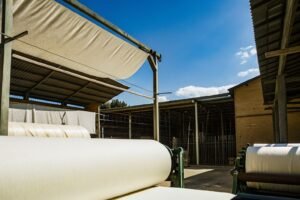
The stenter frame is where fabric gets its "memory." After dyeing and washing, fabric is wet, wrinkled, and dimensionally unstable. It enters the stenter frame, where it’s gripped on both selvedges by pins or clips, stretched width-wise to a specified width, and pulled through a series of heated chambers at a precisely controlled temperature and speed. The heat "sets" the fabric’s molecular structure in the stretched, flat configuration. If this process is done wrong—too hot, too fast, too narrow—the fabric will shrink, twist, or develop a harsh, brittle hand feel the moment your customer puts it in a dryer. "Top quality" dimensional stability is baked in right here, literally.
The parameter trifecta is temperature, dwell time, and overfeed. For a cotton-elastane twill, we set the stenter at 185°C with a dwell time of 45 seconds and an overfeed of 8%. "Overfeed" means the fabric is being fed into the heating zone slightly faster than it’s being pulled out, allowing the warp yarns to relax and crimp before they’re heat-set. If you underfeed or run zero overfeed, the fabric leaves the stenter under tension, and the first time it hits warm water, it shrinks as those stretched yarns snap back to their relaxed state. A large American department store’s technical audit of our facility in May 2024 included a "thermocouple validation" where they attached their own temperature probes to our stenter chambers to verify that the actual fabric surface temperature matched our displayed setting within ±2°C. Our deviation was 1.1°C. The auditor told me that in some mills, the displayed temperature is 180°C but the actual fabric reaches only 162°C because of poor insulation and airflow calibration—a discrepancy that produces "mystery shrinkage" the mill insists isn’t their fault. Our dimensional stability guarantee (maximum 3% x 3% shrinkage after 3 washes per AATCC 135) is directly rooted in this stenter precision. To dive deeper into how heat-setting parameters are optimized for different fiber blends, resources like Textile School’s finishing section provide accessible explanations of the science behind thermal fixation and its long-term impact on fabric performance.
How Does Fumao’s Multi-Stage Quality Control System Actually Work?
A single inspection at the end of the line is a hope-based quality system. You’re hoping the fabric is good, because you didn’t check it at the points where defects are born. A multi-stage QC system is like a series of nets, each catching the defects that slip through the previous stage. The philosophy is simple: the earlier you catch a problem, the cheaper it is to fix. Catching a spinning defect in the yarn costs nothing—you just don’t knit it. Catching a knitting defect before dyeing costs a few dollars—you unravel and re-knit. Catching the same defect after it’s been dyed, finished, rolled, packed, and shipped to a US warehouse costs thousands and kills a supplier relationship.
Our four-gate system works like this: Gate 1 inspects incoming raw materials (yarn evenness, oil content, micronaire—as I’ve detailed before). Gate 2 is an in-line check during weaving or knitting (loom scanner data, GSM monitoring). Gate 3 is the post-dyeing and finishing inspection on our automatic fabric inspection machines, where every meter passes under calibrated LED lights and high-resolution cameras at 60 meters per minute. Gate 4 is the final AQL-based random sampling by our independent QC team, who report directly to our general manager, not to the production manager. This structural separation of QC from production is crucial—the QC team’s bonus is tied to defects found and reported, not to production volume. This incentive alignment means they have no motivation to look the other way on a borderline batch to help the production team hit a target.
The power of this multi-stage approach really shows in the data trends we track. In Q1 2024, our Gate 2 (in-line knitting) detected a 0.7% increase in needle line defects across three machines running a fine-gauge cotton-modal blend. Without Gate 2, those defects would have been buried in the greige fabric, only becoming visible after dyeing when the subtle tension differences showed up as dye uptake variations. By catching the worn needles at Gate 2, we swapped them during a scheduled 20-minute maintenance window, and the defect rate on the dyed fabric from those machines remained at our baseline of 0.3%. The cost of 3 new needle sets was $180. The cost of dyeing 2,000 kilos of defective greige fabric would have been approximately $7,000 in dyes, chemicals, water, energy, and labor, plus the loss of the fabric itself. The four-gate system is a financial firewall that protects both our margins and our clients’ quality assurance. A UK-based jersey wear brand that sources from us has tracked a 99.4% lot acceptance rate over 3 years and 42 individual dye lots, and their purchasing manager once told me, "We don’t even schedule a third-party inspection on your lots anymore; we just review your Gate 4 report." That’s the trust a visible, multi-stage QC system builds.
What Defects Does the Automatic Fabric Inspection Machine Detect at 60 m/min?
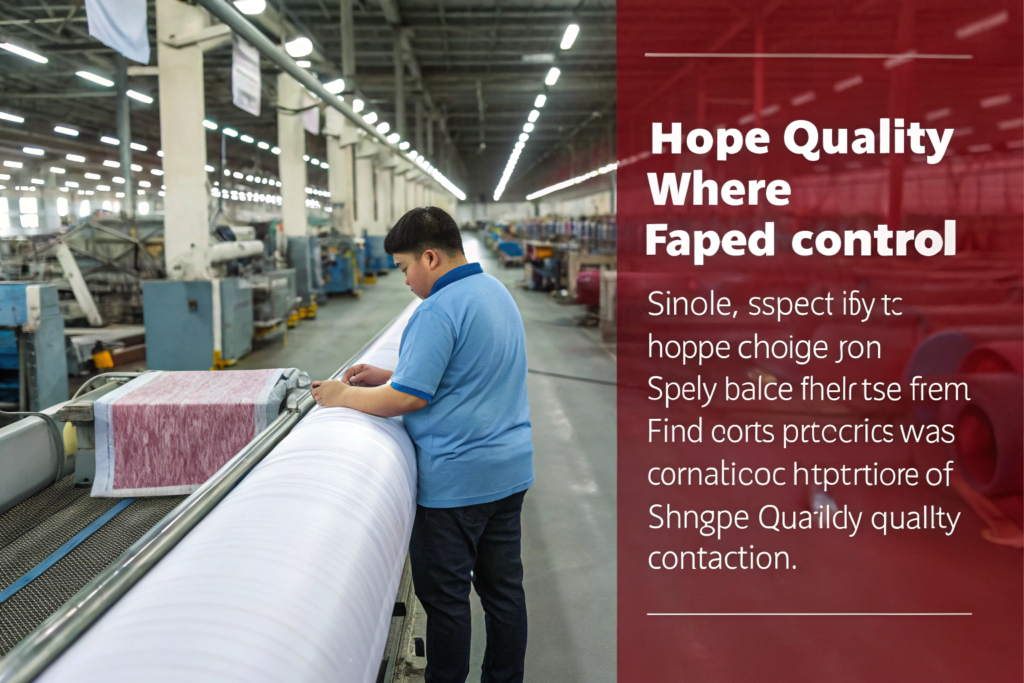
Human inspectors are fallible. After 3 hours of staring at fabric racing by, their defect detection rate drops by 30% or more. An automatic fabric inspection (AFI) machine uses a bank of high-speed line-scan cameras and LED light bars (both reflected and transmitted light) to create a continuous, high-contrast digital image of the entire fabric width. Image-processing software then compares every frame to a "defect-free" reference, flagging any anomaly that exceeds the programmed threshold in size, contrast, or repetition pattern. The machine doesn’t get tired, doesn’t take breaks, and doesn’t have a bad day.
Our Uster EVS Fabriq Vision system classifies defects into 23 categories automatically. It catches the obvious—holes, oil stains, missing yarns, continuous dye streaks—and the subtle: "thin places" where a brief tension fluctuation reduced the pick count locally by 1 or 2 picks per inch, creating a barely visible translucent streak that human eyes miss. The system flags a defect, marks the fabric edge with a sticker, and logs the defect type, image, and GPS-like location on the roll (meters from start) into a database. When our finishing team reviews the roll, they don’t have to scan for problems—they go straight to the marked locations, inspect each flagged anomaly, and decide if it’s reparable (like a small slub that can be removed with a burling tool) or fatal (a hole requiring the roll to be cut and downgraded). In August 2024, this system caught a repetitive defect on a 100% silk charmeuse destined for a luxury sleepwear brand: every 4.2 meters, a tiny 1.5mm "knot" of weft yarn was protruding on the face of the fabric. It was too small and too spaced-out for a human inspector to spot, but the AFI’s pattern recognition flagged the periodic signal. The cause was a single defective bobbin on the weft winding machine that was creating weak splice joints. We replaced the bobbin, re-wound the affected weft packages, and saved a $68,000 shipment from a hidden quality disaster. For comparison with traditional visual-only methods, I often point clients to resources discussing the limitations of human inspection, like those on Fibre2Fashion’s technology section , to help them appreciate the value of automated grading for premium-grade output.
Why Is a QC Team Independent from Production Management Essential?
Imagine a production manager whose monthly bonus depends on shipping 200,000 meters of fabric. On the last day of the month, his line produces a batch that has a slightly low tear strength—passing the minimum spec but well below the historical average. The QC inspector reports the low number. If the QC inspector reports to the production manager, there’s immense pressure to "re-test until it passes" or "just release it, it’s technically within spec." That conflict of interest is the root cause of a huge percentage of the quality inconsistencies that overseas buyers experience. The fox is guarding the henhouse.
At Shanghai Fumao , our 12-person QC department reports directly to our General Manager on a solid-line basis, with a dotted-line reporting relationship to the production manager for information-sharing only. Their KPIs are based on "defect detection rate," "accuracy of Gate 4 AQL reports (compared to client’s incoming inspection results)," and "prevention of customer claims." They are rewarded for finding problems, not for shipping volume. A concrete example: in January 2024, our Gate 4 QC team placed a "FAIL" on a 3,000-yard lot of printed rayon challis because the print registration was off by 1.2mm in the warp direction, creating a slight "halo" effect around the floral pattern. The commercial team and the production manager were unhappy—the registration was within the industry standard 2mm tolerance, the fabric looked "fine" to the naked eye, and the client’s ship window was closing. But the QC team had been briefed that this particular client, a high-end resort wear brand, had a specific 1mm registration tolerance in their tech pack. They held the line, the batch was reprinted at our cost, and the client’s incoming inspection passed with zero findings. Six months later, that client doubled their order volume with us. The independent QC team’s "FAIL" stamp cost us $2,100 in reprint costs but earned $180,000 in incremental annual business. As the saying goes, quality is remembered long after the delay is forgotten.
Can Sustainable Practices and Top Quality Coexist in a Chinese Factory?
There’s a persistent suspicion that "eco-friendly" and "premium quality" are a trade-off. That recycled polyester can’t possibly be as soft as virgin. That organic cotton will always have more neps and lower whiteness. That water-saving dyeing processes produce duller colors. This skepticism is rooted in early-generation sustainable technologies from 15 years ago, which did compromise performance. But the technology has evolved. Today, the question isn’t "can they coexist?" but "how do you engineer the process so sustainability enhances quality, rather than undermining it?"
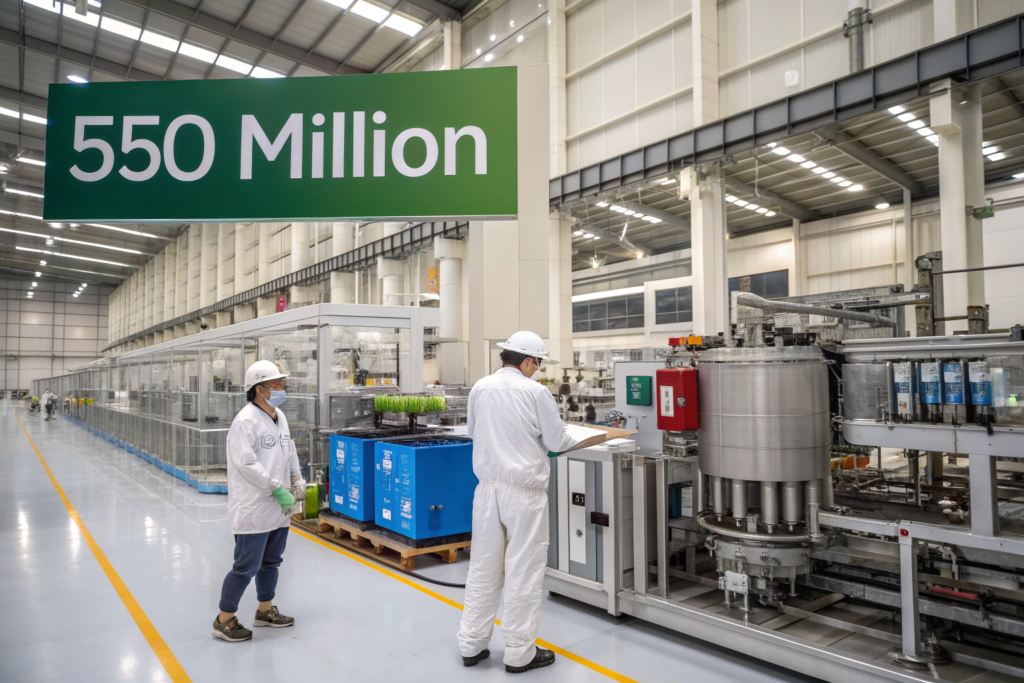
At our factory, the ¥550 million green investment we’ve made isn’t a marketing department’s side project—it’s embedded directly into our manufacturing processes and our quality metrics. We run a closed-loop water recycling system that recovers 85% of our dyeing wastewater, a solar thermal array that pre-heats our dye bath water to 60°C before natural gas boilers take over, and a chemical management system that tracks every auxiliary against the ZDHC Manufacturing Restricted Substances List (MRSL) version 3.1. This isn’t just a "nice to have" for the CSR report. The closed-loop water system actually improves dyeing quality because recovered water has extremely low and consistent mineral hardness (0-5 ppm CaCO3), whereas municipal water varies seasonally from 60-120 ppm. Consistent water chemistry means consistent dye uptake and colorfastness. Our batch-to-batch dyeing reproducibility, measured by dE, is actually better with recycled water than it was with variable municipal water. Sustainability, in this case, is a quality control tool.
Let me give you a hard financial example that connects sustainability to quality and buyer preference. In early 2024, we tendered for a 50,000-yard contract from a major European eco-fashion retailer for recycled nylon activewear fabric. The spec required GRS-certified pre-consumer recycled nylon 6, Oeko-Tex Class I certification, and a "premium matte hand feel" that their designers insisted was non-negotiable. One competitor bid virgin nylon with a cheap, chalky matte finish achieved through titanium dioxide delustering—low cost, decent look, zero sustainability. Another bid truly recycled nylon but with a shiny, "plastic" hand because their mechanical recycling process degraded the polymer chain length. Our bid used a chemically recycled nylon 6 from pre-consumer waste, which depolymerizes the nylon back to caprolactam monomer and re-polymerizes it, producing a polymer chain indistinguishable from virgin, but with an 80% lower carbon footprint. We then applied a precision C0 DWR finish in our low-pickup spray chamber to achieve the exact matte hand the designer wanted without any fluorocarbons. The client paid a 12% premium over the virgin nylon bid, and their post-launch quality score on the garment was 4.8 out of 5 stars, with "fabric feel" cited as the top positive attribute in reviews. The message is clear: top quality in today’s market increasingly requires sustainability, because the most demanding buyers (and their customers) view environmental responsibility as a component of quality itself, not a separate checkbox.
How Does Closed-Loop Water Recycling Improve Dyeing Consistency?
Dyeing is a chemical reaction, and chemical reactions are sensitive to impurities. Municipal water contains variable levels of calcium, magnesium, iron, and chlorine depending on the season and the source. These ions interfere with reactive dye fixation on cotton and disperse dye exhaustion on polyester. Calcium and magnesium ("hardness") bind to dye molecules and form insoluble complexes that precipitate onto the fabric surface, creating a dull, "frosted" appearance and poor rubbing fastness. Iron ions can shift the shade of light colors—turning a soft cream into a dirty beige. Traditional dye houses use chemical sequestering agents and softeners to correct for water variability, but that’s a reactive fix, and the dosage adjustments are often guesswork.
Our closed-loop recycling system transforms wastewater into process water with a Total Dissolved Solids (TDS) level below 50 ppm and hardness below 5 ppm, consistently, 365 days a year. The recycled water is actually cleaner and more chemically predictable than the water coming into the factory from the municipal supply. This consistency translates directly to dyeing reproducibility. In 2023, we conducted an internal study tracking the dE variation of our five top-selling reactive-dyed cotton colors over 12 months. The standard deviation of dE across all production lots for a dark navy (one of the hardest colors to keep consistent) was 0.28. For the industry, a standard deviation under 0.5 is considered excellent. We attribute this tight control largely to the constant, known chemistry of our recycled water—the dye recipes behave exactly as modeled in the lab because the reaction medium never changes. For a large American uniform program we dye annually, where color consistency year-over-year is critical, this water stability means their 2025 navy trousers will match their 2024 navy trousers within dE 0.5, guaranteed. That’s a promise we can only make because we control the water. For broader context on water’s role in textile processing, Water Online’s industrial applications section occasionally covers how closed-loop systems in manufacturing drive both sustainability KPIs and process quality improvements, highlighting the dual benefits.
What ZDHC MRSL Compliance Means for Premium US Retailer Approvals
ZDHC stands for Zero Discharge of Hazardous Chemicals. Their Manufacturing Restricted Substances List (MRSL) is a comprehensive list of chemical substances banned from intentional use in any stage of textile and footwear production—not just the final product. This is different from an RSL (Restricted Substances List), which only limits what’s on the finished garment. MRSL compliance means the factory’s entire chemical inventory, from spinning lubricants to screen-printing solvents to machine cleaning agents, has been audited and certified as free from banned substances. For a premium US retailer like Nordstrom, REI, or Patagonia, MRSL compliance at the mill level is increasingly a minimum requirement to even bid on their business.
The practical path to this certification is a chemical inventory audit and a switch to ZDHC-approved "Level 3" chemistry. We underwent this transformation in 2021-2022. It meant replacing 34 chemical products across our production lines—from a silicone softener that contained trace cyclosiloxanes (D4/D5) to a screen-printing plastisol ink that used a phthalate-based plasticizer. The replacement products were, on average, 25% more expensive and sometimes required process adjustments (the new softener needed a longer dwell time to achieve the same hand feel). But the payoff was immediate access to premium buyer programs. In December 2023, a major US outdoor brand conducted an unannounced ZDHC wastewater sludge test at our facility—they literally dug a sample out of our sludge filter press to test for hidden banned chemistry that might not appear in the water discharge. The test found zero detections above reporting limits for all 14 MRSL substance groups. Three weeks later, we received their "Platinum Tier 1 Mill" designation, which fast-tracks our fabric submissions through their materials approval process and gives us preferential consideration for new developments. That designation is worth more than any marketing slogan because it’s a direct line to $2 million+ annual contracts. To understand the full scope of this standard, many of our clients use the ZDHC Academy’s public resources to become familiar with the MRSL and its implications for their sourcing decisions, ensuring their supply chain aligns with their brand’s chemical management commitments.
Conclusion
So, can a Chinese factory really deliver top quality fabric? The question itself is outdated. The answer isn’t about China; it’s about the specific factory’s machinery list, its quality control architecture, its environmental management systems, and the technical expertise of its workforce. A mill in Keqiao running Picanol looms, processing fabric through a four-gate QC system, dyeing with recycled water in a ZDHC-compliant chemistry environment, and holding itself accountable to the same AATCC and ISO standards as a mill in Biella or Osaka is functionally operating in the same quality universe. Geography is not a quality determinant. Investment, process discipline, and a culture that punishes "good enough" are the determinants.
At Shanghai Fumao , we’ve spent 20 years constructing exactly that kind of operation. We’re not perfect—no factory is—but we are transparent, obsessive, and relentlessly incremental about quality improvement. We invite technical audits, we share our real-time quality data, and we back our fabric with performance guarantees written into the purchase contract. If you’re a brand owner, a sourcing director, or a designer who’s been burned by "China quality" in the past, I’d ask you to give us a chance to reset that experience. Let’s talk about your specific fabric requirements, your technical specs, and your quality benchmarks. We’ll develop a custom quality assurance plan for your order, including the test methods, the allowable tolerances, and the inspection gates. Contact our Business Director, Elaine, who works directly with brands to translate their quality expectations into factory-level specifications and verification protocols. She’s at elaine@fumaoclothing.com. Let’s build something together that proves "Made in China" can mean exactly what you need it to mean: flawless, consistent, and built to last.