

Let’s cut to the chase. You’re sitting on a purchase order worth $15,000, maybe $50,000, and you’re staring at a screen showing a fabric sample that looks perfect. But your gut is screaming: "What if the bulk shipment looks nothing like this?" I’ve seen that panic in a buyer’s eyes too many times. A swatch is a promise—a bulk order is the truth. The nightmare isn’t just receiving off-color fabric; it’s discovering that the 300 GSM French terry you ordered is actually 260 GSM after you’ve already cut it into hoodies. That’s not a supplier problem anymore, that’s a brand-ending quality crisis.
You verify Shanghai Fumao quality by leveraging our three-layer transparency system: digital lab reports accessed through QR-coded rolls, independent third-party inspection rights, and a pre-shipment approval sample that serves as your legal quality benchmark. Here’s what most suppliers won’t tell you—the sample you approved was likely hand-picked from the best 3 meters of a trial run. The 5,000 meters afterward? Different beast entirely. We close that gap by archiving your approved "golden sample" in a climate-controlled library and measuring every bulk roll against its spectrocolorimeter readings, not someone’s tired eyes at 4 PM on a Friday.
This isn’t about trust. Trust is what you have with your dog. This is about verification. I’ve been manufacturing fabric in Keqiao for 20 years, and I’ll walk you through exactly how to check our work before a single dollar leaves your account. We’ll dig into the specific lab equipment we use, the inspection checkpoints that catch defects before they’re sewn into garments, and a real case from March 2024 when a Chicago workwear brand saved $28,000 by catching a selvage curling issue during our pre-shipment review. Stick with me—this is the stuff that separates a supplier who talks about quality from one who proves it.
What Pre-Production Quality Checks Does Fumao Perform on Raw Materials?
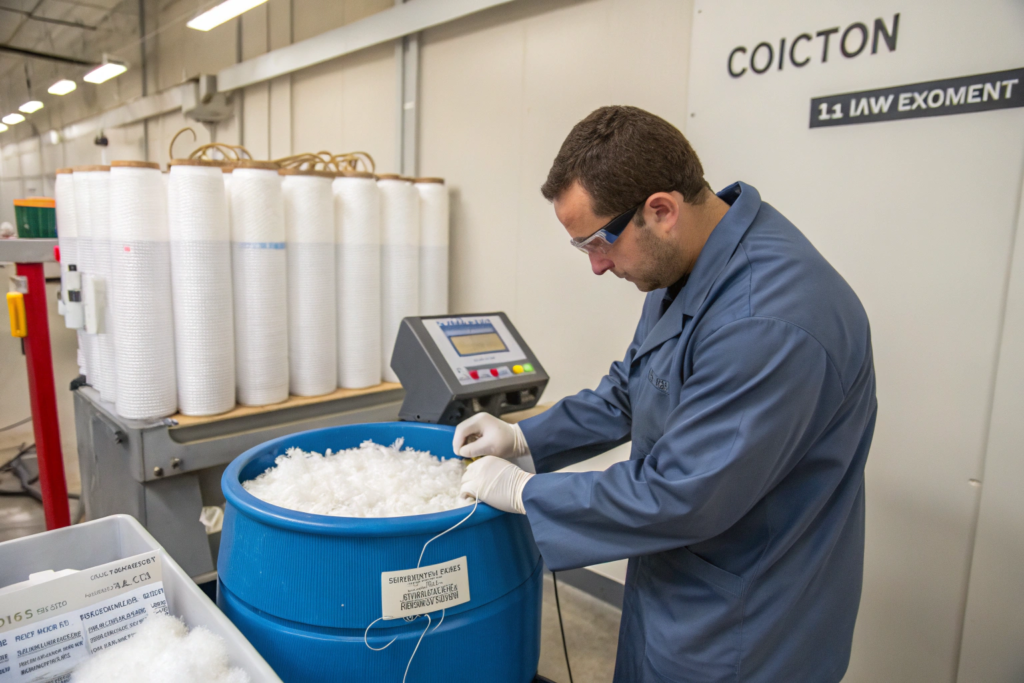
Before a single loom fires up, the war has already been won or lost. You might think quality control starts when the fabric comes off the machine. Wrong. It starts with the yarn cone. If the cotton fiber maturity is low, or the polyester filament has uneven denier, the finished fabric will pill, streak, or tear—and no finishing trick can fix a dead embryo. The anxiety here is invisible. You won’t see yarn defects until the garment is washed three times and tiny fuzz balls bloom all over a "premium" sweater.
We perform the "big four" checks on every incoming raw material lot: yarn evenness (using an Uster Tester 6), single-end strength, oil content for synthetics, and micronaire for cotton. Micronaire is the air permeability test that measures cotton fiber fineness—too low (below 3.5) and you get immature fibers that don’t take dye evenly; too high (above 4.9) and the hand feels like cardboard. For one of our Australian activewear clients, we once rejected an entire 5-ton shipment of "combed compact" cotton yarn in January 2025 because the Uster CV% (coefficient of variation) hit 14.2%, above our internal cap of 13.5%. That yarn would have produced a visually uneven jersey with thick-thin patches every few meters. The supplier was furious, but the client never knew there was a problem—because we killed it at the gate.
Let me drill deeper into something most sourcing agents ignore: the "spin finish" on synthetic yarns. Polyester and nylon arrive with a thin oil coating that helps them run smoothly on knitting machines. If that oil degrades in storage or is applied too thickly, it gums up the needles and creates those mysterious horizontal lines in knitwear. We test the coefficient of friction on incoming yarn packages using a Rothschild tension meter. This isn’t standard practice in most Chinese mills—it’s a discipline I imported after a 2019 disaster with a European sportswear brand where 3,000 yards of interlock fabric developed needle lines 20 minutes into knitting. The problem? The spin finish had oxidized during a hot container transit from a different province. Now, we quarantine all synthetic yarns for a 24-hour climate acclimatization in our humidity-controlled raw material warehouse (65% RH ± 2%, 22°C) before any running starts. That’s the depth of pre-production care that stops problems before they exist.
How Does Yarn Count Consistency Testing Prevent Fabric Streaking Issues?
Yarn count is the backbone of your fabric’s visual identity. A yarn count of 40/1 Ne (English cotton count) means 40 hanks of 840 yards each weigh one pound. If one cone in a warp beam is actually 38/1 while the rest are 40/1, that’s a thinner yarn that packs differently under tension. The result? A subtle, repeating light streak across the fabric width that’s invisible under factory lights but screams "defective" under boutique spotlights. Streaking isn’t always a dye problem—it’s often a birth defect from sloppy yarn buying.
We use an Uster Classimat 5 to grade yarn imperfections automatically. It scans the yarn at 400 meters per minute, counting every neps, thick place, and thin place per kilometer. The magic number for combed cotton knitwear is a Total Imperfections (IPI) value under 50 per kilometer for Neps +140% (neps are small tangled fiber clusters). For a circular knit jersey, anything above 80 IPI means you’ll see random white speckles on dark dye lots. I had a Canadian streetwear client who kept complaining about "white dots" on a black 100% cotton tee. Their previous supplier blamed the dyeing; I traced it to yarn with 120+ neps/km. Neps don’t take dye because they’re a dense knot of immature fibers with a different refractive index. They reflect light differently, hence the "white dot" illusion. We switched to a combed compact yarn with 35 IPI—the dots vanished. Understanding these root-cause relationships is critical, and forums like Textile School’s guide on yarn imperfections explain the testing principles clearly for those who want to dig into the technical standards.
There’s also the "count variation within package" issue. A cone of yarn can average 40/1 but vary from 38/1 at the core to 42/1 at the surface if the ring frame tension wasn’t controlled during winding. We perform a "package-to-package" count test where we randomly pull 10 cones from a pallet, unwind 120 yards from outer, middle, and inner layers of each, and weigh them. If the inner-to-outer deviation exceeds ±2.5%, the entire pallet is flagged for "count migration" risk. This level of fussiness matters. In April 2024, a Los Angeles fashion brand ordering a delicate 60/1 cotton lawn for summer dresses would have suffered severe warp streaks if we hadn’t caught a 4% count variation in their greige yarn. The fabric would have been unusable for their translucent, elegant silhouette. We quarantined the off-spec cones, used them for a coarser twill order, and saved their season.
Why Is Fiber Micronaire Testing Critical for Dye Affinity Uniformity?
Micronaire is the cotton fiber’s fineness and maturity measured by forcing air through a fixed weight of fiber. Think of it as the "breath test" for cotton. A micronaire range of 3.8–4.5 is considered standard for most apparel. But here’s the dyeing connection that non-technical buyers miss: low-micronaire cotton (below 3.5) has thinner cell walls. These immature fibers are like sponges—they soak up dye too quickly and unevenly, creating dark blotches or what we call "cloudy" dyeing. High-micronaire cotton (above 4.9) is so thick-walled that dye sits on the surface like paint on glass, washing off after a few laundry cycles and leaving a faded, old-looking garment.
When a Japanese casual denim brand approached us in early 2024 for a deep indigo-dyed twill, they insisted on ring-spun cotton with a micronaire spec of 4.0–4.3. Their previous Turkish supplier used a 3.6 micronaire cotton to save 5 cents per yard, and the indigo was "frosty"—a ring-dyed effect where the core stayed white but not the attractive kind; the frictional rubbing during stone washing exposed raw white fiber instantly, making the $250 jeans look cheap. We use a Uster HVI (High Volume Instrument) 1000 to test every bale to ensure micronaire uniformity within a 0.3 range across the entire batch. If the variation is wider than 0.3, we blend the bales in a "mixing and opening" process to average out the micronaire before carding. This extra blending step takes 2 hours but guarantees that the dye bath sees a uniform fiber surface area. If you’re buying dark, solid colors—black, navy, deep burgundy—demand a micronaire test report or you are gambling with a "washed-out" look after the customer’s third wear. Detailed resources like Cotton Incorporated’s classification guide can help buyers interpret these micronaire ranges properly and understand what to specify in their purchase orders.
How Does Fumao’s In-Line Production Monitoring Catch Defects Early?
The scariest defects are the ones that repeat. A broken needle on a knitting machine can produce a "drop stitch" line every 20 inches, running the entire length of a 500-yard roll. If nobody spots it until the fabric reaches the cutting table, you’ve just manufactured 500 unsellable t-shirts. Traditional factories rely on end-of-roll inspection—a human checker staring at fabric zooming past at 60 meters per minute. After 3 PM, human eyes glaze over. Fatigue is a defect multiplier. You need machines that never blink.
We deploy a network of optical scanners on our knitting and weaving machines that flag anomalies in real time. On our circular knitting machines, a yarn break sensor stops the machine within 0.3 seconds of a yarn snapping, and a laser scanner maps the stitch density every rotation. That data feeds to a central dashboard. If machine #7 shows a 2.5% drop in stitch density over 10 minutes, a technician is dispatched before a full roll of loose, off-weight fabric is produced. This isn’t futuristic—it’s standard at Shanghai Fumao . We call it "fail fast, fix faster." In May 2024, this system caught a gradual cam setting drift on a machine running a $12/yard modal-elastane blend. Within 9 minutes of the drift starting, we corrected the cam timing, limiting the off-spec fabric to just 8 meters instead of an entire 50-meter roll. That’s a $480 potential write-off reduced to a $96 write-off.
But let’s talk about the human element that technology supports. Even the best scanner can’t detect a subtle "barré" effect—a repetitive variation in dye uptake caused by slight differences in yarn tension during knitting. This shows up as ghost-like horizontal bands visible only at certain angles. We station a dedicated process controller with at least 8 years of knitting experience on each production line. They don’t watch screens; they physically run their fingers across the fabric at the take-down roller every 15 minutes, feeling for tension variations that instruments might miss. It’s a tactile skill honed over thousands of hours. I remember one controller, Lao Zhang, who detected a microscopic feed variation on a single jersey machine that our tension sensors hadn’t flagged because the absolute tension was within tolerance, but the fluctuation pattern indicated a degrading bearing. He logged a maintenance request, the bearing was replaced during a scheduled stop, and a potential machine crash that would have cost $3,000 in repairs was avoided. Gadgets are vital, but trained, experienced hands remain irreplaceable—the blend of technology and expertise is what protects your order from "invisible" defects that surface only after dyeing.
What Automated Optical Inspection Systems Scan for Weaving Irregularities?
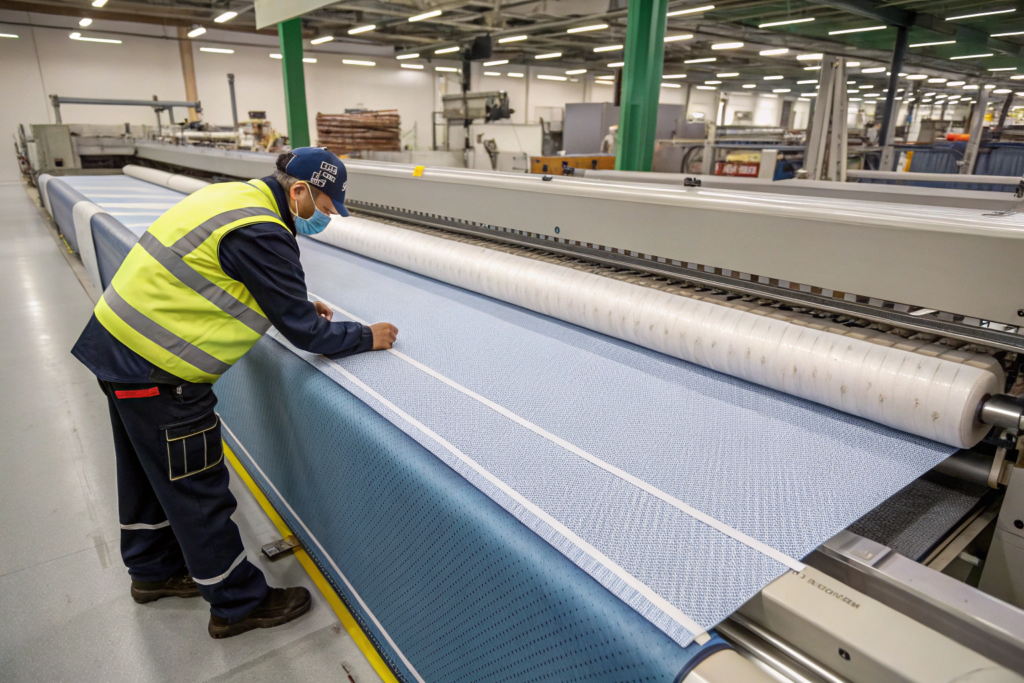
On our weaving floor, fabric doesn’t just roll off and get packed—it passes through an Automated Optical Inspection (AOI) system mounted directly on the loom or at the cloth inspection frame. Think of it as a high-speed camera array linked to image-processing software that has memorized what "perfect" fabric looks like. The system captures images at 60 frames per second, comparing every square millimeter to a "golden template" of your approved weave pattern. It identifies 42 categories of defects, from obvious ones like missing ends and broken picks to subtle ones like "reed marks" (a warp-wise streak caused by a misaligned dent in the reed) or "knot clusters" where a weaver tied too many warp breaks in a small 3-inch section.
For a German upholstery brand ordering a tight, 280-thread-count cotton sateen in August 2024, the AOI flagged a recurring "slub" pattern—a thick place in the weft yarn appearing every 18.5 inches, indicating a defective bobbin on one shuttle. Without the AOI, this would have appeared as a faint horizontal ridge in a $45,000 luxury furniture fabric order. The system mapped the exact location of every thick place, allowing our mending team to remove the defects surgically before finishing. The key metric we track is the system’s resolution threshold—ours is calibrated to detect deviations as small as 0.3mm. That’s about the thickness of three sheets of paper. If your supplier’s AOI only catches 0.8mm defects, a whole class of "fabric noise"—those subtle texture inconsistencies that make a garment feel "off" even if it’s structurally sound—slips through. For deeper insights into how these optical systems compare to traditional grading, I’ve found technical breakdowns on platforms like Textile World’s technology section useful for understanding the latest inspection capabilities shaping our industry.
The data from AOI also creates accountability. Every defect detected is time-stamped and linked to the specific loom, shift, and operator. If loom #18 generates three times the average defect rate on a Wednesday night shift compared to the Tuesday day shift, we know there’s a calibration issue—or an operator who needs retraining. This closed-loop feedback chokes off the root cause within 24 hours, not after an entire production run is contaminated, turning quality control from a reactive gatekeeper into a proactive improvement engine.
How Is GSM Weight Monitored Continuously During Knitting to Avoid Thin Spots?
GSM—grams per square meter—is the heartbeat of fabric weight, and a "thin spot" is like a heart arrhythmia. You order 280 GSM fleece for a premium hoodie. If one panel varies between 240 GSM and 280 GSM because the knitting tension fluctuated, the garment looks patchy, feels flimsy in sections, and fails the customer’s "squeeze test" where they unconsciously feel the fabric in-store. A 10% GSM drop on a $35 hoodie is a 10% perceived quality drop, and that’s a one-way ticket to the clearance rack.
We use a continuous online weight measurement system on our knitting machines—essentially a scanning array that bounces low-energy beta radiation through the fabric immediately after knitting, before it winds onto the take-up roll. The system reads the mass per unit area 100 times per minute, updating a live GSM graph on the machine’s display panel. If the graph drifts outside a ±3% tolerance band from your target, an alarm trips. More subtly, the algorithm looks for "oscillating patterns"—a sinusoidal GSM wave that suggests a periodic variation in yarn feed tension, often caused by a slightly bent needle cylinder or a worn cam track. For a Melbourne athleisure startup we served in March 2024, this system detected a rhythmic GSM dip of 6% occurring every 12 inches on a nylon-spandex compression knit. The fabric felt "fine" to a quick hand test but would have failed the brand’s strict compression grading measurement, which relies on localized consistent thickness to deliver specific mmHg pressure values. The culprit was a single defective needle sinker that wasn’t holding the loop formation consistently. We swapped it in 15 minutes—problem solved. If you’re sourcing technical knits, verifying that your supplier uses continuous GSM monitoring (and not just "cut and weigh" from the roll ends) is crucial because end-of-roll sampling misses the central 90% of the fabric where hidden thin spots often lurk, silently degrading your product’s performance.
What Laboratory Testing Standards Does Fumao Apply to Finished Fabric?
A fabric looks beautiful on the inspection table. It feels substantial. But what happens when your customer washes it? Or when it sits in a hot shipping container for three weeks en route to Miami in July? Laboratory testing isn’t academic—it’s a simulation of the abuse your fabric will endure before it reaches the consumer’s closet. The horror story I hear constantly: a batch of bright red viscose dresses that stained the white collars of customers’ jackets because nobody tested the colorfastness to perspiration. One viral TikTok later, and the brand is issuing refunds and apologies, hemorrhaging trust.
Our lab at Shanghai Fumao doesn’t just test; we test to failure. We follow a modified "worst-case protocol" for American brands. Standard colorfastness to water is tested at 37°C for 4 hours. We test at 50°C for 8 hours—simulating what happens if a garment sits in a car trunk in Arizona in August. If the color migrates at that threshold, it’s not safe for your market. Every finished fabric batch undergoes our "mandatory seven" tests: dimensional stability (shrinkage), colorfastness to washing, rubbing (crocking), perspiration, light, tensile strength, and tear strength. The data populates a digital certificate that’s tied to the fabric’s unique batch number, accessible via the QR code on the roll label I mentioned earlier. This isn’t a one-off "certificate of conformance" printed in bulk; it’s the living data of your specific batch’s chemical and physical performance against international parameters.
The real gold in lab testing, however, is trend analysis. We don’t just look at pass/fail; we look at the numerical drift over time. If your black cotton twill’s rubbing fastness has drifted from a grade 4.5 (excellent) in January to a grade 3.5 (borderline) in June, something has shifted—maybe the dyestuff supplier changed a formulation, maybe the water quality in our pretreatment tank changed seasonally. We track these numbers with statistical process control (SPC) charts, the same methodology used in aerospace and pharmaceuticals. In June 2024, this SPC tracking flagged a gradual decline in the tear strength of a ripstop nylon we were supplying to a Texas-based outdoor gear company. The values were still "passing" at 25 Newtons against a 20N spec, but they had declined from 32N to 26N over six months. We traced the cause to a supplier slightly increasing the denier of the ripstop grid yarn without telling us, altering the fabric’s tear mechanics. We didn’t just accept a "pass"—we investigated the decline and restored the original tear resistance. That’s the depth of diligence that separates a testing-for-compliance mindset from a testing-for-excellence culture.
How Is AATCC 61 2A Wash Fastness Test Performed for US Import Standards?
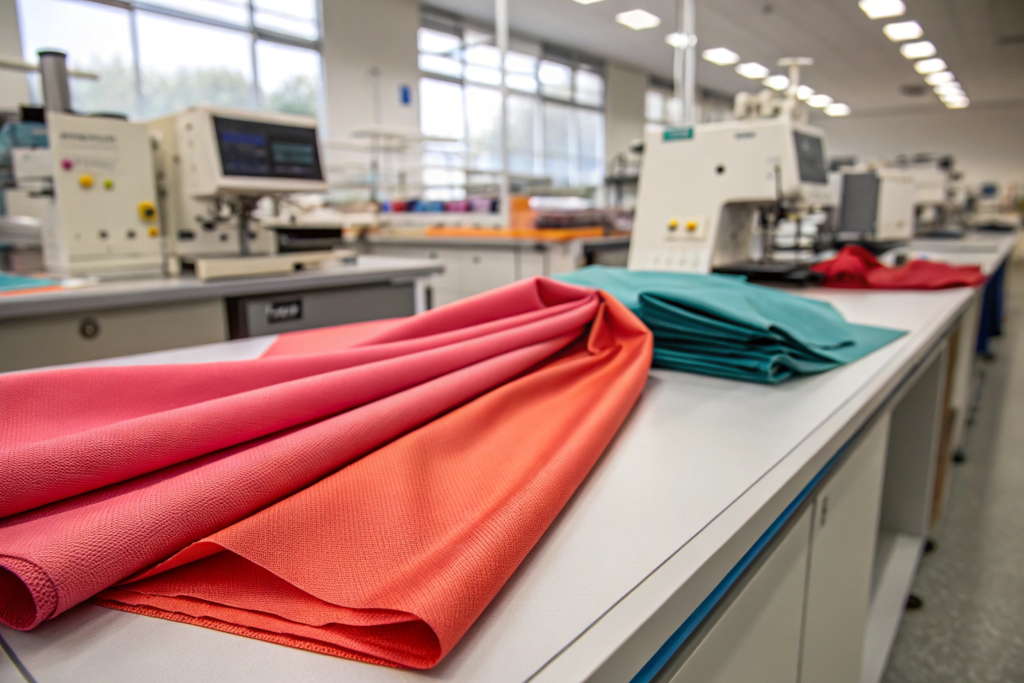
Let’s get specific because this test causes more disputes than any other. The AATCC 61 2A test is the gold standard for American retail brands like Gap, Target, and Nordstrom. It simulates five home launderings in one 45-minute laboratory cycle—a brutal accelerated aging process. We take a fabric specimen measuring 5cm x 15cm, sandwich a multifiber witness strip against its face, and seal them in a stainless steel canister with 150ml of 0.15% standard reference detergent solution and 50 steel balls. The canister is locked into a Launder-Ometer, which rotates at 40 RPM, banging those steel balls against the fabric in a hot bath maintained at 49°C. The mechanical action is violent—the steel balls beat against the fabric like 50 tiny mallets, simulating the agitation of a top-loading American washing machine.
After 45 minutes, we remove the specimen and the multifiber strip, dry them, and evaluate the "stain" transferred from your fabric to the white reference cloth using a Grey Scale for Staining under D65 daylight illumination. A Grade 4 (slight staining) is the bare minimum; Grade 4.5 is expected for multi-colored garments, and Grade 5 (no staining) is mandatory for white fabrics adjacent to dark trims. For a premium women’s blouse label based in San Francisco that we supplied with a red-and-white striped cotton poplin in 2023, we ran AATCC 61 2A and found Grade 3.5 staining on the white stripe from the red dye bleeding. The fabric looked crisp before washing but would have turned into a pink mess after two laundry cycles. We traced the issue to an unfixed reactive dye and re-processed the batch with a higher concentration of fixing agent and an additional high-temperature curing pass, achieving Grade 4.5. That extra 48 hours of work saved the brand from a catastrophic launch. For brands developing washing instruction labels, adhering to the Federal Trade Commission’s Care Labeling Rule is essential, as it mandates accurate care instructions based on reliable evidence—exactly the kind of evidence such lab testing provides.
Why Does ISO 12945-2 Pilling Resistance After 5 Washes Matter for Longevity?
Pilling is the slow death of a garment’s perceived value. Those little fuzz balls that form on a sweater or jogger don’t appear on day one—they bloom insidiously after several wear-wash cycles, like a delayed fuse on a bad customer experience. The ISO 12945-2 test uses a Martindale abrasion and pilling tester to simulate wearing action, but the gold standard for long-term assessment isn’t testing on virgin fabric—it’s testing after the fabric has been through 5 wash/dry cycles. Why? Because washing weakens the fiber surface through water absorption and mechanical agitation, loosening the micro-fibrils that subsequently entangle into pills. A fabric that achieves a Grade 4 pilling resistance when new might degrade to a Grade 2 after five washes if the yarn’s twist factor was too low to hold the fibers together under hydrolytic stress.
For a premium jogger brand we serve in London, this distinction saved their autumn/winter collection. We were developing a brushed-back cotton-polyester fleece, and the initial lab submission passed pilling at Grade 4 fresh off the stenter. But our internal protocol mandates a 5-cycle pre-conditioning before final pilling certification. After 5 washes at 40°C and tumble drying, the pilling grade dropped to a catastrophic Grade 2—the fabric was "pilling like a rabbit," as our lab director said. We diagnosed the issue as insufficient singeing of the back face before brushing; the long, loose surface fibers that gave it a lovely initial hand-feel were not properly anchored and released during wet processing. We tweaked the gas singeing flame intensity to remove 15% more surface protrusion before brushing, and the after-wash pilling stabilized at a solid Grade 4. The brand’s design director told me later that a competing mill’s joggers, which didn’t do post-wash pilling testing, were being returned at a 12% rate for "excessive pilling" while ours maintained a 1.5% return rate. That’s the ROI of testing after simulated customer abuse.
How Can I Use Third-Party Inspection to Independently Verify My Order?
Here’s where you don’t take my word for it—or any factory owner’s word. You bring in a set of outside eyes who have no skin in the game. An independent third-party inspection agency arrives at our factory unannounced (or announced with minimal notice), pulls a random sample based on AQL statistical tables, and applies their own checklists and standards to your specific production batch. Their report goes directly to you, not through me. This is your ultimate backstop against the "bait and switch"—a beautiful sample followed by a mediocre bulk run.
We not only permit third-party inspections—we design our production schedule around them. When you place an order with Shanghai Fumao , we ask you to specify your preferred inspection agency (SGS, Bureau Veritas, Intertek, QIMA) and the desired inspection points: In-line Inspection (during production at around 30-50% completion) and Final Random Inspection (when 100% of goods are packed). We hold the shipment at our loading bay until we receive your go-ahead based on the inspector’s report. In September 2024, a New York-based workwear brand ordered 8,000 yards of heavy 12oz cotton canvas from us, and their BV inspector found that 1.5% of the rolls had a width variance of -2.5 inches against the contract specification—a result of slight relaxation during storage. The rolls were perfectly usable for most patterns but fell below the brand’s cutting table width optimization algorithm. We re-framed the affected rolls to the specified width at our cost and re-inspected them—the whole delay was 3 days, but the client received exactly what they paid for. The BV report wasn’t a "gotcha"; it was the objective evidence that our internal QC had a minor blind spot that we permanently corrected.
To make the inspection truly independent and effective, you need to give the agency a detailed Inspection Criteria Sheet, not just say "check the quality." Specify the AQL level, the defect classification (what counts as Critical, Major, or Minor), and the exact testing equipment they should bring. For a performance stretch woven, specify that they must bring a portable GSM cutter, a digital thickness gauge, and a color spectrometer calibrated to your Lab-dip standards. The real power of a third-party inspection isn’t just catching defects—it’s the deterrent effect. When our stitching department knows that a QIMA inspector with a seam slippage tester will be on-site next Thursday, the attention to needle condition and thread tension on Wednesday becomes laser-focused. The measurement creates the performance. For those looking to understand how to effectively set up these inspection parameters, the International Trade Centre’s market analysis tools provide useful frameworks for establishing quality assurance protocols in global supply chains, ensuring you align your inspection criteria with international trade standards.
What Should My Inspection Criteria Sheet Specify for AQL 2.5 Level II?
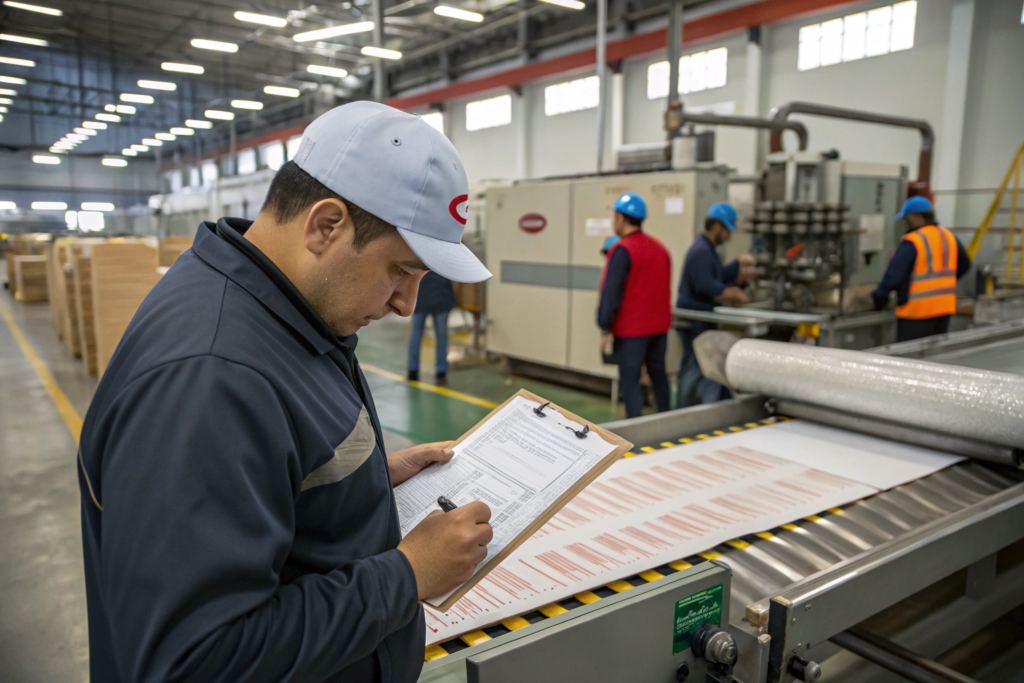
Your Inspection Criteria Sheet is your legal quality contract with reality. Don’t leave it to the inspector to guess what you care about. For apparel fabric, I always recommend AQL 2.5, Level II as the baseline, but you need to define the consequences. An AQL 2.5 Level II sampling plan on a 10,000-yard order means the inspector will pull approximately 200 samples (yards) randomly from across the shipment. The batch passes if no more than 10 samples exhibit Major defects and no more than 14 exhibit Minor defects. But what is a Major versus a Minor defect? That’s your definition.
In your criteria sheet, spell it out with brutal precision. Here’s what I advise my clients to list:
| Defect Category | Definition Examples | AQL Limit (Level II) |
|---|---|---|
| Critical | Presence of sharp metal fragments, chemical odor indicating formaldehyde, incorrect fiber composition (>5% deviation) | Zero tolerance |
| Major | Holes >2mm, continuous dye streak >10cm, width variance >±2% from contract, GSM variance >±5%, color fall outside Lab-dip ΔE>1.5 (CMC 2:1), broken selvedge exceeding 2 meters per roll | Max 10 defects per 200 samples |
| Minor | Isolated slubs <5mm, slight crease mark recoverable by pressing, light loom dust lines removable by lint roller, single missing yarn float <3cm, minor selvage tightness not affecting spreading | Max 14 defects per 200 samples |
The most critical line is color deviation. Without a quantified tolerance, it’s subjective—and "looks a bit dark" from an inspector means nothing legally. Include a physical "sealed Lab-dip standard" in your shipment’s technical package and specify that bulk color must fall within a ΔE (CMC 2:1) of 1.0 for solids and 1.5 for prints. A ΔE of 1.0 is roughly the threshold where the human eye starts perceiving a difference; anything beyond feels like a mismatch. For a Chicago uniform company in 2024, their QIMA inspector used this exact ΔE spec and caught a navy bulk that measured ΔE 1.8 against the approved dip. A human eye might have accepted it, but the uniform’s brand color was a registered Pantone with strict corporate governance—a ΔE>1.0 would have voided their licensing agreement. That inspection criteria sheet, with its hard numbers, protected a $200,000 brand licensing relationship. To navigate these precise color management requirements, buyers can benefit from understanding broader supply chain protocols—resources like the GS1 US standards for supply chain visibility show how clear specifications reduce risk and improve efficiency.
Why Does In-Line Inspection During Production Catch Issues a Final Check Miss?
A Final Random Inspection (FRI) happens when the goods are 100% produced, folded on rolls or packed in cartons, ready to ship. The container is literally waiting outside. If an FRI fails, you’re in crisis mode—either rework everything with the shipping deadline already missed, or ship and negotiate a discount that never fully recovers your lost sales from a delayed launch. In-Line Inspection (ILI), conducted when only 20-40% of the order is produced, is your early warning radar. It catches systemic production faults—a dye recipe drifting, a knitting machine cam wearing down, a finishing pad mangle applying uneven softener—while there’s still time to correct the remaining 60-80% of the run.
The hidden superpower of ILI is that it catches "drift defects" that a final check sees as isolated but are actually pattern failures. In February 2024, a European outdoor brand’s ILI on their windproof softshell fabric (30% through production) showed that the water repellent spray rating was 90 (passing) but was declining from a baseline of 100 on the first 100 meters. The DWR chemical bath’s concentration was depleting because the automatic dosing pump had a clogged filter and was under-dispensing. The inspector flagged the declining trend, we cleaned the filter, recalibrated the pump, and the remaining 70% was coated correctly. At final inspection, the full batch would have averaged a "passing" 80 rating—below spec but statistically masked by the early high values. The ILI’s real-time feedback prevented that decay. ILI also builds confidence. When a client sends an inspector at the 30% mark and the report comes back clean, their anxiety drops for the remaining 70%, and the final inspection often becomes a formality. It transforms inspection from a judgment day into a collaborative checkpoint, and that psychological shift from adversarial to collaborative is worth its weight in fabric.
Conclusion
Verifying fabric quality before a bulk order isn’t a single checklist—it’s a layered, obsessive system of proof. We’ve walked through the unglamorous, deeply technical reality: from killing defective yarn before it touches a loom, to scanning every millimeter of fabric with cameras that never blink, to bathing swatches in acid and steel balls to simulate five laundry cycles in 45 minutes, and finally, opening our doors to inspectors who report directly to you. The thread that ties all of this together is transparency. A quality supplier doesn’t hide behind certificates; they let you look at the raw test data, the SPC charts, the defect maps, and the inspector’s unedited photographs.
At Shanghai Fumao , we’ve built our entire quality architecture around the idea that "trust is earned in the details." Every QR code on our rolls, every Uster test report, every third-party inspection welcomed onto our floor—it’s evidence that we’re not just telling you the fabric is good. We’re proving it in numbers you can verify. If you’re sitting on a sampling cutting from us, or considering placing your first trial order, don’t guess about quality—demand the data. We’ve already generated it; it’s waiting for you.
Let’s move your next collection from anxiety to certainty. Reach out to our Business Director, Elaine, who works directly with American brands to set up the exact verification protocol that matches your product’s risk profile. Whether you need a full AATCC test suite for a babywear launch or a delta-E color audit for a corporate uniform program, she’ll configure the testing and inspection package that lets you sign off on the bulk order from 6,000 miles away with total confidence. You can contact Elaine directly at elaine@fumaoclothing.com. Let’s make your next shipment the one where you sleep soundly, not the one that keeps you up at night.








