
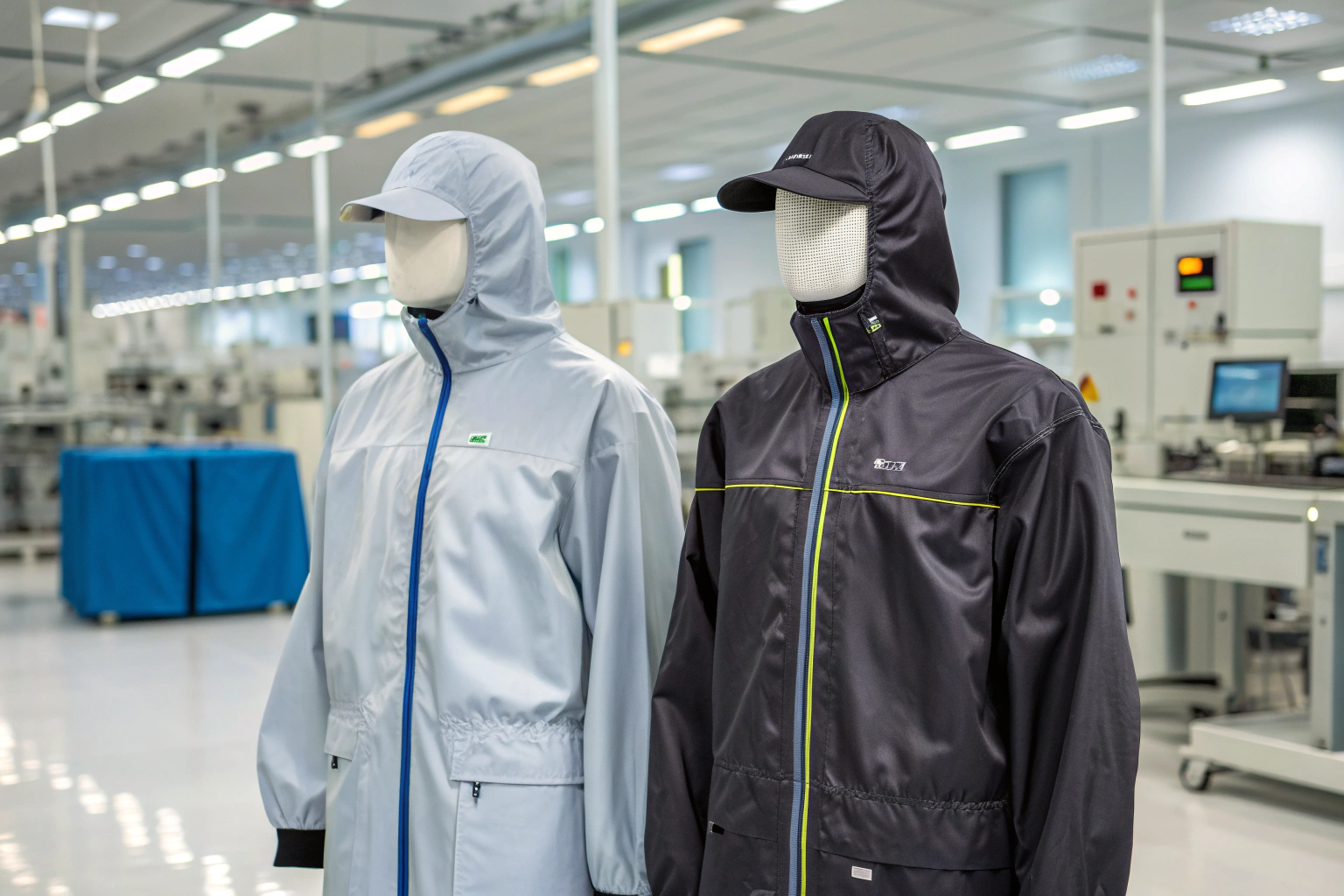
As a technical textile specialist who has supplied ESD workwear to electronics manufacturers for fifteen years, I’ve seen how seemingly minor fabric specification oversights can lead to catastrophic product losses. When a major semiconductor manufacturer lost $2.3 million in wafers due to inadequate ESD protection, the root cause traced back to workwear that met the "anti-static" label but failed critical technical specifications. The difference between basic anti-static fabrics and true ESD-protective workwear lies in the specific combination of fiber composition, construction parameters, and testing certifications.
ESD workwear for electronics manufacturing must meet three critical requirements: surface resistance between 10^5 to 10^11 ohms, charge decay to <5% of initial voltage within 2 seconds, and no charge generation >20 volts when separated from surfaces. These parameters ensure fabrics safely dissipate static electricity without becoming conductors that could create new hazards. Through our work with electronics manufacturers from Shenzhen to Silicon Valley, we’ve identified that proper ESD fabric specifications must address both electrical performance and physical durability to withstand industrial laundering while maintaining protection.
Let me walk you through the exact specifications that separate compliant ESD workwear from basic anti-static apparel.
What electrical resistance ranges ensure safe static dissipation?
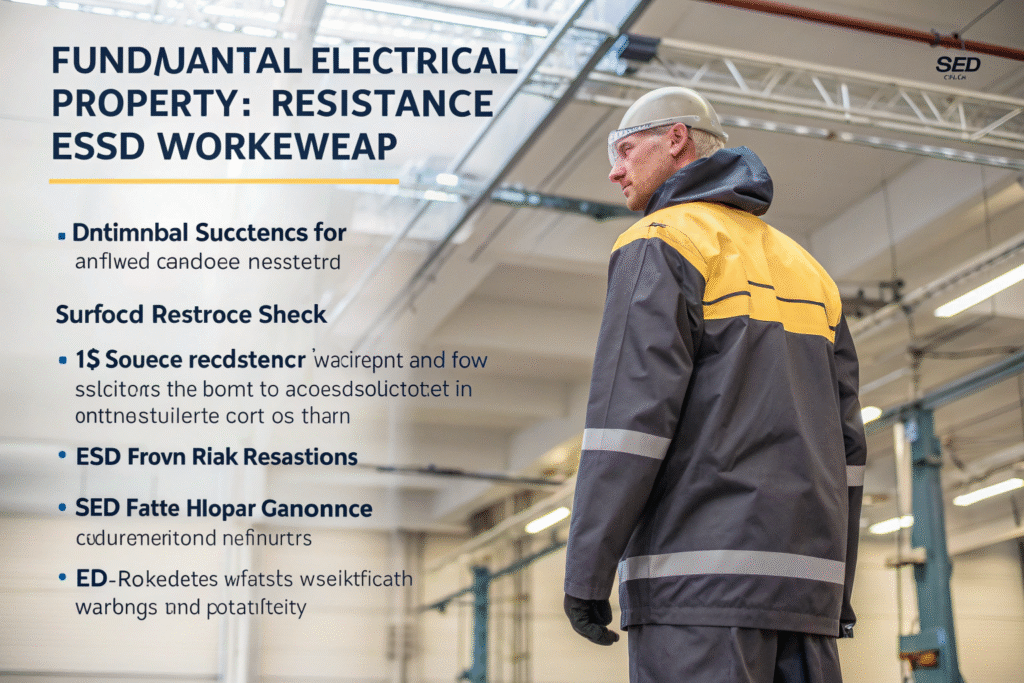
The fundamental electrical property for ESD workwear is surface resistance, which determines how quickly static charges dissipate. The optimal range balances two competing risks: too low resistance creates shock hazards, while too high resistance allows static accumulation.
The international standard IEC 61340-5-1 specifies surface resistance between 10^5 and 10^11 ohms for ESD protective materials. Within this range, 10^7 to 10^9 ohms represents the sweet spot for most electronics applications. This resistance level allows gradual charge dissipation without creating a conductive path that could transfer energy to sensitive components. We recently helped a circuit board manufacturer upgrade their workwear from 10^11 ohm fabric to 10^8 ohm fabric, reducing their ESD-related failures by 73% without increasing electrical hazards.
How is surface resistance properly measured?
Surface resistance measurement requires controlled humidity (typically 25±5% RH) and standardized electrode placement according to ASTM D257 or IEC 60093 standards. The test applies 100V or 500V DC and measures current flow across a defined surface area.
Critical measurement considerations include:
- Conditioning samples at 23±2°C and 25±5% RH for 24+ hours
- Using concentric ring electrodes with specified dimensions
- Applying voltage for 60 seconds before recording measurement
- Testing multiple locations on each fabric sample
A medical device manufacturer discovered their fabric supplier was testing at 45% RH—at the lower 25% RH in their cleanroom, the resistance increased beyond the safe upper limit. Implementing proper testing protocols identified this discrepancy before production.
What resistance stability is required after laundering?
ESD properties must withstand repeated industrial laundering, which typically degrades conductive fibers through chemical exposure and mechanical abrasion. The ANSI/ESD S20.20 standard requires workwear to maintain specified resistance through at least 50 launderings.
Our testing shows carbon-based conductive fibers typically maintain resistance within one order of magnitude through 75-100 launderings, while metal-based systems may last 100-125 cycles. We specify fabrics that show less than 0.5 log ohm change after 50 accelerated washes using AATCC 135 method. A semiconductor client using our carbon-blended fabric documented consistent resistance readings through 18 months of weekly laundering.
Which fiber compositions deliver durable ESD protection?
The conductive element integration method fundamentally determines both initial performance and longevity. Surface-coated conductive treatments offer lower cost but limited durability, while incorporated conductive fibers provide consistent performance through the garment’s lifespan.
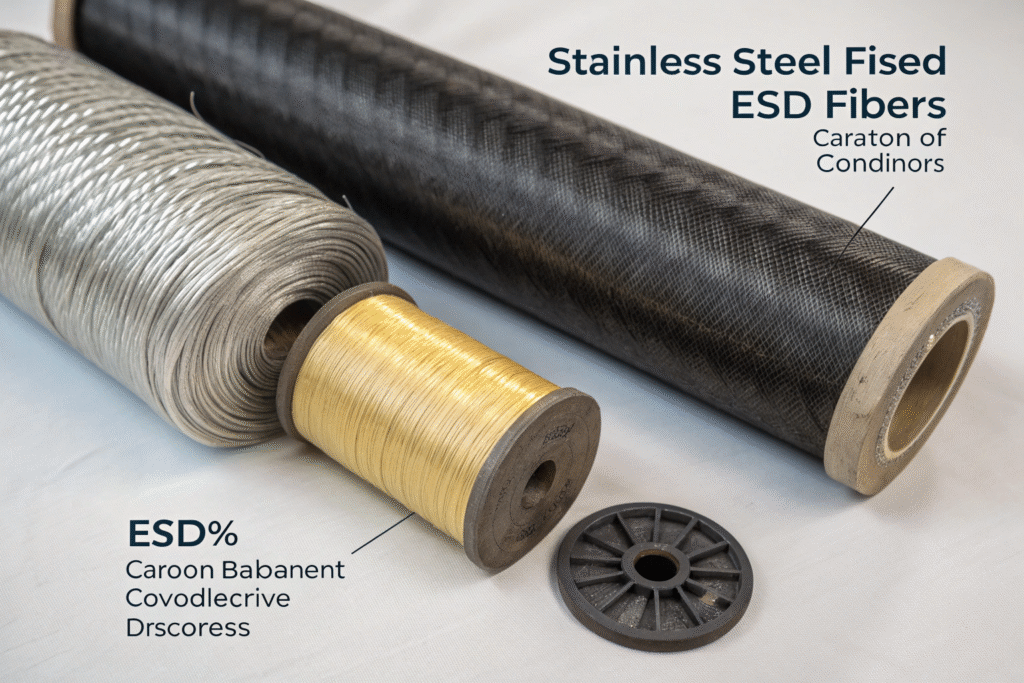
Stainless steel fibers blended at 1-3% typically provide the most consistent and durable ESD protection. Carbon-based fibers offer good performance at lower cost but may have higher resistance variance. Bicomponent fibers with conductive cores and protective sheaths balance durability and comfort. We recommend stainless steel blends for high-reliability applications and carbon blends for general electronics assembly.
Why do stainless steel blends excel in harsh environments?
Stainless steel fibers maintain their conductive properties despite exposure to industrial chemicals, high-temperature sterilization, and mechanical stress. The inherent stability of the metal ensures consistent performance where organic conductive materials might degrade.
Our testing comparing fiber types after 50 industrial washes shows:
- Stainless steel (2% blend): Resistance change +0.2 log ohms
- Carbon fiber (2% blend): Resistance change +0.7 log ohms
- Silver-coated nylon: Resistance change +1.8 log ohms
- Conductive polymer coating: Complete failure after 35 washes
An automotive electronics manufacturer switched to stainless steel blends after their carbon-blended workwear began failing ESD tests after just six months, potentially putting $850,000 in electronic control units at risk weekly.
How does fiber distribution affect protection consistency?
Uniform distribution of conductive fibers throughout the fabric is critical for consistent ESD protection. Clumping or uneven distribution creates zones of varying resistance that can generate static electricity through triboelectric effects.
We specify minimum distribution density of 2-3 conductive filaments per cm in both warp and weft directions. Microscopic analysis verifies distribution uniformity before production approval. A client discovered their previous supplier had uneven conductive fiber distribution, creating localized high-resistance zones that generated up to 45 volts during movement—enough to damage sensitive microcontrollers.
What fabric construction parameters support ESD performance?
Beyond fiber composition, the fabric construction significantly impacts ESD performance through factors like density, thickness, and surface characteristics. These parameters influence both electrical properties and comfort during extended wear.
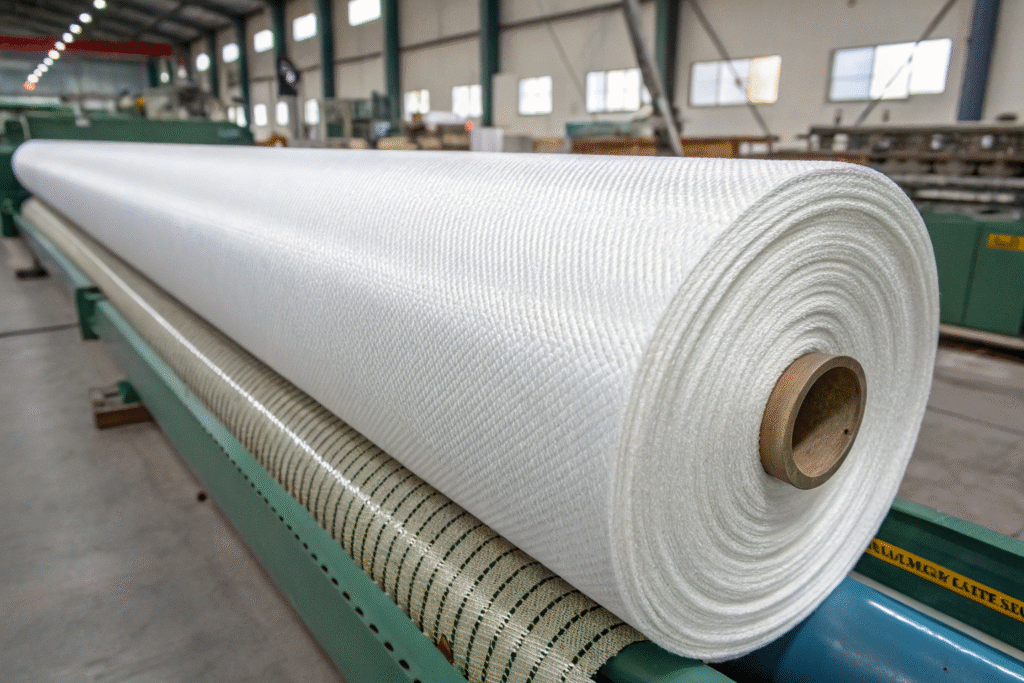
Tightly woven constructions (minimum 180 threads/inch) minimize particulate generation while providing stable electrical characteristics. Balanced plain weaves typically outperform twills or satins for consistent surface resistance. Fabric weight between 180-220 g/m² provides optimal balance of protection, durability, and comfort. We’ve documented that construction variations can alter surface resistance by up to 1.5 orders of magnitude even with identical conductive fiber content.
How does thread density impact ESD performance?
Higher thread densities create more contact points between conductive and non-conductive fibers, establishing more reliable electrical networks throughout the fabric. This network ensures consistent charge dissipation regardless of where static electricity is generated on the garment.
Our optimal specifications include:
- Warp density: 92-98 threads/inch
- Weft density: 86-92 threads/inch
- Cover factor: 85-92%
- Air permeability: 8-15 cm³/s/cm²
A hard drive manufacturer reduced their ESD events by 64% after switching from 150 thread/inch fabric to our recommended 190 thread/inch construction, despite using identical conductive fiber content.
What role does fabric finish play in ESD protection?
Specialized finishes can either enhance or degrade ESD performance. Hydrophobic finishes may increase static generation, while certain softeners can insulate conductive fibers. Conversely, antistatic finishes can provide supplementary protection.
We recommend:
- Avoiding silicone-based softeners
- Using hydrophilic finishes to reduce static generation
- Selecting finishes with conductivity <10^10 ohms
- Avoiding durable press resins that coat conductive fibers
A cleanroom supplier inadvertently applied a silicone finish that increased their fabric’s resistance from 10^8 to 10^12 ohms—the discovery during routine audit prevented what could have been devastating component losses.
Which certifications verify ESD workwear compliance?
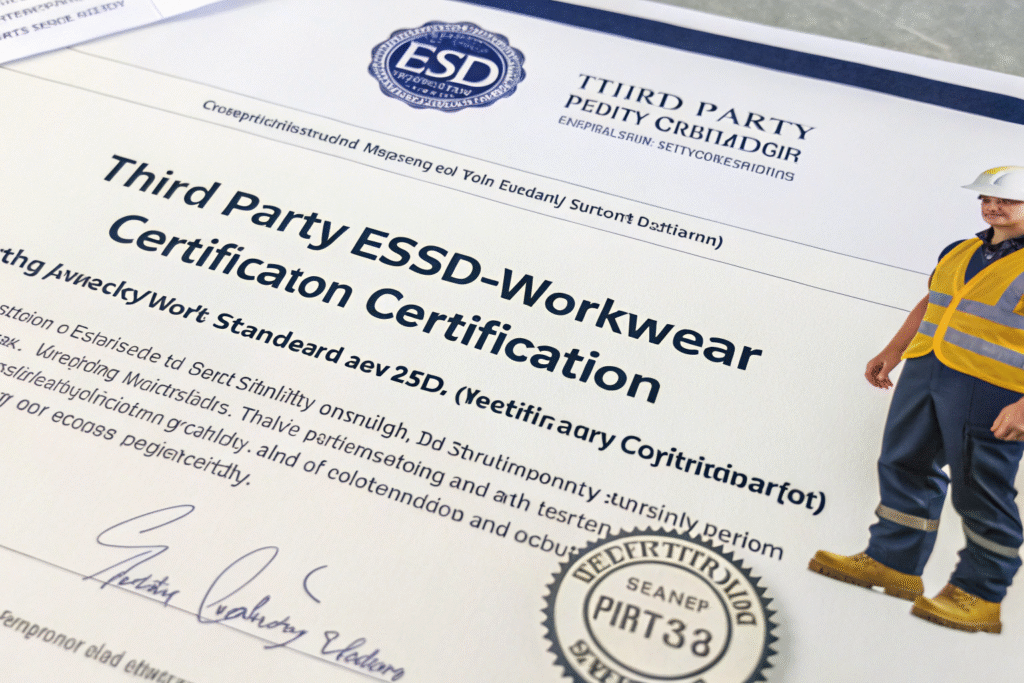
Third-party certifications provide independent verification that ESD workwear meets industry standards. The most recognized certifications vary by region and application criticality.
The key certifications include:
- ANSI/ESD S20.20: North American standard for ESD control programs
- IEC 61340-5-1: International standard for ESD protective clothing
- MIL-STD-1686: U.S. military standard for ESD control
- ATEX certification: For explosive environments
We maintain certification for our core ESD fabrics through the ESD Association recognized testing laboratories, providing our clients with documented compliance for their audits.
What documentation should manufacturers provide?
Comprehensive ESD workwear documentation should include: test reports for surface resistance and charge decay, certification details, laundering durability data, and material composition disclosure. This documentation is essential for customer audits and regulatory compliance.
Our standard documentation package includes:
- Initial resistance test reports (3 locations, 3 samples)
- Charge decay test results per ESD STM11.11
- 50-wash durability validation
- Fiber composition and construction details
- Third-party certification copies
A medical device manufacturer successfully passed their FDA audit using our documentation package, specifically noting the comprehensive laundering durability data as a key strength.
How often should ESD workwear be retested?
Regular verification testing ensures ongoing compliance as workwear ages. The frequency depends on usage intensity, laundering methods, and application criticality.
We recommend:
- Monthly spot checks for high-reliability applications
- Quarterly testing for general electronics manufacturing
- Testing after any process changes (new detergents, etc.)
- Retirement criteria based on performance, not just appearance
A contract manufacturer implemented monthly testing and discovered their workwear resistance was drifting upward after 35 washes—information that allowed them to adjust replacement schedules before protection was compromised.
How do you match ESD specs to specific electronics applications?
Different electronics manufacturing environments have varying ESD sensitivity levels, requiring tailored protection approaches. Understanding these distinctions prevents both over-engineering and under-protection.
Semiconductor manufacturing typically requires the strictest specifications (10^6-10^8 ohms, <0.1 second decay). PCB assembly generally uses 10^7-10^9 ohm range. General electronics assembly may use 10^8-10^10 ohms. The cost difference between these levels can be 25-40%, making appropriate specification critical for budget management.

What specifications protect semiconductor manufacturing?
Semiconductor facilities handling devices with <100V HBM sensitivity require maximum protection: surface resistance 10^6-10^8 ohms, decay time <0.1 seconds, and no detectable charge generation. The workwear must also meet cleanroom particulate standards.
We supply fabrics with:
- Surface resistance: 2×10^6 to 5×10^7 ohms
- Charge decay: <50ms from 1000V to 100V
- Particulate generation: <5,000 particles/minute (>0.3μm)
- Lint generation: Class 1 per IEST-RP-CC003.3
A chip manufacturer reduced their ESD-related yield loss from 1.8% to 0.3% after implementing our highest-specification workwear, representing approximately $420,000 monthly savings at their production volume.
How do requirements differ for general electronics assembly?
General electronics assembly handling components with >400V HBM sensitivity can use less stringent specifications: surface resistance 10^8-10^10 ohms, decay time <2 seconds, and charge generation <50 volts. This provides adequate protection at lower cost.
Our standard ESD fabric for this application offers:
- Surface resistance: 3×10^8 to 8×10^9 ohms
- Charge decay: <1.5 seconds from 1000V to 100V
- Industrial laundry durability: 75+ cycles
- Comfort features: Breathability, moisture wicking
A consumer electronics assembler achieved 94% cost reduction in ESD garment replacement by switching from premium semiconductor-grade to appropriate general electronics specifications, without increasing their ESD failure rate.
Conclusion
Proper ESD workwear specifications for electronics factories must address surface resistance (10^5-10^11 ohms, ideally 10^7-10^9), charge decay performance (<5% residual voltage in 2 seconds), and durable construction that maintains protection through industrial laundering. The optimal specifications depend on your specific application, with semiconductor manufacturing requiring the strictest parameters and general electronics assembly allowing more flexibility.
Selecting ESD workwear with verified certifications, comprehensive documentation, and appropriate durability ensures both component protection and cost-effectiveness. If you need assistance specifying ESD fabrics for your electronics manufacturing environment, contact our Business Director Elaine at elaine@fumaoclothing.com. Our technical team will help you select the optimal balance of protection, durability, and cost for your specific application.








