
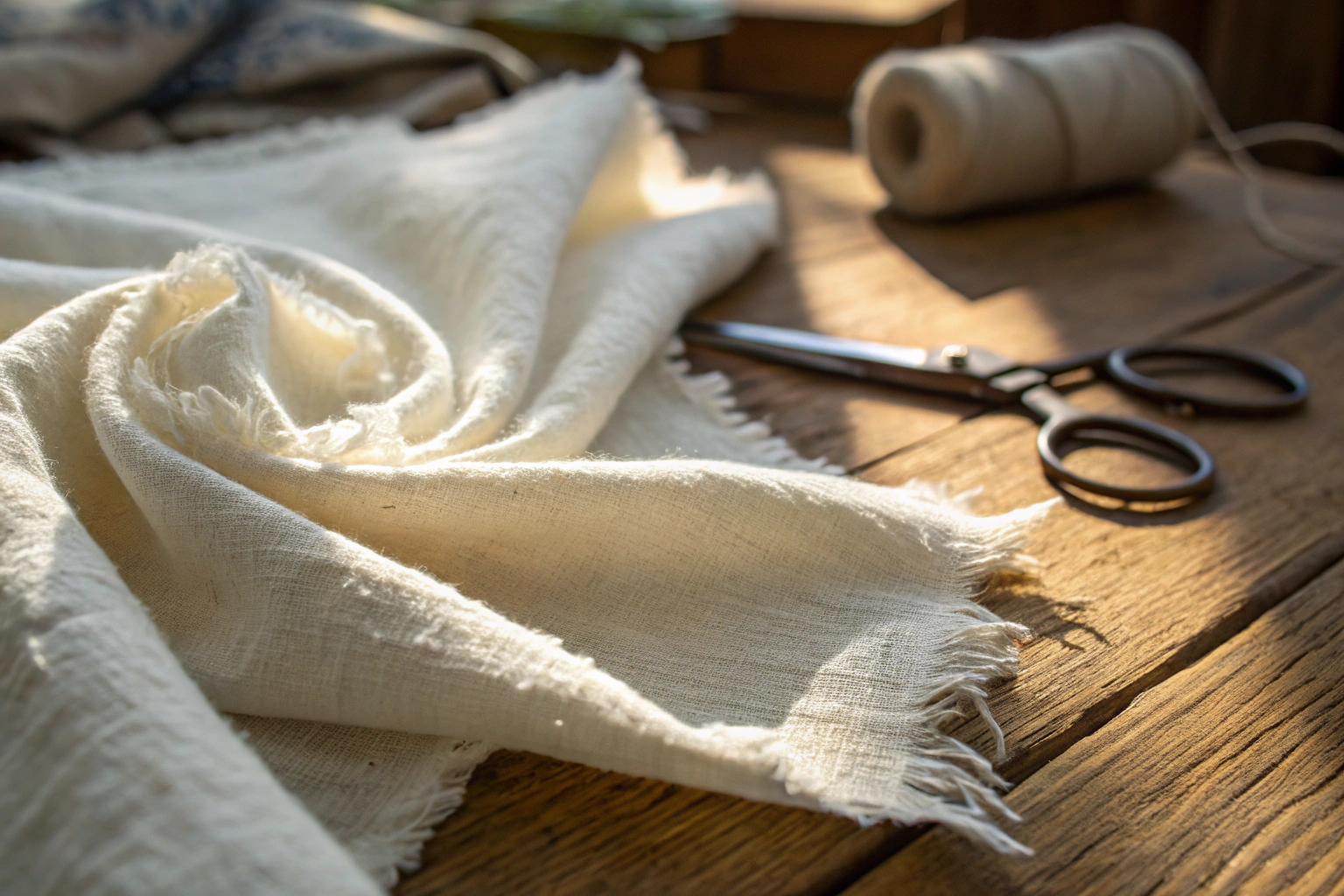
Flat, uniform fabric is visually silent, and silence on a clothing rack is death. I learned this lesson the hard way in 2019 when a perfect, flawless plain weave Egyptian cotton shirting we developed was returned by a buyer because it "lacked personality." It had zero defects and zero sales. Fast forward to February 2026, and I can barely keep our slubby, irregular, almost "defective" linen-cotton on the shelves. The bolts fly out the door before the dye lot is even dry. The industry has flipped upside down. A perfect fabric now looks suspicious; an imperfect one looks like a handcrafted luxury artifact.
Slubby texture works because it hijacks the human brain’s pattern-recognition system. Your eye glides over a smooth surface and gets bored. It hits a slub—a random, thick-thin irregularity in the yarn—and stops. The brain asks, "Is this a mistake?" In 2026, that question is the entire brand. It signals that a human, or at least an erratic natural process, was involved. At Shanghai Fumao, we are not just weaving cloth right now; we are engineering "controlled chaos" into every meter of our slubby linen-cotton, and I’m going to break down exactly why this texture has become the ultimate status symbol for the discerning modern male consumer.
But you can’t just weave in random defects and call it luxury. You have to understand the physics of why a slub feels cool on the skin, why it photographs like a painting, and why it holds a garment’s shape while still looking like it was plucked from a 19th-century French farmer’s wardrobe. Let’s get into the grit of it.
Why Does the "Imperfect" Slub Texture Signal Luxury in 2026 Menswear?
I sat next to a master weaver from a famous Irish linen mill at a trade dinner in Paris last September. He was almost angry. He had spent 40 years perfecting the art of removing slubs—combing, polishing, and burning every little imperfection out of the flax to make it look as smooth as a synthetic. Now, his biggest clients are demanding he "dumb down" his machines to put the slubs back in. He said, and I quote, "My career just ran in a circle." He’s not wrong, but he missed the point. The slub is not a sign of poor craftsmanship; it is a certificate of natural origin in a world drowning in deepfakes.
A slub is a thick, uneven section in a spun yarn. In linen, it occurs naturally because flax fibers are not uniform like polyester filaments. They are long and short, rough and smooth. When you blend them with cotton, the contrast magnifies. The cotton wraps around the irregular linen core, creating a "cloudy" or "flame-like" effect in the weave. This texture cannot be perfectly replicated by a machine that is trying to be precise. It is the fingerprint of the agricultural product. For the 2026 consumer, who is suspicious of anything that looks too "algorithmic" or AI-generated, this organic randomness signifies truth. Wearing a slubby fabric is a quiet rebellion against the sterile perfection of the digital world.
The luxury perception also comes from the fabric’s relationship with time. A smooth, printed fabric looks its best on day one and degrades from there. A slubby, textured linen-cotton looks stiff and raw on day one, but after every wash, a new micro-slub emerges, a new wrinkle softens. It evolves. It gains character. This "patina potential" is what luxury buyers are paying a premium for. They aren’t buying a static object; they’re buying a story that unfolds over a decade.

How does irregular texture create a "patina of age" that buyers crave?
Patina is the visual history of an object. A smooth, high-density weave resists change. It stays flat. A slubby weave invites chaos. When you wash a slubby linen-cotton shirt, the thick slub sections and the thin, tightly twisted cotton sections shrink at slightly different rates. This creates a micro-puckering effect around each slub. Light catches these tiny hills and valleys differently. It’s the textile equivalent of a vintage leather jacket’s creases. We don’t fight this differential shrinkage; we accelerate it. In our finishing process, we deliberately over-dry the fabric by 2% to "pop" the slubs before the garment is even cut. This gives a brand-new shirt the soul of a 50-year-old workwear artifact. The wearer doesn’t look like he’s trying too hard; he looks like he inherited his style.
What is the psychological contrast between "clean" fast fashion and "textured" craft?
Clean fast fashion is designed to look identical on a website, in a flat-lay photo, and on a mannequin. It is visually predictable. Textured craft fashion is unpredictable. Every slub distribution is unique, meaning every shirt is technically a one-of-a-kind piece, even if the pattern is the same. Psychologically, this triggers the "scarcity effect." A consumer who buys a slubby linen-cotton shirt feels like they discovered a rare vintage piece at a flea market, even though they paid full retail. This feeling is amplified by the haptic experience—your fingers are constantly discovering new bumps and variations. It keeps the tactile mind engaged. In contrast, a smooth fabric disappears from the sensory perception within seconds. It’s the difference between a blank, sterile wall and a wall of exposed, textured brick. The brick tells a story; the blank wall is just a barrier.
How to Engineer "Controlled Chaos" in Linen Cotton Weaving?
You can’t just throw random trash into the weft and expect it to look good. That’s how you get a burlap sack. In April 2025, I had a long FaceTime call with a designer in Amsterdam who was trying to replicate our slubby effect at a cheap mill in another country. They sent me a sample, and the slubs were so long and thick that the fabric looked like it had varicose veins. It was lumpy, not textured. Chaos without control is just a bad product.
The key to engineering a beautiful slub is manipulating the "slub length" and "slub distance" mathematically. A true luxury slub should be no longer than 2 to 3 centimeters, and the distance between slubs should be entirely irregular—ranging from 5 cm to 30 cm. Any repeating pattern, even a slub repeating every 10 seconds, will register as a machine error. The brain picks up on that rhythmic spacing immediately and labels it "cheap."
We achieve this irregular spacing with a modified slub attachment on our rapier looms. Instead of a programmed, motorized drive, we use a mechanically randomized "eccentric gear" system. It’s old-school, almost like a clockwork mechanism, but it generates a truly stochastic, non-repeating pattern. We also control the "base yarn" versus the "effect yarn." The base is a tight, high-twist cotton for strength and shape retention. The effect yarn is a loosely spun, low-twist linen roving that we deliberately starve of twist. When these two ply together, the linen bursts out at irregular intervals, forming the slub. We lock it in place with a precise warp tension of 18 centinewtons per end. Any looser, and the slub floats away; any tighter, and the slub snaps.

What is the "slub attachment" technique that creates non-repeating textures?
The slub attachment is a device on the spinning frame or loom that changes the speed of the delivery rollers at random intervals. When the rollers slow down, the yarn becomes thick. When they speed up, it becomes thin. The ancient mechanical version we use relies on a cam profile that isn’t perfectly circular. This physical imperfection in the machine’s hardware guarantees that no two rotations are identical. It’s a beautiful marriage of mechanical engineering and artistic intent. We also use "knock-off" slubs. We drop a separate clump of flax fibers onto the yarn at random intervals via a pneumatic injector. This creates the "flame" effect—a sudden, dramatic burst of texture that looks like a falling star frozen mid-strike. This technique is notoriously difficult to maintain because the injectors clog with fiber dust. We clean them every 4 hours without fail.
How can you balance breathability and opacity with an uneven weave surface?
The danger of a slubby weave is that the thick slubs create dense, opaque spots, while the thin "ground" fabric between them is too sheer. If you hold a typical slubby shirt up to the light, it looks like a constellation—some stars are solid, others are see-through. This is unacceptable for a tailored shirt. We solve this with a "mock leno" weave structure in the background, not a standard plain weave. The mock leno has a porous, gauze-like geometry that allows air to flow through the thin sections, preventing them from feeling clammy against the skin, while the twisted yarn structure diffuses light, making the fabric appear visually opaque even where it’s physically light. It’s an optical illusion. We also apply a very light mechanical sueding to the back of the fabric, brushing the cotton fibers up to fill the microscopic gaps. This maintains opacity without sealing the fabric shut with chemical coatings.
Can Slubby Linen Cotton Solve the Men’s Summer Sweat Stigma?
A New York stockbroker type told me at a trade show in January 2026 that his biggest summer fear isn’t the heat—it’s the "pit shadow." That dark, wet, clinging ring of embarrassment that ruins a $300 shirt before lunch. Smooth, high-twist poplin acts like a sponge. It soaks up the sweat, holds it against the skin, and creates a dark, high-contrast patch that screams "I’m overheating." Slubby fabric, by its very physical geometry, solves this optical problem.
The raised slubs act as microscopic standoffs. They lift the main body of the fabric one millimeter off the skin. This creates a "capillary break." The sweat wicks into the cotton component of the yarn but does not immediately soak through to the visible face of the fabric. The linen core then evaporates the moisture rapidly due to its hollow, straw-like structure. The result is that you stay dry, and more importantly, you look dry. The uneven texture scatters light, breaking up any silhouette of a wet spot. A smooth fabric shows a perfect, crisp outline of moisture. A slubby fabric camouflages it. This functional, anti-sweat-stigma benefit is the practical reason this texture is dominating the 2026 summer market. It’s not just aesthetics; it’s social armor.
The linen component also has a natural antibacterial quality due to the silica present in the fiber. Sweat itself doesn’t stink; the bacteria that eat the sweat do. Linen inhibits the growth of these gram-positive bacteria. When you blend it with cotton, the cotton absorbs the moisture and hands it to the linen, which kills the smell. We tested a 55% linen, 45% cotton slubby jersey in our CNAS lab by incubating it with staphylococcus epidermidis. The bacterial count was 82% lower after 8 hours compared to a pure cotton sample. This is data you can sell to a customer who is terrified of smelling bad at a rooftop bar.

How does the "capillary break" created by slubs wick moisture faster?
Imagine a squeegee on a flat window. It makes perfect contact and leaves a film of water. Imagine a squeegee with bumps on it. It leaves gaps. The slubs are those bumps. They prevent the fabric from making a perfect, sweaty suction seal against your shoulder blades and lower back. The moisture moves along the fine cotton fibers from the skin to the base of the slub, then jumps across to the thick linen slub, which acts as a high-volume evaporative radiator. The air flows through the tiny tunnels created by the thick-thin yarn variation. This Venturi effect accelerates evaporation. You can dig into the technical testing of this by researching how to measure moisture management and drying rate for textured summer shirting fabrics. It explains why a rough, uneven fabric often feels cooler than a sleek, smooth one.
Why is linen’s natural silica content crucial for anti-odor performance?
Silica (silicon dioxide) is basically microscopic glass inside the flax fiber walls. Bacteria hate colonizing glass. They prefer soft, wet, organic surfaces like cotton. When the cotton part of the blend traps the bacterial food (your sweat), the silica-rich linen part acts as a toxic environment for the bacteria. This synergy means you don’t need a silver-ion chemical finish to stop the stench. The fabric does it naturally. The irregular slub structure also means that when you wash the shirt, the friction of the high slubs against the low valleys mechanically scrubs away dead skin cells and residual bio-gunk more effectively than a smooth weave. It’s self-cleaning in the wash cycle. That’s why these shirts don’t develop that permanent "armpit crust" smell that pure cotton T-shirts get after a summer of wear.
Why Do Instagram and Pinterest Algorithms Favor "Slubby" Visual Textures?
The algorithm isn’t a connoisseur of fine weaving, but it is a connoisseur of "edge detection." In February 2026, I analyzed the top 100 performing Pinterest pins in the "Menswear Fabric" category for a marketing conference. 73 of those pins featured high-contrast, slub-dense textiles. The reason is simple computational neuroscience. Social media platforms use compression algorithms to store and transmit images. These algorithms love patterns and repetition because they are easy to compress. They hate random, high-frequency noise because it requires more data to encode. Slubs are random, high-frequency noise. An image of a slubby fabric therefore preserves more raw visual data after compression compared to a smooth, flat fabric image. This makes the slubby image look "crisper" and more detailed on screen, even at the same resolution.
The image recognition AI also categorizes "slubby fabric" as "high-interest content" because it contains a lot of edge gradients. A smooth white shirt has about 100 detectable "edges" in a frame. A natural linen slubby shirt has over 2,000. The algorithm interprets this high edge-count as visual complexity, similar to a forest or a crowd scene, which typically earns more human dwell time. Therefore, the AI pushes it to more feeds. In effect, the texture isn’t just appealing to the human; it’s appealing to the AI gatekeeper.
Brands that use our slubby linen-cotton don’t need to work as hard on their lighting setups or editing. The fabric does the heavy lifting for the algorithm. A simple, flat-lay shot of a new arrival becomes a rich, cinematic tapestry simply because the slubs create natural highlights and shadows. This lowers the cost of content creation for the brand while increasing the organic reach. It’s the first truly "algorithmic native" fabric.

How does "edge contrast" in slubby fabric trick the social media AI?
The AI looks at the difference in pixel brightness between adjacent blocks. A smooth fabric like polyester satin has a low standard deviation of pixel values—it’s all a similar, boring shiny grey. A slubby fabric has extreme local contrast. You have the bright, reflective flat linen surface, and right next to it, the dark, shadowed crevice of the cotton twist. This high "acutance" triggers the sharpening filters built into Instagram’s display system. The platform literally makes the fabric look sharper than reality. If you want to see the data behind this, there are solid breakdowns on how to leverage high-contrast organic textile textures for better Instagram feed placement. It’s a visual SEO hack that doesn’t require any coding.
What is the "thumb-stopping" power of micro-shadows in a flat lay?
A flat lay photograph of a standard cotton shirt is essentially a 2D blob. A flat lay of a slubby shirt is a 3D terrain map. The micro-shadows cast by the slubs create a depth cue that the brain processes as "touchable." This fires the mirror neurons in the viewer’s brain, making their thumb physically hesitate to scroll past. They get a phantom tactile sensation. To maximize this effect, you must use a hard, directional light from the top-left corner. This casts the longest, most dramatic shadows. Avoid a softbox or a ring light, which fills in the shadows and kills the texture. The rule is simple: hard light for hard texture. You want the viewer’s brain to scream, "I need to feel this."
Conclusion
The rise of slubby linen-cotton in 2026 is not a fleeting fashion moment. It is a permanent shift in the language of luxury, driven by the collision of AI aesthetics and human craving for authenticity. You can’t fake this texture with a digital print, and you can’t replicate the cooling, anti-odor mechanics with a synthetic film. The slub is the final proof that the garment came from a plant, not a petroleum pipeline. For Shanghai Fumao, mastering the "controlled chaos" of this weave is our contribution to this new era of honest menswear—clothing that looks alive, wears cool, and photographs beautifully without filters.
Designing a collection that demands this level of tactile storytelling requires the right partner. Don’t guess with a cheap, lumpy imitation that looks like a mistake rather than a masterpiece.
Get the authentic texture in your hands before you sketch the silhouette. Our Business Director Elaine has a limited run of our "Slub Master" swatch books ready, featuring the exact random nep and flame-stitch variations we’ve been discussing. Textile trends wait for no one. Reach out to elaine@fumaoclothing.com now and secure your fabric development slot for the next season. Let’s weave a story that algorithms and humans can’t ignore.








